
How to Read Compliance Claims on Shirt Packaging Accessories
How to Read Compliance Claims on Shirt Packaging Accessories
A shirt shipped into Europe or North America usually travels with more documentation than the accessories inside it cost to produce. For buyers of shirt packaging accessories, the binding constraint in 2026 is rarely whether a collar band, collar stay or clip can be manufactured. It is whether the material statement and the qualification language attached to that component can be read, checked and repeated when a retail customer, an importer or an auditor asks for evidence months after the order has closed.
This article treats a compliance claim as a document rather than a slogan. Every claim has a subject, a scope, an issuer and a date, and each of those four elements can fail independently. The sections below show how to read the material and qualification language around collar bands, stays, clips, pins and butterflies, how wash labels and apparel tags fit into the same package, and which acceptance criteria belong in purchasing terms before a supplier is confirmed.

Shirt packaging accessories are specified late in the garment timeline but carry the qualification paperwork of the finished shirt.
The claim travels further than the accessory
Shirt packaging accessories sit at the end of the specification chain. A collar stay is normally confirmed only after the collar interlining, the collar tape and the folding method are settled, and it is usually bought against a landed-cost target rather than a technical brief. Collar bands, butterflies and clips follow the same pattern. That sequencing carries a compliance consequence: the accessory inherits the market expectations of the garment it ships inside, but it is documented last, and often by a different team from the one that specified the shirt.
The resulting risk is asymmetric. Adding a qualification statement to a collar band order before production is a short administrative task. Recovering that statement after 10,000 shirts are packed, folded and loaded is not, because the evidence has to be retrieved from a supplier, matched to the exact article that shipped, restated in purchasing language and re-accepted by whoever raised the question.
Buyers working through research and evaluation should therefore read accessory claims as procurement constraints rather than as marketing copy. The useful question is not whether a supplier describes a clip as eco-friendly. It is which document, covering which article, for which market, remains valid on which date.
Three kinds of claim, three different checks
Most confusion in this category comes from treating three unrelated statements as though they were the same thing. They are verified in different ways, and only the third can be quoted in a purchase order without interpretation.
Material identity is the narrowest and most checkable. A clip is specified as PS or metal; a metal collar stay as stainless steel; a metal pin as stainless steel or brass; a PVC collar stay as PVC; a plastic butterfly as PVC or PET; a paper butterfly as 400 g single white paper at 400 GSM; an apparel tag as 100% natural wood-pulp paper at 500 GSM; a washing label as polyester or nylon taffeta. Each of these is a line item that can be compared against a specification sheet, an approved sample and an order confirmation.
Property language describes behaviour: eco-friendly materials, resistance to deformation, custom design, logo printing. These descriptors are useful in a commercial conversation, but they carry no issuer, no number and no scope. They become verifiable only when tied either to a named material or to a qualification record that covers the specific article.
Qualification records are the documents themselves: a certification name, an issuing body, a certificate number, a standard reference, an issue date, an expiry date, a scope statement and a market statement. Each element can be checked against the supplier's file, and each element can be quoted verbatim in a purchasing document.
The most common sourcing error is to accept a property word as if it were a qualification record, or a qualification record as if it covered every article a supplier sells. Neither substitution survives a documentation request.
Reading a certificate record line by line
A qualification claim is only as strong as the least precise line in the record behind it. Taking the OEKO-TEX STANDARD 100 record held for the accessory range as a working example, each line has a distinct reading and a distinct question attached to it.
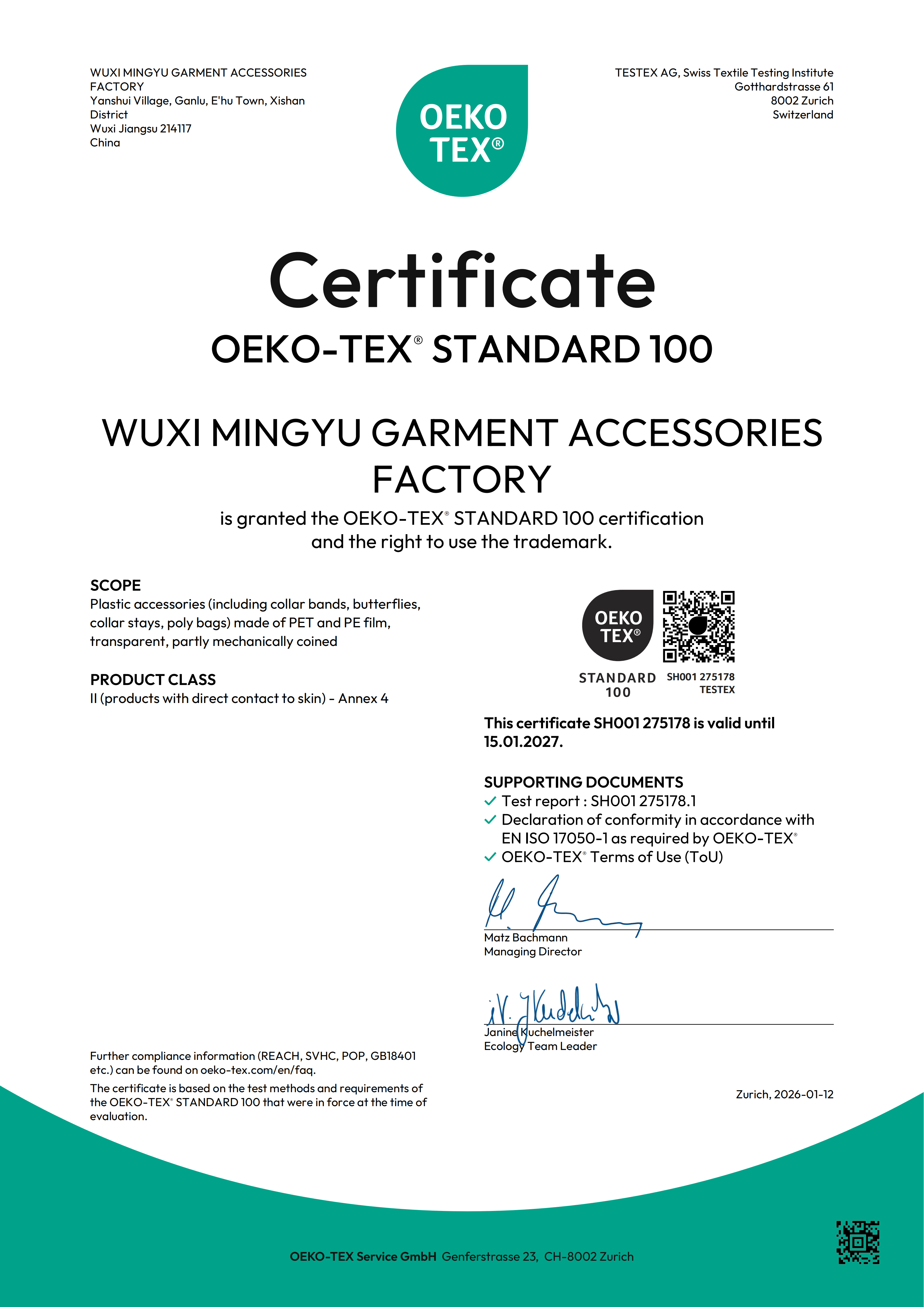
A qualification record is read in four parts: issuer and standard, number and validity window, scope sentence, and market wording.
The issuing body and the standard line
The record names TESTEX as the issuing body and cites OEKO-TEX® STANDARD 100 together with EN ISO 17050-1. Two references in one line should be read as two parts of a single basis rather than as a choice between them. A buyer preparing a purchase order should ask the supplier to confirm which part of the assessment each reference covers, and should quote the full standard line rather than the shorter certification name, because shortening the line changes what has actually been asserted.
The certificate number and the validity window
The certificate number is SH001 275178. It was issued on 12 January 2026 and expires on 15 January 2027. Both dates carry weight, because expiry determines whether the document will still be valid when goods ship, when they clear customs and when the retail customer audits the file. An order confirmed in the final quarter of 2026 sits inside the current window. An order shipping in the first quarter of 2027 may not, so the renewal request belongs at order confirmation rather than at the shipping desk.
The scope sentence buyers skip
The scope line decides whether the document applies at all, and it is the line most often skimmed. In this record it describes plastic accessories — including collar bands, butterflies, collar stays and poly bags — made of PET and PE film, transparent, partly mechanically coined. Four filters sit inside that single sentence: the article family, the polymer, the visual form and the production process.
Read carefully, the scope is narrower than the product list attached to the same record. That list includes paper butterflies, paper collar bands, cardboard, metal pins, metal collar stays, washing labels and apparel tags, while the scope sentence describes plastic accessories made of PET and PE film. The two are not automatically interchangeable, and this is precisely where buyers get caught: a paper butterfly and a PVC collar band are different articles on different material bases, and the scope sentence, not the family name, is what a certificate is read against. Where a catalogue entry describes an accessory in a polymer or paper grade that the scope sentence does not name, the correct step is to request article-level confirmation in writing before the claim is repeated in a purchase order.
The market wording
This record states applicability across world markets, while several article-level statements in the same file reference the EU market specifically. The second does not cancel the first, but the two are not identical statements either. A buyer shipping outside the EU should request the applicable market wording in writing for the named article, instead of assuming that the shorter EU phrasing is the whole story or that a worldwide line answers a market the buyer never asked about.
How the accessory families map to the documents
The table below collects specification and qualification facts that a buyer can quote directly, family by family. MOQ values appear as published, and they expose a secondary documentation issue: some minimums are stated in pieces while the supplier's headline capability is stated in sets, so the unit must be agreed before an order quantity means anything.
| Accessory family | Material and published specification | Published MOQ | Qualification note |
|---|---|---|---|
| Plastic collar band (8291) | Paper and PVC versions; 0.50 mm thickness; 50 cm x 3.4 cm | 10,000 pcs | Listed on the OEKO-TEX record, number SH001 275178 |
| Collar band (7969) | Collar band family for shirt packing | 10,000 pcs | Listed on the OEKO-TEX record |
| Paper collar band (8155) | Paper base | 10,000 pcs | Listed on the OEKO-TEX record; scope sentence names PET and PE film, so confirm article-level scope |
| Metal collar stay (8290) | Stainless steel; 55.9 / 63.5 / 69.9 / 76.2 mm x 9 mm x 0.8 mm; five colours; laser-engraved logo | 1,000 pcs | Listed on the OEKO-TEX record, issued by TESTEX |
| PVC collar stay (8143) | PVC; white; 6.35 cm x 1 cm x 0.75 mm; customisable logo | 10,000 pcs | Listed on the OEKO-TEX record, number SH001 275178 |
| Collar support (8156) | Light blue PVC; 22.7 cm x 18.5 cm; 0.35 mm; no logo by default | 10,000 pcs | Listed on the OEKO-TEX record |
| Clip (8145) | PS or metal; 3.3 cm or 3.7 cm x 0.8 cm x 1.2 mm; silver; X shape | 100,000 pcs | Listed on the OEKO-TEX record |
| Metal pin (8146) | Stainless steel or brass; 26 mm x 0.6 mm; 0.6 or 0.65 mm thickness | 10,000 pcs | Listed on the OEKO-TEX record |
| Plastic butterfly (8144) | PVC or PET; 26 cm x 10.4 cm; 0.25 mm; light blue fine sand PVC variant | 10,000 pcs | Listed on the OEKO-TEX record |
| Paper butterfly (8164) | 400 g single white paper; 400 GSM; 15 cm x 3 cm | 10,000 pcs | Listed on the OEKO-TEX record; confirm scope against a paper-based article |
| Apparel tag (8154) | 100% natural wood-pulp paper; 500 GSM; 4 cm x 7 cm | 10,000 pcs | Listed on the OEKO-TEX record; printed copy is a separate specification |
| Washing label (8153) | Polyester / nylon taffeta | 10,000 pcs | Listed on the OEKO-TEX record; care text is a separate specification |
| Plastic bag (8148) | Eco-friendly material claim; custom design and logo printing | 10,000 pcs | Linked to the GRS record SGC-GRC09119-GRS-2026-07 issued by SGS |
Two readings follow. First, MOQ is not a single number across a mixed order: a clip at 100,000 pieces, a metal collar stay at 1,000 pieces and most paper or PVC components at 10,000 pieces travel in the same shipment, and a purchase order stating one figure for the whole basket is ambiguous. Second, specification depth varies by family. A metal collar stay publishes four lengths, a common 0.8 mm thickness and five colours; a clip publishes a 1.2 mm thickness and two lengths; a paper butterfly publishes format and grammage. Buyers should match the detail they require to the detail that exists, and write the remainder as an approved-sample reference.
What the recycled-content record adds, and what it does not
A second qualification record sits alongside the first, and confusing the two is a recurring documentation error. The Global Recycled Standard record is numbered SGC-GRC09119-GRS-2026-07, was issued by SGS, and cites Global Recycled Standard V4.0, Content Claim Standard V3.1 and the Textile Exchange Standards Claims Policy V1.3. It was issued on 31 July 2026 and expires on 30 July 2027.
Its scope is expressed as activities rather than as a material percentage: trading, warehousing and distribution of final products, and manufacturing. That distinction matters in practice. The record establishes that a certified system covers those activities; it does not, in the text a buyer receives, state a recycled input percentage for a named accessory. Where a recycled-content figure is material to the order, it has to be requested and confirmed separately against the specific product, and the answer should be treated as a commercial term rather than inferred from a certificate number.
The two records also answer different questions and do not substitute for each other. The OEKO-TEX record addresses a defined article and material scope; the GRS record addresses a recycling claim and the activities behind it. A supplier holding one is not thereby holding the other for the same item, and a purchase order that cites the wrong record is effectively uncited.
Wash labels and apparel tags belong in the same package
The compliance package for a packed shirt is often discussed as though accessories and labels were separate purchases. Operationally they are not. The washing label in this range is specified as polyester or nylon taffeta; the apparel tag is 100% natural wood-pulp paper at 500 GSM in a 4 cm by 7 cm rectangle, with a 10,000-piece minimum. Both are printed components with a material base and a content layer.
The material base is what a qualification record can address. The content layer is a specification decision owned by the brand: the care and fibre information printed or woven into a wash label, and the product and price information carried on a hang tag, are approved copy rather than accessory properties. Nothing in the scope statements reviewed above addresses printed care text, so label copy should be handled as a separate approval step with its own retained master sample.
Stating that separation in purchasing terms is worthwhile because the failure mode is visible. A washing label is one of the last items a consumer reads before washing a shirt, and a care statement that does not match the shirt it is sewn into is a defect no matter how well the label itself was made. The same logic applies to a hang tag: its material can be certified while its printed copy is wrong.
Acceptance criteria to write into purchasing terms
Acceptance criteria turn a claim into something a supplier can fail. For shirt packaging accessories, the following items can be written from facts already published, and each one closes a specific gap.
- Material designation with grade. Name PS or metal for clips, stainless steel for metal collar stays, stainless steel or brass for metal pins, PVC for collar stays and collar supports, and the paper grade with grammage for paper butterflies, cardboard and apparel tags.
- Dimensions and thickness with the measuring basis. Metal collar stays publish four lengths at a common 0.8 mm; the PVC collar stay publishes 6.35 cm by 1 cm by 0.75 mm; the collar support publishes 22.7 cm by 18.5 cm at 0.35 mm; the plastic butterfly publishes 26 cm by 10.4 cm at 0.25 mm.
- MOQ with an explicit unit. State pieces or sets, and state whether the figure applies per article or per mixed order.
- The qualification reference quoted in full. Certification name, issuing body, certificate number, standard line and expiry date, tied to the named article.
- A scope confirmation sentence. Ask the supplier to confirm in writing that the named article falls inside the scope of the cited record.
- Logo method. Laser engraving is the published method for metal collar stays; printing is the published method for paper, PVC and plastic components.
- Sample retention and inspection basis. The supplier states 100% testing across production; the buyer's counterpart is an approved sample held by both parties and referenced by revision.
- Delivery window. Published lead time is 7 to 20 days after order confirmation, which sets the latest sensible date for a certificate renewal request.
None of these clauses requires new evidence. They reorganise existing facts into checkable positions, which is the point: a claim that cannot be failed cannot be accepted.
Where the claim stops: fit boundaries for buyers
Every qualification statement in this category has an edge, and buyers who know where the edge sits avoid most disputes.
A descriptor is not a certificate. Eco-friendly materials appears as a property across clips, pins, paper components and bags. It is a legitimate commercial summary, but it becomes auditable only when mapped to a named material or to a specific record with a number and a date.
A performance property is not a qualification. Resistance to deformation describes how a clip or a stay is expected to behave in packing and transport. It is a material and design outcome rather than a certification, and it is accepted through a sample rather than a document.
Validity is time-bound. Both records reviewed here expire within the following twelve months of a late-2026 order book: 15 January 2027 and 30 July 2027. A claim accurate at order confirmation can be out of date at shipment, so the purchasing term should say which date governs.
A scope is a filter, not a family name. The single most useful habit in this category is to read the scope sentence before the product list, and to treat a mismatch between them as a question rather than an answer.
Accessory evidence does not cover garment-level claims. A record on a collar band says nothing about the shirt, the carton, the retail packaging system or printed care copy. Each layer needs its own reference.
Qualifying the supplier behind the documents
Documents are only as durable as the organisation maintaining them. Wuxi Mingyu Garment Accessories Factory, known as MingYu Garment Accessories, is a shirt packaging accessory manufacturer founded in 2004, operating a 2,500 m² facility with 25 employees, three engineers and an annual output of 90 million sets. Around 85% of output is exported, with Europe, North America, South America and Asia as the main markets. The company added a Sri Lanka factory in 2013 and a Vietnam factory in 2017, and works through distribution warehouses and agencies in Sri Lanka, Argentina, Bangladesh, Indonesia, Colombia and Kenya.
For a compliance-led evaluation, four attributes matter more than the brochure. The first is an in-house quality-control team running full-range inspection through each production stage, because certificate maintenance depends on routine process discipline rather than on a single audit. The second is independent export qualification, which determines whether documentation can be produced in the buyer's name without a third party. The third is the OEM and ODM scope, which covers size, colour, style, printing and foiling, mould opening and logo customisation — the same variables a scope sentence has to describe. The fourth is a documented management system, in this case an OA system adopted in 2018, which is what makes a renewal traceable to a date rather than to a memory.
Market scale, and why it is not a compliance signal
Commercial research estimates the global garment packaging market at USD 18.6 billion in 2025, with a projection of USD 31.4 billion by 2034, and places Asia Pacific at a 41.5% revenue share in 2025 (Dataintelo, research dated April 2026). Those figures describe the size of the category an accessory order sits inside. They do not, on their own, show that qualification scrutiny has increased, and a market forecast should not be read as a compliance trend. What the figures do support is a narrower procurement inference: in a category of that scale, documentation requests are routine rather than exceptional, and a supplier unable to produce a scope statement quickly is a scheduling risk as well as a compliance risk.
Outlook: claim literacy as a buying skill
The direction of travel in this category is toward shorter, more specific claims rather than longer ones. Buyers who ask for a certificate number, an expiry date and a scope sentence at the sampling stage end up with a file that can be reused for the next order; buyers who accept a product description end up rebuilding that file every season. On current evidence, the practical advantage sits with the purchasing team that keeps a claim register — article, material, record number, issuer, scope confirmation, expiry — as a living document rather than as a folder of images.
That register also changes how suppliers are compared. Once the four elements of a claim are separated, documentation quality becomes a comparable dimension alongside price and lead time, rather than an afterthought argued about at shipment.
For buyers who want the component range and factory capability in one place, the company profile is available as a downloadable PDF brochure.
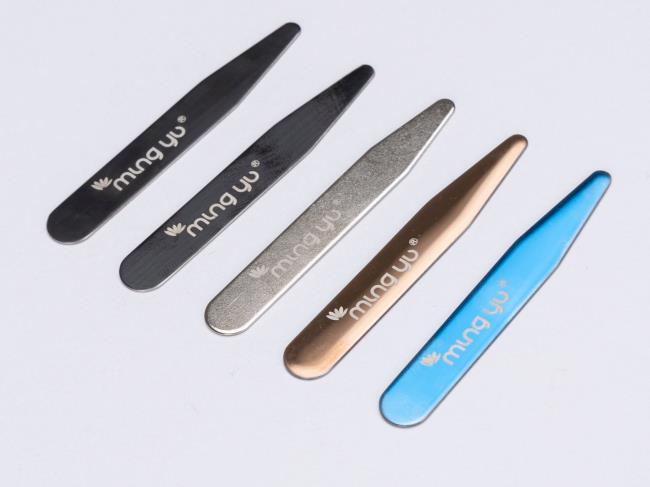
A Metal collar stay publishes four lengths, a common 0.8 mm thickness, five colours and laser engraving as the logo method.
FAQ
What does a certification scope statement actually control on a collar band or a clip?
The scope statement defines which articles, materials, forms and processes the certificate covers. On the OEKO-TEX STANDARD 100 record SH001 275178, the scope sentence describes plastic accessories including collar bands, butterflies, collar stays and poly bags made of PET and PE film, transparent, partly mechanically coined. A clip or collar band that does not match those filters may still be supplied, but the certificate should not be presented as covering it until the supplier confirms the article-level position in writing.
Are eco-friendly materials claims on clips and metal pins verifiable on their own?
Not on their own. Eco-friendly materials is a property descriptor without an issuer, a number or a scope, and the same wording appears across clips, metal pins, paper components and bags. It becomes checkable when it is linked either to a named material, such as the PS or metal construction of a clip or the stainless steel or brass construction of a metal pin, or to a specific record with a certificate number and an expiry date that names the article.
Do collar bands, collar stays and clips need different material checks?
Yes, because their material bases differ. A clip is specified as PS or metal; a metal collar stay as stainless steel; a PVC collar stay as PVC; a plastic butterfly as PVC or PET; a paper butterfly as 400 g single white paper at 400 GSM. Those differences also change the qualification question, since a scope sentence written around plastic film does not automatically describe a paper-based article, and the buyer should confirm which listing applies to each family in the order.
How should certificate expiry dates be handled in a shirt packaging order?
Treat expiry as a delivery condition rather than a filing detail. The OEKO-TEX record expires on 15 January 2027 and the GRS record on 30 July 2027. With a published lead time of 7 to 20 days after order confirmation, the practical rule is to check that the record will still be valid on the shipment date, and to request the renewed document at order confirmation when the shipment falls after the expiry.
What belongs in the acceptance criteria for wash labels and apparel tags?
Two separate sets. The material set specifies the base: polyester or nylon taffeta for the washing label, and 100% natural wood-pulp paper at 500 GSM in a 4 cm by 7 cm format for the apparel tag, both at a 10,000-piece minimum. The content set specifies approved printed copy, held as a revision-controlled master sample. The material base can be tied to a qualification record; the printed care and product text cannot, and should be approved as copy in its own right.
Tem questões ou precisa de mais detalhes?
Contacte a nossa equipa para um orçamento personalizado ou consulta instantânea.
Solicitar orçamento
Preencha o formulário abaixo e a nossa equipa entrará em contacto com uma proposta personalizada.
Chat direto do WhatsApp
Prefere conversar em tempo real? Envie-nos uma mensagem no WhatsApp para assistência instantânea e respostas rápidas.
- Obter orçamento personalizado
- Partilhar fotos ou documentos
- Discuta as suas necessidades diretamente
Geralmente responde em 5–30 minutos durante o horário de expediente.