
How to Read MPA Z-15486A/25: Type 41 EN 12413 Checklist
How to Read MPA Z-15486A/25: Type 41 EN 12413 Checklist
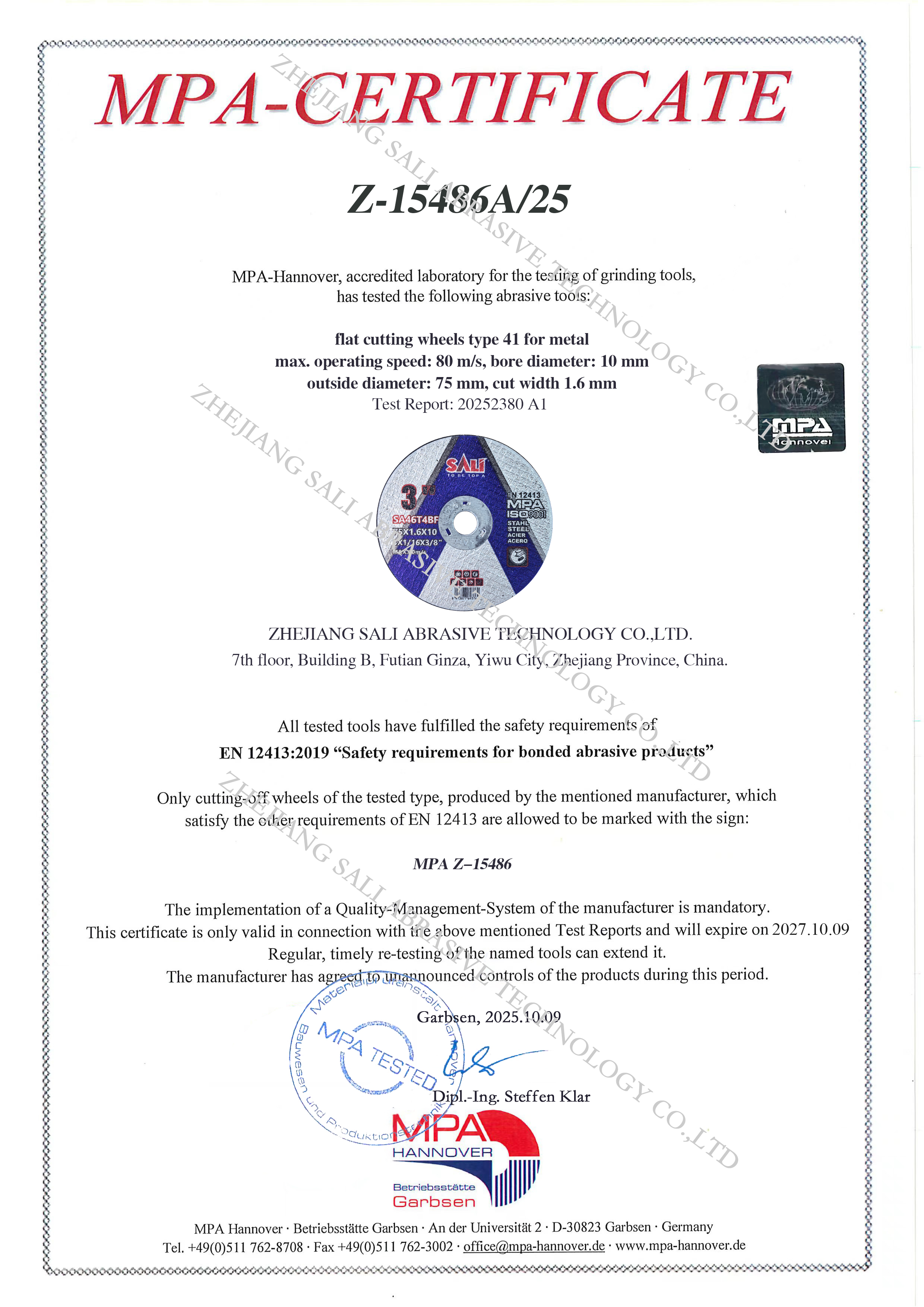
Certification Reference
A cutting disc certificate is only worth the fields that match the order. MPA certificate Z-15486A/25, issued by MPA Hannover (Garbsen Site) against EN 12413:2019 and valid from 2025-10-09 to 2027-05-23, is a scope document rather than a general endorsement. It names one wheel shape, one workpiece material, one maximum operating speed and a defined list of dimensions. Outside that list, it certifies nothing.
The holder is SALI Tools, the brand of ZHEJIANG SALI ABRASIVE TECHNOLOGY CO., LTD, whose flat cutting-off wheels type 41 for metal are covered by this document. For a buyer working through the research and evaluation stages of a cutting disc purchase, the useful question is not “is this supplier certified?” but “does the certificate in front of me describe the exact disc on the pallet?” Those are different questions, and only the second one protects a purchase order.
What follows reads the certificate as a qualification checklist: the identity fields first, then the scope sentence, then the points where a mismatch usually hides.
What MPA Hannover Actually Certifies
MPA Hannover provides independent safety testing for bonded abrasive products entering the European market, including burst testing and side-load testing, and its approval is commonly represented by the “MPA tested” mark. That testing sits inside the framework of EN 12413:2019, the mandatory European safety standard for bonded abrasive products, which specifies requirements for burst testing, marking and dimensional tolerances.
Two consequences follow for a buyer. First, the certificate is a product-safety document: it speaks to whether a defined wheel configuration survived defined test conditions, not to how many cuts that wheel will deliver on a jobsite. Second, because it is written against a configuration, it cannot be read as a company-wide licence. A certificate number is a key that opens one door, and the door is labelled with a shape, a material, a speed and a dimension list.
The practical rule: the standard (EN 12413:2019) tells you what the product was measured against. The certificate number (Z-15486A/25) tells you which product was measured, by whom, and until when. Buyers need both pieces of information, and they are not interchangeable.
The Identity Block: What to Confirm Before Reading Any Dimension
Six fields establish whether the document is the right document at all. They are short, they are at the top of the page, and they are the ones most often skimmed.
| Field | Entry on the certificate record |
|---|---|
| Certificate holder | ZHEJIANG SALI ABRASIVE TECHNOLOGY CO., LTD (SALI Tools) |
| Issuing body and site | MPA Hannover, Garbsen Site |
| Standard applied | EN 12413:2019 |
| Certificate number | Z-15486A/25 |
| Validity | 2025-10-09 to 2027-05-23 |
| Market context | Certificate applicable to the EU market |
Check the issuer and the site, not just the logo. “MPA Hannover” and “MPA Hannover, Garbsen Site” point to a specific testing location, and a document that names a testing body without a site is harder to verify. Check the number character by character: certificates that differ by a letter or a final digit are different documents with different scopes, and a transposed character in a quotation is not a typographical detail — it is a different claim.
Check the dates against the transaction, not against today. A certificate valid from 2025-10-09 to 2027-05-23 supports a claim made inside that window. If a supplier presents the same number in 2028, the first question is which current document replaces it.
Decoding the Scope Sentence
The scope of Z-15486A/25 can be read as four constraints stacked together: a shape, a workpiece family, a speed ceiling and a dimension list. A product must satisfy all four, not three.
“Flat cutting-off wheels type 41” is a shape constraint
Type 41 designates a flat cutting-off wheel: a disc with a constant thickness profile and no depressed centre. A depressed-centre wheel is a different shape and is not covered by a type 41 certificate, however similar the two discs look on a bench. SALI’s own certification record demonstrates the separation clearly: depressed-centre cutting-off wheels type 42 are covered by a separate certificate, Z-15485A/25, at 230 mm outside diameter, 3.0 mm cut width and 22.2 mm bore at the same 80 m/s maximum operating speed. A buyer ordering a type 42 wheel cannot cite Z-15486A/25 as evidence for that order, and a supplier who offers only the type 41 number for a type 42 delivery has left a gap in the documentation chain.
“For metal” is a workpiece constraint
The certificate names metal as the workpiece family. Wheels built and marked for other families — stone, for instance — sit outside this document even when they carry the same brand and the same outer diameter. This is not a technicality. Abrasive producers formulate bonds and grain differently by workpiece, and application guidance for bonded cutting discs is explicit that a wheel must be matched to the material being cut: standard wheels are not to be used on soft metals such as aluminium or copper, or on wood and plastic, because loading can lead to violent wheel failure.
“Max. operating speed 80 m/s” is a ceiling, not a target
Eighty metres per second is the maximum peripheral speed the certified configuration is approved for. It is not a recommendation and not an average. Two checks follow. The first is documentary: the certificate states a speed, and the wheel marking states a maximum speed, and the two must be consistent with each other. The second is at the machine: the maximum RPM printed on the wheel must exceed the grinder’s rated maximum speed. A certificate cannot reconcile a disc with the wrong machine, and no document in a supplier pack will protect an operator who mounts a disc on a tool running beyond the marked limit.
The dimension list is where most mismatches occur
The certified scope covers outside diameters of 115 mm, 125 mm, 180 mm and 230 mm. SALI’s approved type 41 metal scope record sets the bore diameter at 22.23 mm, with cut widths of 1.2 mm at 115 mm and 125 mm, 1.6 mm at 180 mm and 2.0 mm at 230 mm, all at the 80 m/s maximum operating speed. Every one of those values is a separate line of scope. A 230 mm disc with a different bore is a different product, and so is a 125 mm disc with a different cut width.
Read the document, not the summary. The values above describe how the certificate record is structured for this product family. For any specific order, the certificate page supplied with that order is the authority — including any additional or narrower dimension lines it prints. Dimension lines that do not appear on the document are outside its scope.

Why Each Field Must Match the Ordered Product
A certificate mismatch is rarely dramatic at the point of purchase. It appears later, when a consignment is questioned, an audit samples a delivery, or a tender requires documented evidence for the exact item supplied. The table below sets out what each field controls and where the verification actually happens.
| Certificate field | What a mismatch creates | Where to verify |
|---|---|---|
| Certificate number Z-15486A/25 | A near-identical number on a packing list may belong to a different shape or dimension list; a single changed character is a different document | Compare the PDF to the number quoted in the offer, order acknowledgement and packing list |
| Type 41 (flat) | A depressed-centre disc delivered against a flat-disc certificate sits outside the documented scope | Disc profile and the type marking on the wheel and label |
| Workpiece: metal | A wheel formulated and marked for another workpiece family is not evidenced by this document | Wheel marking and the supplier’s material designation on the carton |
| Max. operating speed 80 m/s | A disc run on a tool whose rated speed exceeds the marked maximum is outside both the certificate and safe practice | Grinder nameplate against the maximum RPM printed on the wheel |
| Outside diameter 115 / 125 / 180 / 230 mm | A diameter not listed is not covered, even within the same product family | Caliper measurement at goods-in against the order line |
| Bore 22.23 mm and cut widths 1.2 / 1.6 / 2.0 mm | A different bore or thickness changes the product identity and the machine fitment | Measured bore and thickness at goods-in; fitment check on the arbor |
| Validity 2025-10-09 to 2027-05-23 | A document relied on outside its stated window does not support the same claim at that time | Date on the certificate versus the date of the quotation, audit or delivery |
Note what the table does not include: performance. Nothing in the certificate states how many cuts a disc will deliver, how long it will last in a specific alloy, or what it costs per cut. Those are commercial and application questions answered by testing the product on the actual workpiece, not by reading a safety document.
Three Ways the Document Gets Misread
First, treating one certificate as a catalogue-wide licence. A distributor with several hundred abrasive SKUs may hold one MPA certificate and describe the whole range as “MPA certified”. That description may be honest in intent and still wrong in detail. The correct reading is narrower: one document, one configuration list. When the order line is not on the list, the buyer needs a different document, not a more confident sentence.
Second, confusing the standard with the certificate. “EN 12413” is a claim that a product is made to a standard. “Z-15486A/25” is a claim that a named body tested a named configuration. The first is a specification reference that any manufacturer can print; the second carries an issuer, a site, a number and an expiry date that can be checked. Buyers who accept the standard reference in place of the certificate have accepted a much weaker form of evidence.
Third, confusing a quality management certificate with a product certificate. SALI’s quality management system is certified to GB/T19001-2016/ISO9001:2015 under certificate 01525Q20094R001, issued by WIT Assessment, with a scope of “production of grinding wheels” and validity from 2025-12-16 to 2028-12-15. That document says something real and useful: production is managed under an audited system. It does not say that a particular 125 mm type 41 wheel passed a burst test. Both documents belong in a supplier pack, and neither replaces the other.
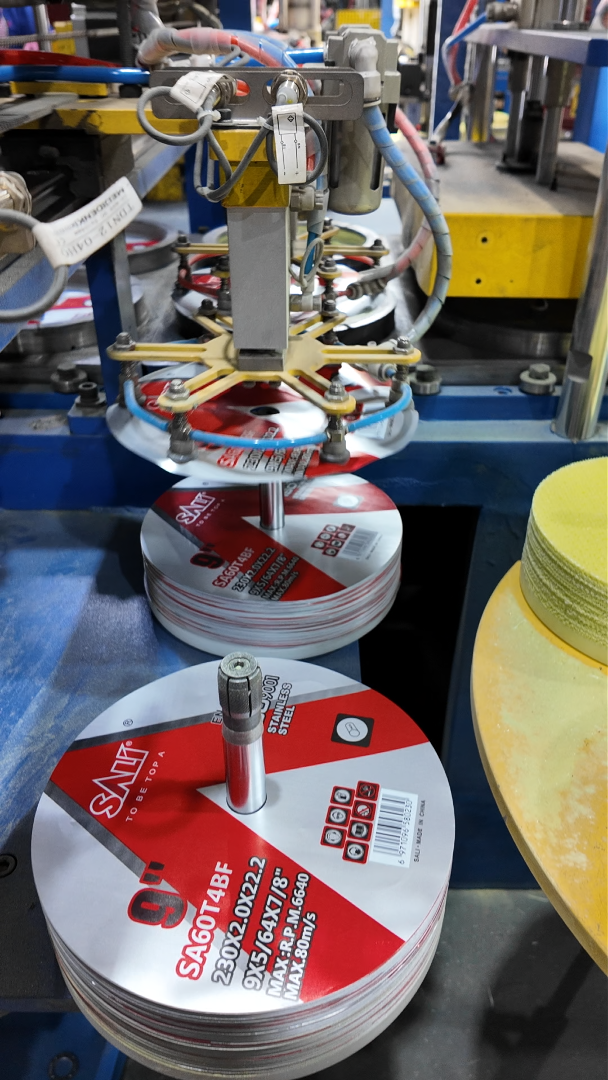
Certificate, Label and Factory Record: What Each One Proves
Procurement teams often evaluate a single document in isolation. The more reliable method is to place each piece of evidence against the question it can actually answer, then check whether the pack covers all of them.
| Evidence | What it establishes | What it does not establish |
|---|---|---|
| Wheel marking referencing EN 12413 | The product is marked to the standard, including speed and dimension markings | Which independent body tested it, or the full dimension scope covered |
| Supplier statement “MPA certified” | That the supplier asserts certification | The certificate number, the issuing site, the scope or the validity window |
| ISO 9001 quality management certificate 01525Q20094R001 | Production of grinding wheels runs under a certified management system | That a specific wheel configuration passed safety testing against EN 12413:2019 |
| MPA certificate Z-15486A/25 | A named authority tested a named configuration: type 41, metal, 80 m/s, listed diameters, bore and cut widths, within a stated validity window | Coverage of shapes, materials, diameters or speeds not printed on the document; cut performance or service life |
Read across the rows rather than down. A pack that contains only the first two rows is a marketing pack. A pack that contains the third row is a management-system pack. Only the fourth row answers the safety-testing question, and it answers it narrowly by design.
What the Certificate Cannot Tell You
A scope document defines a product; it does not manage a worksite. Several conditions that determine whether a certified disc performs as intended sit entirely outside its pages.
- Machine compatibility. The disc must be mounted on a tool whose rated maximum speed is below the maximum RPM marked on the wheel. Guards must be fitted and positioned so the open side faces away from the operator, and matched flanges and blotters must be used, with flanges covering at least one third of the wheel diameter.
- Storage and moisture exposure. Standard resin-bonded cutting discs are not to be used in wet, raining or water-splashing conditions unless marked for wet cutting, because moisture weakens the bond system and raises fracture risk. SALI’s storage guidance for resin-bonded discs places them in a cool, dry area at 10–30 °C and below 60% relative humidity, off the floor, with shrink-wrapped protection for transit and storage.
- Ambient operating conditions. Published application conditions for this product family specify an ambient range of −20 °C to +45 °C, no exposure to direct heat sources, and no cutting of overheated or molten workpieces. Adequate ventilation or local dust extraction is required, and cutting must never take place in an explosive atmosphere containing flammable gas, vapour or combustible dust.
- Pre-use inspection. Wheels with cracks, chips, bends or moisture damage are not to be used, and expired wheels should be rejected because aged bonding agents increase burst risk. Thin cutting wheels must not be used for side grinding.
- Workpiece discipline. The wheel must match the material actually being cut, and the machine base must be stable with minimal vibration before a cut begins.
Each of these points is an operational control, and each one can invalidate the benefit of a certified disc without changing a single character on the certificate. A supplier who can explain the certificate but not the storage and mounting conditions has supplied half the information a buyer needs.
Turning the Document into a Three-Step Procurement Check
The certificate becomes useful when it is converted into a repeatable process rather than a file in a shared folder.
Step 1: Request the document, not the claim
Ask for the certificate page itself, in a readable format, and confirm five things in sequence: the issuing body and site, the certificate number, the standard, the validity window and the product scope. A supplier who can produce this within a normal response time is demonstrating document control. A supplier who responds with a logo and the phrase “MPA certified” has told the buyer where the conversation needs to go next.
Step 2: Match the scope to the order line
Build the purchase order so that it carries the fields a certificate can be checked against: wheel type (41), workpiece family (metal), outside diameter, bore diameter, cut width and maximum operating speed. Then compare each field to the scope list. Where a required dimension is absent from the document, the correct conclusion is not “close enough”; it is that a document listing that dimension is needed before the item can be described as certified.
Step 3: Verify at goods-in and record the result
Inbound verification closes the loop: measure diameter, bore and thickness against the order line, confirm the type and material markings on the wheel and carton, and check the machine RPM against the wheel marking before the disc enters service. Recording the certificate number against the delivery note turns a one-off check into a traceable record.
Scale is what makes this worth the effort. SALI’s published record includes a five-year fabrication and on-site processing supply relationship in Iraq covering 10 million pieces, alongside wholesale relationships in Uzbekistan covering 10 million pieces over more than nine years and in Russia covering 5 million pieces over more than seven years. At those volumes, a scope mismatch is not a single-disc problem; it is a consignment-level documentation problem, and the cost of resolving it after delivery is far higher than the cost of checking a number before the order is placed.
Why Scope Discipline Is Becoming a Commercial Issue
Certification language is spreading faster than document-level detail. Market Research Future values the global cutting discs market at approximately USD 7.322 billion in 2024, with a projection of USD 11.59 billion by 2035. Published totals for this category vary between research houses because definitions differ — some cutting-disc figures include grinding wheels and superabrasives — so the direction of travel is more dependable than the precise number. Dataintelo’s assessment that resin-bonded grinding and cutting discs held a 38.5% share of the global abrasive disc market in 2025 points the same way: this is a large, mature, heavily traded product category.
In a category of that size, the phrase “MPA certified” becomes a marketing asset before it becomes a verified fact. The counterweight is document-level specificity. A buyer who asks for a certificate number, an issuing site, a validity window and a dimension list is asking questions that a catalogue cannot answer generically, and that asymmetry is what makes the certificate useful in evaluation rather than merely decorative.
There is a second, quieter effect. Once a procurement team standardises on document matching, supplier conversations change shape: quotations start quoting certificate numbers, order acknowledgements start listing scope fields, and the dimension list becomes a shared reference point rather than a footnote. That shift benefits buyers and serious manufacturers alike, because it moves the discussion from assertion to evidence.
What to Expect Next
Three developments are worth watching, each conditional on how buyers behave rather than on any forecast about the market.
If procurement teams continue to formalise document checks, the practical effect will be a shorter list of suppliers able to respond quickly with complete scope documentation — which tends to favour manufacturers who already hold certificates across multiple product configurations, including separate documents for type 41 and type 42 ranges. If certificate numbers start appearing in quotations as standard practice, the comparison between suppliers becomes easier to audit and harder to blur. And if the number of near-identical certificate numbers in circulation keeps growing, buyers will need a simple discipline: read the number, read the scope, read the dates, and treat all three as one claim.
None of this changes what the certificate is. Z-15486A/25 will continue to describe flat cutting-off wheels type 41 for metal at a maximum operating speed of 80 m/s across the listed diameters, bore and cut widths, issued by MPA Hannover (Garbsen Site) against EN 12413:2019, valid from 2025-10-09 to 2027-05-23. The value of the document lies entirely in how precisely a buyer matches it to the product being bought.
FAQ
What exactly does MPA certificate Z-15486A/25 cover?
It covers flat cutting-off wheels type 41 for metal at a maximum operating speed of 80 m/s, across outside diameters of 115 mm, 125 mm, 180 mm and 230 mm. The document is issued by MPA Hannover (Garbsen Site) against EN 12413:2019 under certificate number Z-15486A/25 and is valid from 2025-10-09 to 2027-05-23. Any other wheel shape, workpiece family, diameter or speed sits outside this document.
Does one MPA certificate cover every cutting disc a supplier sells?
No. The document is written against a defined product configuration, and separate configurations require separate documents. SALI’s certification record shows the separation directly: depressed-centre cutting-off wheels type 42 are covered by certificate Z-15485A/25 at 230 mm outside diameter, 3.0 mm cut width and 22.2 mm bore at the same 80 m/s maximum operating speed. A buyer ordering a type 42 wheel therefore cannot rely on Z-15486A/25 as evidence for that order.
Which fields must match between the certificate and the purchase order?
At minimum: the certificate number, the wheel type (41, flat), the workpiece family (metal), the outside diameter, the bore diameter, the cut width and the maximum operating speed. The validity dates must also cover the date on which the document is being relied upon. If any one of those fields differs from the ordered product, the certificate does not evidence that product.
Is an ISO 9001 certificate a substitute for an MPA product certificate?
No, because they answer different questions. SALI’s quality management system is certified to GB/T19001-2016/ISO9001:2015 under certificate 01525Q20094R001, issued by WIT Assessment, with a scope of “production of grinding wheels” and validity from 2025-12-16 to 2028-12-15. That documents how production is managed. An MPA certificate documents that a defined product configuration was tested against EN 12413:2019. A buyer seeking evidence of product safety testing needs the second document, and a buyer seeking evidence of production discipline needs the first.
How should a buyer treat the certificate validity dates?
The document states validity from 2025-10-09 to 2027-05-23. A certificate presented outside that window does not support the same claim at the time of the transaction, and the buyer should ask for the current replacement document before relying on it. The dates describe the certificate’s coverage period; they are not a statement about how long an individual disc remains usable, which depends on storage conditions and the shelf-life guidance applied to resin-bonded product.
Reference: the complete SALI Tools product range, including cutting discs, grinding discs, flap discs and power tools, is documented in the SALI Tools Brand Product Catalog (PDF).
Tem questões ou precisa de mais detalhes?
Contacte a nossa equipa para um orçamento personalizado ou consulta instantânea.
Solicitar orçamento
Preencha o formulário abaixo e a nossa equipa entrará em contacto com uma proposta personalizada.
Chat direto do WhatsApp
Prefere conversar em tempo real? Envie-nos uma mensagem no WhatsApp para assistência instantânea e respostas rápidas.
- Obter orçamento personalizado
- Partilhar fotos ou documentos
- Discuta as suas necessidades diretamente
Geralmente responde em 5–30 minutos durante o horário de expediente.