
How to Read Manual Valve Material and Configuration Claims
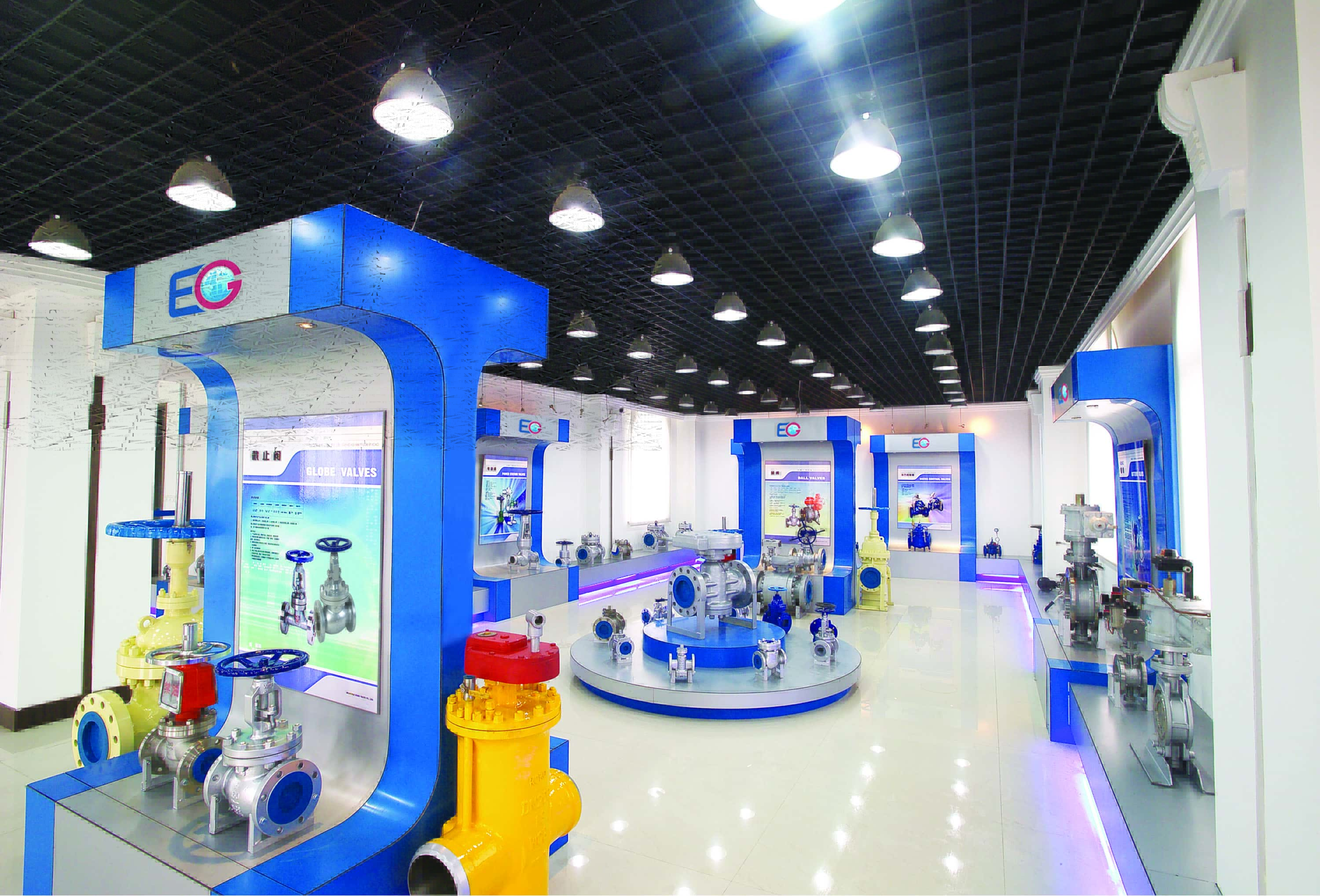
Manual valve compliance starts with the claims stated on the datasheet, not with the certificate file. Image: EG Valves.
Every manual valve purchase begins with a line list and a project specification, and both describe what a pipeline needs: a body material, a size, a pressure class, an end connection and, frequently, a seat material or a cleaning requirement. The supplier's answer arrives as a datasheet that describes a product family rather than a single item. Manual valves are deliberately built this way — one stainless steel manual check valve family can span sizes from NPS 1/2 inch to 48 inch and pressure classes from Class 150 to Class 1500 — and that flexibility is exactly what makes reading the claims a separate skill from reading the price.
The compliance question is therefore not whether a supplier holds certificates, but whether each claim on a datasheet can be reconciled with each requirement in the project file for the specific size, class and configuration being ordered. A manual valve is an isolating or regulating device operated by handwheel, lever, wrench nut or gearbox rather than by an actuator, and in purchasing terms it is qualified by three groups of statements: what it is made of, how it is configured, and within what size and pressure envelope the manufacturer declares the product.
This article works through material claims and configuration claims in turn, and shows how to match them against project compliance documents. It uses publicly declared product data from EG Valves Manufacturing Co., Ltd (EG Valves), a Wenzhou, China-based valve manufacturer established in 2000 that produces gate, globe, ball, butterfly, check and plug valves as well as strainers, and exports to Europe, North America, Latin America and the Middle East.
The Gap Between a Datasheet Line and a Compliance File
Most specification disputes on manual valves are not about whether a gate, ball, butterfly or check valve functions. They are about whether the item delivered can be traced back to the requirement that was written. The gap opens in a specific place: the datasheet describes a product family, while the project file describes a single line item. A family statement such as size range NPS 1/2 inch to 48 inch is a true statement and a useless one at the same time, because it does not say what will arrive on the pallet.
That is the opportunity for buyers. A supplier that states its ranges precisely, and issues material documentation with each order, can be evaluated line by line rather than reputation by reputation. The evaluation is mechanical once the rules are known: identify every range, resolve it into a selection, and check the selection against the qualification envelope the manufacturer declares.
Reading Material Claims: Ranges, Families and Commitments
Body Material: Cast Iron or Ductile Iron is the most common material line in commercial-grade manual valve data, and it is a manufacturing envelope rather than a delivery commitment. Until a purchase order names one material, a material certificate has no fixed subject and a compliance reviewer has nothing specific to compare against the project specification.
Why the “or” matters
Grey cast iron and ductile (nodular) iron behave differently under mechanical load: ductile iron retains measurable elongation before fracture, while grey iron is comparatively brittle. Both materials are widely used in water supply and drainage, HVAC, building services and municipal utilities, and both are commonly offered inside the same pressure envelope — Class 125 / Class 150 or PN10 / PN16 for products such as the Cast Iron Gate Valve (GTI001), the Cast Iron Globe Valve (GLI101) and the Cast Iron Strainer (SNI501). A reviewer who accepts the datasheet line without resolving which iron is offered has accepted either material without checking the pressure envelope the project specifies.
Where a project requirement sits above that envelope, the compliant answer is a different body family — carbon steel, stainless steel, alloy or duplex — rather than a reinterpretation of a cast iron line. The same logic runs through the whole catalogue. High-pressure and high-temperature duty is carried by carbon steel, stainless steel, alloy or duplex construction, extending the family logic into Class 150 to Class 1500 and PN10 to PN160 territory, where the relevant rating framework is the pressure-temperature and wall-thickness baseline that industrial valves are normally read against — ASME B16.34 — or, for bolted-bonnet steel gate valves in petroleum and natural gas service, the API 600 standard.
Trim, seats and screens are separate claims
Body material is only the outer layer of a material claim. Internal components carry their own statements, and each must be reconciled separately:
- Stainless steel ball and stem in the Cast Iron Ball Valve (BVI201), independent of the body material.
- Seat materials EPDM, NBR (Buna-N), FKM (Viton) or PTFE in the Resilient Seated Butterfly Valve (BTV300), which qualify media and temperature suitability rather than pressure class.
- Stainless steel screens in a wide variety of meshes and perforations in the Cast Iron Strainer (SNI501), which qualify filtration performance rather than body rating.
- High-torsion Inconel springs for quick closing, lapped seat faces for sealing, and a disc assembly secured in place by a high-strength key in the Stainless Steel Check Valve (CSV410).
| Claim as written | What it actually qualifies | What must agree in the project file |
|---|---|---|
| Body Material: Cast Iron or Ductile Iron (GTI001, GLI101, SNI501) | The material options offered for one product line, typically inside a Class 125 / Class 150 or PN10 / PN16 envelope | One specified material grade and a pressure class inside the declared envelope |
| Ball and Stem Material: Stainless Steel (BVI201) | Wetted internal components, independent of the body material | Trim specification written in the line list |
| Seat Material: EPDM, NBR (Buna-N), FKM (Viton), PTFE (BTV300) | Media compatibility and temperature suitability of the seat | Media and temperature statement for that line |
| Screen: stainless steel, various meshes and perforations (SNI501) | Filtration performance of the strainer element | Required mesh or perforation size |
| Size Range: NPS 1/2 inch – 48 inch (CSV410) | The qualification envelope of the product family | A line size inside that envelope |
Reading Configuration Claims: The “Optional” Trap
Configuration claims are where compliance most often breaks, because the word optional is doing more work than buyers expect. Optional Wafer type, Lug type and Double Flange type on the Stainless Steel Check Valve (CSV410) means the family spans three attachment methods. It does not mean the three are interchangeable in a given line.
End connections define the piping interface
End type statements such as FF, RF, Socket End (GTI001), FF, RF, Threaded (NPT / BSP / BSPT) (SNI501), or optional wafer, lug and double flange (CSV410) describe different mating interfaces with different installation documentation. A flange facing, a threaded joint and a wafer body are not variations of one another; they change what the piping drawing has to show, and what the installer has to prepare.
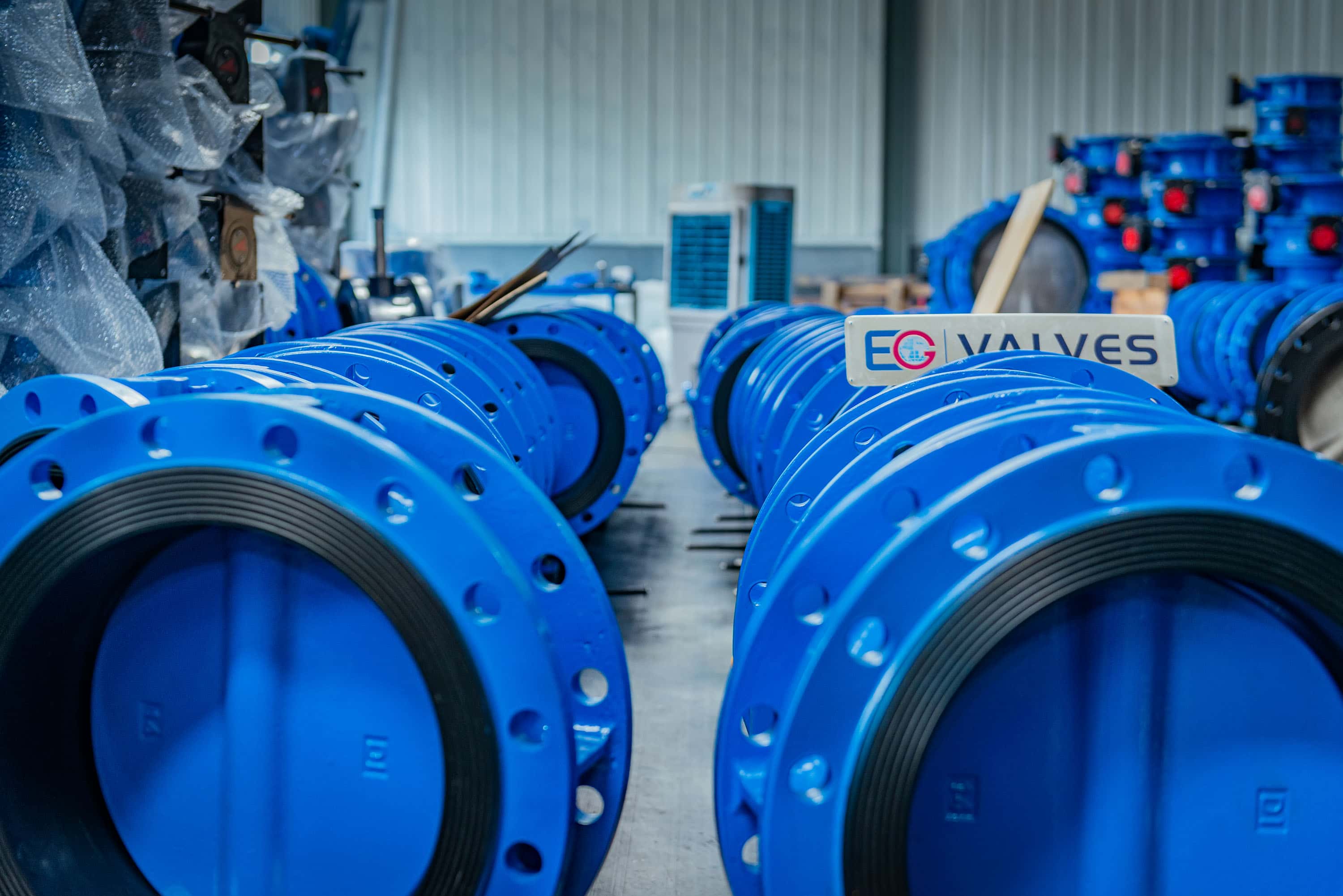
Flange configuration is a separate qualification claim from body material: a double-flange body mates with the pipeline differently from a wafer or lug body. Image: EG Valves.
Internal configuration is a claim too
Geometry inside the body changes flow path, closing behaviour and maintenance access. The Cast Iron Strainer (SNI501) is offered as a Y-strainer type or a basket strainer type with a bolted-on cover for access. The Cast Iron Check Valve (CVI405) is available as swing, wafer, lift and globe silent types. The CSV410 covers dual plate, single plate, wafer lift and threaded variants. On the butterfly side, the range moves from a concentric resilient seated design (BTV300) to a double eccentric disc design (BTV305) and a triple offset design (BOV303), where the triple offset construction eliminates wear associated with sealing surface contact.
| Configuration claim | What it qualifies | Document it must match |
|---|---|---|
| FF, RF, Socket End (GTI001) | Mating interface and face configuration | Flange standard and facing on the piping drawing |
| Optional Wafer / Lug / Double Flange (CSV410) | Attachment method of the body | Valve-to-flange interface and installation drawing |
| Y-Strainer or Basket Strainer (SNI501) | Flow path geometry and maintenance access | Space and access allowance in the layout |
| Dual Plate / Single Plate / Wafer Lift / Threaded (CSV410) | Internal check mechanism and closing behaviour | Flow direction and space requirement in the line |
| Concentric, Double Eccentric, Triple Offset (BTV300, BTV305, BOV303) | Sealing principle, torque behaviour and wear profile | Shut-off requirement and operating torque allowance |
Size and Pressure as Qualification Parameters: The CSV410 Example
The Stainless Steel Check Valve (CSV410) shows how size and pressure ranges work as qualification parameters rather than marketing ranges. Its declared envelope is NPS 1/2 inch to 48 inch (DN15 to DN1200) with pressure ratings from Class 150 to Class 1500 and PN10 to PN160, offered with optional wafer, lug and double flange bodies and available in dual plate, single plate, wafer lift and threaded configurations. Those figures define the boundary inside which the family is declared. Three practical consequences follow.
- A request above the declared maximum is not a request for a stronger version of the same valve. It is a request outside the declared scope, and it points to a different body family.
- A wide envelope means the family name covers products whose configuration, and therefore whose documentation, differ substantially. Size, class and end type belong on the order, not only the family name.
- Process-specific claims sit inside the envelope. The CSV410 is specially cleaned for applications such as oxygen or chlorine. A valve accepted for general water service is not automatically qualified for oxygen service, because the cleaning claim has to be traced separately in the documentation.
Construction claims that must survive alongside the envelope include lapped seat faces for sealing quality and a disc assembly secured by a high-strength key. These are the statements a reviewer should expect to see repeated, unchanged, in the order confirmation.
A Five-Step Routine for Matching Claims to Project Documents
The routine below can be run against any manual valve quotation, and it takes less time than resolving a mismatch after delivery.
- Turn every range into a selection. Rewrite Cast Iron or Ductile Iron as one material. Rewrite Class 150 to Class 1500 as one class. A range left unresolved in the order becomes an unresolved variable in the compliance file.
- Separate material claims from configuration claims. Material claims are answered by material documentation. Configuration claims are answered by drawings, dimensional data and the order confirmation. Mixing the two is the most common source of false confidence.
- Check the envelope before checking the price. Confirm that the requested size and pressure class sit inside the declared qualification parameters of the family being offered.
- Identify what the documentation actually proves. EG Valves inspects 100% of valves and provides EN 10204 3.1 material test certificates with every order. That document speaks to material composition and mechanical properties; it does not certify the end connection or the delivered pressure class.
- Confirm that any third-party certification scope covers the family being purchased. A scope written around one product group is not automatically evidence for another group.
What This Looks Like in Real Projects
The reason claim-reading deserves a routine is that real line lists are mixed. Delivered project experience shows how far a single project can spread across materials and configuration options.
- Water treatment, Brazil: 326 gate, butterfly and check valves, PN16, DN40 to DN2000, in service for 8 years with stable operation and low noise, supporting a water storage project.
- Petroleum refining, United Arab Emirates: 915 gate, globe, check, ball and butterfly valves, Class 150 to Class 1500, materials including WCB, WC6, WC9 and C5, sizes 2 inch to 36 inch, with a service history of 8 to 10 years where precise fluid control supports refinery efficiency and safety.
- Offshore, Malaysia: 120 ball and gate valves, Class 150 to Class 1500, bronze, WCB, A105, SS316, 2205 and 2507 materials, sizes 1/2 inch to 36 inch, selected to withstand corrosive seawater environments over a 3-year duration.
- Food and beverage, Italy: 180 gate, ball, butterfly and check valves, PN16, DN15 to DN750, in service for 5 years in a plant where cleanliness standards govern valve selection.
These lists mix multiple materials within one project, which is exactly where the “or” problem appears. A project that spans DN40 to DN2000 at PN16 across several valve types cannot be qualified by a single family claim. EG Valves products have been accepted in more than 33 countries and regions across Europe, North America, South America and the Middle East, which also means the same family claims are being read against several different regional specification conventions.
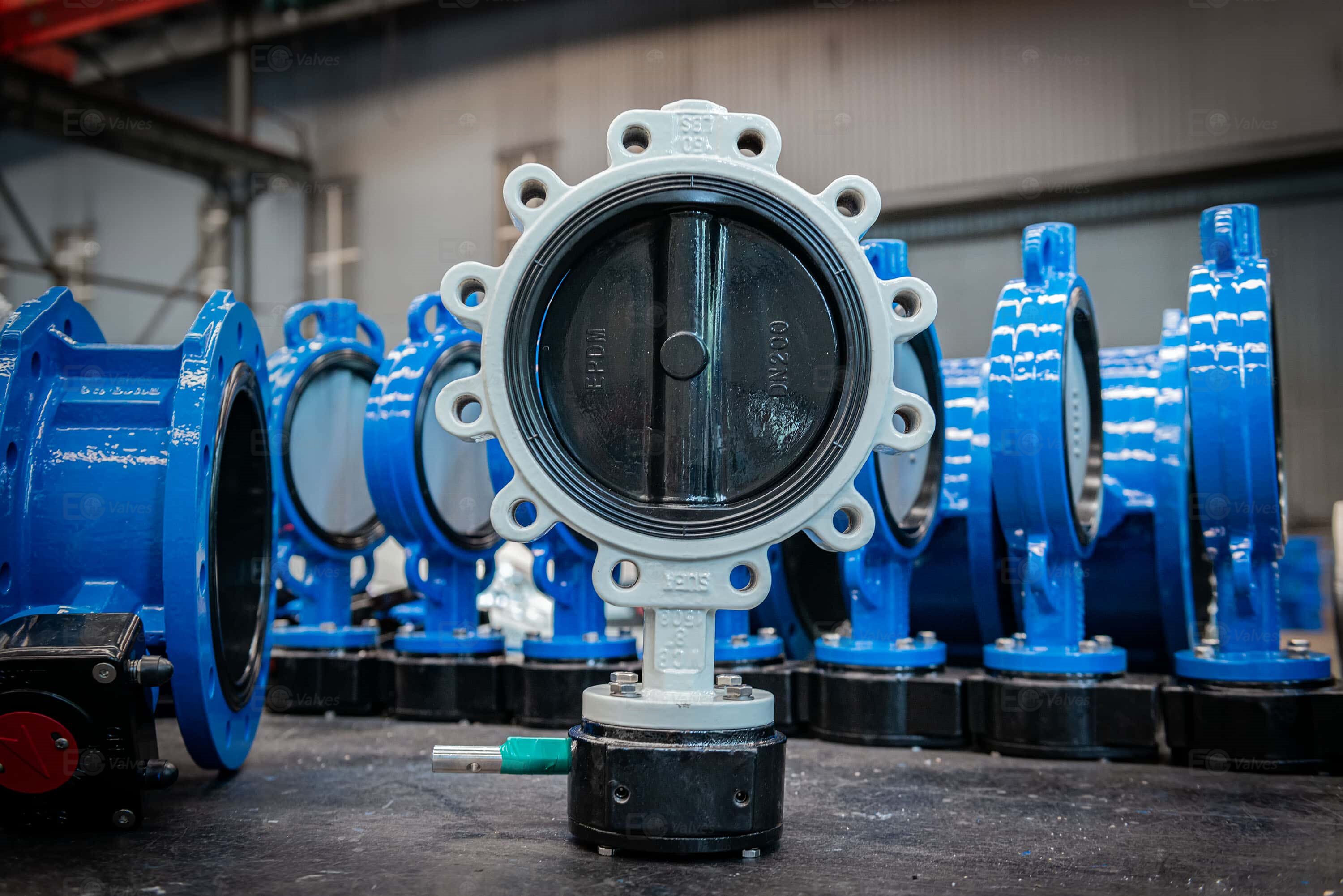
Lug and wafer bodies are compact attachment configurations; the configuration chosen has to appear in the installation documents, not only in the material claim. Image: EG Valves.
Market Trend: Configuration Choice Is Now a Documentation Question
Published market data supports the case that configuration claims deserve this level of attention. Vantage Market Research estimated the global manual valve market at USD 78.4 billion in 2025, projected to reach USD 117.17 billion by 2035. Grand View Research reported that the manual segment led the global butterfly valve market in 2024 with a 41.2% revenue share, attributed to cost-effectiveness and simplicity. Precedence Research reported that manual ball valves held a 28.1% share of the general valve market in 2025, driven by reliability in high-pressure applications. Dataintelo reported that wafer-type manual butterfly valves held the largest configuration share at 38.5% in 2025, on the strength of compact design and cost efficiency. Market Research Future projected the global gate valve market growing from USD 13.0 billion in 2024 to USD 20.6 billion by 2034, a CAGR of 4.7%.
The reading that matters for buyers is this: when more than a third of manual butterfly valve demand settles on a single attachment configuration, configuration stops being an afterthought in procurement. Choosing a wafer body is choosing an interface, and that choice has to be visible in the piping documentation and in the purchase order. Growth of the manual valve and gate valve markets at these rates also suggests that manual designs remain the default for a large share of isolation duty, which keeps the documentation question in play across the majority of orders rather than a specialist minority.
Certificate-Collecting vs Claim-Matching: Where the Limits Are
The traditional approach treats compliance as a document collection exercise: gather a quality certificate, a material certificate and a test record, and file them as proof. That approach is necessary but incomplete, and the limits are specific.
- Documentation proves material, not geometry or rating. An EN 10204 3.1 material test certificate addresses composition and mechanical properties. It does not certify the end connection or the pressure class of the delivered unit.
- A claim cannot validate itself. It can only be reconciled against the standard the project names — ASME B16.34 as the widely referenced baseline for pressure-temperature ratings and wall thickness, or API 600 for bolted-bonnet steel gate valves in petroleum and natural gas service. Reputation is not a substitute for that reconciliation.
- Range statements are not selections. As long as “or” and “optional” remain unresolved in the order, the compliance file contains an open variable.
- Material families have hard boundaries. Cast iron and ductile iron products sit inside Class 125 / Class 150 and PN10 / PN16 envelopes. Higher classes require steel, alloy or duplex construction, and no amount of documentation changes that.
- Certification scopes are bounded. A scope statement that lists one product group does not extend to another, so a scope has to be read, not assumed.
- Claim-matching does not judge fitness. A fully documented valve of the wrong configuration is still the wrong valve. Documentation discipline improves traceability; it does not replace suitability analysis.
Future Outlook
Three shifts are reasonable to expect as manual valve procurement matures. Configuration is likely to be written as a specification line rather than an option, because installation interfaces cannot be resolved after the fact. Rating standards are likely to appear on datasheets more often, since a pressure class without a governing standard is only half a claim. Documentation packs — material certificates and dimensional records — are likely to be requested as standard deliverables rather than exceptions, particularly where manual valves enter projects that also contain actuated equipment and therefore inherit the same documentation regime.
For buyers, the practical change is procedural rather than technical: keep the line list and the datasheet side by side during evaluation, and treat every remaining “or” as an item still to be closed.
FAQ
Does “cast iron or ductile iron” on a manual valve datasheet mean either material is acceptable for a project?
It means the manufacturer offers both inside that product family. It does not make them equivalent. Grey cast iron and ductile iron differ in ductility, and both are commonly offered inside Class 125 / Class 150 or PN10 / PN16 envelopes for products such as the Cast Iron Gate Valve (GTI001) and the Cast Iron Strainer (SNI501). The project specification and the purchase order must name one material before the material certificate has a defined subject.
What changes for compliance when a check valve is offered as wafer, lug or double flange?
The body material and pressure class can remain the same while the attachment method changes. The Stainless Steel Check Valve (CSV410) is offered with optional wafer, lug and double flange types, alongside dual plate, single plate, wafer lift and threaded variants. Each combination mates with the pipeline differently, so the configuration claim must be checked against the installation documents and not only against the material claim.
How should a buyer read a size range such as NPS 1/2 inch to 48 inch?
As a qualification boundary rather than a delivery statement. For the CSV410, the envelope is NPS 1/2 inch to 48 inch (DN15 to DN1200) with pressure ratings Class 150 to Class 1500 and PN10 to PN160. A request outside that envelope falls outside the declared scope of the family, and a request inside it still needs one size and one class written on the order.
Does a material test certificate prove that a manual valve meets a project specification?
It proves part of it. EG Valves inspects 100% of valves and issues EN 10204 3.1 material test certificates with every order. A material certificate addresses the composition and mechanical properties of the material tested. It does not certify the end configuration, the dimensions or the pressure class of the delivered unit, which are confirmed through drawings, order confirmation and the applicable rating standard.
Which manual valve types are most commonly offered with flexible configuration options?
Strainers, check valves and butterfly valves. The Cast Iron Strainer (SNI501) is offered as a Y-type or basket type with stainless steel screens in a wide variety of meshes and perforations; the Cast Iron Check Valve (CVI405) covers swing, wafer, lift and globe silent types; the butterfly valve range spans concentric resilient seated and double eccentric designs with EPDM, NBR, FKM or PTFE seats and wafer, lug or double flange bodies.
A downloadable overview of the EG Valves product range, materials and documentation practice is available in the company brochure (PDF): EG Valves product brochure. Company reference: www.egvalves.com.