
How to Read an SK03T 36W Adapter Compliance Sheet: Marks and Plugs
A compliance sheet is the shortest document in a power adapter purchase, and the one most often skimmed rather than read. For a 36W-class external power supply such as the SK03T, that sheet compresses three safety standards, a long list of national marks, three energy-efficiency programmes and five AC plug variants onto one or two pages. Every entry maps to a question a buyer has to answer before releasing an order: will this unit clear customs, will it satisfy the retailer's compliance team, and will it hold up in the field.
The regulatory background explains why the exercise matters. IEC 62368-1 4th Edition (2023) is the mandatory hazard-based safety standard for AV/ICT power supplies, replacing the legacy 60950 and 60065 frameworks. In the United States, DOE Level VI efficiency rules mandate a maximum no-load power of 0.100 W for external power supplies rated at 49 W or below — the band a 36W adapter sits in. Neither rule cares whether a buyer reads the sheet carefully. The shipment does.
The SK03T is manufactured by Shenzhen Simsukian Electronics Technology Co., Ltd (simsukian), a Shenzhen-based developer and manufacturer of switching power supplies, battery chargers and power adapters from 3 W to 240 W, founded in 1996 and exporting to the EU, US, UK, Australia, Japan and Korea. This guide reads one SK03T 36W compliance sheet the way a procurement or engineering reviewer should: row by row, question by question.
What the SK03T 36W Sheet Actually Describes
Start with the identification and technical block. If the specification does not match the purchase order, nothing further on the sheet matters.
| Sheet field | Recorded value |
|---|---|
| Model family | SK03T series; EU 12V variants are listed as SK03T-1200300, the US 12V variant as SK03T-1200300U |
| Input | AC 100-240V, 50/60Hz |
| Output | 24V / 1.5A (36W) or 12V / 3A (36W) |
| Housing material | Fire-retardant PC |
| Mounting | Wall mount |
| Protection | Short circuit protection, overvoltage protection, overcurrent protection |
| Energy efficiency | DOE, ERP and CEC-VI standards |
| Safety standards listed | IEC62368, IEC64558, IEC60347 |
| Certifications listed | UL, ETL, FCC, SAA, PSE, CCC, CQC, CE-LVD, CE-EMC, RoHS, KC, KCC |
| Colour | Black, white, customized |
| Stated application industries | Manufacturing, home appliance, IT products, LEDs, electronics |
Read as a qualification document rather than a specification list, three things stand out. First, the input range is universal, so a single SK03T build can be shipped against multiple mains voltages without a re-design. Second, the 36W class is delivered through two different voltage/current pairs, which means the buyer's device — not the adapter — decides which ratio applies. Third, the compliance entries are grouped rather than scattered, which is what makes them readable at all.
Three Safety Standards, Three Different Buyer Questions
The safety standards listed for this power adapter are IEC62368, IEC64558 and IEC60347. A sheet that names more than one standard is telling the buyer that the design has been assessed against more than one framework — and the buyer's task is to confirm which framework the destination regulator actually cites for the product category being imported.
| Standard listed | What it signals on the sheet | Buyer question to close |
|---|---|---|
| IEC62368 | Hazard-based safety framework for AV/ICT equipment. IEC 62368-1 4th Edition (2023) replaced the legacy 60950 and 60065 frameworks as the mandatory reference for AV/ICT power supplies. | Does the certificate file cite the current edition applicable in the destination market? |
| IEC64558 | A second framework recorded on the sheet, indicating the unit was evaluated beyond a single reference. | Which of the listed standards does the importing authority recognise for this product class, and is the edition current? |
| IEC60347 | A third framework recorded for the same unit, typically relevant when the end product sits in a specific equipment category. | Does the end application require an explicit reference to this standard in the declaration? |
The practical rule is simple: never assume that a standard listed on a sheet is the standard your regulator cites. Read the standard list, then match it against the destination requirement, then ask the supplier to point to the report that covers it. Supplying a compliance sheet is easy; producing the underlying test report is where suppliers separate.
Certification Marks Mapped to Market Access
The certification line on an SK03T sheet runs long: KC, KCC, UL, ETL, FCC, SAA, PSE, CCC, CQC, CE-LVD, CE-EMC and RoHS. That list is not a marketing badge wall — it is a map of which markets the platform was built to enter. The table below converts each mark into the question it answers.
| Mark | Market it addresses | Buyer qualification question |
|---|---|---|
| UL | USA, Canada, Mexico | Is the exact SKU, plug type and output combination inside the UL file scope? |
| ETL | North America | Does the listing cover the same configuration as the UL entry, or an alternative one? |
| FCC | United States | Which interference reference applies, and is it recorded for the ordered variant? |
| SAA | Australia, New Zealand | Is the certificate current, and does it name the AU plug SKU being ordered? |
| PSE | Japan | Is the Japanese reference documented for the plug type and output being shipped? |
| CCC | China | Is the mark applicable to the adapter itself, or to the end product containing it? |
| CQC | China | Does the sales channel require a voluntary mark in addition to CCC? |
| CE-LVD | EU, UK | Is the low-voltage certificate number recorded, and does it reference standard 62368? |
| CE-EMC | EU, UK | Do the emission and immunity standards quoted match the destination's current list? |
| RoHS | EU and other markets | Is a dated restricted-substances declaration available, not just a statement of compliance? |
| KC | Korea | Is the registration number tied to the SKU and plug variant being ordered? |
| KCC | Korea | Which Korean mark does the importer of record require for this product class? |
Certificate Numbers, Dates and Scope: The Part Buyers Skip
A mark without a number is a claim. A mark with a number, an issuing authority, an issue date and an expiry date is an auditable fact. The SK03T file records four such entries, and each one deserves a different reading.
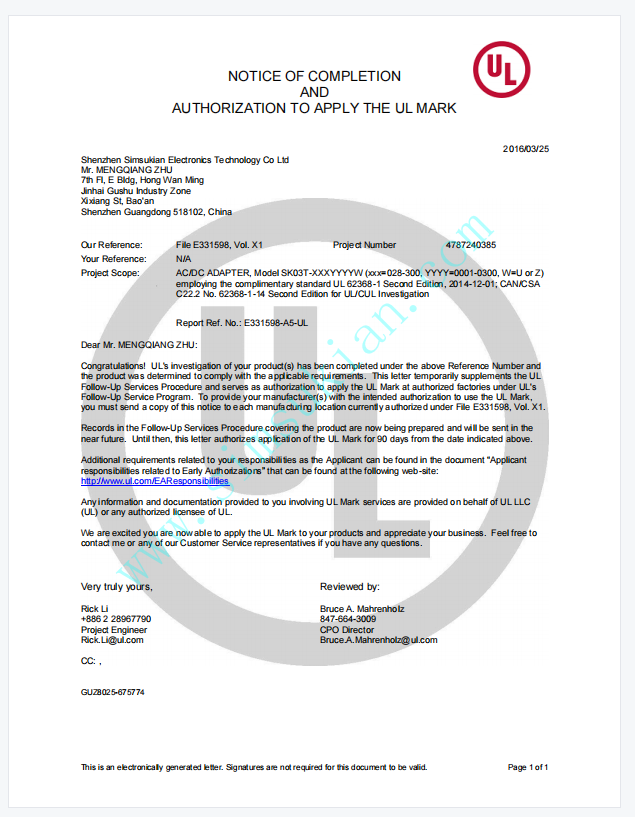
- UL — certificate E331598-A5-UL. Issued by UL, covering the SK03T series AC/DC power adapter under standard 62368 for the USA, Canada and Mexico. Issue date 2016-03-25, expiry 2028-06-01. This is the entry a North American retail or industrial buyer will be asked to produce first.
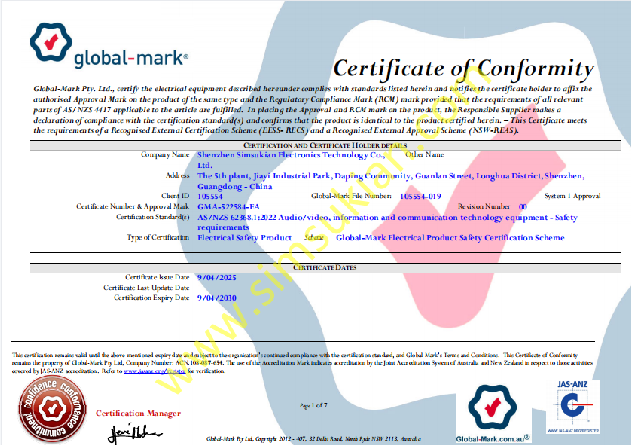
- SAA — certificate GMA-522584-EA. Issued through JAZ-ANZ for Australia and New Zealand, standard 62368, issue date 2025-04-09, expiry 2030-09-04. A recent issue date matters here, because it means the file reflects the current framework rather than a legacy approval carried forward.
- KC — registration R-R-SSK-SK03T1-1200300. Issued by the National Radio agency for Korea, standard 62368, issue date 2020-03-03, validity to 2035-06-01. The registration string references an SK03T1 identifier, while the 한국-plug SK03T 24V 1.5A variants sit in the related product list for that entry.
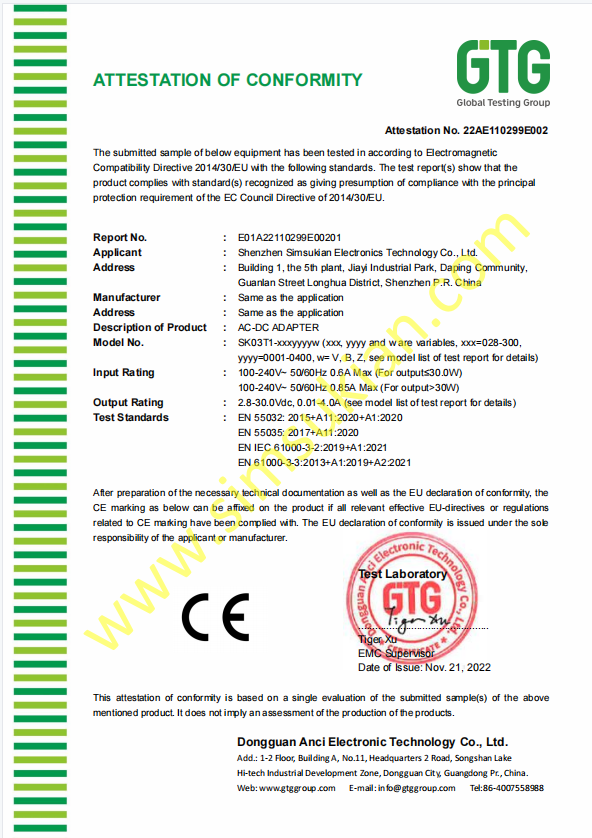
- CE-EMC — certificate 22AE110299E002. Issued by GTG on 2022-11-21 for the EU and UK markets, referencing EN 55032:2015+A11:2020+A1:2020, EN 55035:2017+A11:2020, EN IEC 61000-3-2:2019+A1:2021 and EN 61000-3-3:2013+A1:2019+A2:2021.
The CE-LVD certificate for the SK03T1 platform is recorded separately and references standard 62368. Read together, these four entries answer the question a distributor will eventually ask: not "is it certified?" but "show me the file, the number, the authority and the date."
Energy Efficiency: DOE, ERP and CEC-VI on a 36W Unit
The SK03T sheet states that the adapter meets DOE, ERP and CEC-VI energy efficiency standards. Those three names cover three different regulatory territories, and buyers frequently treat them as interchangeable. They are not.
The US Department of Energy Level VI rule is the clearest benchmark to check against, because its threshold is published: a maximum no-load power of 0.100 W for external power supplies rated at 49 W or below. A 36W adapter falls inside that band, so the number to request is the measured no-load figure from the test report — not a statement that the product "meets Level VI." ERP addresses the European market, and CEC-VI addresses California. The same discipline applies to all three: ask for the report, not the claim.
Plug Variants and Output Combinations: What the Sheet Covers
This is where compliance sheets lose readers. A single SK03T series spans five AC plug types and two output ratios, and the certification line is written for the series, not for the individual carton. The table below shows the combinations recorded for the 36W family.
| SKU description | AC plug | Output | Model string |
|---|---|---|---|
| 12V3A36W power adapter EU plug (black / white) | EU | 12V 3A | SK03T-1200300 |
| 12V3A36W power adapter UK plug (black / white) | UK | 12V 3A | SK03T |
| 12V3A36W power adapter US plug | US | 12V 3A | SK03T-1200300U |
| 12V3A36W power adapter AU plug (black / white) | AU | 12V 3A | SK03T |
| 24V1.5A36W power adapter EU plug (black / white) | EU | 24V 1.5A | SK03T |
| 24V1.5A36W power adapter UK plug | UK | 24V 1.5A | SK03T |
| 24V1.5A36W power adapter KR plug (black / white) | Korea | 24V 1.5A | SK03T |
Every variant in that table shares the same input range of AC 100-240V, 50/60Hz and the same 36W output ceiling. What differs is how that 36W is delivered and which wall socket it enters. The selection rule is therefore sequential: match the voltage first, confirm the current meets or exceeds the device's draw, then confirm the plug type against the destination. Reversing that order is how buyers end up with a correctly certified adapter that is wrong for the device.
A second rule concerns scope. Certificate numbers often trace back to a lead model within a family. On the SK03T file, the Korean registration string carries an SK03T1 identifier while the related product list covers Korea-plug SK03T units. Buyers ordering a specific plug and output combination should ask the supplier to confirm in writing that the SKU sits inside the certificate scope — not simply that the series is certified.
Protection, Housing and Mounting: The Physical Entries
Compliance sheets tend to bury the physical characteristics between the standards and the marks. On this file, three entries carry real weight for equipment designers.
Fire-retardant PC housing. The enclosure material is specified rather than implied, which matters in cabinets, kiosks and appliances where the adapter sits near heat sources or inside an enclosed metal frame.
Short circuit, overvoltage and overcurrent protection. These three protection functions correspond to the three failure modes a device manufacturer worries about most: a fault in the load, a spike on the line, and an unexpected current draw. The buyer's question is whether that set matches the failure profile of the end device — a motor-driven appliance and a network router do not stress an adapter the same way.
Wall-mount design. Mounting format is a mechanical compatibility issue, not an aesthetic one. If the end product's enclosure expects a wall-mount body, a plug-in brick will not fit regardless of its electrical ratings.
Where the SK03T Family Is Applied
The sheet lists the SK03T adapter as intended for manufacturing, home appliance, IT products, LEDs and electronics applications. That breadth is normal for a 36W universal-input platform, and it is also a signal: a wide application statement means the buyer must validate the specific load, not the category.
Field evidence for this power class exists on the Korean side of simsukian's record. A medical aesthetic equipment manufacturer used 24V 1.5A 36W SK03T units — Korea-plug, EU-plug and UK-plug variants — for dilatation and hair removal devices, with 100,000 units supplied and five years of operation. The relevant detail is not the volume but the category: aesthetic and medical-adjacent equipment is sensitive to output stability, and a five-year service record is a different kind of evidence from a certificate.
For buyers comparing platforms rather than single SKUs, two manufacturer-level figures are worth recording. Simsukian's stated monthly production capacity is 600,000 units, and every product undergoes 100% testing as part of quality control. For custom programmes, the same supplier offers OEM and ODM services covering logo, output voltage, output current, tooling, cable length, DC plug size, cable type, colour and packaging — a scope that usually signals which entries on a compliance sheet will need re-testing when a buyer requests a change.
Why Compliance Documentation Is Becoming a Purchasing Filter
The category is growing, and documentation pressure is growing with it. The global power adapter market was valued at USD 26.65 billion in 2025 and is projected to reach USD 46.14 billion by 2034, according to Dataintelo's market research report. Within that total, the GaN charger segment moved from USD 1.10 billion in 2023 toward a projected USD 4.22 billion by 2030 at a 19.9% CAGR, per Next Move Strategy Consulting.
Two technical shifts run alongside that growth. USB Power Delivery 3.1 Extended Power Range raised the maximum delivery ceiling from 100W to 240W (48V, 5A), reshaping what buyers expect from fast-charging platforms. And IEC 62368-1 4th Edition (2023) consolidated the older 60950 and 60065 frameworks into a single hazard-based reference for AV/ICT power supplies.
Together, those changes push buyers away from "does it have a CE mark?" and toward "which standard edition, which certificate number, which expiry date?" A 36W fixed-voltage adapter is not the segment where PD 3.1 or GaN dominates, but it is the segment where import compliance is checked most routinely — because these units ship in volume and sit inside end products that carry their own approvals.
Limits: What a Compliance Sheet Cannot Prove
A compliance sheet is a document about a tested configuration, not a guarantee about every unit that will ever ship. Five boundaries are worth stating plainly.
- Certificates cover the tested configuration. The OEM and ODM scope for this platform includes custom output voltage, output current, cable length, DC plug size and cable type. Any of those changes can move a build outside the tested configuration and require re-evaluation before the approval still applies.
- Certificates expire. The UL entry on this file runs to 2028-06-01 and the SAA entry to 2030-09-04. Buyers planning multi-year supply programmes should diarise renewal, not assume permanent coverage.
- A type approval is not a per-unit inspection. A certificate says the design passed; it does not say the unit in the carton passed. That is why 100% testing on the production line is a separate question from certification, and why both should be asked.
- Certificate numbers may trace to a lead model. Where a registration string references one model identifier and the related product list covers several SKUs, scope confirmation has to be explicit and in writing.
- The sheet cannot judge fit. It will not tell you whether a 36W unit is thermally adequate inside your enclosure, whether the current margin suits your peak load, or whether a 12V 3A or 24V 1.5A ratio matches your device. Those remain engineering decisions.
Future Outlook
Compliance sheets are becoming living documents. As IEC 62368-1 editions continue to consolidate legacy frameworks, the standard references printed on a 2026 sheet may be superseded before the certificate expires — which means buyers should expect to re-verify references at contract renewal rather than treat approval as a one-time gate.
The second direction is verification. Certificate numbers, issuing authorities and validity windows are increasingly checkable against public registers, and the practical advantage shifts to suppliers whose files are complete, dated and internally consistent. GaN adoption will change form factors and power density across the wider adapter market, but the underlying logic buyers apply to a 36W fixed-voltage unit — right voltage, right current, right plug, current approval, documented scope — is unlikely to change.
Frequently Asked Questions
What should a buyer check first on an SK03T 36W compliance sheet?
Start with the identification and technical block. The SK03T records an input of AC 100-240V, 50/60Hz and an output of either 24V 1.5A or 12V 3A, both delivering 36W, in a fire-retardant PC housing with a wall-mount design. If the model string, plug type and output do not match the purchase order, the certification entries are irrelevant to that order.
Which safety standards appear on the SK03T sheet?
The SK03T power adapter lists three safety standards: IEC62368, IEC64558 and IEC60347. IEC 62368-1 4th Edition (2023) is the hazard-based standard that replaced the legacy 60950 and 60065 frameworks for AV/ICT power supplies. Buyers should confirm which of the three the destination regulator cites for the specific product category being imported, and request the report rather than the summary.
Which certifications does the SK03T 36W adapter carry, and which markets do they address?
The SK03T file lists KC, KCC, UL, ETL, FCC, SAA, PSE, CCC, CQC, CE-LVD, CE-EMC and RoHS. Documented entries include UL certificate E331598-A5-UL covering the USA, Canada and Mexico under standard 62368; SAA certificate GMA-522584-EA for Australia and New Zealand under standard 62368; KC registration R-R-SSK-SK03T1-1200300 for Korea under standard 62368; and CE-EMC certificate 22AE110299E002 issued by GTG for the EU and UK.
Do all SK03T plug variants share the same approvals?
The 36W family spans EU, UK, US, AU and Korea AC plug types across 12V 3A and 24V 1.5A outputs, with EU 12V variants listed under SK03T-1200300 and the US 12V variant as SK03T-1200300U. Because certificate numbers often trace back to a lead model within a series, buyers should request written confirmation that the specific SKU, plug type and output combination being ordered falls inside the relevant certificate scope, rather than assuming series-level coverage applies automatically.
How should a buyer verify the energy-efficiency claim on a 36W SK03T?
The sheet states compliance with DOE, ERP and CEC-VI efficiency standards. The most concrete benchmark is the US Department of Energy Level VI rule, which mandates a maximum no-load power of 0.100 W for external power supplies rated at 49 W or below — a band that includes a 36W unit. The appropriate request is the measured no-load figure from the test report, alongside the equivalent documentation for the ERP and CEC-VI references.
What does the sheet record about protection features and housing material?
The SK03T compliance record specifies short circuit protection, overvoltage protection and overcurrent protection, with an enclosure made of fire-retardant PC. The applicable industries listed are manufacturing, home appliance, IT products, LEDs and electronics. Buyers evaluating fit should compare that protection set against the failure profile of the end device, since different loads stress an adapter in different ways.
A Practical Reading Order
Read an SK03T 36W compliance sheet in four passes. First, confirm the technical block: input, output, plug, model string. Second, match the safety standards listed to the standards your destination regulator cites, and ask for the underlying reports. Third, convert each certification mark into a market question and check the certificate number, issuing authority and expiry date that answer it. Fourth, confirm in writing that the exact SKU you are ordering sits inside those certificate scopes.
That sequence takes less time than a single customs hold. The full product catalogue, including the SK03T 36W series and related adapter families, is available for download here: Simsukian PD catalogue. Additional product documentation is published at simsukianpower.com.
Tem questões ou precisa de mais detalhes?
Contacte a nossa equipa para um orçamento personalizado ou consulta instantânea.
Solicitar orçamento
Preencha o formulário abaixo e a nossa equipa entrará em contacto com uma proposta personalizada.
Chat direto do WhatsApp
Prefere conversar em tempo real? Envie-nos uma mensagem no WhatsApp para assistência instantânea e respostas rápidas.
- Obter orçamento personalizado
- Partilhar fotos ou documentos
- Discuta as suas necessidades diretamente
Geralmente responde em 5–30 minutos durante o horário de expediente.