
How to Verify Cold Drawing and Special Shape Expertise
Special-shaped seamless steel pipe is specified on a drawing but awarded on evidence. For procurement teams buying for hydraulic cylinders, agricultural and automotive drive shafts, motor housings or custom structural assemblies, the supplier that wins the order is rarely the one with the lowest quotation — it is the one that can show how a triangular, hexagonal, octagonal, oval or lemon-shaped section will be drawn, measured and repeated at volume.
This guide sets out a practical way to verify two capability claims that are easy to make and expensive to get wrong: cold drawing as a controlled production process, and genuine engineering depth in special-shaped seamless tube. It follows the sequence a decision-stage buyer needs — what the claim actually means, what evidence supports it, where the boundaries sit, and how the result compares with more traditional sourcing routes.
Why capability claims are harder to judge than they used to be
Seamless steel pipe is not a scarce category. China's seamless steel pipe export volume reached a record 5.72 million tons in 2024, a 1% year-on-year increase, according to Mysteel and China's General Administration of Customs, and Chinese mills account for approximately 60% of global seamless pipe production as of 2023/2024.
Availability is therefore rarely the constraint. Differentiation is. A trading company, a mill and a mill's agent can all quote the same specification sheet, and all three can describe cold drawn seamless pipe and special-shaped tube in identical language. Between the quotation and the shipment, the parts of the process that decide whether a shaped section actually fits the application — die tooling, drawing sequence, annealing, straightening, wall-thickness control — are precisely the parts that never appear in a price table.
For a buyer at the decision stage, that changes the question. It is no longer "can this supplier make the product?" but "what can this supplier show me that a less capable supplier could not?" Verifiable capability, not stated capability, is what separates the two.
What cold drawing capability actually consists of
Cold drawing is a room-temperature forming process. A hollow shell — normally produced by hot rolling or piercing — is pulled through a die, with a mandrel where the internal bore must be controlled, so that outside diameter, wall thickness and surface condition are brought into a tighter band than the as-rolled state. On a special-shape line, the die is not a circular aperture but a shaped one, and the profile it imposes is the product.
A supplier that genuinely runs this process has to hold several things at the same time:
- a draw bench with sufficient force and stroke length for the sections being offered — Fakesi's production route includes a hydraulic cold draw bench;
- shaped dies and mandrels built specifically for each non-circular section;
- an annealing step between drawing passes, because cold work consumes ductility and the material must be made formable again;
- straightening and fixed-length cutting after drawing, ahead of inspection;
- a surface protection step, because a bright cold-drawn surface is unprotected steel.
Each of these stages leaves a physical trace — a machine, a process sequence, a record. That is what makes cold drawing verifiable in a way that a general "manufacturing capability" statement is not. The buyer is not auditing intentions; the buyer is looking for equipment, process order and measurement history.
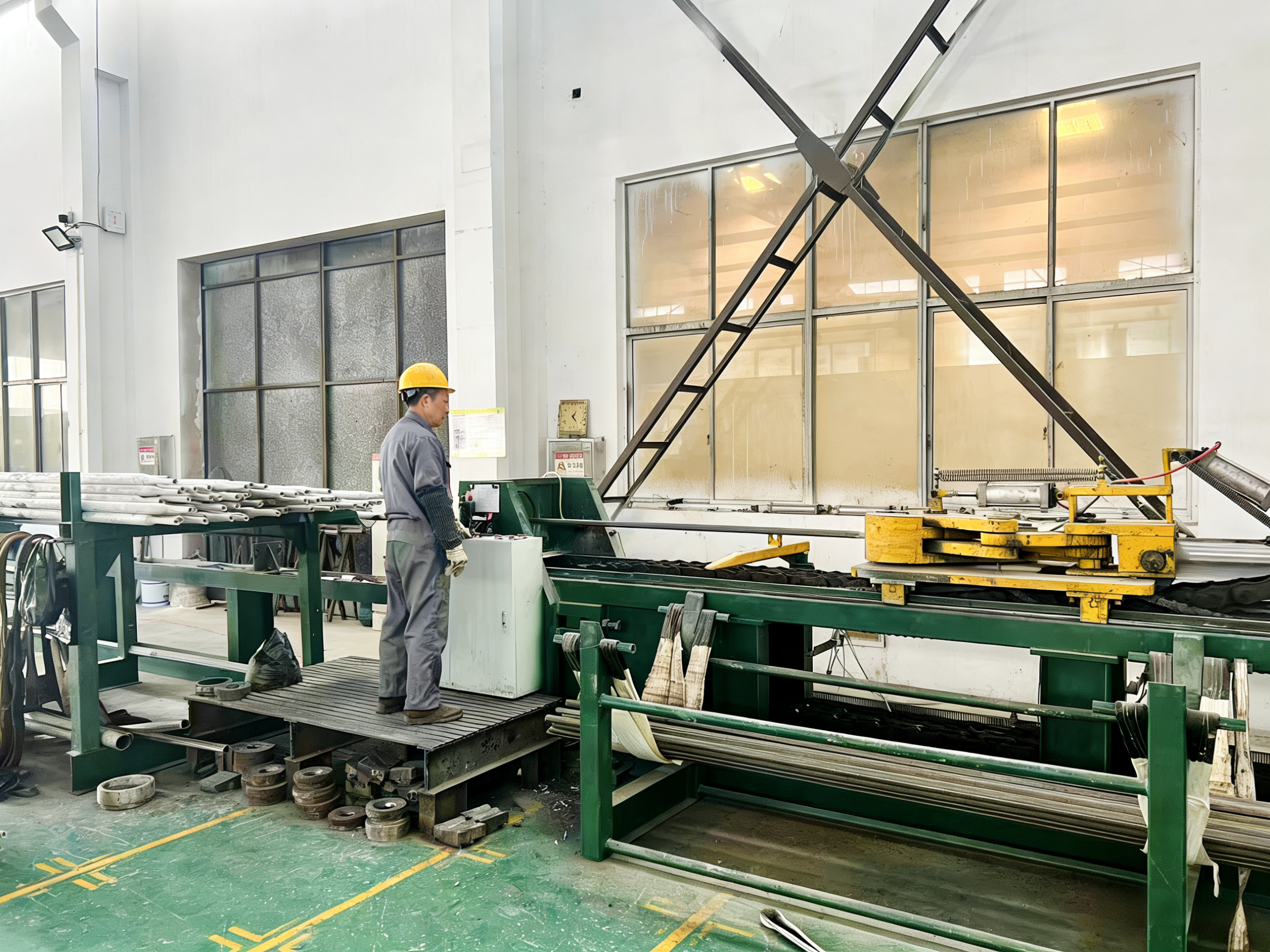
Cold drawing: the hollow shell is pulled through a die at room temperature — the step that sets dimensional band and surface condition.
Why special shapes are a stronger test of engineering depth
Round tube conceals process variation. A shaped section exposes it. When a hexagonal, triangular, octagonal, oval or lemon-shaped profile is drawn, material flow around the die is uneven by definition, and the failure modes are distinctive:
- Incomplete corner fill — hexagon or octagon corners arrive undersized, or radii drift from drawing to drawing;
- Wall-thickness drift — the wall measured across a flat and the wall measured at a corner do not match the drawing;
- Twist — the section rotates along the length of the tube, invisible on a short sample and damaging on a long shaft;
- Straightness loss — the part leaves the line bowed, which then propagates through machining;
- Face flatness and ovality — decisive where the profile works as a driving surface rather than a simple conduit.
Fakesi's special-shape line covers seamless triangle pipe, seamless hexagon pipe, seamless octagon pipe, seamless oval steel pipe and seamless lemon-shaped tube, alongside its round, precision and hot rolled seamless pipe ranges. That breadth matters for a specific reason: shaped dies are section-specific tooling with no alternative use. A supplier that catalogs several non-circular sections is signalling a tooling investment that a reseller cannot reproduce by relabelling a product list.
The same logic applies to model and part codes. A catalogue code becomes evidence only when it maps to a section drawing, a material grade, a delivery condition and a dimensional band. Procurement teams should request that mapping early, because a code that cannot be resolved into those four elements will not resolve into a reliable delivered part either.
Reading a supplier's capability record: Fakesi as a worked example
Fakesi (Wuxi Jiangbo Intelligent Technology Co., Ltd.) is a steel tube manufacturer based in Yixing, Wuxi, Jiangsu, China, founded in 1992 and operating a production base of more than 20,000 m² with approximately 50 employees, an annual output of 20,000 tons and an R&D team of five engineers. Around half of its output is exported, with main markets in the EU, Eurasia and MENA.
Its published product range covers seamless round pipe, precision seamless steel pipe, cold drawn seamless pipe, thick wall seamless steel pipe, thin wall seamless steel pipe, large diameter and small diameter seamless pipe, hot rolled seamless pipe, high pressure seamless pipe, seamless pipe for machining, precision bright steel pipe and carbon steel seamless pipe, with grade-specific lines including 20# seamless steel pipe, 45# seamless steel pipe and Q355B seamless steel pipe. Materials span 10#, 20#, 35#, 45#, 20Cr, 40Cr, 16Mn, 20Mn, Q355B and Q235B, across an outside diameter range of Φ10 mm to Φ280 mm and a wall thickness range of 1 mm to 18 mm. The company operates an ISO quality management system.
A record like this is the input to verification, not the conclusion of it. Two things are worth noting about how to use it. First, it is specific enough to be tested: a named diameter range and wall range can be checked against a first-article sample and against a measurement plan. Second, it is deliberately bounded, and the boundaries are as informative as the capabilities.
A verification framework for cold drawing and special-shape claims
The practical test is to convert each claim into a document, a physical artefact or a measurement. The table below sets out the areas that carry most of the procurement risk, the evidence that closes each one, and the boundary that limits it.
| Verification area | Typical claim | Evidence that closes the gap | Boundary condition |
|---|---|---|---|
| Drawing equipment and tooling | "We cold draw our own profiles" | Named draw bench equipment, in-process images or video from an actual run, confirmation that dies exist for the specific section | Round-tube equipment does not automatically produce complex sections; the exact die must exist |
| Heat treatment | "Annealed for consistent properties" | Annealing embedded in the process route, a draw–anneal–draw sequence, batch records | Properties are tied to a stated grade and delivery condition, not to the word "annealed" |
| Dimensional control | A quoted tolerance figure, for example ±0.1 mm | A measurement plan naming instruments, sampling frequency and the feature the tolerance applies to | A tolerance only means something at a defined feature and length; elsewhere it is just a number |
| Profile geometry | "We can produce hexagon, triangle, octagon, oval and lemon-shaped sections" | Section drawing with corner radii, a wall-thickness map at corner and flat, first-article inspection report | Feasible section complexity depends on material grade and section size |
| Material and traceability | "20#, 45#, Q355B and other grades available" | Grade certificates, heat-number traceability, incoming material records | A published material list is finite; grades outside it require separate qualification |
| Surface and protection | "Rust-free delivery" | Anti-rust oil application, waterproofing and anti-corrosion method, packaging and loading records | Storage and handling after arrival remain the buyer's responsibility |
| Capacity and continuity | "We can supply at volume" | Facility size, installed capacity, export record, delivery history | Annual output is a total-site figure shared across all product lines, not a reserved allocation |
Buyers get the most value by running the assessment in a fixed order: documents first, process evidence second, sampling third. Each step is cheap to check and expensive to skip, and a supplier that cannot clear step one rarely clears step three.
Two risk controls deserve to be named explicitly because they surface late in most sourcing programmes. Rust and corrosion are managed at Fakesi by applying anti-rust oil to the surface, combined with waterproofing and anti-corrosion measures for the shipment. Misfit risk — the failure mode where a shaped tube arrives dimensionally outside the drawing — is managed through compatibility inspection and control of dimensional straightness rather than through a final visual check.
Where special-shaped and cold-drawn seamless tube is used
The applications for these products are broad but not interchangeable, and the verification emphasis shifts with each one.
- Hydraulic and pneumatic cylinders — bore consistency and internal surface condition dominate; cold drawing brings the tube into a machinable band with a cleaner surface than the as-rolled state.
- Agricultural drive shafts — profile fit and torsional behaviour matter more than outside diameter alone, which is why non-circular sections are common here.
- Automotive drive shafts, motorcycle and auto parts — straightness, twist control and repeatability across production batches.
- Motor housings, smart lock components and custom structural parts — shape-driven applications where a non-circular section removes machining operations from the buyer's process.
- Construction machinery and mold manufacturing — thicker walls, tighter straightness and higher pressure requirements, typically served by thick wall or high pressure seamless pipe.
The common thread is that the buyer is not buying tube; the buyer is buying a reduction in downstream operations. Every dimension the supplier holds is a machining step the buyer does not pay for. That is the commercial logic behind spending time on capability verification, and it is also why the verification has to be run against the buyer's own process rather than against a generic specification sheet.
Market context: why cold-drawn capability is becoming a sharper differentiator
The global seamless pipe market was estimated at USD 130.76 billion in 2024 by Market Research Future. Reported market sizes vary widely depending on what analysts count — other published estimates for the same period range from USD 246.1 billion in 2024 to USD 280.54 billion in 2025 — so the useful signal is not the absolute number but the direction and the mix.
Two mix indicators are more actionable for buyers. Carbon steel remains the dominant material in the pipe market, accounting for approximately 78% of global market share in 2026 projections published by Future Market Insights, which is consistent with the grade lists specialist mills publish, where carbon and low-alloy grades carry the bulk of the volume. Separately, cold-drawn seamless steel tubes are projected to reach a market value of USD 26.14 billion by 2035 with a CAGR of 16.57%, according to Spherical Insights. That projection sits at the specialised end of the scale and should be read as a directional indicator rather than a figure to plan against.
On the supply side, the market is led by large integrated producers including Tenaris, Vallourec, Nippon Steel and TPCO. Below that tier, specification-driven buyers — the ones sourcing shaped sections, precision bright tube or machining-ready stock — typically work with specialist cold-drawing mills whose value lies in tooling, tolerance control and responsiveness rather than in tonnage. The technical reference point for this segment is the European standard EN 10305-1, which sets technical delivery conditions for cold-drawn tubes and covers outside diameters up to 380 mm with strict dimensional tolerances.
Comparison with traditional solutions — and where the advantage stops
The traditional alternative to a cold-drawn special shape is a hot-rolled or as-rolled tube brought to final geometry by the buyer's own machining. That route is flexible and easy to source, but it moves dimensional risk and processing cost onto the buyer, and it is slow to change when a design changes.
Against a specific legacy profile, Fakesi's comparative analysis for agricultural machinery drive shaft applications reports a 5% lower cost and an extended service life of 200% to 400% relative to the PTO Profile Tube alternative, together with tighter tolerances, higher torsional strength, an anti-cracking reinforced tube construction, smoother running characteristics with reduced vibration, and lower maintenance requirements.
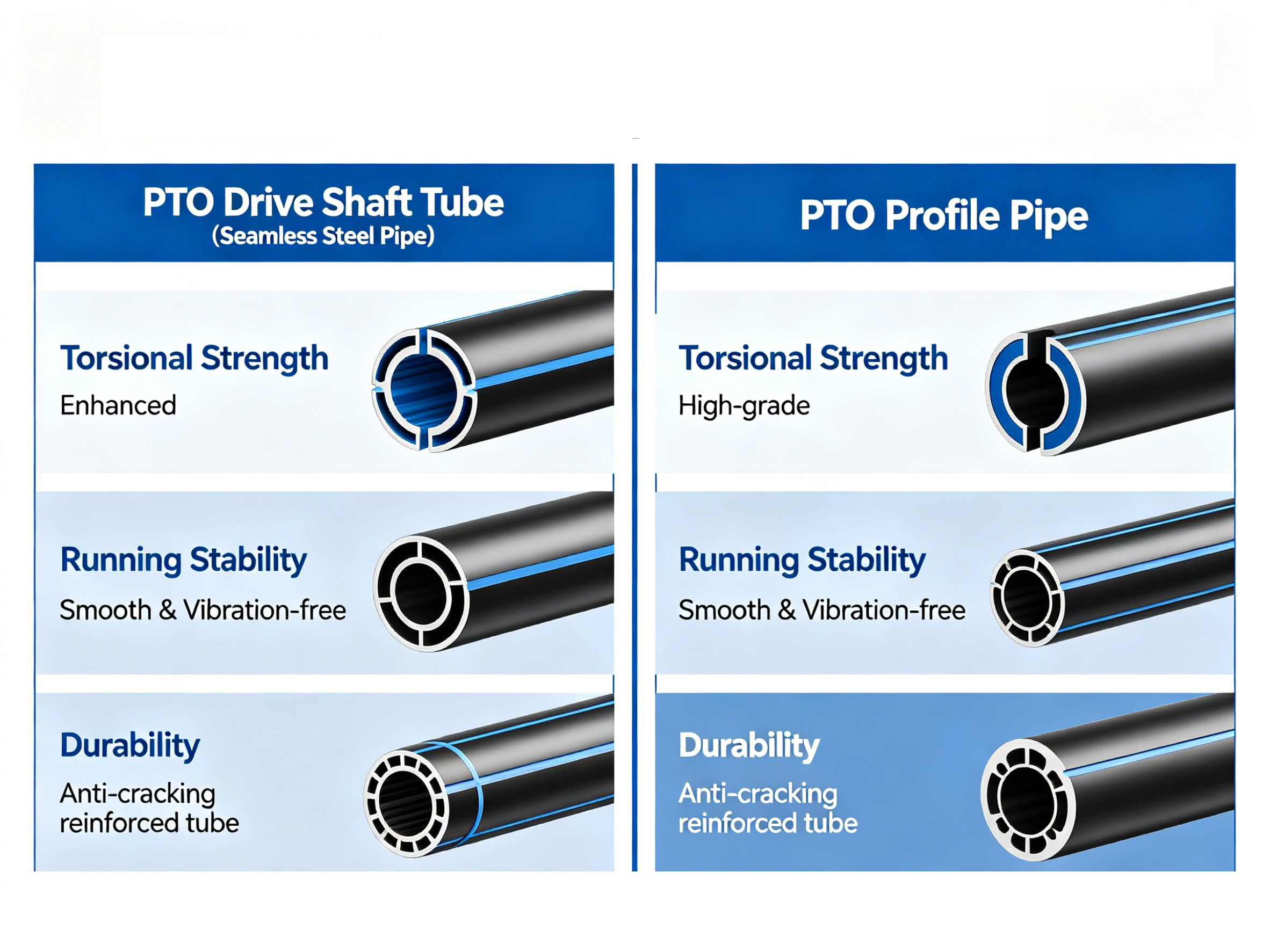
Profile comparison: the drive shaft tube and the PTO profile pipe it replaces in agricultural drive applications.
The boundaries of that comparison matter as much as the figures. Those results come from a defined application comparison — agricultural machinery drive shafts against a PTO profile tube — and should not be extrapolated to unrelated sections, materials or duty cycles without re-testing. A buyer evaluating a different profile should request the equivalent comparison for their own application rather than assume the same outcome.
There are also hard limits in the product range itself. Fakesi's published manufacturing range is an outside diameter of Φ10 mm to Φ280 mm and a wall thickness of 1 mm to 18 mm, with the material list set out earlier. Requirements outside those limits — very large diameter sections or heavier walls — sit outside the cold-drawn special-shape route and need a different supply solution, where hot rolled seamless pipe is the conventional starting point. Cold drawing also adds process steps, including drawing passes, annealing, straightening and fixed-length cutting, so the route rewards buyers who plan order cycles around a defined process rather than treating it as an instant-turnaround option.
Future outlook
Three trends are likely to shape how buyers verify suppliers over the next few years. First, the shift toward near-net profile supply: as shaped sections replace machined round stock, a supplier's die library becomes a more important commercial asset than its raw tonnage, and buyers will increasingly audit tooling rather than capacity. Second, tightening standard pressure: reference frameworks such as EN 10305-1 give buyers a shared vocabulary for tolerance and delivery condition, which raises the cost of vague capability claims. Third, traceability expectations: as application requirements harden, the ability to link a delivered tube back to a material grade and a process record moves from a nice-to-have to a tender requirement.
For procurement teams, the practical implication is straightforward. The suppliers that stay competitive in that environment are the ones that can already answer a capability question with a document, a die and a measurement — which is exactly what the verification framework above is designed to test.
Frequently asked questions
What documentation should a buyer request before accepting a cold drawing capability claim?
Three categories. Process documents: equipment list, the draw–anneal–draw sequence, and heat treatment records. Tooling evidence: section drawings and confirmation that dies exist for the specific profile being quoted. Measurement records: a plan naming instruments, sampling frequency and the feature each tolerance applies to, plus a first-article inspection report for the section in question. Photographs of finished tube do not substitute for these, because finished tube looks similar whether it was drawn in-house or purchased from another mill.
How can tolerance claims on special-shaped pipe be verified before mass production?
Convert the claim into a testable definition. A tolerance figure — for example ±0.1 mm — must be tied to a specific feature such as across-flats, across-corners, corner radius, wall at corner, wall at flat, straightness or twist per unit length, and to a stated measurement method. The sequence is: section drawing, first-article sample measured against that plan, then a declared sampling frequency for production. If a supplier cannot say which feature a tolerance applies to, the number is not yet usable for procurement.
Which materials and size ranges apply to cold-drawn special-shaped tube, and where do they stop?
Fakesi's published range covers carbon and low-alloy grades — 10#, 20#, 35#, 45#, 20Cr, 40Cr, 16Mn, 20Mn, Q355B and Q235B — at outside diameters from Φ10 mm to Φ280 mm and wall thickness from 1 mm to 18 mm, with non-circular sections including seamless triangle pipe, seamless hexagon pipe, seamless octagon pipe, seamless oval steel pipe and seamless lemon-shaped tube. Requirements outside those dimensions, or in grades not listed, fall outside the standard range and require separate qualification.
How does a cold-drawn special-shape tube compare with a PTO profile tube on cost and service life?
In Fakesi's comparative analysis for agricultural machinery drive shaft applications, the cold-drawn drive shaft tube is reported as 5% lower in cost and 200% to 400% longer in service life than the PTO Profile Tube alternative, with tighter tolerances, higher torsional strength, smoother running with reduced vibration, and lower maintenance. Because these results come from one defined application comparison, a buyer should request an equivalent comparison for their own profile, material and duty cycle before treating the figures as transferable.
When is a cold-drawn special-shape supplier the wrong choice?
When the requirement sits outside the process window or when the application does not benefit from a near-net profile. Sections beyond Φ280 mm outside diameter or over 18 mm wall, grades outside the published material list, and applications where a hot-rolled or as-rolled tube is machined to final geometry anyway are all cases where additional drawing steps add cost without removing a downstream operation. In those situations a conventional seamless pipe supply combined with in-house machining is usually the more economical route.
Reference material
Fakesi's full specification and capability documentation — product range, material grades, dimensional limits and process information — is available as a downloadable brochure: Fakesi product brochure (PDF). Company information is published at wxjiangbo.com.