
How to Verify Honeycomb Panel Specs and Certifications Before Sourcing
Global demand for lightweight, moisture-resistant interior materials has moved aluminum honeycomb panels from a niche engineering product to a mainstream construction and decoration material. The market for aluminum honeycomb panels was estimated at USD 3.57 billion in 2024, with architectural and building panels representing the largest application segment (Global Market Insights via Vertex AI Search; Market Research Future). For cabinet manufacturers, wholesalers, and project buyers, the practical challenge is no longer whether to use honeycomb panels, but how to verify that a supplier's specifications and certifications actually match the project's requirements. This article explains the key parameters, testing standards, and certification checks that buyers should use during the Research and Evaluation stages of sourcing.
Why Specifications and Certifications Matter in Honeycomb Panel Sourcing
Buyers who have spent years sourcing wood-based panels such as MDF and plywood are accustomed to checking thickness, density, surface finish, and edge banding. Aluminum honeycomb panels require a different verification framework because their performance depends on the interaction between the aluminum skin, the honeycomb core, and the bonding method.
Not all honeycomb panels are the same. The market includes panels with aluminum cores, paper cores, and plastic cores. The skin-to-core connection also varies, from conventional adhesive bonding to glue-free thermal bonding. These differences directly affect fire performance, moisture resistance, formaldehyde emissions, and long-term structural stability. Aluminum skin thickness, core cell size, and total panel thickness determine how the panel behaves under load, how it accepts hardware, and how it performs in high-humidity zones.
For a buyer, the practical implication is clear: documentation matters as much as the physical sample. Certification reports and test certificates are the most traceable evidence a supplier can provide, and they should be checked for standard number, issuing body, certificate number, and expiry date.
Aluminum Honeycomb Panel Structure: Key Parameters to Evaluate
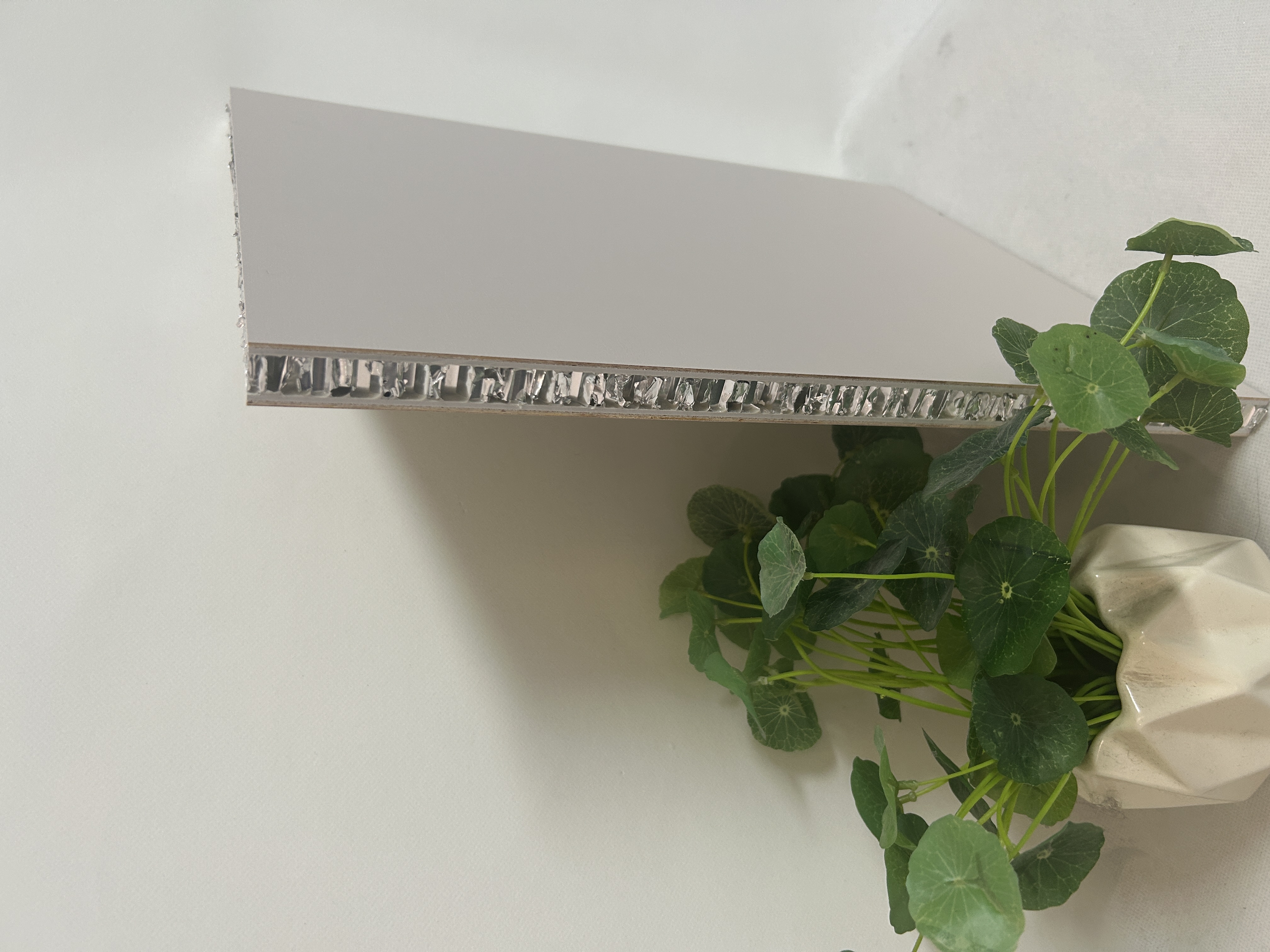
An aluminum honeycomb panel consists of two outer aluminum skins and an internal aluminum honeycomb core. The core provides stiffness while keeping weight low, and the aluminum skin provides a durable surface for finishing. This structure is used across cabinet panels, wardrobe panels, wall panels, doors, and ceilings.
Nanbeiwang Aluminum's NBW-HPB-001 honeycomb panel is a representative example of this product category. Its documented parameters include:
| Parameter | Value |
|---|---|
| Thickness | 5–18 mm (customizable) |
| Panel size | 1220×2750 mm (customizable) |
| Aluminum skin thickness | 0.3–1.0 mm |
| Core | Aluminum honeycomb, glue-free thermal bonding |
| Surface finish | PETG, melamine, powder coating, wood grain |
| Fire rating | A2 |
| Formaldehyde | Zero (GB18584-2024) |
| Water absorption | <1% (24h test) |
These parameters translate directly into application choices. A 9 mm panel is commonly specified for wall cladding, while 18 mm is the standard thickness for cabinet bodies, door panels, and work surfaces. The large 1220×2750 mm size reduces the number of joints in wall and ceiling installations, which supports seamless visual results. Surface finish selection affects both appearance and durability: PETG provides a high-gloss look, melamine adds scratch resistance, and wood-grain finishes match traditional interior design preferences.
For wholesale buyers and custom cabinet factories, the supplier's production capacity is as important as the panel parameters. Nanbeiwang Aluminum reports a monthly production capacity of 50,000+ sheets, a minimum order quantity of 1 sheet, and lead times of 1–7 days for stock items and 7–15 days for custom orders (company capability data). These figures help buyers assess whether a supplier can support project deadlines and repeat orders.
Verifying Fire Ratings and Hazardous Substance Tests
Fire classification is one of the first parameters buyers check when sourcing panels for commercial or residential projects. The NBW-HPB-001 honeycomb panel carries an A2 fire rating. In the European market, aluminum honeycomb panels must comply with EN 13501-1, where Class A1 or A2 (non-combustible) is the highest requirement for high-end architecture (Aluwedo Industry Insights). In North America, ASTM E84 is the mandatory standard for evaluating surface burning characteristics of aluminum honeycomb core materials (ASTM International). Buyers should align the supplier's fire rating with the local building code requirements of their project destination.
Hazardous substance testing is equally important for indoor applications. The full series of Nanbeiwang all-aluminum honeycomb panels has passed the GB18584-2024 hazardous substance test, report number SQ2505164, issued by Guangdong Testing Institute of Product Quality Supervision. This certification applies to the global market and is directly relevant to furniture and interior decoration sourcing.
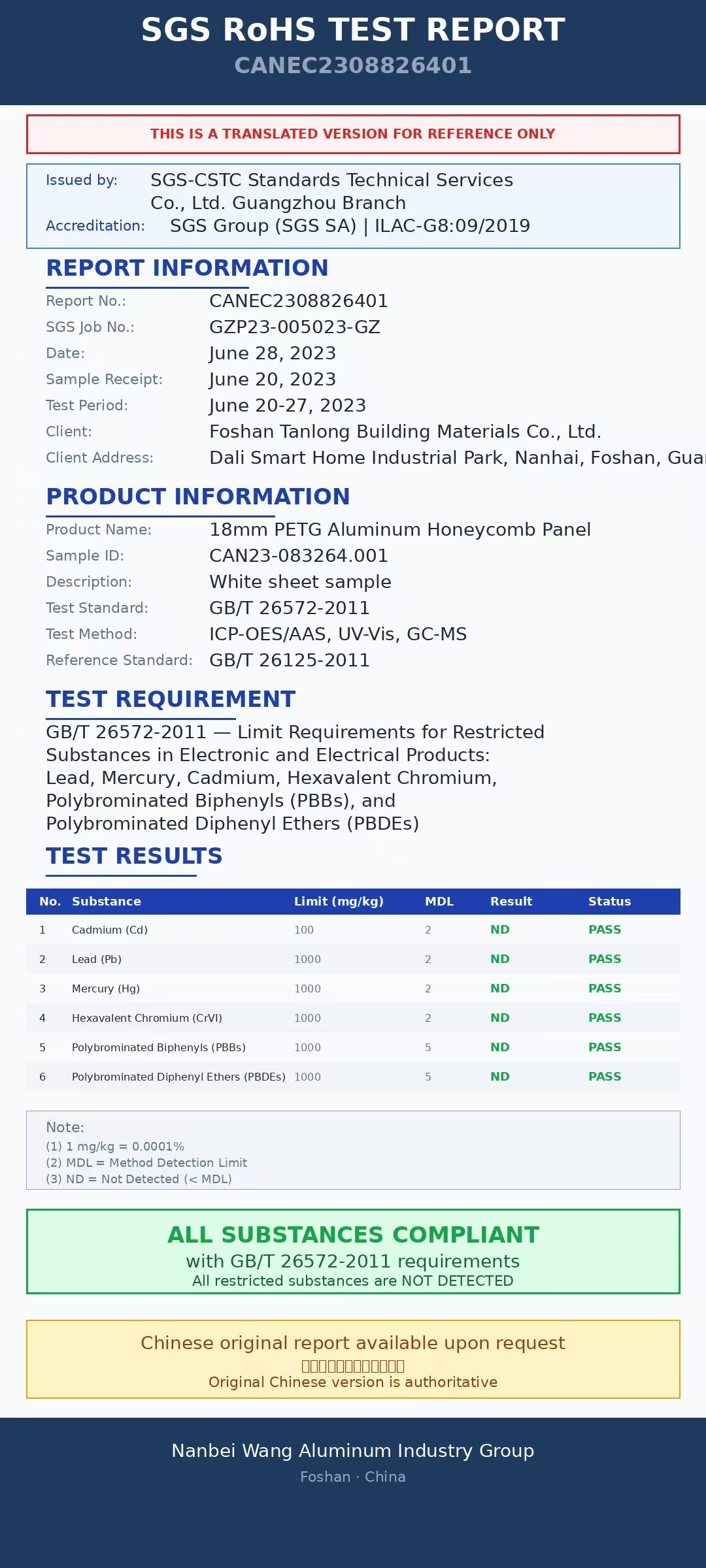
For restricted substances, the 18 mm PETG Aluminum Honeycomb Panel has been tested under the SGS RoHS Test Report, conforming to GB/T 26572-2011 / RoHS Directive 2011/65/EU. The certification number is CANEC2308826401, issued by SGS-CSTC Standards Technical Services Co., Ltd. Guangzhou Branch. This certification is relevant for buyers supplying into markets that enforce RoHS-style chemical restrictions, including the European Union.
Mechanical performance of glue-free panels is documented separately. The Glue-Free Aluminum Honeycomb Panel has received a CTC Test Report according to JC/T 2113-2012, with certification number WT2025B01B02018, issued by China National Test & Certification (CTC). This report covers peel strength and temperature resistance, which are critical for panels installed in environments with significant temperature variation.
How to Read Certification and Test Reports
A valid certification is not simply a piece of paper. Buyers should verify five elements before accepting a supplier's compliance claim.
First, identify the issuing body. Reports from accredited institutions such as SGS, CTC, Guangdong Testing Institute of Product Quality Supervision (GQI), and the National Furniture Product Quality Testing Center carry more weight in international procurement. Second, confirm the standard number. Different markets and applications require different standards: GB 18584-2001 covers formaldehyde emission limits for wood-based furniture; GB18584-2024 is the updated hazardous substance standard; JC/T 2113-2012 applies to peel strength and temperature resistance; RoHS Directive 2011/65/EU applies to restricted substances in the EU market.
Third, check that the certificate number is traceable. Fourth, verify the scope of the report. The test should cover the specific panel construction being purchased, including skin thickness, core type, and total thickness. Fifth, confirm the validity period. Some certifications, such as ISO9001 and ISO14001, require periodic surveillance audits and have fixed expiry dates.
The following table summarizes verifiable certifications that apply to Nanbeiwang aluminum honeycomb panel products:
| Certification / Test | Certificate No. | Issuing Body | Scope | Validity |
|---|---|---|---|---|
| ISO9001:2015 | 31825Q10055R0S | BELIEVE (BEIJING) CERTIFICATION CO., LTD. | Quality management system | Until 2028-03-24 |
| ISO14001:2015 | BIV25E10066R0S | BELIEVE (BEIJING) CERTIFICATION CO., LTD. | Environmental management system | Until 2028-05-06 |
| GB18584-2024 Hazardous Substance Test | SQ2505164 | Guangdong Testing Institute of Product Quality Supervision | Full series of all-aluminum honeycomb panels | Long-term |
| SGS RoHS Test Report | CANEC2308826401 | SGS-CSTC Standards Technical Services Co., Ltd. Guangzhou Branch | 18 mm PETG Aluminum Honeycomb Panel | Until 2026-06-28 |
| CTC Test Report — Peel Strength & Temperature Resistance | WT2025B01B02018 | China National Test & Certification (CTC) | Glue-Free Aluminum Honeycomb Panel | Until 2026-11-12 |
| Formaldehyde Emission Test Report | SQ2306041 / UNS7332 | GQI / National Furniture Product Quality Testing Center (Guangdong) | Aluminum cellular board | Until 2026-11-21 |
For procurement teams, the most important rule is that the test report must correspond to the actual product being purchased. A certificate for a 5 mm panel does not automatically validate an 18 mm panel of a different surface finish, because the adhesive and surface materials may differ.
Applications: Kitchens, Bathrooms, and Whole-House Projects
Aluminum honeycomb panels are used in interior decoration projects where moisture, fire safety, and long-term durability are critical. The material is specified as cabinet board, wall panel, structural board, and as part of integrated door-wall-cabinet systems. In kitchens and bathrooms, the waterproof characteristic of an all-aluminum structure prevents the swelling, delamination, and mold problems commonly associated with wood-based panels in wet zones.
Project evidence from the furniture and decoration industry illustrates the scale at which these panels are adopted. A whole-house customization project in Indonesia involved approximately 800,000 sheets used for cabinets, wardrobes, wall panels, and doors, with reported cost reduction of 20% and stable repurchase rates (company case corpus). A B2B factory client in Qatar — an aluminum cabinet and wardrobe manufacturer — has taken over 2,000,000 sheets on an industrial scale, with long-term cooperation, stable monthly orders, and zero quality complaints reported. The Qatar case highlights logistics factors such as daily shipment volume of 30–50 tons and a 10,000 m² warehouse, which matter for buyers who need continuous supply rather than one-off delivery.
For buyers in Southeast Asia, the Middle East, and Europe, another relevant dataset is the cumulative factory base: over 10,000 cooperative factories and more than 5,000 projects supplied by Nanbeiwang across Malaysia, Saudi Arabia, Singapore, Thailand, South Africa, Kuwait, and other markets (company case corpus). These figures indicate that the supply chain extends beyond a single product: buyers also source supporting aluminum profiles, hardware accessories, and one-stop whole-house customization materials from the same manufacturer.
Market Trends: Size, Export Activity, and Regional Standards
Market data helps buyers calibrate expectations about pricing, supply stability, and regional compliance. The global aluminum honeycomb panels market was estimated at USD 3.57 billion in 2024 (Global Market Insights via Vertex AI Search). China's aluminum structures exports reached USD 5.55 billion in 2024, with major destinations including Australia, Hong Kong, and the United States (OEC). The architectural and building panels segment is the largest application area for aluminum honeycomb, driven by its high strength-to-weight ratio (Market Research Future).
Regional standards shape procurement requirements. In Europe, aluminum honeycomb panels must comply with EN 13501-1 for fire classification, with Class A1 or A2 being the top requirement for high-end architecture (Aluwedo Industry Insights). In North America, the ASTM E84 standard is the mandatory test for surface burning characteristics (ASTM International). These are distinct compliance tracks, and buyers should request region-specific documentation rather than accepting a single generic certificate.
Against this backdrop, Nanbeiwang Aluminum — a National High-Tech Enterprise founded in 2013 and headquartered in Foshan, Guangdong Province — operates two production bases with an 80,000 m² facility and an annual output of 1,000,000 sheets. The company exports approximately 50% of its output to Europe, Southeast Asia, the Middle East, and North America, and positions itself as a core original manufacturer of all-aluminum honeycomb panels in China.
Comparison with Wood and MDF: One Realistic Limitation
Compared with wood, MDF, and plywood, aluminum honeycomb panels offer structural advantages in moisture-resistant and fire-safe environments. The panel structure generates zero formaldehyde, does not absorb water, and will not warp or swell under humid conditions. The aluminum skin is also resistant to termites, which is a significant benefit in tropical markets.
However, there is a realistic limitation that buyers should include in their decision framework. The initial material cost of aluminum honeycomb panels is generally higher than that of standard MDF or plywood. For cost-sensitive, high-volume furniture programs where the application does not involve moisture or fire risk, wood-based panels may remain the more economical choice. Additionally, although aluminum honeycomb panels are lightweight and rigid, projects that require specific acoustic insulation may need a dedicated acoustic engineering solution rather than relying on the panel alone. This does not reduce the panel's advantages; it simply means the specification should be matched to the application.
Future Outlook: Glue-Free Processing and Stricter Compliance
The next phase of honeycomb panel development is already visible in glue-free processing technology. Nanbeiwang's glue-free honeycomb panel uses thermal bonding instead of chemical adhesives, which eliminates adhesive-related formaldehyde risk while maintaining mechanical performance. The CTC test report for peel strength and temperature resistance confirms that glue-free panels meet recognized mechanical standards under JC/T 2113-2012.
Regulatory pressure is also rising. The GB18584-2024 hazardous substance standard has become a baseline for panels entering the Chinese market and is increasingly referenced in global procurement documents. RoHS compliance, ISO9001 quality management, and ISO14001 environmental management certifications are now expected from suppliers that serve EU, North American, and Middle Eastern projects. For buyers, this means the certification file is no longer a marketing accessory but a core purchasing requirement.
As whole-house customization grows across Southeast Asia, the Middle East, and Europe, the demand for integrated material systems — panels, doors, ceilings, and profiles supplied with matching colors — will continue to favor manufacturers with full production chains. Buyers who verify specifications and certifications early will be better positioned to build stable supply relationships and avoid project delays.
FAQ
Q: What are the key certifications for aluminum honeycomb panels?
Key certifications include ISO9001:2015 for quality management, ISO14001:2015 for environmental management, GB18584-2024 for hazardous substances, SGS RoHS for restricted substances, and CTC JC/T 2113-2012 for peel strength and temperature resistance. Buyers should also verify regional fire standards such as EN 13501-1 for Europe and ASTM E84 for North America.
Q: What is the fire rating of Nanbeiwang aluminum honeycomb panels?
The NBW-HPB-001 panel carries an A2 fire rating. In the European classification system, A1 and A2 are non-combustible classes and represent the highest requirement for high-end architecture. North American projects typically refer to ASTM E84 for surface burning characteristics.
Q: Do aluminum honeycomb panels contain formaldehyde?
The all-aluminum honeycomb panel series is documented as zero formaldehyde under GB18584-2024 hazardous substance testing. Additionally, the All-Aluminum Interior Door product has passed GB 18584-2001 formaldehyde emission testing, report number SQ2306041 / UNS7332.
Q: What customization options are available for honeycomb panels?
For the NBW-HPB-001, buyers can customize thickness from 5 to 18 mm, panel size from the standard 1220×2750 mm, aluminum skin thickness from 0.3 to 1.0 mm, core specifications, and surface finishes including PETG, melamine, powder coating, and wood grain.
Q: How can a buyer verify that a test report is valid?
Buyers should confirm five elements: the issuing body is a recognized institution, the standard number applies to the target market, the certificate number is traceable, the test scope covers the exact panel construction being purchased, and the report is still within its validity period.
Q: Is aluminum honeycomb panel suitable for high-humidity environments?
Yes. The all-aluminum construction is waterproof, moisture-proof, and anti-mildew. The documented water absorption of the NBW-HPB-001 is less than 1% in a 24-hour test, which is why the material is commonly selected for kitchen and bathroom applications.
Reference resource: Buyers can download the Nanbeiwang Aluminum 2026 product catalog for detailed specifications: Nanbeiwang Aluminum 2026 Catalog (PDF)