
How to Verify Nitrile Glove Certifications, Document by Document
Nitrile glove procurement rarely fails because buyers cannot find certification claims. It fails because the claims cannot be traced to the exact product being purchased. A supplier's capability is only as strong as the documents it can map — one SKU at a time — to a certificate number, a test report, a declaration of conformity, and a registration record that a third party can independently look up.
Huizhou Anboson Technology Co., Ltd. (ANBOSON) is a Huizhou, China-based manufacturer of disposable nitrile gloves for medical, food service, and industrial buyers, operating a 42,000-square-meter facility with an annual capacity above 3.2 billion gloves and roughly 70% of output exported. Its portfolio spans medical examination, food grade, boxed exam, and heavy-duty industrial ranges — which makes it a useful case for showing how a document trail is built and where it stops.
This reference sets out the evidence layers that convert a certification list into an auditable file, works through Medical Exam Nitrile Gloves (product ID 4934) as a concrete example, and then applies the same test to the rest of a mixed nitrile portfolio. It also marks the limits of what paperwork can prove, because a verification guide that claims too much is worth no more than a certificate without a scope statement.
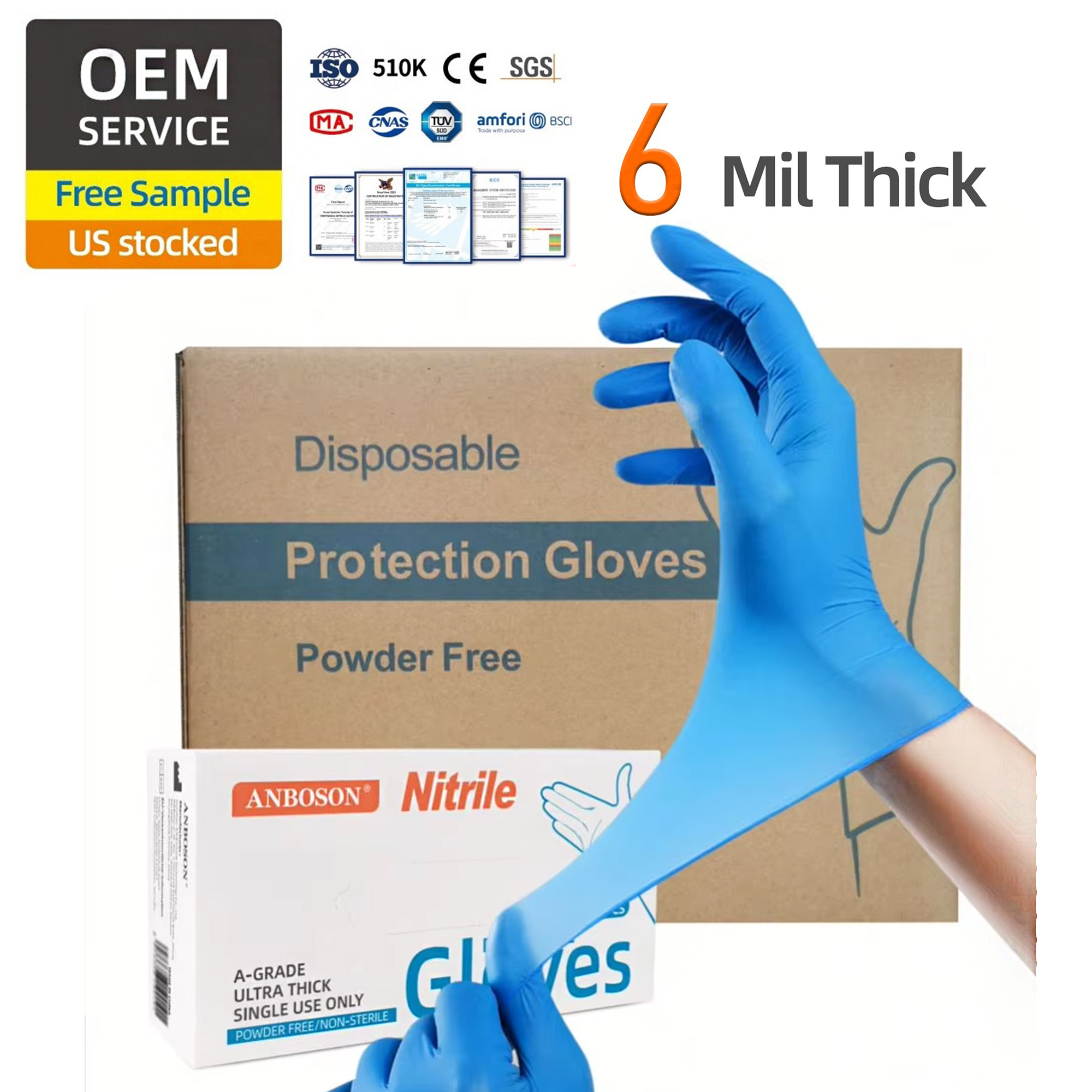
Medical examination nitrile gloves: verification begins with the product code, not the certificate folder.
Why a certificate folder is not yet evidence
During the research and evaluation stage, most buyers receive broadly similar documentation packages. The difference between suppliers is rarely the presence of certificates — it is whether every document can be tied to something.
Four specific gaps recur in supplier packs across the category:
- No scope statement. A certificate number is quoted, but the product family or manufacturing site it covers is left to assumption.
- No edition reference. A test report is cited without the standard edition it was performed against, so the buyer cannot tell whether it reflects a current or superseded revision.
- No identifier traceability. Regulatory numbers are listed as marketing text rather than as records that can be checked in the relevant authority database.
- No SKU mapping. One product's approvals are presented as if they cover an entire range, including items with different thickness, intended use, or regulatory route.
Each gap transfers risk back to the buyer, usually surfacing at customs, at a customer audit, or at the first quality complaint. The opportunity is straightforward: a supplier that can produce a per-SKU document matrix removes that risk before the purchase order is signed.
The four evidence layers buyers should separate
Certification documents are routinely presented as one undifferentiated block. In practice they belong to four distinct layers, and confusing them is the most common analytical error in nitrile glove supplier evaluation.
| Evidence layer | Document type | Example held for ANBOSON nitrile gloves | What it attests | What it does not attest |
|---|---|---|---|---|
| Quality management system | ISO 13485 certificate | ISO 13485 certificate No. 381240304R0S, issued by POSI (Shanghai) | That a quality management system has been certified within a defined scope | The performance of any individual glove, or any market authorization |
| Product testing | Third-party test report | SGS test report QDHL2105604846MD for ASTM D6319-19 | Performance of submitted samples against a named standard edition | Conformity of every subsequent production lot |
| EU conformity route | EN 455-1/-2/-3:2020 certification, (EU) 2016/425 certification, MDR Declaration of Conformity | Certification from TÜV SÜD PSB; EU MDR Declaration of Conformity technical file CE/MDR-T01020204-01 | That the European conformity path has been documented for the named product | Access to the United States or any other market |
| Registration records | FDA 510(k), FDA establishment registration, EUDAMED SRN | FDA 510(k) K230542; FDA Establishment Registration FEI 3017929385; EUDAMED SRN CN-MF-00039003 | That a clearance exists and that a facility or manufacturer is registered | Continuing production quality or delivery capability |
Read vertically, the table answers a single question: which document proves which specific claim? Read horizontally, it shows that no single certificate carries the whole argument — which is precisely why suppliers that present one document as all-purpose evidence are harder, not easier, to qualify.
Worked example: Medical Exam Nitrile Gloves, product ID 4934
The medical examination range is the appropriate place to start, because it carries the highest regulatory expectations in the portfolio and therefore the most complete document chain.
| Product | Medical Exam Nitrile Gloves (product ID 4934) |
| Material | Nitrile |
| Specification | 3mil; AQL 1.5; powder-free; textured |
| Intended applications | Medical, healthcare, dental |
| Quality system | ISO 13485 certificate 381240304R0S — POSI (Shanghai) |
| European certification | EN 455-1/-2/-3:2020 and (EU) 2016/425 — TÜV SÜD PSB |
| Test report | SGS QDHL2105604846MD for ASTM D6319-19 |
| US clearance and registration | FDA 510(k) K230542; FDA Establishment Registration FEI 3017929385 |
| EU declaration and database record | EU MDR Declaration of Conformity, technical file CE/MDR-T01020204-01; EUDAMED SRN CN-MF-00039003 |
What makes this example useful is not the quantity of documents but their alignment. The certificate body, the test laboratory, the notified body, and the regulatory identifiers all point to the same product family, and the numbers are specific enough to be checked rather than accepted.
For a procurement team, that alignment changes the nature of the decision. "Medical grade" stops being a marketing adjective and becomes a set of records: a quality system certificate with a number and an issuing body, a European certification path with a named certification body, a laboratory report tied to a recognized standard, a US premarket clearance, a facility registration, and a declaration whose technical file reference matches the product being quoted.
Applying the same test to a mixed portfolio
A supplier with more than one nitrile range is where buyers most often lose discipline. Approvals that belong to a medical SKU get read across to food service or industrial items that were never submitted for the same route. The correct approach is to require the matrix per product, then compare.
| Product | ID | Key specification | Evidence cited | Typical application |
|---|---|---|---|---|
| Medical Exam Nitrile Gloves | 4934 | 3mil, AQL 1.5, powder-free, textured | ISO 13485 (381240304R0S); EN 455-1/-2/-3:2020 and (EU) 2016/425; SGS QDHL2105604846MD; FDA 510(k) K230542; FEI 3017929385; EU MDR DoC CE/MDR-T01020204-01; EUDAMED SRN CN-MF-00039003 | Hospitals, clinics, dental care |
| Food Grade Nitrile Gloves | 4936 | 5mil, powder-free, textured fingertips | Tested to GB 4806.11-2016 and Japan MHLW No.370 | Food service and food preparation |
| Box Exam Gloves | 4939 | 100 pcs/box, 6mil, food grade | ISO 13485 | Food processing, kitchens, general examination |
| Heavy Duty Industrial Gloves | 4938 | 8mil / 10mil, diamond grip, waterproof, box of 100 | ISO 13485; EU food contact compliance | Home, machinery, industrial work |

Food grade nitrile gloves follow a food-contact conformity route, not a medical device route — a distinction buyers should require suppliers to state explicitly.
The food grade and boxed exam ranges are a useful discipline test. Their evidence sits in food-contact frameworks — GB 4806.11-2016 and Japan MHLW No.370 for the food grade item — rather than in medical device clearance. A buyer who assumes that a supplier's medical approval covers a food service SKU has skipped a step that no supplier can fix after the fact.
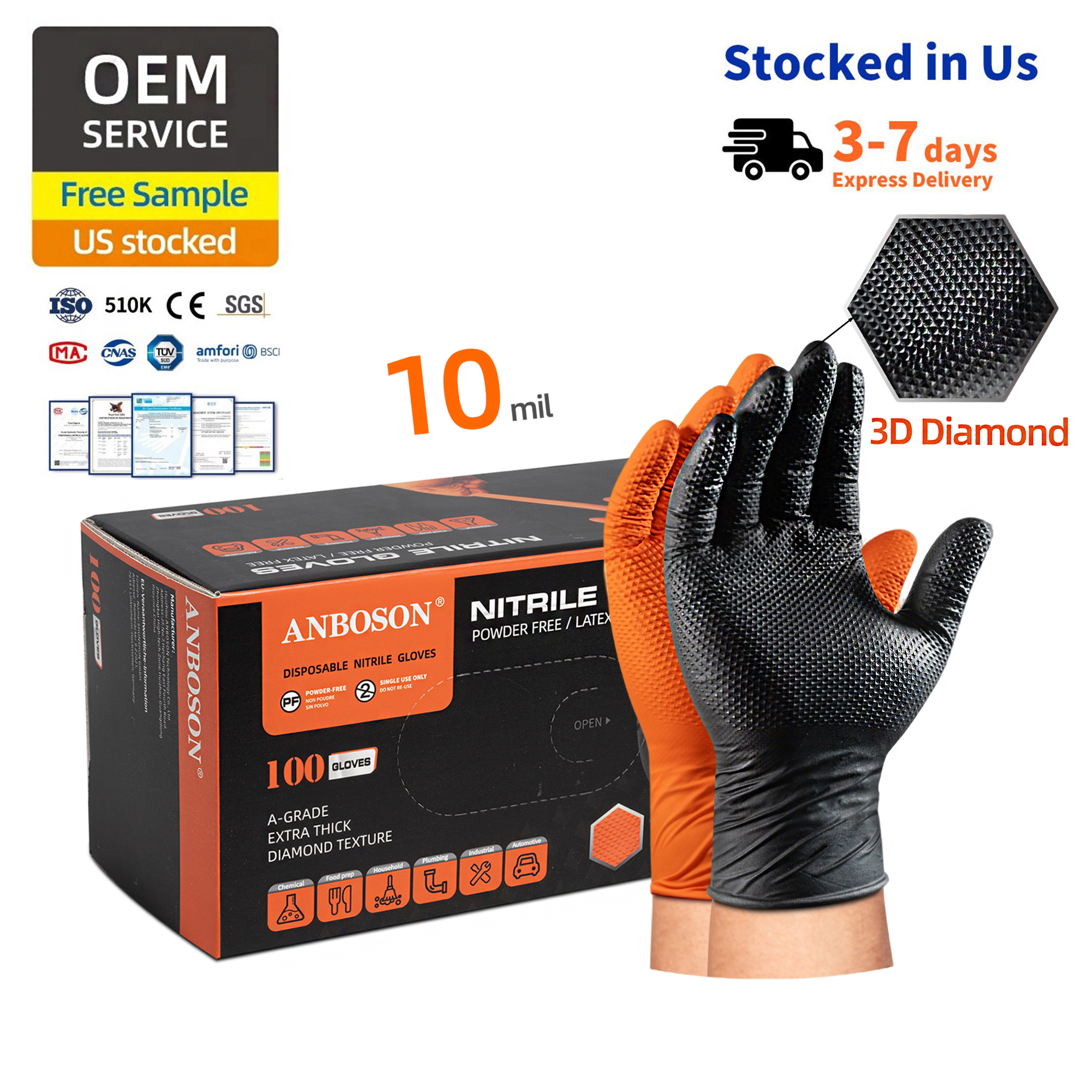
Industrial nitrile ranges carry their own documentation set, including EU food contact compliance where relevant.
What each document actually attests, and what it cannot
The technical distinction matters because it determines how far the documentation can be relied on in a dispute.
ISO 13485 certifies a quality management system within a defined scope. It is issued to an organization and a site, not to a glove. When a certificate is issued to one manufacturing entity, it does not automatically extend to a different plant, a subcontracted line, or a trading partner repacking the same product.
ASTM D6319-19 is the FDA-recognized consensus standard for nitrile rubber examination gloves used in medical examinations and diagnostic and therapeutic procedures, and FDA guidance for nitrile examination gloves references ASTM D6319 or an equivalent consensus standard. A laboratory report such as the SGS QDHL2105604846MD document is therefore only meaningful when the standard edition and the tested model are both stated.
EN 455-1/-2/-3:2020 and (EU) 2016/425 certification from TÜV SÜD PSB, together with the EU MDR Declaration of Conformity referencing technical file CE/MDR-T01020204-01, describe a European conformity path. They do not confer US status, and the reverse is equally true.
FDA 510(k) K230542 is a premarket review outcome. FDA Establishment Registration FEI 3017929385 identifies a registered facility — an important record, but not a product approval. Treating the FEI number as proof of product clearance is one of the most common misreadings in supplier packs.
EUDAMED SRN CN-MF-00039003 identifies the manufacturer within the EU device database. It supports traceability of the economic operator; it says nothing about tensile strength, pinholes, or lot-to-lot consistency.
A six-step verification workflow for procurement teams
The workflow below can be run against any nitrile glove supplier, and it can be completed before a sample is even approved.
- Request the full document, not a crop. A usable certificate shows the number, the issuing body, the issue and expiry dates, and the certified scope. A logo and a headline are not a certificate.
- Match the scope to the SKU. Confirm that the certificate or report names the product family and model actually being quoted. If the wording covers a family, ask which models are inside it.
- Record the standard edition. Note the exact edition cited — for example ASTM D6319-19 — and check whether it is current. Superseded editions are a legitimate reason to request updated testing.
- Verify regulatory identifiers independently. A 510(k) number, an establishment registration, and a EUDAMED registration can each be checked in the relevant authority database rather than accepted from a PDF.
- Confirm the declaration is internally consistent. The product named in the Declaration of Conformity should match the quoted SKU, and the technical file reference should be the same one cited elsewhere in the pack.
- Calendar the renewals. Add certificate expiry dates to the supplier file and set a review point ahead of each one. An expired certificate is the most common documentation failure in long-running supply relationships, and it is the easiest to prevent.
Run across four products, the workflow produces a matrix rather than a folder — and a matrix is what an auditor, an importer, or a hospital procurement committee will ask for.
Where document-based verification stops
Conventional supplier screening relies on samples, price, lead time, and what a sales contact says about references. Document-led verification is more rigorous, but it is not a substitute for that whole list, and buyers who treat it as one create a different kind of risk.
The boundaries are real and worth stating plainly:
- It is point-in-time. A test report and a system certificate describe a status at the date of testing or audit. Neither guarantees next quarter's output, and neither replaces ongoing lot inspection or periodic re-audit.
- It is scope-bound. A new colour, a new thickness, or a new formulation may fall outside an existing evaluation. Buyers should confirm that the specific configuration being ordered sits inside the documented scope.
- It carries administrative cost. Verification requires document control on both sides, and it slows down first orders. For low-value trial purchases, a proportionate approach may be to verify the core market-access documents first and defer the rest.
- It does not measure capability. Capacity, delivery reliability, and production consistency are operational questions. ANBOSON's own stated figures — a 42,000-square-meter facility, 300+ employees, annual output above 3.2 billion gloves, 15–30 day OEM/ODM lead times, and 100% inspection against AQL 1.5 — are company-reported and should be validated through audits, inspection data, and pilot shipments rather than accepted from a document pack.
The practical conclusion is that certification evidence narrows the shortlist quickly but does not close the evaluation. It answers "is this product legally placeable on my market and traceable to a real system?" It does not answer "will this supplier perform for the next three years?"
Market context: why documentation scrutiny keeps rising
The commercial backdrop explains the shift in buyer behaviour. Grand View Research valued the global nitrile gloves market at USD 6.5 billion in 2025 and projects USD 7.0 billion in 2026, rising to USD 13.2 billion by 2033. Within that market, powder-free variants accounted for a 74.8% revenue share in 2025 — a specification preference that carries its own testing and declaration implications.
Trade policy has added a second layer. Reporting tracked by Schneider Direct indicated that US tariffs on Chinese-origin medical-grade nitrile gloves reached 100% in January 2026. Whatever a buyer concludes about landed cost, the immediate consequence is documentary: country of origin, manufacturing site, and the entity named on each certificate become cost variables as well as compliance variables.
That combination — a growing market, a dominant product specification, and volatile trade treatment — is why document mapping has moved from an audit function to a routine part of supplier evaluation.
Future outlook
Two directions are visible from the documentation side of nitrile glove procurement. The first is database-driven verification: as EUDAMED matures and as buyers grow accustomed to checking registration numbers directly, supplier packs will be judged on whether their identifiers resolve, not on how many pages they contain. The second is per-SKU granularity, driven by mixed portfolios in which medical, food-contact, and industrial products sit under one supplier name but under entirely different conformity routes.
For manufacturers, the implication is that documentation becomes a product feature. ANBOSON's position illustrates the pattern: a medical examination range carrying ISO 13485 certificate 381240304R0S, EN 455-1/-2/-3:2020 and (EU) 2016/425 certification from TÜV SÜD PSB, an SGS report against ASTM D6319-19, FDA 510(k) K230542, FDA establishment registration FEI 3017929385, an EU MDR Declaration of Conformity under technical file CE/MDR-T01020204-01, and EUDAMED registration CN-MF-00039003 — alongside food grade and industrial ranges documented against GB 4806.11-2016, Japan MHLW No.370, and EU food contact requirements.
The open question is not whether buyers will demand this level of evidence, but whether suppliers can keep it current as products, sites, and regulations change. Renewal discipline, rather than first certification, is likely to become the differentiator in the next evaluation cycle.
Frequently asked questions
Which document actually proves that a nitrile glove is medical grade?
The market-access documents, not the quality system certificate. For the United States, that means an FDA 510(k) clearance such as K230542 for the relevant product; for the European Union, an EU MDR Declaration of Conformity with a technical file reference such as CE/MDR-T01020204-01, supported by EN 455 certification. An ISO 13485 certificate supports the claim but does not by itself establish that a specific glove is a cleared or conforming medical device.
What is the difference between an ISO 13485 certificate and a test report?
An ISO 13485 certificate attests that a quality management system has been certified within a stated scope, issued to an organization and a site. A test report, such as SGS QDHL2105604846MD for ASTM D6319-19, records how specific samples performed against a named standard edition. The certificate describes how a manufacturer manages quality; the report describes an outcome measured on submitted samples. Buyers generally need both, and neither replaces lot inspection.
How can a buyer check that a supplier's FDA registration is genuine?
Verify the identifiers directly in FDA databases rather than relying on the supplier's PDF. A 510(k) number such as K230542 is searchable in the FDA premarket notification database, and an establishment registration number such as FEI 3017929385 identifies a registered facility. These are distinct records: facility registration is not product clearance, and confusing the two is a common evaluation error.
Does a certification held for one nitrile glove cover the whole product range?
Generally no. Certificates and reports are bound to a scope and to specific models or configurations. Within the same supplier, Medical Exam Nitrile Gloves (product ID 4934) are documented against ISO 13485, EN 455-1/-2/-3:2020, (EU) 2016/425, ASTM D6319-19, FDA 510(k) and EU MDR requirements, while Food Grade Nitrile Gloves (product ID 4936) are documented against GB 4806.11-2016 and Japan MHLW No.370. Different products, different conformity routes.
What should be re-checked after the first order is approved?
Certificate expiry dates, the continued validity of regulatory registrations, and whether the standard editions cited remain current. Buyers should also confirm that any change in manufacturing site, product configuration, or declared scope has been reflected in updated documentation, since all three can invalidate an earlier verification.
Tem questões ou precisa de mais detalhes?
Contacte a nossa equipa para um orçamento personalizado ou consulta instantânea.
Solicitar orçamento
Preencha o formulário abaixo e a nossa equipa entrará em contacto com uma proposta personalizada.
Chat direto do WhatsApp
Prefere conversar em tempo real? Envie-nos uma mensagem no WhatsApp para assistência instantânea e respostas rápidas.
- Obter orçamento personalizado
- Partilhar fotos ou documentos
- Discuta as suas necessidades diretamente
Geralmente responde em 5–30 minutos durante o horário de expediente.