
How to Verify Submersible Pump Specs and Certifications
Submersible pumps are used in applications where the pump and motor must operate below the water surface, including deep wells, boreholes, sewage tanks, and solar-powered irrigation systems. Because the equipment is permanently submerged, buyers need to evaluate not only hydraulic performance but also enclosure protection, motor efficiency, and market-specific certifications. This article provides a verification-oriented reference for buyers moving from research to supplier evaluation.
Problem: Technical Documentation Is Often Uneven
One of the most common problems in submersible pump procurement is the uneven quality of technical documentation. Two pumps with the same nominal power may use different impeller materials, motor efficiencies, sealing systems, or certification scopes. A datasheet may list 'CE' without explaining which models and directives are covered. Another problem is that market requirements vary: the EU has its own low-voltage and electromagnetic compatibility framework, while North America relies on UL standards. These gaps create risk of failed inspections, rejected shipments, or performance mismatches.
The opportunity for buyers is to replace brand-level assumptions with a verification checklist based on specifications and certificate details. Price can be used as a screening criterion, but a reliable comparison should start with a fixed specification envelope. The same pump type can have very different cost implications depending on motor efficiency, wetted materials, protection rating, and certification scope.
A Structured Reference Case: Zhejiang Happy Pump Industry Co., Ltd.
One supplier that illustrates this structured approach is Zhejiang Happy Pump Industry Co., Ltd., a manufacturer based in Daxi Town, Wenling City, Zhejiang Province, China. Established in 1990, the company reports an annual output of approximately 4 million pumps and employs around 800 people, including about 200 professional and technical staff. Its main product series include surface pumps, submersible pumps, deep well pumps, solar pumps, motors, pressure control tanks, and spare parts. The company states that 99% of its products are exported to more than 150 countries and regions.
From a buyer's perspective, the useful part is that the product data can be verified. The pump product family covers a power range of 0.25–550 kW, head range of 20–100 m, and flow range of 1.5–5500 m³/h. Protection levels are stated as IP44 to IP68. Main materials include cast iron, stainless steel, and engineering plastics. The company also states a monthly capacity of 400,000 units, with 100% testing before delivery. OEM/ODM services are available with voltage and logo customization; lead time is reported as 30–45 days, with MOQ of 100 pieces for pumps below 3 HP and 50 pieces above 3 HP.
For buyers evaluating long-term supply, the company reports an enterprise research institute and high-tech R&D center using CFD, FEA, and motor electromagnetic design tools. It also lists remote support as part of its after-sales service. These facts are not claims about the entire industry; they are reference points that a buyer can ask any supplier to confirm.
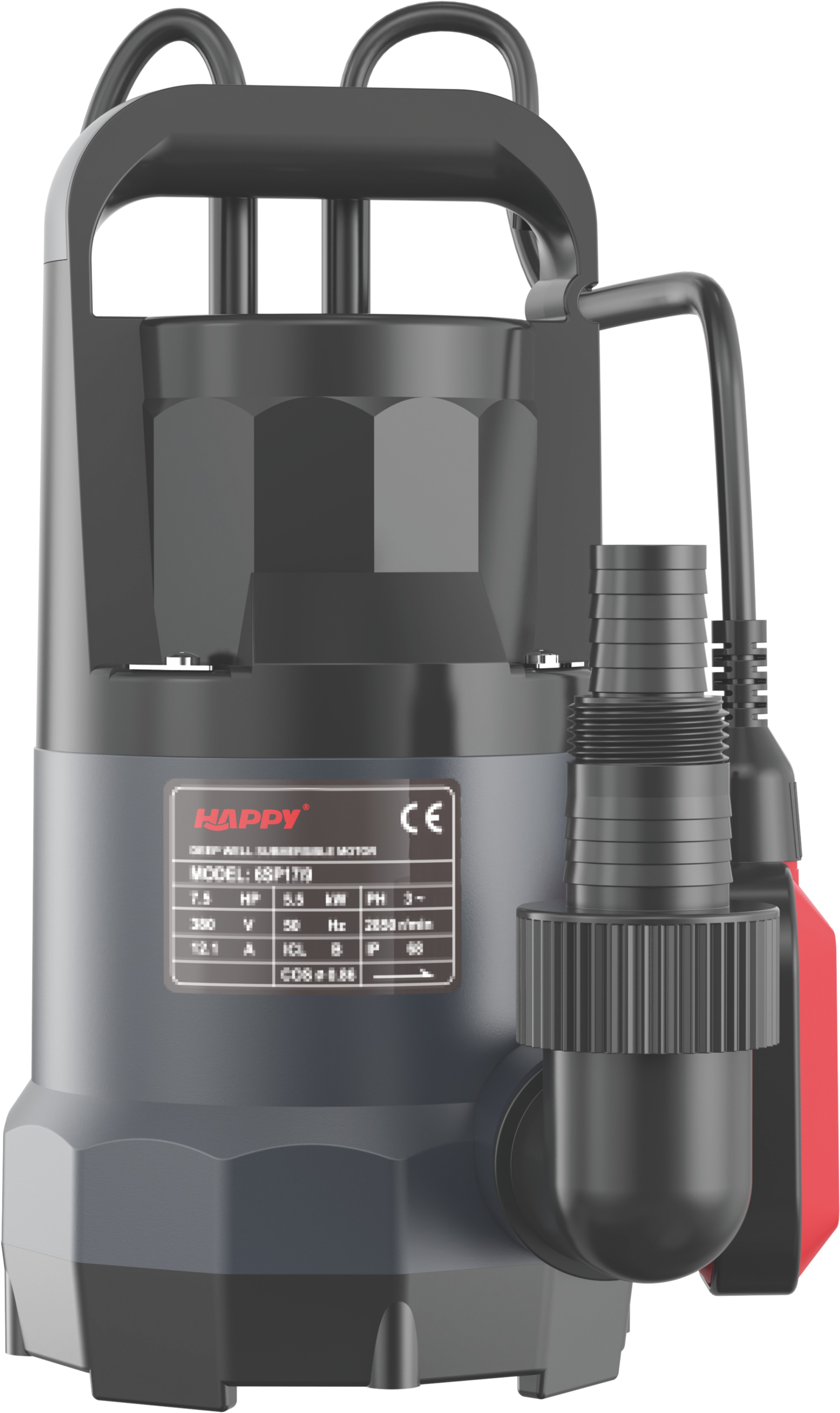
Example of a QDP series submersible pump, which falls within the certified pump families described in this article.
Technical Explanation: Key Parameters to Verify
Before comparing quotations, buyers should map their own constraints to measurable technical parameters. Key parameters include power, head, flow, duty cycle, motor efficiency, enclosure protection, material compatibility, and operating frequency or voltage. Voltage and frequency, for example 50 Hz versus 60 Hz, are application constraints that should be confirmed with the motor winding and controller settings. In some cases, special input or output voltage and frequency require customization confirmation.
| Parameter | Verification question | Example from reference supplier |
|---|---|---|
| Rated power | What is the power at the operating point? | 0.25–550 kW pump range |
| Head range | Can the pump deliver the required head at the required flow? | 20–100 m |
| Flow range | What flow is available at the design head? | 1.5–5500 m³/h |
| Enclosure protection | What IP rating is required for continuous immersion? | IP44 to IP68 |
| Motor efficiency | Is the motor IE3 or higher? | IE2, IE3, IE4, and MS types; product classified as IE3 |
| Certifications | Which certificate scope, standard edition, and model list apply? | CE, LVD, and EMC certificates with specific model scopes |
Motor Efficiency
Motor efficiency deserves special attention. The product is classified as an IE3 efficiency motor. Available motor types include IE2, IE3, IE4, and MS. The motor power range is 1–430 HP, with speeds of 934–2980 rpm. Buyers should check the efficiency class relevant to their market, since IE3 is a common benchmark for reducing electricity consumption over the pump's service life.
Enclosure Protection
The product offers a protection level ranging from IP44 to IP68. IP68 indicates protection against continuous immersion, while lower IP ratings may only be splash-proof. For submersible pumps, the IP rating should be matched to the actual installation depth and fluid type.
Certification Scope
Certification details are often more important than a general 'CE available' statement. The CE certification for water pumps applies to models including HQBm, QB60, IDB35, HPSm-AX, HRSm-A, QDP series, and QDX series. It confirms compliance with the Low Voltage Directive (2014/35/EU), the Electromagnetic Compatibility Directive (2014/30/EU), and the Machinery Directive (2006/42/EC). The certificate is issued by ECES under certificate number CE-5072-160326.
The LVD certification covers the QB60 and HQBm pump models under the Pumps product category. It is issued by OViS-CERT under certificate number OViS202507249L, applying EN 60335-1:2012+A11:2014+A13:2017+A1:2019+A14:2019+A2:2019+A15:2021+A16:2023 and EN IEC 60335-2-41:2021+A11:2021.
The EMC certification applies to water pumps, including submersible, deep well, and solar pump models. It verifies compliance with EN IEC 55014-1:2021, EN IEC 55014-2:2021, EN IEC 61000-3-2:2019+A1:2021+A2:2024, and EN 61000-3-3:2013+A1:2019+A2:2021. It is issued by OVIS-CERT under certificate number OViS202507249E.
| Certificate | Certificate No. | Scope | Key standards or directives |
|---|---|---|---|
| CE | CE-5072-160326 | HQBm, QB60, IDB35, HPSm-AX, HRSm-A, QDP series, QDX series | 2014/35/EU, 2014/30/EU, 2006/42/EC |
| LVD | OViS202507249L | QB60, HQBm | EN 60335-1 series, EN IEC 60335-2-41:2021+A11:2021 |
| EMC | OViS202507249E | Water pumps including submersible, deep well, solar | EN IEC 55014-1:2021, EN IEC 55014-2:2021, EN IEC 61000-3-2 series, EN 61000-3-3 series |
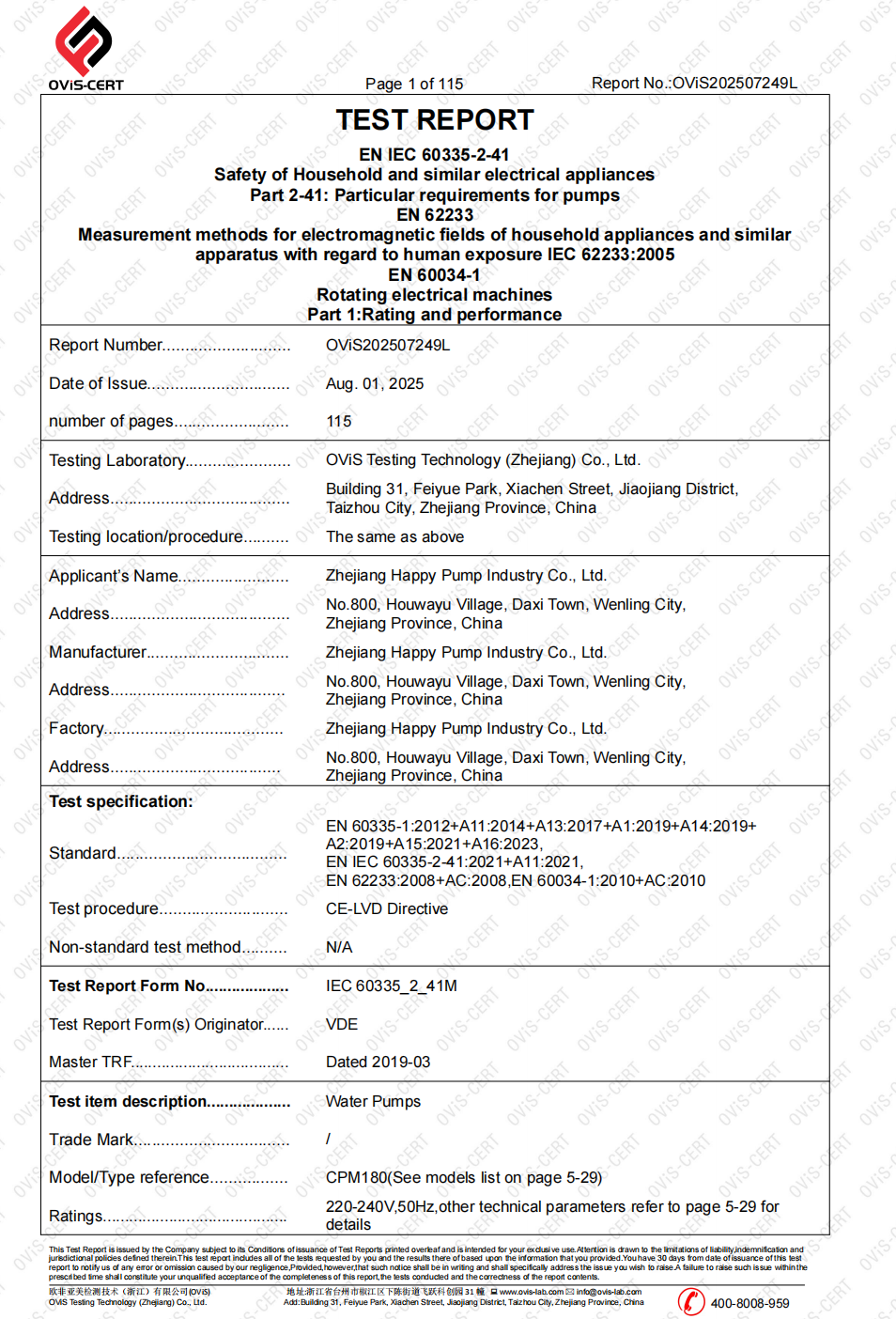
LVD certificate example from OViS-CERT for the QB60 and HQBm pump models.
Beyond these EU-specific certificates, buyers should know the relevant international benchmark. IEC 60335-2-41:2024 establishes safety requirements for electric submersible pumps for household and agricultural use. For the North American market, UL 778 is the primary safety standard for motor-operated water pumps. A CE mark therefore does not automatically satisfy US or Canadian requirements.
Application and Use Cases
Submersible pumps serve multiple sectors: agriculture irrigation, residential and building water supply and drainage, municipal water and drainage, industrial circulation and cooling, solar water pumping, swimming pool circulation, and sewage treatment. Working conditions can include clean water, sewage or particle-containing water, high-head pumping, and continuous or intermittent submersible duty.
Typical project types include household water supply, garden irrigation, agricultural irrigation, solar off-grid water supply, municipal and engineering projects, and pool circulation or sewage discharge systems. In many configurations, the pump works with pressure tanks, controllers, junction boxes, and filters. For sewage and particle-containing water, pump models must be selected with appropriate solids-handling capacity. Some sewage pumps use cutting mechanisms, so buyers should verify the fluid characteristics against the pump hydraulic design.
Supplier case records from Happy Pump describe typical use cases including domestic or household water supply, garden irrigation, agricultural irrigation, sewage and engineering drainage, pool circulation, and solar water pumping systems. The same records list stable operation as a reported outcome and highlight low noise and high quality as observed characteristics. Buyers can use these as discussion points when asking for reference installations.
Material selection is a critical part of application matching. Products in this category are available in cast iron, stainless steel, and engineering plastics, so buyers should match the wetted materials to water chemistry and abrasion risk.
Market Trend Analysis
Current market data can help buyers calibrate their sourcing expectations. According to Grand View Research, the global submersible pumps market was valued at USD 13.3 billion in 2025 and is projected to reach USD 19.4 billion by 2033. Other agencies provide different baselines; for example, SNS Insider valued the market at USD 14.75 billion in 2024. Market size figures should therefore be treated as directional evidence rather than precise forecasts.
Regionally, Fortune Business Insights reports that Asia Pacific dominated the submersible pump market with a 39.72% share in 2025, reaching USD 7.05 billion. By product segment, Grand View Research estimates that the borewell segment held the largest share at 46.7% in 2025. Electric drive also dominates: Fortune Business Insights attributes 74.37% of the market to electrical submersible pumps by drive type in 2026, while another Grand View Research finding places electric drives at nearly 80% of global installations in 2024.
Agricultural demand is visible in revenue terms. Grand View Research estimates the agricultural pump market revenue from electric submersible pumps at USD 2,515.6 million in 2025. Solar pumping is an area with faster growth projections. Credence Research projects the solar water pump market to grow from USD 556.57 million in 2024 to USD 2.9 billion by 2032, a 22.95% CAGR. Within solar pumping, Grand View Research reports that the AC submersible segment held a 39.5% revenue share in 2023. Adoption of solar-paired submersible pumps is also increasing in South Asia, where 75–100% of freshwater withdrawal is used for agriculture.
Comparison with Traditional Solutions
Compared with surface pumps, submersible pumps offer the advantage of being installed directly in the water source. This avoids suction-lift limitations, reduces priming problems, and usually runs more quietly. However, they also have clear boundaries.
| Aspect | Submersible pump | Surface pump |
|---|---|---|
| Installation | Submerged in well, sump, or borehole | Above ground near source |
| Suction issue | Minimal | Must be primed; limited suction lift |
| Noise | Generally lower due to submersion | Motor and fan noise exposed |
| Maintenance | Pump must be lifted for service | Easier access to pump components |
| Sealing | High requirement to prevent water ingress | Less severe but suction leaks possible |
| Typical use | Boreholes, sewage tanks, deep wells | Garden, booster, and transfer duties |
Certification is another boundary. A pump may carry CE for the EU, but that does not imply coverage for all markets. In North America, UL 778 is the primary standard; in other regions, buyers should confirm national approvals. Buyers should also remember that a single certificate number may cover only specific models or product families. In the Happy Pump example, CE covers seven series, while LVD is explicitly listed for the QB60 and HQBm models. This distinction is normal and reinforces the need to check the certificate scope rather than relying on a general company statement.
Future Outlook
Efficiency requirements will continue to shape the submersible pump market. IE3 motors are becoming more common, and some markets are moving toward even higher efficiency classes. Solar compatibility is likely to become a standard request rather than a niche feature, especially in agricultural regions with unreliable grid power. Buyers should prepare for more integrated systems: pump, motor, and controller, not only the pump itself. Remote support and digital monitoring may grow, making specification documentation and after-sales response more important.
Frequently Asked Questions
What protection rating should a submersible pump have?
For submersible pumps, the reference supplier states a protection level from IP44 to IP68. IP68 is used for continuous immersion; lower ratings may be suitable for less demanding conditions but should be confirmed against the installation.
Is the submersible pump motor available in IE3 efficiency?
Yes. The product is classified as an IE3 efficiency motor. Motor types available from the manufacturer include IE2, IE3, IE4, and MS, with a power range of 1–430 HP and speeds from 934 to 2980 rpm.
Which pump models are covered by CE certification?
CE certification for water pumps applies to HQBm, QB60, IDB35, HPSm-AX, HRSm-A, QDP series, and QDX series. It confirms compliance with 2014/35/EU Low Voltage Directive, 2014/30/EU EMC Directive, and 2006/42/EC Machinery Directive. The certificate number is CE-5072-160326, issued by ECES.
What is the LVD certification scope?
The LVD certification covers QB60 and HQBm pump models under the Pumps product category, certificate OViS202507249L issued by OViS-CERT. Applicable standards include EN 60335-1:2012+A11:2014+A13:2017+A1:2019+A14:2019+A2:2019+A15:2021+A16:2023 and EN IEC 60335-2-41:2021+A11:2021.
Does CE certification mean the pump can be sold in North America?
No. CE is an EU market indication. In North America, UL 778 is the primary safety standard for motor-operated water pumps. Buyers should confirm separate approvals for the destination market.
What EMC standards apply to submersible pumps?
The manufacturer's EMC certification applies to water pumps, including submersible, deep well, and solar pump models. It verifies compliance with EN IEC 55014-1:2021 and EN IEC 55014-2:2021, plus EN IEC 61000-3-2:2019+A1:2021+A2:2024 and EN 61000-3-3:2013+A1:2019+A2:2021. Certificate number is OViS202507249E.
Buyers who wish to review the full product line and current certification information can access the manufacturer's brochure here.
Tem questões ou precisa de mais detalhes?
Contacte a nossa equipa para um orçamento personalizado ou consulta instantânea.
Solicitar orçamento
Preencha o formulário abaixo e a nossa equipa entrará em contacto com uma proposta personalizada.
Chat direto do WhatsApp
Prefere conversar em tempo real? Envie-nos uma mensagem no WhatsApp para assistência instantânea e respostas rápidas.
- Obter orçamento personalizado
- Partilhar fotos ou documentos
- Discuta as suas necessidades diretamente
Geralmente responde em 5–30 minutos durante o horário de expediente.