
How to Verify Welded Mesh Fence Certifications: ISO9001, SGS & BV
How to Verify Welded Mesh Fence Certifications: ISO9001, SGS & BV
A welded mesh fence quotation almost always arrives with documents attached. The useful question at award stage is not whether certificates exist, but which specific procurement risk each document removes — and which risks stay with the buyer.
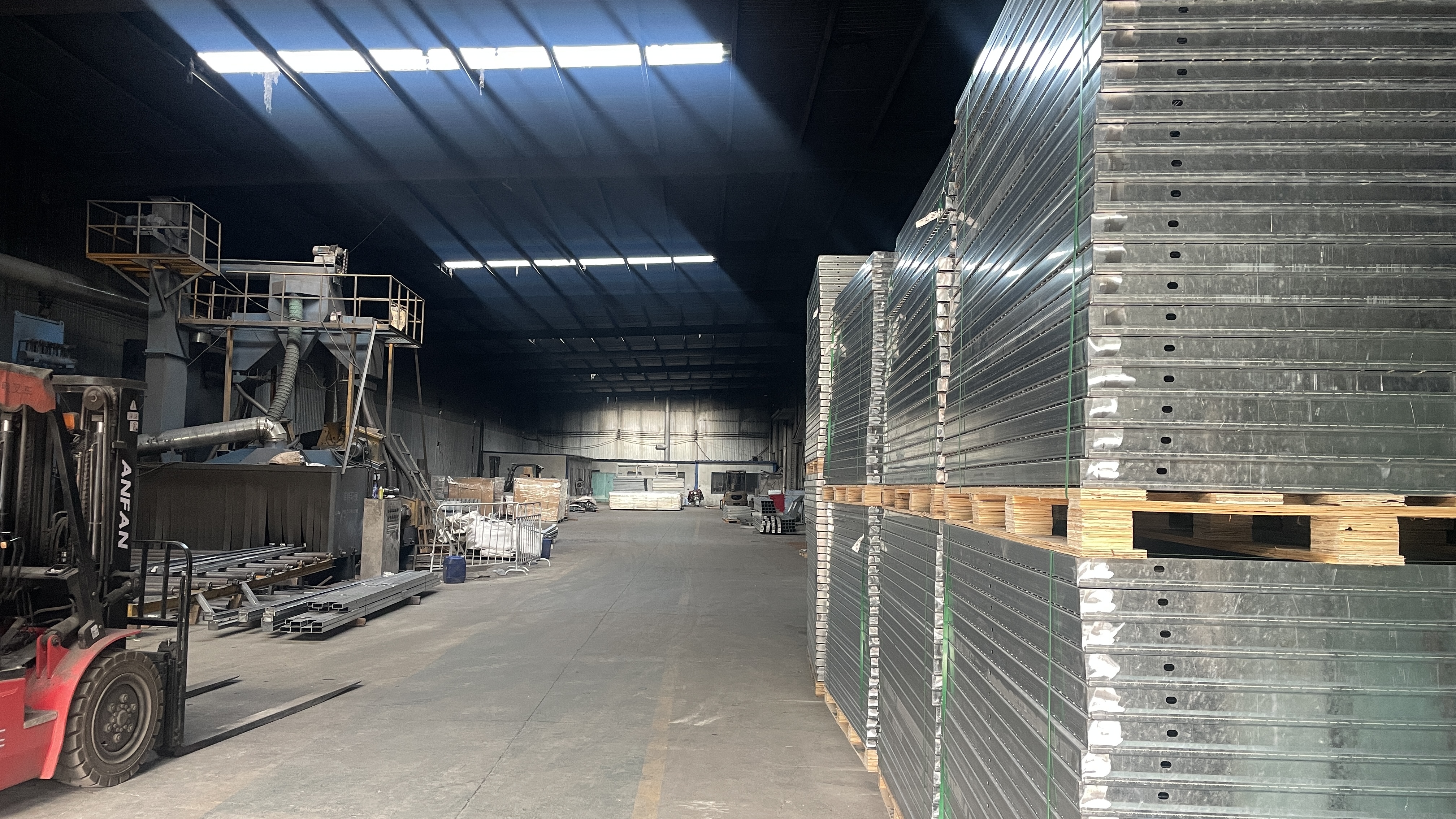
Welded wire mesh production floor — the manufacturing environment that management-system and inspection documents are meant to describe.
Why Certification Sits at the Centre of the Award Decision
Fencing is a low-attention, high-consequence purchase. A welded mesh fence is specified once and then stands in place for a decade or more, exposed to weather, to attempted intrusion and, in rail and utility environments, to cable theft. Because a delivered and installed fence cannot be re-inspected cheaply, buyers push verification upstream: evidence is requested before the order rather than after delivery.
That shift explains why ISO9001, SGS and BV appear so consistently in welded mesh fence offers in the Security & Protection category. It also explains why they are so often misread. The three are presented as one block labelled “certified”, but they answer different questions. One addresses how a factory manages quality. The others record what an independent organisation found when it examined a defined sample, batch or shipment.
For a decision-stage buyer — a contractor closing out a school perimeter, a rail authority protecting cable routes, an industrial operator fencing a plant boundary — conflating the three produces the same failure mode every time: a document pack that satisfies an internal checklist while leaving the actual performance questions unanswered.
ISO9001, SGS and BV Are Not the Same Kind of Evidence
ISO9001 is a quality management system standard. Certification confirms that a manufacturer’s arrangements for controlling quality — documented procedures, defined inspection points, corrective action, traceability — have been assessed against that standard by a certification body. It is a statement about the system that produces the goods, not about the goods themselves.
SGS and Bureau Veritas, commonly shortened to BV, are third-party inspection, testing, verification and certification organisations. In welded mesh fence procurement their names usually appear on test or inspection documents rather than on system certificates. An SGS or BV document normally relates to a bounded scope: a submitted sample, a production batch, or a pre-shipment inspection of a specific order. Its value lies in the fact that the finding was produced by a party independent of the factory that made the panels.
A third category is frequently filed into the same folder: product test reports that reference a fencing standard rather than a management system. Two standards appear regularly in this context. EN 10223-7:2012 is the active European standard specifying requirements for steel wire welded panels for fencing used in schools, parks and industrial sites. ASTM F2453/F2453M-14 covers the standard specification for welded wire mesh fence fabric with metallic or polymer coatings for high-security applications. These are product standards, not certificates, and a supplier should be able to state precisely which standard a given report refers to.
| Document | What it is | What it typically confirms | What it does not confirm on its own |
|---|---|---|---|
| ISO9001 certificate | Management system certification issued against a standard | That quality processes, inspection points and traceability procedures were assessed | Corrosion performance, mesh tolerance or load behaviour of any specific panel |
| SGS document | Third-party test or inspection finding | Results observed on a defined sample, batch or shipment | That future production will match the tested item |
| BV document | Third-party inspection, verification or certification document | Conformity of a defined order, batch or claim at the time of inspection | Anything outside the stated scope, order reference or inspection date |
| Product standard test report | Test report referencing a fencing product standard | Measured performance against criteria in that standard | Compliance with a different market’s standard or with local building codes |
How Dengfeng Documents Certification and Inspection
Anping Dengfeng Wire Mesh Products Co., Ltd. is a wire mesh manufacturer based in Anping County, Hebei Province, China, producing welded mesh rolls, welded wire mesh panels, 358 security fences, BRC and roll-top fences, double-wire panels, chain link fences, temporary fences, barbed and razor wire, and gabion baskets. The company was founded in 2008 and operates a 70,000 m² facility with 80 employees, an R&D team of 10 engineers and an annual output of 5,000,000 m². Roughly 80% of production is exported, with main markets in Europe, Saudi Arabia, the Middle East, the United Arab Emirates and the United States.
For buyers assembling a verification file, the relevant starting point is the certification set attached to the welded mesh fence product line: certifications including ISO9001, SGS and BV, with a stated service life of over 10 years. These are the documents a procurement team should expect to receive and check against the order, alongside the order-specific inspection record.
Dengfeng’s documented quality measures give that file a second layer. They include 100% raw material inspection, a finished product load test, and full delivery inspection. Corrosion damage and structural deformation are controlled through hot-dip galvanizing and powder coating, together with a thickened wire structure. In verification terms, this matters because it names the inspection points a buyer can request evidence for: incoming wire, finished panel load performance, and pre-shipment checks. A certificate tells a buyer that a system exists; these records show where in the flow the system acts.
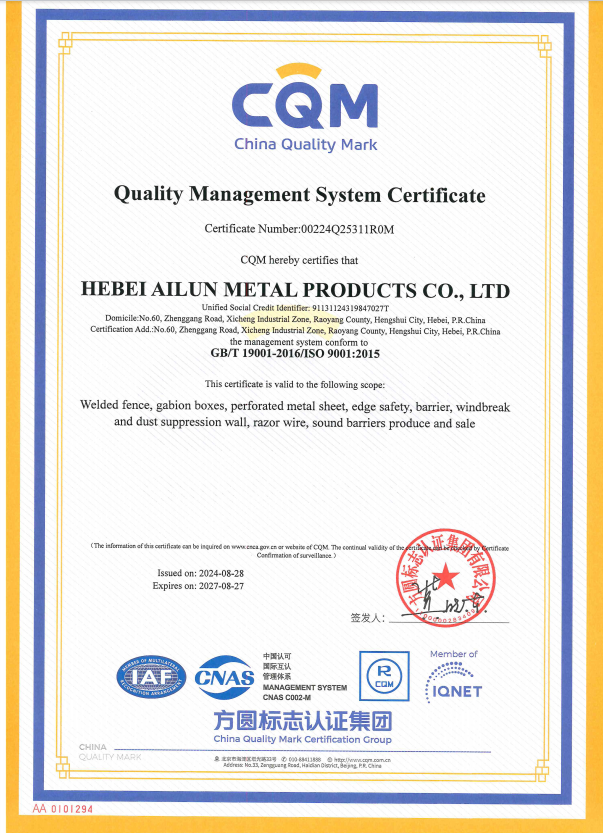
ISO9001 Quality Management System certificate — a document about process control, not about the performance of a specific panel.
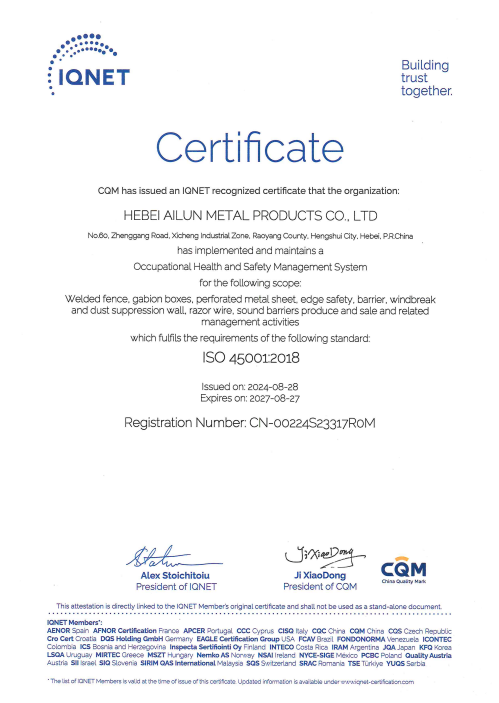
Product quality inspection test report — the batch-level evidence that sits beneath a management-system certificate.
Reading a Supplier’s Certificate Pack: Four Checks That Matter
Most certificate-package problems are clerical rather than fraudulent, and four checks catch the majority of them.
- Legal name match. The entity named on the certificate should be the entity that will appear on the contract and the commercial invoice. Where a supplier is a trading company rather than the mill, the buyer should ask for the manufacturer’s documents and a clear written statement of who actually produces the goods.
- Scope and site. A certificate covers a defined product scope and a defined location. A document issued for one product family or one plant does not automatically describe a different panel type, a different coating line or a different address.
- Validity and revision. Certificates carry issue and expiry dates, and test reports carry test dates. An out-of-date document is not evidence about current production, even when the supplier’s capability has not changed.
- Sample, batch or order level. Read the noun. A report about a sample is a report about a sample. If the buying decision depends on the delivered lot, the document needs to reference that lot or that order.
The Boundary: What Certification Cannot Do
ISO9001 certification does not guarantee that a particular welded mesh fence panel will pass a corrosion test, because it assesses a management system rather than a product result. A third-party test report describes the item that was tested, not the panels that will be produced next quarter. Certificate scope may exclude the exact coating system or panel profile being ordered. And no certificate transfers automatically if production moves to another line or site.
None of this argues against certification. It argues against treating a certificate folder as a substitute for three things that remain the buyer’s responsibility: a written specification, a batch-level inspection record, and incoming inspection or sample approval before volume release. The most reliable supplier conversations are the ones in which the supplier can say plainly which claim each document supports and which it does not.
Which Documents to Request, by Application
Documentation requirements follow the site, not the product name. The same welded mesh fence panel can be an acceptable solution for a residential boundary and an inadequate one for a rail corridor, and the evidence requested should track that difference.
| Application | Dominant performance risk | Documents worth requesting |
|---|---|---|
| Schools | Climb resistance, panel rigidity, edge safety | ISO9001 certificate, dimensional and load test record, standard reference (for example EN 10223-7:2012, which addresses welded panels for schools, parks and industrial sites) |
| Parks and public space | Corrosion under mixed weather, low-maintenance requirement | Coating specification, corrosion protection documentation, batch inspection record |
| Sports fields | Impact loading, spectator safety, rebound behaviour | Panel and post specification sheet, load test evidence, installation guidance |
| Residential boundaries | Appearance retention, coating durability | Coating type and thickness statement, service-life claim in writing, sample approval |
| Industrial perimeter | Forced entry, structural deformation | Anti-climb panel specification, 358 or double-wire panel data, load test record, third-party inspection document |
| Railways | Cable theft, unauthorized access along long runs | Rigid frame panel specification, anti-cut and anti-climb design documentation, batch inspection record |
| High-security areas | Determined intrusion, cut resistance | Standard reference such as ASTM F2453/F2453M-14 for coated welded wire mesh fence fabric, third-party test evidence, pre-shipment inspection |
Market Context: Verification Is Moving Earlier in the Buying Process
The welded wire mesh fence category is expanding, which pushes documentation questions further upstream. The global welded wire mesh fence market was valued at USD 7.04 billion in 2025 and is projected to reach USD 11.72 billion by 2034, according to Dataintelo. Grand View Research estimates the broader global fencing market at USD 33.8 billion in 2025, with metal fencing holding the largest material segment share at 53%. Within welded mesh specifically, Asia Pacific held a 38.5% revenue share in 2025, largely driven by infrastructure projects in China and India.
Competitive behaviour points the same way. Betafence Group expanded its perimeter security portfolio in February 2024 with new-generation welded mesh systems incorporating intrusion detection and solar surveillance — a move that shifts the category from static barrier toward monitored perimeter. Key global players commonly identified in the security fencing market include Betafence, Bekaert, Ameristar Perimeter Security and Jacksons Fencing. Welded mesh fences are also widely preferred for critical infrastructure such as railways, where cable theft prevention matters, and for schools, because rigid frame panels and anti-climb geometry suit those environments.
Market sizing estimates vary between research houses because inclusion criteria differ — for example, whether installation services are counted alongside product value. Buyers should treat any single figure as a directional indicator, not as a project input.
Certified Supply Versus Conventional Low-Cost Supply
Supplier-provided comparison data makes the trade-off explicit. Against ordinary cheap wire mesh fence, a verified welded mesh product is described as delivering better anti-corrosion and anti-climb performance, with a service life more than six years longer, and as best suited to construction, community and airport security projects. The stated cost position is roughly 5% higher initial cost against 40% lower replacement cost, with zero maintenance within 10 years, since replacement frequency and daily maintenance are the main lifetime cost drivers rather than energy use.
The limitation belongs in the same paragraph. These figures are supplier-provided and describe a comparison against a general category of low-cost mesh, not against a named competitor product. A 5% premium is a year-one number; whether the 40% replacement-cost advantage materialises depends on the installed environment, the coating system actually applied, and whether the panels were handled correctly on site. Certification documentation also adds administrative lead time to the order cycle. Buyers should therefore test the comparison against their own site conditions and, where the project scale justifies it, against a physical sample before committing to a full order.
A Verification Checklist Before the Purchase Order
- Write the specification first — panel type, wire diameter, mesh aperture, coating system, post spacing — and make the certificates answer to it, not the reverse.
- Confirm the legal entity name on every certificate matches the contracting party and the invoice issuer.
- Check that certificate scope covers the product family and the manufacturing site for the ordered item.
- Request the batch or order-level inspection record, not only the system certificate.
- Ask which standard any test report references, and confirm that the standard is relevant to the destination market.
- Confirm the inspection sequence in writing: incoming raw material control, finished product load test, pre-shipment inspection.
- Verify coating claims — hot-dip galvanizing, powder coating or both — against the corrosion environment of the site.
- Approve a sample and retain it as the physical reference for disputes.
- Record the document reference numbers in the contract so that later substitution is visible.
Future Outlook
Two forces are likely to shape welded mesh fence documentation over the next few years. The first is the movement of verification from the certificate folder to the order record: buyers are increasingly asking for batch-level inspection data and pre-shipment findings rather than a single static certificate. The second is the merging of the fence with monitoring layers, visible in the 2024 direction taken by Betafence, which makes the physical panel one component of a documented security system and raises the standard of evidence expected for the barrier itself.
For manufacturers, the practical implication is that traceability becomes a commercial asset rather than an administrative burden. For buyers, the implication is simpler: the suppliers worth shortlisting are those that can explain, without prompting, exactly what each document in the pack does and does not prove.
FAQ
Does ISO9001 certification mean a welded mesh fence panel will pass a corrosion test?
Not necessarily. ISO9001 assesses a quality management system, not the corrosion performance of an individual panel. A buyer who needs coating performance evidence should request a product test report referencing a relevant standard — for example EN 10223-7:2012 for steel wire welded panels used in schools, parks and industrial sites — and should confirm whether the report covers a sample, a batch or the specific order.
What is the difference between an ISO9001 certificate and an SGS or BV report?
ISO9001 is a management system certificate issued against a standard and describes how a factory controls quality. SGS and BV documents in a fence quotation are typically third-party test or inspection findings on a defined scope such as a sample, a production batch or a shipment, and describe what an independent organisation observed at a point in time.
How can a buyer confirm that a certificate belongs to the supplier being contracted?
Check that the legal entity name matches the contracting entity, that the scope covers the product family and the manufacturing site, that the document is within its validity period, and that the certificate number can be confirmed with the issuing body. Where the seller is a trading company rather than the producer, ask for the manufacturer’s documents and a written statement identifying who manufactures the goods.
Which standards should a welded mesh fence test report reference?
It depends on the destination market and application. EN 10223-7:2012 specifies requirements for steel wire welded panels for fencing in schools, parks and industrial sites. ASTM F2453/F2453M-14 covers the standard specification for welded wire mesh fence fabric with metallic or polymer coatings for high-security applications. A usable report identifies the standard, the tested item and the test date.
How does a stated service life relate to certification?
A service life figure is a product performance claim rather than a certificate. The welded mesh fence product line carries a stated service life of over 10 years, supported by corrosion protection measures such as hot-dip galvanizing and powder coating. Buyers should connect that claim to the specific coating system, the local environment and the inspection record for their order.
A downloadable brochure covering welded wire mesh and galvanized wire specifications is available at: welded wire mesh and GI wire brochure.