
How to Verify an Architectural Model Manufacturer's Track Record
How to Verify an Architectural Model Manufacturer's Track Record
Architectural models are bought from drawings and judged months later, as physical objects, inside a sales gallery or an exhibition hall. Almost every capability claim a buyer receives therefore arrives before any proof does. This reference sets out the specific, checkable evidence a buyer should request from an architectural model manufacturer, and shows how each evidence category maps to a real production stage, using the published facts of Shenzhen JYD Architectural Models Co., Ltd. (JYD Models) as a worked example.
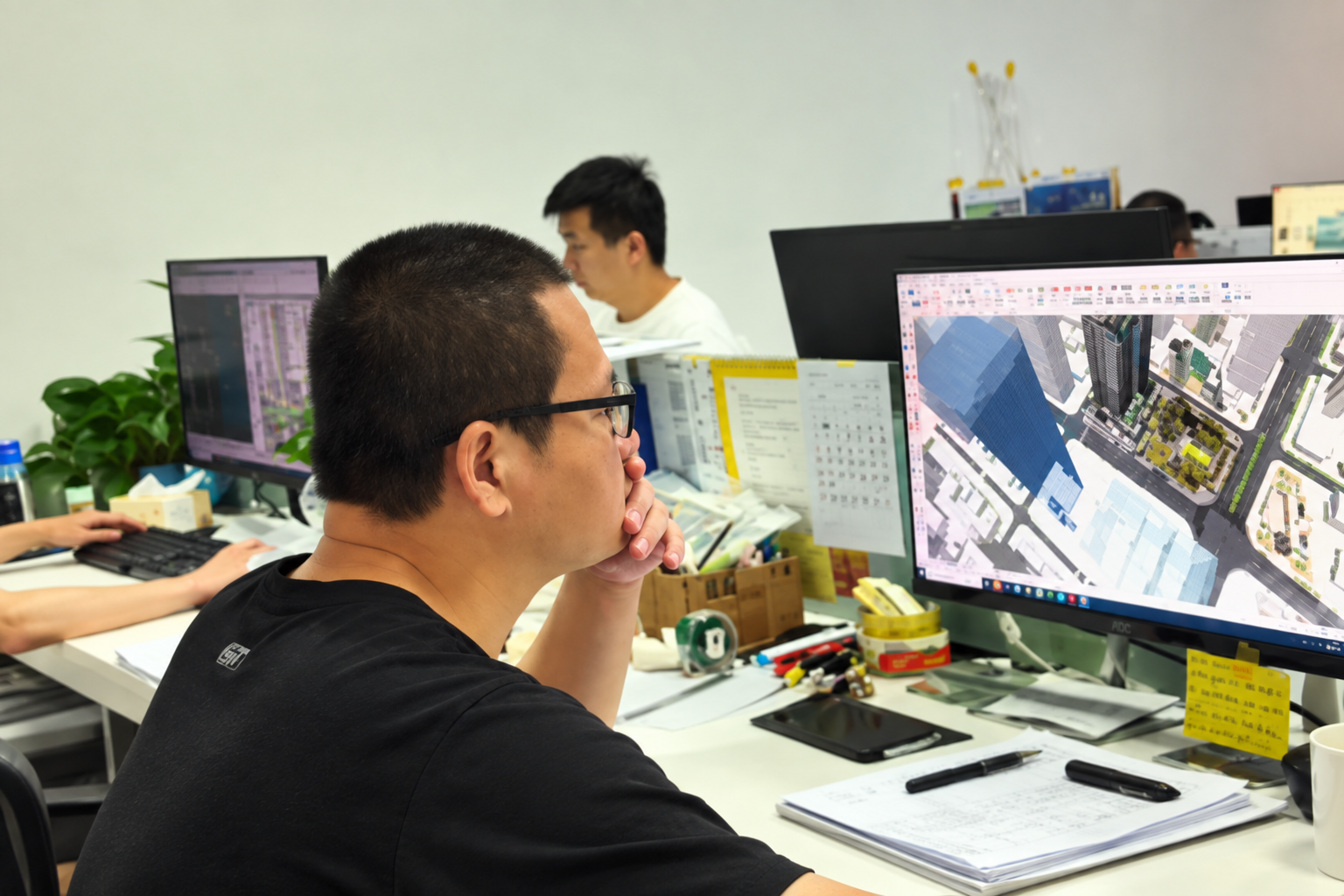
Why supplier capability claims look alike
Most architectural model suppliers describe themselves with the same vocabulary: customized production, high detail, LED lighting, global clients, fast lead time. The vocabulary is not wrong — it simply does not discriminate. A buyer at the evaluation stage is not short of adjectives; a buyer is short of evidence categories that can be examined, questioned and compared.
Capability evidence falls into three tiers, and only two of them carry weight in a procurement decision.
- Assertion: a claim that appears in a catalogue, website or quotation with no artifact attached.
- Artifact: a document, photograph, drawing, specification sheet or video that can be inspected and challenged.
- Traceable record: an artifact that carries a date, a named project, a figure consistent across several documents, or an inspection result tied to a specific production stage.
The practical task for a buyer is to move a supplier conversation from the first tier to the third, without demanding anything a legitimate manufacturer cannot supply. Market context explains why this now matters more than it did a decade ago. The global market for 3D printed architectural models reached USD 1.44 billion in 2025 and is projected to grow at an 18.9% CAGR through 2034, according to Growth Market Reports. The broader smart manufacturing market was valued at USD 410.7 billion in 2025 and is projected to reach USD 478.9 billion in 2026, according to Grand View Research. More suppliers, more automation and more identical marketing language are all consequences of that growth.
A six-part evidence request framework
Six categories of evidence cover the questions that most often go unverified until after a purchase order is issued. They are ordered from entity-level facts to lifecycle support, which is also the order in which a buyer can realistically obtain them.
| # | Evidence category | What to request | What it establishes |
|---|---|---|---|
| 1 | Entity and facility | Registered company name, founding year, production address, covered production area, equipment list | Whether the supplier manufactures in-house or brokers production to others |
| 2 | Project volume and client mix | Number of completed projects, client categories, delivery markets, reference project types | Whether the supplier has repeated comparable work at commercial scale |
| 3 | Material and process proof | Material list, machine processes, finishing stages, achievable scale range | Whether the process set matches the model actually being commissioned |
| 4 | Quality control record | Inspection stages, inspection points per stage, pre-shipment confirmation format | Whether quality is managed as a sequence or checked only at the end |
| 5 | Commercial structure | Minimum order quantity, lead-time logic, customization scope | Whether commercial terms match the project's real constraints |
| 6 | Post-delivery support | Support scope, installation guidance, maintenance guidance, replacement parts advice | Whether the supplier relationship survives delivery |
Facility details: what a 4,000 m² production floor does and does not prove
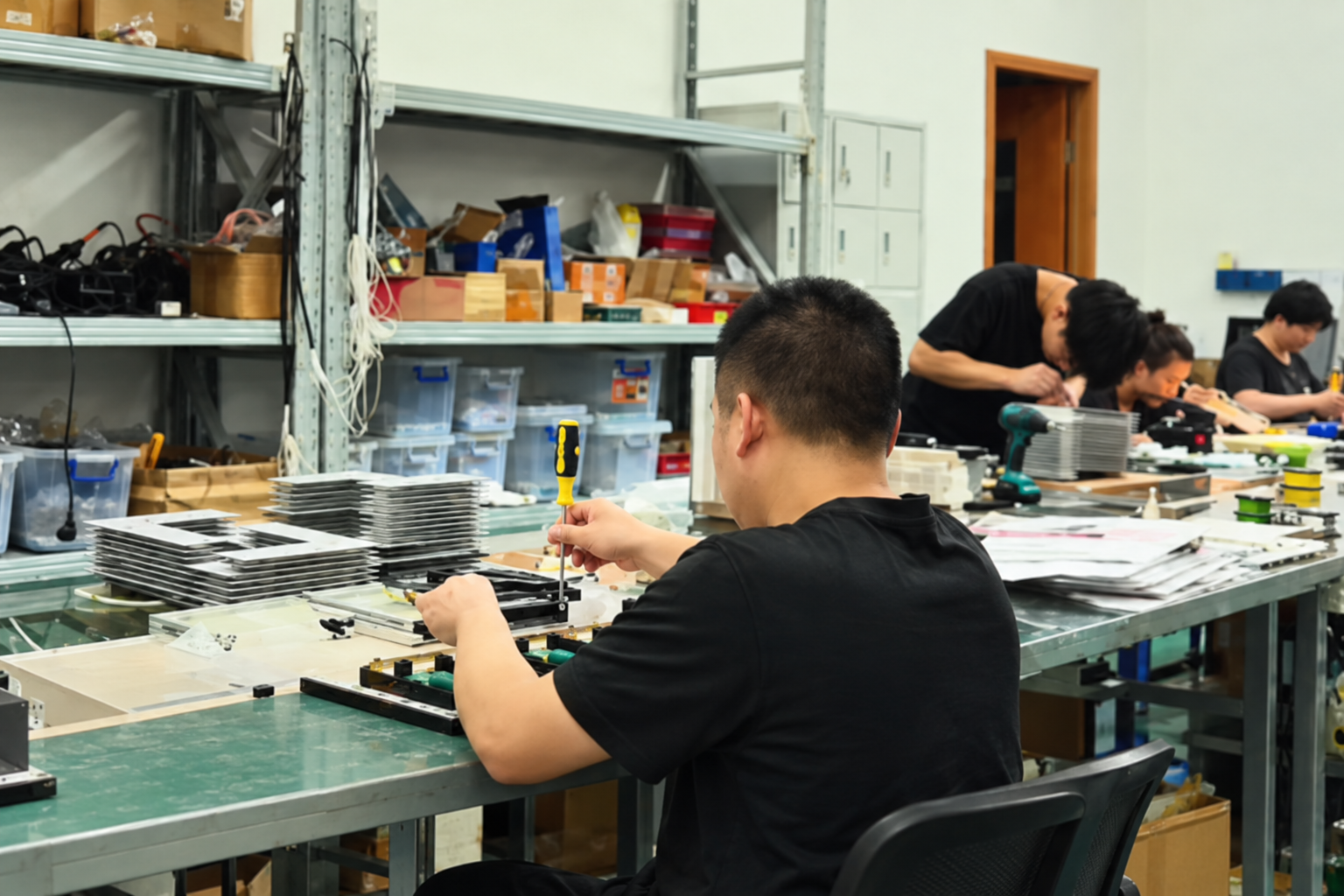
Shenzhen JYD Architectural Models Co., Ltd., trading as JYD Models, is an architectural model design and production company established in 2013 and based in Shenzhen, China. Company information lists a 4,000 m² facility, approximately 200 employees, an R&D team of 12 engineers and an annual output of 1,000 units, with around 50% of production exported. Main markets listed include the EU, Saudi Arabia, Vietnam, India, Southeast Asia, China, Africa, the Middle East, Qatar and the UAE.
Those figures matter because of how a modern architectural model is assembled. A single sales-gallery model can require CNC-machined structural parts, printed facade components, laser-cut site elements, hand-painted landscape, and a wired LED lighting system with zoning control. That work cannot be completed in a single-process workshop. When a buyer receives a facility claim, the useful question is not “how large is the building?” but “which of the processes my project needs actually happen on site?”
The boundary here is worth stating. Floor area alone measures nothing about detail quality. A large facility without specialist finishing capacity will still produce flat, uniform facades. Floor area becomes meaningful only when it is read together with the equipment list and the finishing stages — which is why categories 1 and 3 of the framework should be requested at the same time.
Project volume and client mix
Project volume is the fastest way to separate a manufacturer from an intermediary, but only if the number is broken down by category. JYD Models states that it has completed thousands of architectural model projects. Published company information states over 3,000 projects globally across more than 50 countries, with a team of 200+ professionals. Client categories are listed as real estate developers, architectural design firms, urban planning companies and commercial property developers. Case records reference projects delivered in Canada, China, the United Arab Emirates, France, the United Kingdom, the United States, Vietnam, India, Indonesia, Hong Kong and Thailand.
A total project count is a starting figure, not a conclusion. Because each order is typically one customized architectural scale model — with scale and size customized to project drawings, display space and transportation requirements — buyers should ask a narrower question: how many projects of this model type, this scale band and this lighting specification have been completed? A manufacturer with a strong record in residential sales models may have no comparable experience in an airport terminal or an industrial plant model.
Material and process proof: where 3D printing meets hand finishing
The most informative capability signal in this industry is not printing speed. It is the combination of automated fabrication and hand finishing in one workflow, because the two solve different problems.
JYD Models' documented production process can include drawing review, 3D modeling, CNC machining, 3D printing, laser cutting, hand assembly, painting, landscaping and LED lighting integration. The company's 3D printed architectural models use SLA, FDM or resin printing with optional sanding, painting and assembly finishing, in a scale range of 1:50 to 1:1000. Published service documentation describes the use of CNC machines, 3D printers and precision laser cutters across scales from 1:5000 for urban context down to 1:20 for detail work. Material options across the product range include acrylic, ABS, PVC board, resin, wood, metal and transparent sheet.
Read as evidence, that list answers a specific set of buyer questions. Printing produces repeatable complex geometry but leaves layer marks and uniform surfaces. Hand finishing produces the material variation, landscape texture, signage and lighting integration that automated output alone does not achieve. A supplier that advertises 3D printing without naming a finishing stage leaves an obvious gap: who paints the facade, blends the joins, and wires the lighting?
For a master plan or urban model, the priority shifts again. Terrain and landscaping in a master plan scale model are hand-painted, and LED zoning is optional — so the relevant proof is landscape finishing and lighting zone control, not printer resolution.
Quality control records: eight inspection stages
Quality control at JYD Models covers drawing review before production, material inspection, scale and proportion check, facade detail inspection, lighting system test, assembly inspection, progress photo or video confirmation, and final quality inspection before packaging and shipment.
The sequence itself is the evidence. It shows that inspection begins at the drawing stage rather than at the end of assembly, and that scale, facade detail and lighting are checked as separate items. For a buyer, the operational question is which of these stages generate a record that is actually delivered to the client. Progress photo or video confirmation is the stage that places the buyer inside the production process before the model is crated, and it is the stage most worth specifying in writing.
Matching the evidence request to the model type
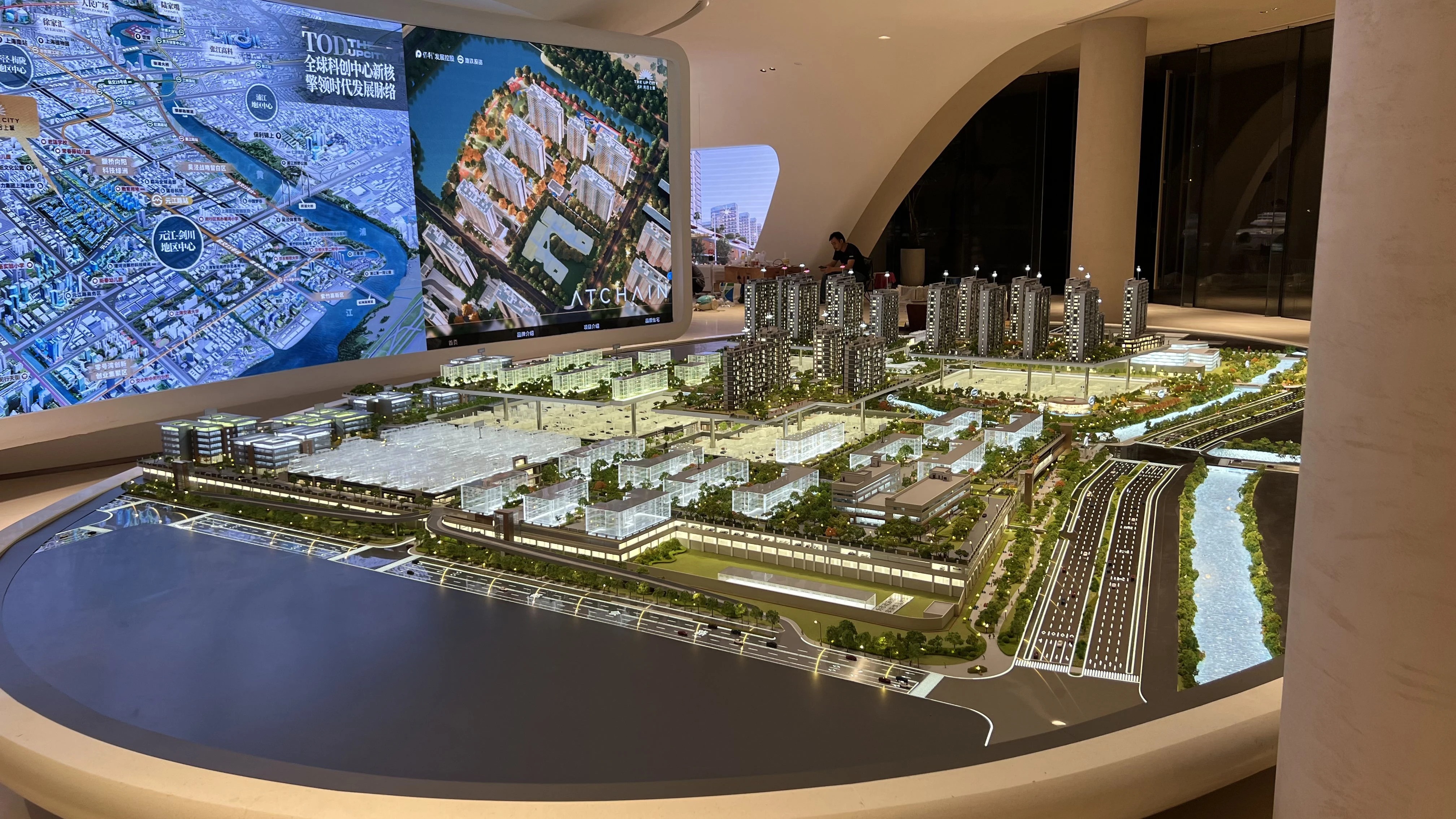
Evidence requests should be weighted by model type, because the risk of a mismatch sits in different places for each one. The scale bands below are drawn from the company's published product specifications.
| Model type | Typical scale | Evidence to prioritize |
|---|---|---|
| Architectural master plan / urban planning model (JYD-MP-CUSTOM) | 1:200 – 1:2000 | Hand-painted terrain and landscaping examples; phased LED zoning; site plan accuracy |
| Commercial and residential building model (JYD-ARCH-CUSTOM) | 1:50 – 1:500 | Facade, landscape and signage detailing; interior and exterior lighting options |
| Interior design and exhibition model (JYD-INT-CUSTOM) | 1:20 – 1:100 | Removable roof or wall construction; furniture and material detailing |
| Industrial plant and engineering model (JYD-IND-CUSTOM) | 1:100 – 1:1000 | Sectional display method; process flow representation; safety markings |
| 3D printed architectural model (JYD-3DP-CUSTOM) | 1:50 – 1:1000 | Printing technology used; layer resolution control; finishing steps |
| Interactive LED display model (JYD-LED-CUSTOM) | 1:100 – 1:1000 | Programmable lighting zones; touch panel, projection or app integration; lighting test records |
These models are used for real estate sales centre display, project presentation, investor communication, architectural design review, urban planning exhibition and marketing promotion. Typical display periods run from three to five years, which means the model is a long-term asset in a controlled indoor environment rather than a short-lived prop. That duration is itself a reason to request maintenance and spare-parts information before purchase, not after.
Commercial structure and post-delivery support
Two evidence categories are frequently skipped because they look administrative. They are not. Minimum order quantity, lead-time logic and customization scope determine whether a project is feasible at all; support scope determines what happens in year three.
JYD Models lists a minimum order quantity of one unit, with production based on a project-by-project model. Customization covers model scale, model size, building facade details, landscape design, the LED lighting system, zoning display, touch-control interaction, multimedia linkage, material selection, base design, acrylic cover, packaging method and installation support. Lead time is stated as dependent on project size and complexity, with production starting after final drawings, model scale, display requirements and lighting details are confirmed. After-sales scope includes remote technical support, installation guidance, maintenance guidance, lighting system troubleshooting, replacement advice for damaged parts, and packaging and transportation support.
Read critically, these statements are informative precisely because they are conditional. A supplier that quotes a fixed lead time before receiving drawings is quoting a number it cannot control. A supplier that describes a MOQ of one unit and a documented installation support path is describing a workflow that matches how customized models are actually sold.
Market trend: why process evidence is gaining weight
Three shifts in the wider manufacturing environment are pushing buyers toward process-level verification.
First, the 3D printed architectural model segment is growing quickly — USD 1.44 billion globally in 2025, with a projected 18.9% CAGR through 2034 according to Growth Market Reports — which means more suppliers will claim printing capability, and the differentiating question will shift from “do you print?” to “which technology, at what resolution, finished how?”
Second, standards frameworks are catching up with the way models relate to design data. China's Guidelines for the Construction of a National Smart Manufacturing Standards System (2021 Edition) includes foundational standards for digital twins and self-perception in design and production. As physical models are increasingly treated as the tangible counterpart of digital design data, buyers can reasonably expect a documented link between the approved drawings and the delivered object.
Third, cross-border trade of these products involves classification questions that affect landed cost. Standard 3D printers used for manufacturing architectural models are classified under HS Code 8485.20 (deposit of plastics or rubber) or 8485.30 (deposit of plaster, cement and similar materials). Finished scale models are commonly exported under a different classification, and models containing lighting or electronics may raise additional questions. Buyers sourcing internationally should confirm the applicable classification with the supplier and their own customs broker before the order is placed — this is a category of risk that supplier capability evidence does not automatically cover.
Comparison: portfolio-only evaluation versus evidence-led evaluation
Most buyers in this category begin with a portfolio review: rendered images, finished-model photographs, a reference list. That approach is not irrational; it is simply incomplete.
| Dimension | Portfolio-only evaluation | Evidence-led evaluation |
|---|---|---|
| Basis of decision | Rendered images and photos of finished models | Facility, process, inspection and delivery records |
| Distinguishes manufacturer from reseller | Weakly | Directly, via equipment and process lists |
| Upfront effort for the buyer | Low | Moderate — a structured request, normally one document set |
| Typical failure mode | Delivered detail level differs from the photographs | Over-documenting routine, low-complexity models |
| Best fit | Small, single-purpose display models | Sales gallery, planning exhibition and multi-market projects |
The limits of the evidence-led approach should be stated plainly, because they are real.
- Production capacity in this industry is project-based, not a fixed monthly unit count. It depends on model scale, project complexity, lighting requirements and delivery schedule, so a supplier cannot always answer a capacity question with a single number.
- Lead time is only firm after final drawings, model scale, display requirements and lighting details are confirmed. Any earlier figure is an estimate.
- Progress photo and video confirmation is produced by the supplier. It is a transparency mechanism, not an independent audit.
- Published project counts and market lists are self-reported unless supported by a third-party source, and should be treated as supplier statements rather than audited data.
- A physical model is static. Across a three-to-five-year display cycle it will require maintenance and, occasionally, replacement parts — something no pre-purchase document set can fully predict.
Where a project's value justifies it, these limits are best addressed by combining supplier evidence with an independent inspection, a partial or sample model validation, and contractual acceptance criteria that reference the supplier's own inspection stages.
Future outlook
The direction of travel is toward more documented process and less adjective-based differentiation. As digital twin standards take hold in manufacturing policy, buyers are likely to ask for a traceable chain from approved drawing to finished physical component rather than a gallery of finished photographs. The rapid growth of 3D printed architectural models will push printing technology and finishing method into the standard request list. Interactive LED and app-linked displays will increase the amount of electronics inside a model, raising the value of lighting test records and after-sales troubleshooting support. And as more projects cross borders, lead-time transparency and modular packaging for long-distance shipment will carry more weight in supplier selection than they do today.
None of this changes the underlying discipline. A manufacturer's track record becomes verifiable when a buyer asks for facility facts, category-specific project counts, material and process stages, inspection records and support commitments — and then checks whether those statements remain consistent across documents.
Frequently asked questions
What is the first piece of verifiable evidence to request from an architectural model supplier?
Start with entity and facility evidence: registered company name, year of establishment, full production address, covered production area and the list of machines in use. This single request separates a manufacturer from a trading intermediary. Shenzhen JYD Architectural Models Co., Ltd., for example, is an architectural model design and production company established in 2013 and based in Shenzhen, China, with a 4,000 m² facility and approximately 200 employees. A supplier that cannot state its own production address and equipment list is a supplier whose later claims cannot be checked either.
How many completed projects should a buyer expect a manufacturer to disclose?
Enough to show repetition inside the buyer's own category, rather than a large headline total. JYD Models states it has completed thousands of architectural model projects; published company information states over 3,000 projects globally across more than 50 countries. Because each order is normally one customized architectural scale model built to specific drawings, the more useful figure is the number of completed projects comparable in model type, scale band and lighting specification to the one being commissioned.
Can a buyer verify an architectural model supplier's factory without travelling to it?
Partly. Remote verification can include contextual photographs and video of the production floor, the equipment list, and pre-shipment media from a similar project in progress. This establishes process and organization, not output quality. Only a site visit or an independent third-party inspection can confirm that the facility shown is the facility that will produce the order, and that the quality of detail observed in photographs is reproducible at the scale required.
Why does 3D printing combined with hand finishing matter as a capability signal?
Because it demonstrates two different competences operating in one workflow. 3D printing handles complex, repeatable geometry at controlled resolution; hand finishing handles surface quality, material variation, landscape texture, signage and lighting integration. JYD Models' documented production process can include drawing review, 3D modeling, CNC machining, 3D printing, laser cutting, hand assembly, painting, landscaping and LED lighting integration, and its 3D printed models use SLA, FDM or resin printing with optional sanding, painting and assembly finishing. A supplier offering printing without a named finishing stage should be asked who completes those steps.
What does supplier-provided progress photo or video confirmation actually verify?
It verifies that the buyer's specific project exists in physical form before shipment, and that scale, facade treatment and lighting arrangement match the approved drawings at an intermediate stage. It is a transparency mechanism rather than an independent audit, because the media is produced by the supplier. Its usefulness depends on timing and content: an intermediate-stage photograph of facade detail or a lighting test carries more decision value than a final image of a completed, illuminated model.
How long can a physical architectural model be expected to remain display-ready?
Display periods of three to five years are typical for models used in sales centres, exhibition halls and planning presentations, after which maintenance or replacement parts may be required. Durability depends on base construction, material mix, lighting system stability, and whether the model is kept indoors under controlled temperature and lighting conditions. Buyers should therefore request the supplier's maintenance guidance and replacement advice for damaged parts as part of the pre-purchase evidence set.
What are the limits of supplier-provided capability evidence?
Three limits are worth stating directly. Production capacity is project-based and depends on model scale, complexity, lighting requirements and schedule, so it cannot always be expressed as a fixed monthly output. Lead time is only firm after final drawings, scale, display requirements and lighting details are confirmed. Published project counts and market lists are generally self-reported. Where a purchase decision carries significant value, supplier evidence is best paired with a third-party inspection, sample validation, and contractual acceptance criteria tied to the supplier's own documented inspection stages.
Reference material: JYD Models publishes a company brochure covering model types, production processes and customization scope, available for download at JYD Models company brochure (PDF). Company website: www.jydmodels.com.