
Humid-Market Cabinet Suppliers: Multi-Material Comparison
Humid-Market Cabinet Suppliers: Multi-Material Comparison
For buyers sourcing Multi-Material Bathroom Cabinets for humid markets, the decision is not a simple material ranking. It is a supplier-fit decision. The same PVC, stainless steel, space aluminum, multi-layer solid wood or plywood cabinet can perform very differently depending on board grade, edge sealing, hardware, coating, assembly and packaging. This comparison sets out the criteria a Decision-stage buyer should use when comparing direct manufacturers, trading companies, overseas local suppliers and low-end factory offers.
The practical answer is that humid-climate sourcing requires evidence, not labels. A moisture-tolerant material can still fail through poor joints, weak hardware or inadequate packing. A supplier with the right material range can still be the wrong fit if MOQ, certification support, installation format or lead time does not match the project. The comparison below therefore treats material choice and supplier route as connected decisions.
Why humid markets change the supplier comparison
Humidity is a system issue, not only a material property. A bathroom cabinet faces water splash at the basin, condensation on cold surfaces, cleaning chemicals, steam from showers, limited ventilation and, in some installations, direct contact with damp walls or floors. The risk points are usually the edges, joints, fixing points, hinges, runners, mirror electronics and the back panel. For that reason, a buyer should compare how a supplier controls the full assembly, not only what the main panel is called.
A humid-market supplier comparison should therefore test four things together. First, the material specification: what exactly is the cabinet body, door and basin support made from? Second, the construction: how are edges sealed, joints welded or fastened, and hardware protected? Third, the evidence: are there raw-material reports, finished-product tests, hardware cycle data and packing specifications? Fourth, the commercial fit: do MOQ, sample terms, lead time, certification documents and flat-pack options support the buyer’s channel?
This is where a catalogue-only comparison breaks down. A PVC bathroom cabinet, a stainless steel bathroom cabinet and a multi-layer solid wood bathroom cabinet may all be presented as suitable for humid bathrooms, but they do not carry the same verification burden. The buyer’s task is to match the material and the supplier’s evidence to the actual installation, budget and after-sales model.
Multi-material comparison for humid bathroom cabinets
The table below compares common cabinet materials on buyer-relevant humid-market criteria. It does not declare a universal winner. Material performance depends on grade, construction, coating, hardware and installation, so each row includes the points a buyer should verify before shortlisting.
| Material | Humid-market fit | Buyer verification |
|---|---|---|
| PVC Bathroom Cabinet | A moisture-tolerant plastic cabinet option used in fluted and modern vanity designs. Performance depends on wall thickness, joint construction, door rigidity, edge finish and hardware quality. | Check material compound or grade, panel thickness, door flatness, colour-fastness, hinge and runner quality, and whether the supplier provides test reports for the finished cabinet. |
| Stainless Steel Bathroom Cabinet | A metal cabinet category with a different failure profile from wood or PVC. Corrosion resistance depends on alloy grade, surface finish, weld treatment and cleaning chemicals. | Confirm alloy grade, weld seams, coating or finish, hardware compatibility and any corrosion-related report the supplier can provide for the intended environment. |
| Space Aluminum Bathroom Cabinet | A lightweight metal cabinet category. Structural rigidity depends on alloy, profile thickness, joint design, door alignment and surface coating. | Ask for alloy and profile details, coating adhesion information, load-bearing test evidence and door-alignment checks after assembly. |
| Multi-Layer Solid Wood Bathroom Cabinet | An engineered wood cabinet built from multiple wood layers. Humid performance depends on moisture-proof treatment, coating, edge sealing and installation. Hengran states that it has addressed solid wood moisture-proof treatment in its manufacturing. | Verify moisture content, coating system, edge sealing, warranty terms and finished-product test reports. Do not accept a material name without construction details. |
| Plywood Bathroom Cabinet | An engineered wood panel option. Humidity fit depends on adhesive class, veneer quality, edge sealing and installation. Flat-pack plywood vanities are available in the supplied product range. | Check plywood grade, adhesive specification, screw-holding performance, flat-pack fitting quality and packaging protection for sea freight. |
The cabinet body is only one part of the system. A Bathroom Cabinet with Ceramic Basin, a Bathroom Cabinet with Mirror or a Smart Mirror Bathroom Cabinet adds basin weight, mirror mounting and, in smart models, electrical integration. Buyers should verify those interfaces separately. A moisture-tolerant cabinet does not by itself prove that a mirror, LED driver or smart control will be suitable for a humid bathroom in the destination market.
Supplier routes: a four-way decision framework
Material selection is only half of the comparison. The supplier route changes cost structure, responsiveness, quality control and risk. The supplied comparison evidence identifies four practical routes for humid-market buyers: direct manufacturers, independent trading companies, overseas local suppliers and low-end factory offers. They should be compared on the same project requirements.
| Supplier route | What the buyer gains | What must be verified | Commercial note |
|---|---|---|---|
| Direct manufacturer | In-house control over materials, structure and quality; direct technical communication; customization and factory audit access. | Factory identity, production equipment, QC records, test reports, product-specific certification, capacity and actual delivery performance. | Hengran states factory-direct pricing can be 25% lower than through independent trading companies and 35%–50% lower than overseas local vanity suppliers for equivalent specifications. These are supplier-stated comparisons, not a market benchmark. |
| Independent trading company | Potentially broader sourcing and consolidated communication, but typically without direct control over production. | Which factory is actually used, who controls QC, how changes are approved and whether technical claims can be traced to the production site. | The stated factory-direct benchmark is 25% lower cost, but buyers should compare quotes on the same specifications, Incoterm, packaging and certification scope. |
| Overseas local supplier | Local stock, proximity and potentially faster replacement support for small or urgent orders. | Whether the product is a like-for-like material and specification, what landed cost includes, and whether humid-climate suitability is documented. | Hengran states 35%–50% lower unit cost for equivalent specifications, but freight, duties, installation and local service can change the landed-cost result. |
| Low-end factory offer | Low entry price and simple volume offers. | Material grade, hardware quality, in-line QC, packing and after-sales terms. Low price should not be read as humid-market suitability. | Hengran states its use of virgin material, stable hardware and strict in-line QC versus low-end alternatives, with a stated yellowing and mould failure rate below 3% versus over 20% for low-end versions. These claims require sample and test-report verification. |
The four routes are not equally suitable for every buyer. A direct manufacturer is often a better fit when the buyer needs customization, technical changes and volume. A local supplier may be better for urgent small quantities or local installation support. A trading company may be useful where the buyer needs a very wide, mixed-category basket and does not have the resources to manage several factories. A low-end offer may fit a temporary or low-risk application, but it should not be used where moisture failure, hardware corrosion or after-sales cost is material.
Where Hengran fits in the comparison
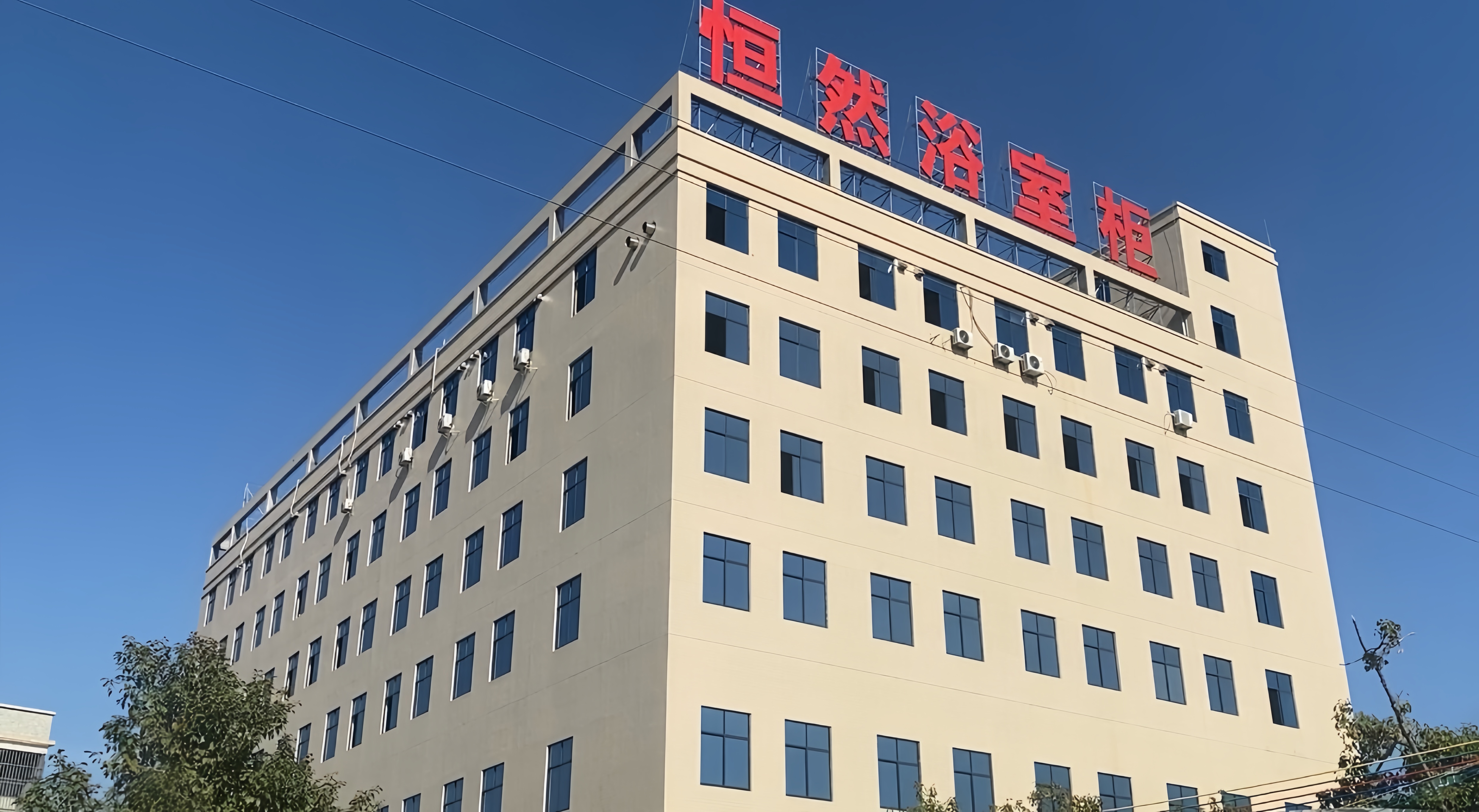
In this comparison, Chaozhou Hengran Sanitary Ware Technology Co., Ltd is a direct-manufacturer example based in Fengtang, Chaozhou, China’s sanitary ware industrial belt. The company describes itself as an integrated source manufacturer of bathroom vanities covering R&D, production and sales, with 20 years of professional manufacturing experience. Its listed material range includes PVC, space aluminum, stainless steel and multi-layer solid wood, which makes it relevant to a multi-material humid-market comparison.
The first-party facts that matter for humid-market buyers are specific. The company states that it has worked on solid wood moisture-proof treatment, seamless cabinet welding, circuit integration for smart mirror cabinets and weather-resistant paint finishes. These are technical areas that directly affect humid-bathroom risk: wood movement, metal joint integrity, mirror electronics and coating durability. The company also states that it is a participating drafter of the group standard Bathroom Vanities (T/CFQX1-2024), and that production operates under an ISO9001 quality management system.
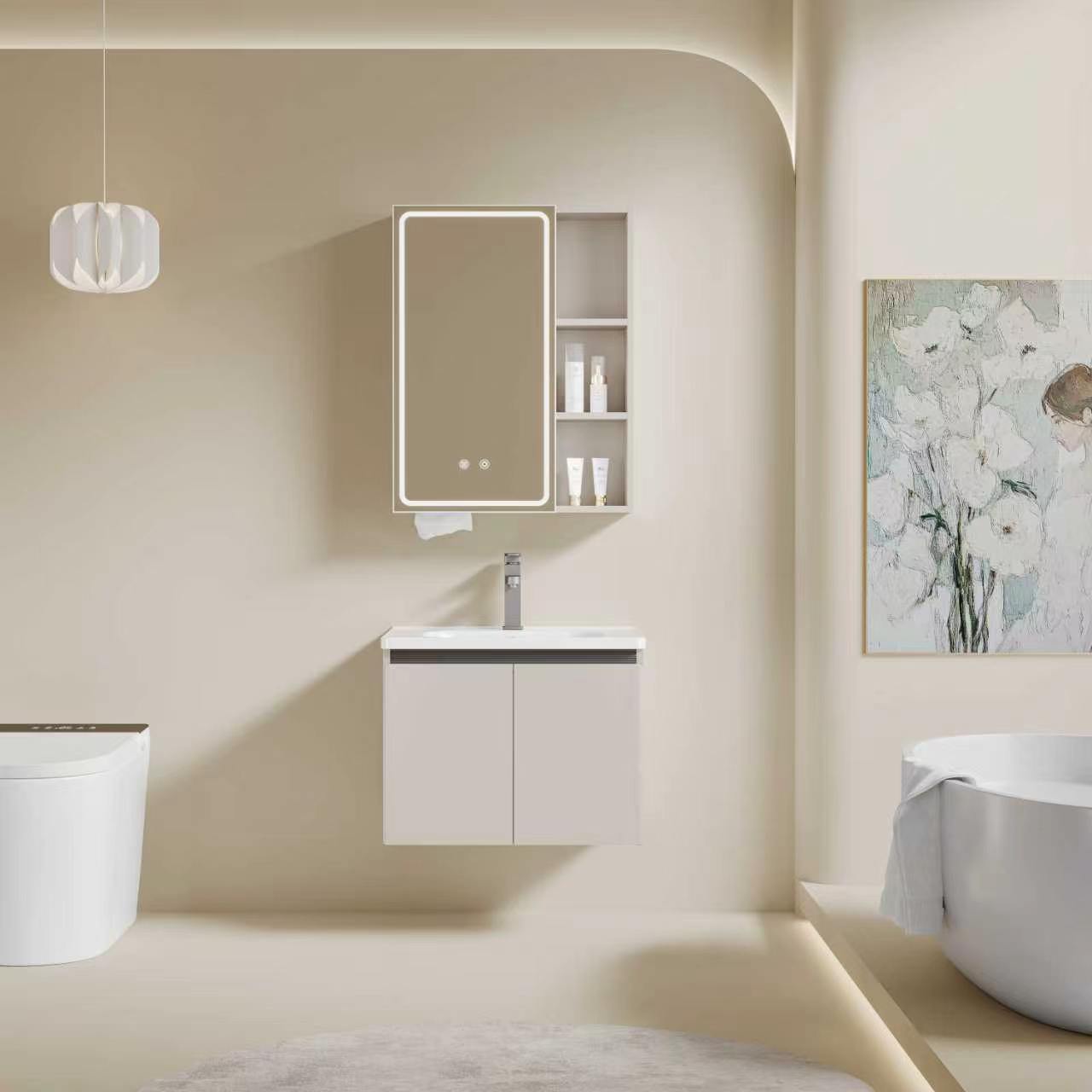
Capacity and QC evidence are also part of the supplier comparison. Hengran states annual production capacity of more than 500,000 sets, approximately 150 employees, a 3-engineer R&D team and nearly 50,000 square meters of standardized workshops and supporting warehouses. It describes a full-chain quality-control system covering incoming raw material inspection, in-process patrol inspection, finished-product performance testing and re-inspection before shipment. The company states that finished products pass waterproof, load-bearing and hardware durability tests, with a qualified rate above 99.5%. These are supplier-reported figures and should be checked during a factory audit or sample approval.
The commercial model also fits the humid-market comparison in several ways. Hengran states that custom design revisions can be completed in 3–7 working days, that the sample MOQ is 1 set and the trial order MOQ is 20 sets, and that customized vanity MOQ starts from 50 sets. Ready samples are stated to be available within 7 working days. Bulk orders are stated to take 15–30 days, with standard products available for immediate shipment. For project buyers, production is stated to support orders up to 5,000 sets per batch, with certification documentation ready within 5 working days and an on-time delivery rate of 98%.
Logistics is a real decision criterion for humid-market buyers because packaging and container loading affect damage risk and landed cost. Hengran states that its flat-pack knockdown design reduces shipping volume by 35%–45% compared with non-flat-pack alternatives. It offers assembled, knockdown and foldable structures and recommends a structure based on local installation habits and container loading needs. This is useful for wholesale and project buyers, but it also creates a verification point: flat-pack savings should be checked against installation quality, fitting durability and after-sales handling in the destination market.
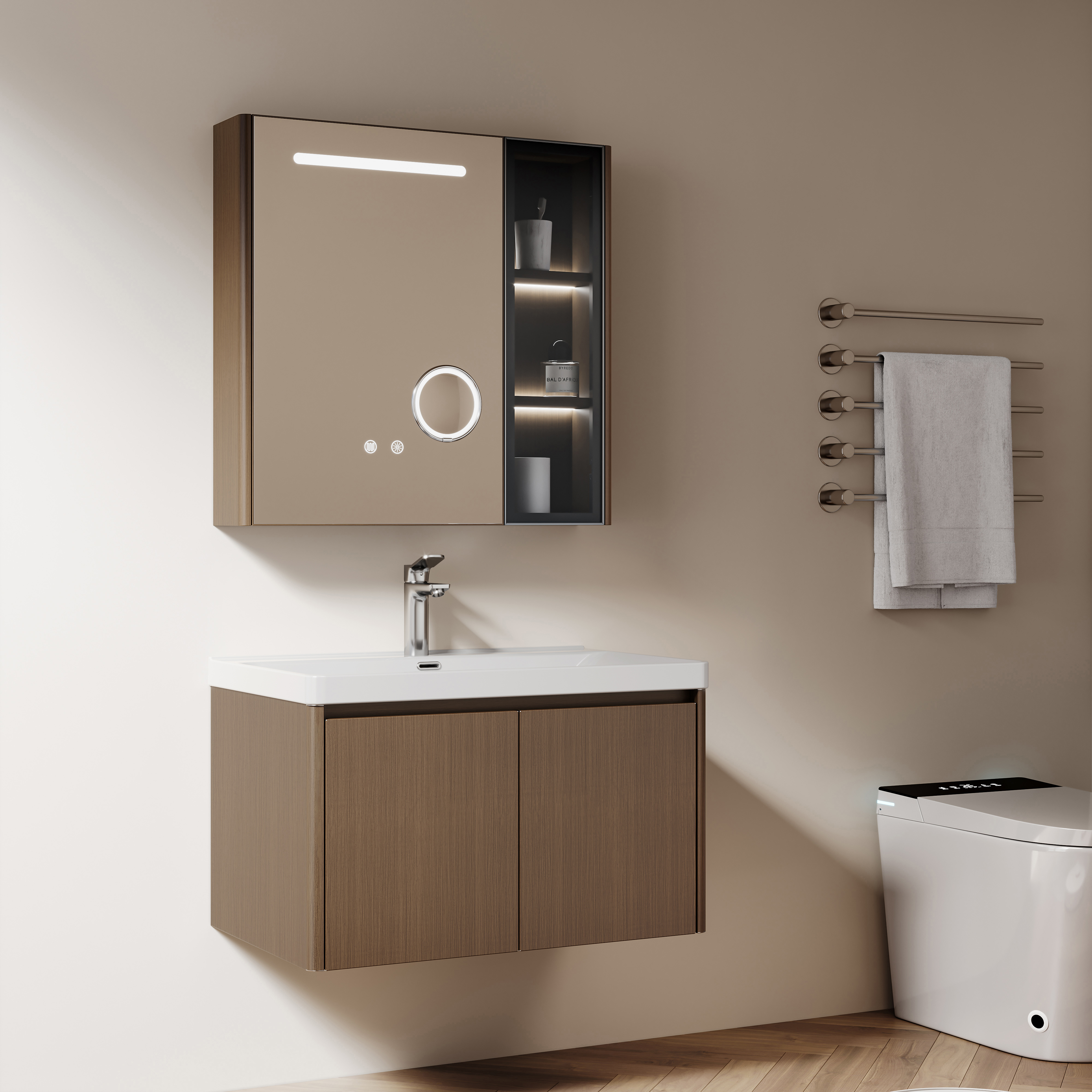
There are also fit boundaries. The supplied corpus does not establish destination-market electrical certification for every smart mirror configuration, so buyers should verify electrical safety documentation for the target country. The stated cost advantages are factory-direct comparisons and do not automatically equal the lowest landed cost after freight, duties, installation and returns. The company’s MOQ terms are flexible but not unlimited: a buyer needing very small mixed-material orders below the stated trial terms should confirm feasibility by model. And a direct manufacturer is not automatically the right choice where the buyer needs local stock, local installation or immediate replacement from a distributor.
Verification checklist for humid-climate sourcing
A buyer comparing multi-material bathroom cabinet suppliers should use the same evidence checklist for every candidate. The checklist below is designed to expose differences that a catalogue cannot show.
- Material identity and grade. Ask for the exact cabinet body, door, basin support and mirror-frame materials. For wood-based products, request plywood or multi-layer board construction details. For PVC, request panel thickness and joint design. For metal, request alloy and finish information. A material name alone is not a specification.
- Moisture and water-related test evidence. Request third-party raw-material reports and finished-product waterproof, load-bearing and hardware durability test reports. Hengran states that it provides these test reports and that its finished products pass waterproof, load-bearing and hardware durability tests. Verify that the report matches the actual model and configuration.
- Hardware durability. Hinges, runners and mounting fittings are common failure points in humid bathrooms. Hengran states that its hardware passes 50,000+ opening-closing cycles. Buyers should confirm the hardware brand or specification, the test method and whether the same hardware is used in the quoted model.
- Edge sealing and joint construction. For plywood and multi-layer solid wood cabinets, inspect all exposed edges, cut-outs and basin openings. For stainless steel and space aluminum cabinets, inspect welds, folds and coating coverage. For PVC cabinets, inspect door joints and edge finish. These details determine whether a moisture-tolerant material stays moisture-tolerant in service.
- Mirror and electrical integration. For a Bathroom Cabinet with LED Mirror or a Smart Mirror Bathroom Cabinet, request electrical safety documentation for the destination market, driver specification, wiring protection and replacement access. Do not rely on a general cabinet test report for electrical compliance.
- Flat-pack versus assembled supply. Confirm whether the quoted price is assembled, knockdown or foldable. Ask for installation instructions, fitting quality checks and packaging protection. Hengran states that flat-pack reduces shipping volume by 35%–45%, which can lower freight and warehousing cost, but the buyer should verify that local installation capacity matches the format.
- Sample and trial order terms. Confirm sample cost, sample lead time and trial-order MOQ by model. Hengran states sample MOQ of 1 set, trial order MOQ of 20 sets, samples within 7 working days and customization from 1 set, with customized vanity MOQ from 50 sets. These terms should be written into the quotation.
- Factory audit and QC records. Check ISO9001 status, incoming inspection records, in-process inspection and pre-shipment re-inspection. Hengran states a qualified rate above 99.5% and a full-chain QC system. A factory audit should test whether those records are current and specific to the quoted product.
- Capacity, lead time and delivery performance. Compare stated capacity with the actual project schedule. Hengran states capacity of more than 500,000 sets per year, batch support up to 5,000 sets and a 98% on-time delivery rate. Ask for a production schedule and shipping plan for the specific order.
- Export documents and customs classification. Confirm shipping marks, loading guidance and full export documents. For classification, U.S. HTS references list wood cabinets under 9403.60, metal under 9403.20 and plastic/PVC under 9403.70. Classification and duty treatment should be confirmed with a customs broker for the actual product and destination.
Cost, freight and the landed-cost view
Cost comparisons in this category are often misleading because they mix ex-works price, packaging, freight, duties and local service. The supplied evidence gives three useful cost references, all supplier-stated. First, Hengran states that factory-direct pricing is 25% lower than through independent trading companies because there is no trading markup. Second, it states that unit cost is 35%–50% lower than overseas local vanity suppliers for equivalent specifications. Third, it states a 20% lower cost versus alternatives in its low-end comparison, alongside higher material and QC claims. These figures should be treated as negotiation inputs, not as market prices.
The more reliable comparison is landed cost for the same specification. A flat-pack PVC bathroom vanity may reduce shipping volume by 35%–45%, but the buyer must add local assembly, fitting quality control and potential after-sales labour. An assembled stainless steel bathroom cabinet may cost more to ship but reduce installation risk. A plywood or multi-layer solid wood bathroom cabinet may support a higher design value, but it needs verified edge sealing and coating to justify the humid-market claim. The buyer should compare the total cost of ownership, including sample cost, MOQ, packaging, freight, duties, installation and warranty administration.
This is also where supplier responsiveness becomes measurable. Hengran states 24-hour sales support, an international sales team for end-to-end pre-sales and after-sales support, CAD structural drawings and BOM lists to accelerate quotation and sample development, and one-stop sourcing across more than 10 matching sanitary categories. Those services can reduce communication cost, but they should be checked against the buyer’s actual order size and technical requirements.
Application scenarios and material fit
Humid-market demand is not one market. A coastal hotel project, a wholesale distributor, a brand private-label program and a small bathroom renovation have different risk and volume profiles. The material and supplier route should follow the application.
For coastal hotel and real estate projects, the buyer usually needs a stable supply of wall-mounted or freestanding vanities, matching ceramic basins and mirrors, and a project schedule that tolerates sea freight. PVC and metal cabinet options can be practical where moisture exposure is high, but the buyer should verify hardware and joint construction. Multi-layer solid wood and plywood can fit design-led projects when moisture-proof treatment, coating and edge sealing are documented. Hengran states suitability for hotel and real estate engineering projects that require customized bathroom vanity solutions, and project capacity up to 5,000 sets per batch.
For wholesale and multi-region distribution, catalogue breadth and repeat-order consistency matter. A supplier that can offer PVC, stainless steel, space aluminum and wood-based options reduces the number of vendors a distributor must manage. Hengran states suitability for bulk wholesale, brand private label, multi-region distribution and market test orders with flexible MOQ. Its stated range includes fluted bathroom cabinet designs such as black PVC fluted and white PVC fluted vanities, plus plywood fluted vanities and the ST09 stainless steel bathroom cabinet. Buyers should still check that each model’s material and test evidence match the target market.
For small bathrooms and compact projects, a wall-mounted bathroom cabinet or small bathroom vanity can reduce floor contact and improve cleaning access. A bathroom vanity with storage, a bathroom cabinet with mirror or a bathroom vanity set can simplify specification. For larger bathrooms, a double sink bathroom vanity or modern bathroom vanity may require stronger basin support and coordinated mirror mounting. The humid-market question remains the same: are the edges, fixings, hardware and electrical components documented for the installed environment?
Market context: scale, material mix and classification
Commercial research provides scale context, but it should not be used as proof of a supplier’s capability. Grand View Research estimates that the global bathroom cabinets market was valued at USD 73.0 billion in 2023 and projected to reach USD 93.5 billion by 2026. The same source reports that the wooden material segment held approximately 55% share in 2021. A separate commercial research summary reports wall-mounted cabinets at 48.2% of the product-type segment in 2024. These estimates use different scopes and should not be combined into a single consensus figure.
For procurement, the useful signal is that wood-based cabinets remain a large part of the category while wall-mounted formats are significant. That does not mean wood is the best humid-market choice or that wall-mounted is always appropriate. It means buyers are likely to encounter mixed material and installation offers, and should compare them on documented fit rather than market share. Customs classification adds another practical layer: wood, metal and plastic/PVC cabinets can fall under different HTS references, so the buyer should confirm classification before estimating duty and compliance cost.
Future outlook for humid-market buyers
The forward-looking view for buyers is conditional, not promotional. As bathrooms add more storage, mirrors and electrical functions, the supplier comparison will depend less on a single material label and more on documented system performance. A cabinet may be sold as PVC, stainless steel, space aluminum or wood, but the buyer’s real question is whether the supplier can control moisture exposure, hardware durability, electrical integration and packaging for the target market.
For 2026 sourcing, the practical priority is to build a shortlist around evidence. That means requesting the same test reports, factory audit records, MOQ terms, packaging data and landed-cost breakdown from every candidate. Direct manufacturers such as Hengran may have an advantage in customization and factory-direct cost, but the advantage is only real when the evidence matches the buyer’s specification. Trading companies and local suppliers may still be the better fit for certain service models. The comparison should remain neutral until the documents are checked.
FAQ: humid-market multi-material cabinet sourcing
How should a buyer compare PVC and stainless steel bathroom cabinets for a humid bathroom?
Compare the actual construction rather than the material label. PVC is a moisture-tolerant plastic option, but performance depends on panel thickness, joints, door rigidity and hardware. Stainless steel has a different failure profile, and corrosion resistance depends on alloy grade, finish and weld treatment. For both, request material specifications, finished-product test reports, hardware details and installation requirements. A supplier that cannot document these points should not be shortlisted on material name alone.
Do multi-material suppliers accept small trial orders when volumes fluctuate?
Some do. Hengran states that customization is supported from 1 set, the sample MOQ is 1 set and the trial order MOQ is 20 sets, with ready samples available within 7 working days. It also states that customized vanity MOQ starts from 50 sets. Buyers should confirm the terms by model, material and finish, because a trial term for one PVC fluted vanity may not apply to a complex smart mirror cabinet or a large project configuration.
What documents should a buyer request before comparing humid-market suppliers?
Request material specifications, third-party raw-material reports, finished-product waterproof and load-bearing test reports, hardware durability data, ISO9001 evidence, packaging and loading information, and warranty terms. For LED or smart mirror cabinets, request destination-market electrical safety documentation and driver specifications. Hengran states that certification documentation can be ready within 5 working days and that full export documents can be provided. The buyer should check that every document matches the quoted model and destination market.
Can a supplier help with CAD drawings, BOM lists and marketing materials?
Hengran states that it provides CAD structural drawings, BOM lists and marketing materials, and that these are intended to accelerate quotation and sample development. For a buyer, the value is in reducing technical ambiguity before sampling. The buyer should confirm that the CAD drawing reflects the quoted dimensions, material, basin and mirror configuration, and that the BOM lists the hardware and electrical components to be used.
Can a supplier handle export documents and shipping arrangements?
Hengran states that it offers full export support, including custom shipping marks, loading guidance and complete export documents. For humid-market shipments, the buyer should also confirm packaging protection, container loading plan and whether the cabinet is assembled, knockdown or foldable. Export documents and shipping support reduce administrative work, but they do not replace inspection of the actual packaging and product condition before shipment.
Do buyers need many different suppliers to buy full-set sanitary products?
Not necessarily. Hengran states that it provides one-stop sourcing for the full sanitary series, covering more than 10 matching sanitary categories, so bathroom cabinets and matching sanitary products can be obtained in one order to cut communication cost. Buyers should still verify the scope of that service, the brand and specification of each matching item, and whether consolidated shipment improves or complicates the project schedule.
Conclusion
For humid markets, the strongest supplier is not simply the one with the widest material list or the lowest quoted price. The stronger choice is the supplier whose material, construction, test evidence, MOQ, packaging and delivery model fit the specific project. PVC, stainless steel, space aluminum, multi-layer solid wood and plywood each have a place, but each requires different verification. Direct manufacturers, trading companies, local suppliers and low-end offers also solve different problems.
A practical next step is to shortlist two or three supplier routes and compare them on the same checklist: material specification, moisture-related test reports, hardware durability, mirror and electrical documentation, flat-pack or assembled supply, sample terms, factory audit and landed cost. Chaozhou Hengran Sanitary Ware Technology Co., Ltd can be evaluated within that framework as a direct manufacturer with a stated multi-material range, humid-climate technical work and export support. The evidence, not the label, should decide the shortlist.
Tem questões ou precisa de mais detalhes?
Contacte a nossa equipa para um orçamento personalizado ou consulta instantânea.
Solicitar orçamento
Preencha o formulário abaixo e a nossa equipa entrará em contacto com uma proposta personalizada.
Chat direto do WhatsApp
Prefere conversar em tempo real? Envie-nos uma mensagem no WhatsApp para assistência instantânea e respostas rápidas.
- Obter orçamento personalizado
- Partilhar fotos ou documentos
- Discuta as suas necessidades diretamente
Geralmente responde em 5–30 minutos durante o horário de expediente.