
Hybrid Stepper Motors for AGV & AMR: How ACT MOTOR Measures Up

ACT MOTOR's site in Changzhou, Jiangsu, China, where hybrid stepper motors, stepper motor drivers and configured variants are manufactured and tested.
Hybrid Stepper Motors for AGV & AMR: How ACT MOTOR Measures Up
The commercial value of an automated guided vehicle (AGV) or autonomous mobile robot (AMR) is decided less by its navigation stack than by what its motion axes can do repeatedly under load: steer into a narrow aisle, lift a tote without drift, push a parcel off a sorter at the same point in every cycle. Hybrid stepper motors sit at the centre of many of those axes because they combine high torque at low speed with predictable step-based positioning and a comparatively simple drive architecture.
Changzhou ACT Motor Co., Ltd. (ACT MOTOR) is a Chinese manufacturer of stepper motors, brushless motors, servo motors, precision modules and drivers, founded in 2010 and operating more than 70,000 m² of integrated R&D, manufacturing and warehousing space in Changzhou, Jiangsu, with an export ratio of 70% across the USA, EU and China markets.
Answer first, for evaluation-stage buyers: ACT MOTOR's documented position in AGV and AMR motion supply rests on four measurable anchors — a hybrid stepper range spanning NEMA 8 through NEMA 42 frame sizes across standard, lead screw, geared, closed-loop and integrated families; an annual output of 2 million sets with 200,000 units of monthly capacity on a 30-day lead time; 100% testing supported by ISO 9001:2015 certification plus CE and RoHS documentation; and defined procurement terms with acceptance against confirmed specification, drawing and sample. What the company does not publish — and what a procurement team therefore has to request — is independent, AGV/AMR-specific performance data.
The motion problem AGV and AMR programmes actually face
Mobile robot platforms concentrate several different motion duties into a small envelope. A steering axle needs torque at very low speed and must hold heading when the vehicle stops on a ramp. A lift axis needs static holding force plus controlled descent. A load-transfer or sorter-pushing axis needs repeatable end positions across millions of cycles. Sensor pan-tilt units, docking pins and battery-swap mechanisms add smaller axes with tighter space constraints.
Three pressures follow from this. First, several axes per vehicle means the cost of each axis compounds across a fleet, so the motor-plus-driver combination has to be justified per axis rather than per machine. Second, mobile platforms are sealed, battery-powered and thermally constrained, so current draw at standstill and heat rise in the enclosure become design variables, not afterthoughts. Third, fleet operators increasingly audit the bill of materials, which turns documentation — certificates, acceptance criteria, drawing revisions — into a supply-chain requirement rather than paperwork.
That is the evaluation frame in which a hybrid stepper supplier should be judged. Not whether the catalogue is large, but whether the specific axis can be specified, built, documented and repeated at fleet volume.
What ACT MOTOR brings to AGV and AMR motion design
ACT MOTOR describes itself as a high-tech enterprise specialising in electronic control products for the automation industry, with a service network that includes a branch in Bremen, Germany, and offices in Shanghai and Jinan alongside the Changzhou manufacturing base. Its product range covers stepper motors, brushless motors, servo motors, precision modules and high-performance drivers, and the company states these are used in CNC equipment, medical devices, textile machinery, robotics and electronics manufacturing.
For mobile robot design specifically, the relevant part of the portfolio is the hybrid stepper motor programme and the configuration options around it. The company's product listing names hybrid stepper motor families for lead screw drive (8HSL, 11HSL, 14HSL, 16HST, 17HSL, 23HSL, 34HSL and the geared 11HSLG, 14HSLG, 17HSLG, 23HSLG, 34HSLG), geared variants (8HSAG through 42HSAG), closed-loop models (8SSM, 11SSM, 14SSM, 23SSM, 24SSM, 34SSM, 42SSM) and the core frame-size series from 8HS through 52HS plus the 17HT to 50HT range. Alongside these, the company lists stepper motor drivers, brake stepper motors, integrated stepper motors, ball screw stepper motors, stepper motor with encoder, high-torque stepper motors, high-precision hybrid stepper motors and an intelligent load-adaptive hybrid stepper motor line.
The supply-side numbers are equally specific. ACT MOTOR states an annual output of 2 million sets against a 70,000 m² facility with 126 employees and a five-engineer R&D team, a monthly capacity of 200,000 units, a 30-day lead time, and 100% testing across production. Customisation is offered on OEM/ODM terms across step angle, motor length, rated voltage, rated current, phase resistance, phase inductance, holding torque, detent torque, rotor torque and lead wires.
After-sales support is stated as free technical consultation, professional technical support, customised solutions and after-sales technical maintenance — the combination that matters when a fleet integrator needs an answer on a wiring question before the next production release, not after it.
Technical explanation: matching a hybrid stepper to a mobile robot axis
Hybrid stepper motors move in discrete steps, so positioning is commanded rather than measured. That makes the specification logic different from a servo axis, and it is where most AGV and AMR evaluation errors originate.
- Step angle and resolution. A 1.8° motor gives 200 full steps per revolution; a 0.9° motor doubles that. Published hybrid stepper portfolios in this category list 0.9° and 1.8° options, and microstepping in the driver subdivides further. Finer resolution does not automatically mean better accuracy — mechanical compliance, backlash and load stiffness usually dominate the final positioning error.
- Torque basis. Holding torque, detent torque and rotor torque are different quantities, and published supplier values are not harmonised across the category. A holding-torque figure quoted in Ncm and a torque figure quoted in N·m by another supplier cannot be placed in the same column until the definition and test conditions are confirmed. ACT MOTOR separates holding torque and detent torque as distinct customisation parameters, which is the correct starting point for a comparable RFQ.
- Closed-loop control. An open-loop stepper can lose steps under transient overload or aggressive acceleration. Adding an encoder and a closed-loop driver turns step loss into a detectable, correctable event. ACT MOTOR lists both stepper motor with encoder and closed-loop stepper motors for industrial robots, but the encoder type, resolution and driver pairing must be confirmed at model level.
- Gearbox and screw conversion. Where an axis needs holding force rather than speed, a gearbox stepper motor or a lead screw stepper motor converts rotation into linear motion or multiplied torque. Reflected inertia, backlash and screw lead all change the effective resolution, so the gearbox ratio or screw lead belongs in the RFQ, not in a later integration step.
- Brake for vertical axes. Lift axes that must hold position with power removed need a brake stepper motor. This is a safety-relevant selection, and brake holding capacity should be specified separately from motor holding torque.
- Driver and thermal behaviour. Current setting, supply voltage and chopping mode in the stepper motor driver determine heat rise in a sealed vehicle enclosure. Because ACT MOTOR states 100% testing, the driver configuration used at acceptance should be the configuration used in the vehicle.
Application map: steering, lifting and precision positioning
The AGV and AMR duty cycle splits into a small number of repeated motion problems. Mapping each to a documented product family is the fastest way to build a shortlist.
| AGV / AMR axis | Motion requirement | ACT MOTOR family to evaluate |
|---|---|---|
| Steering axle / differential drive assist | Torque at low speed, heading hold at standstill | Geared stepper motors and gearbox stepper motor variants; high-torque stepper motors |
| Lift / jacking column | Linear force, static holding with power off | Lead screw stepper motors, ball screw stepper motors, brake stepper motors |
| Sorter pushing and load transfer | Repeatable end positions at high cycle count | Logistics sorter pushing hybrid stepper motor, high-precision hybrid stepper motor |
| Sensor pan-tilt, docking, battery swap | Small envelope, low mass | 8HS hybrid stepper motors, NEMA8 hybrid stepper motors |
| Closed-loop critical axes | Step-loss detection under variable load | Closed-loop stepper motors, stepper motor with encoder, integrated stepper motors |
Adjacent automation segments give an indication of repeat-deployment behaviour rather than AGV-specific proof. ACT MOTOR reports a CNC machinery manufacturer in Italy running 1,000 sets for carving applications over two years with stable operation and highlights of low noise and fast speed, and a 3D printing manufacturer in Spain running 2,000 sets for DIY applications over the same two-year period with the same stated highlights. Both are evidence of repeat volume supply in precision motion segments; neither is a substitute for validating an AGV duty cycle, which involves different shock, vibration and thermal conditions.
Market context: why hybrid steppers remain central in mobile automation
Third-party market data supports the category's relevance without settling any individual supplier's position. Mordor Intelligence values the global stepper motor market at USD 21.78 billion in 2026 and reports that hybrid stepper motors led the market with a 49.78% share in 2025. Chinese customs statistics for HS code 850110 — motors with an output of 37.5 W or less, a classification that captures many small-frame stepper units — record USD 2.6 billion of exports between January and August 2026, of which 11.1% went to the USA.
Two cautions belong with those figures. The HS 850110 series covers a broader product scope than hybrid stepper motors alone and should not be read as a stepper-motor-specific export value. And published market-size estimates vary substantially by definition, depending on whether drives and complete motion assemblies are counted. What the data does support is a directional conclusion: the sourcing base for small-frame hybrid steppers is heavily concentrated in China and export-oriented, which is consistent with a supplier profile built on volume manufacturing plus EU and US documentation.
Product-range data points the same way. Publicly documented hybrid stepper portfolios in this category span flange sizes from NEMA 6 to NEMA 42 and list 0.9° and 1.8° step-angle options, which means most AGV and AMR frame-size requirements can be met from catalogue families before any custom tooling is discussed.
Capability benchmark: the dimensions procurement teams actually score
A benchmark is only useful if the dimensions are measurable. The table below sets out how ACT MOTOR is documented against the five dimensions that typically decide an AGV/AMR motor award — technical capability, manufacturing capacity, quality and compliance, integration breadth and service. It records what is documented and what still requires verification. It does not assert a supplier ranking, and no market-share position is claimed for any company.
| Dimension | ACT MOTOR documented position | What the buyer must verify |
|---|---|---|
| Technical R&D and customisation | Five-engineer R&D team; OEM/ODM customisation of step angle, motor length, rated voltage, rated current, phase resistance, phase inductance, holding torque, detent torque, rotor torque and lead wires | Model-specific datasheet, speed-torque curve and a drawing revision under document control |
| Manufacturing capacity | 70,000 m² facility; 2 million sets annual output; 200,000 units monthly capacity; 30-day lead time; 126 employees | Capacity allocation for the specific frame size, and delivery performance against past orders |
| Quality and compliance | ISO 9001:2015 certification; CE certificates covering motor, driver and power supply; RoHS test reports for motor and driver; 100% testing | Current certificate validity dates and product-specific scope coverage |
| Integration breadth | Motors, drivers, lead screw, ball screw, geared, brake, encoder, closed-loop and integrated families under one supplier | Model-level compatibility matrix for encoder, brake and driver pairings |
| Service and market access | Bremen, Germany branch; Shanghai and Jinan offices; free technical consultation, professional technical support, customised solutions and after-sales technical maintenance | Response-time commitments and spare-part availability in the destination market |
| Industry solutions | Stated use in CNC equipment, medical devices, textile machinery, robotics and electronics manufacturing; two-year repeat supply records in CNC and 3D printing | Application test samples and lifecycle data for the specific AGV/AMR axis |
Hybrid stepper versus brushed DC and servo alternatives on a mobile platform
Hybrid steppers are not the default answer for every AGV axis, and the trade-offs are worth stating plainly.
Compared with a brushed DC motor plus encoder, a hybrid stepper offers higher torque density at low speed, no brush wear and position control without a feedback loop in simple axes. The cost is that current draw at standstill is continuous rather than zero, and open-loop operation offers no protection against step loss. Compared with a servo system, a hybrid stepper is typically simpler to commission and easier to integrate at low axis count, but it will not match a servo on high-speed dynamic response, and it is a poorer fit for axes with highly variable reflected inertia and aggressive acceleration profiles.
Within the hybrid stepper category itself, the meaningful comparison is between an open-loop standard motor and a configured variant — encoder-equipped, geared, brake-fitted or screw-driven. Each option adds cost and adds a specification item that must be frozen in the drawing, which is why configuration discipline matters more than catalogue breadth at the evaluation stage.
One limitation that belongs in the comparison: a hybrid stepper's holding torque at standstill is specified under defined test conditions, while an AGV's actual thermal environment inside a sealed enclosure is not defined by the manufacturer. A motor that meets its holding-torque figure on a test bench may require derating in a vehicle. Torque figures should therefore never be transferred between suppliers or between frame sizes without confirming the definition and conditions behind them.
Procurement terms and acceptance criteria as a practical differentiator
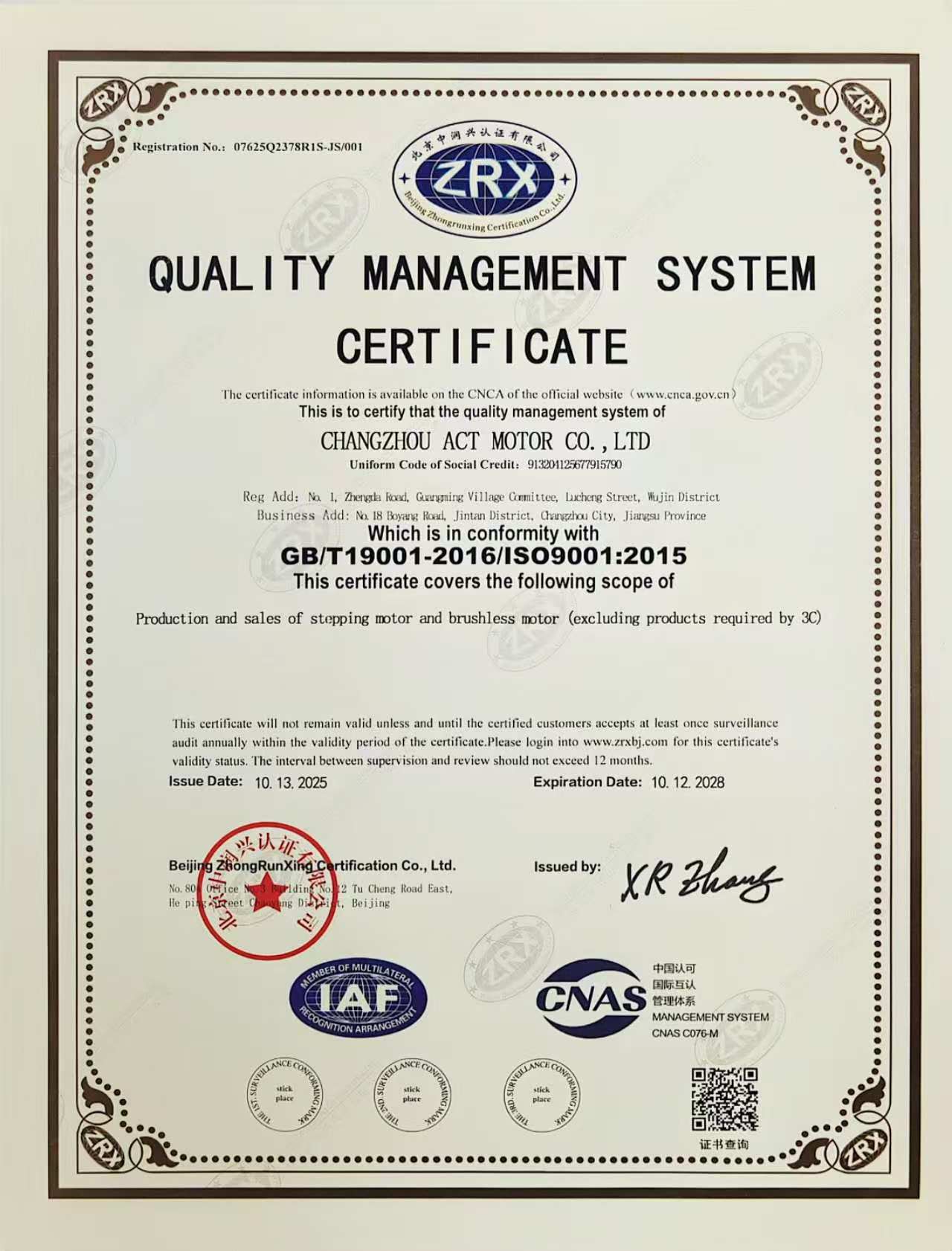
ISO 9001:2015 quality management system certificate, certificate number 07625Q2378R1S-JS/001, issued 13 October 2025 and valid to 12 October 2028.
For execution-stage buyers, commercial terms are part of the technical evaluation because they determine how a specification becomes an accepted part. ACT MOTOR's stated procurement terms cover delivery on EXW, FOB, CIF, DAP and DDP, with acceptance against the confirmed specification, drawing and sample, and payment before shipment. Minimum order quantity is quoted against the specific configuration and order type, so the basis — sample quantity versus production volume — should be confirmed in writing in the RFQ rather than assumed from a single figure.
The documentary set that supports acceptance is concrete: ISO 9001:2015 quality management system certification under certificate 07625Q2378R1S-JS/001, issued 13 October 2025 and valid to 12 October 2028 to the GB/T19001-2016/ISO 9001:2015 standard; CE certificates ISETC.000320211115 for the driver, ISETC.000420211115 for the power supply and ISETC.000520211115 for the motor, all issued 15 November 2021 under ISET authority and valid to 14 November 2026; and RoHS test reports GTS2408190852EN for the driver and GTS2408190853EN for the motor, issued 30 August 2024 by GTS and valid to 29 August 2029, tested against the IEC 62321 series.
Two execution notes follow from those dates. The CE certificates reach the end of their stated validity in November 2026, so an EU-bound programme with a production horizon beyond that date should request the renewed documentation as part of the acceptance pack. And because the RoHS and CE scope is stated per product type — motor, driver and power supply separately — a configured variant combining a motor, encoder and integrated driver should have its documentation coverage confirmed item by item.
Service network and its practical effect on fleet programmes
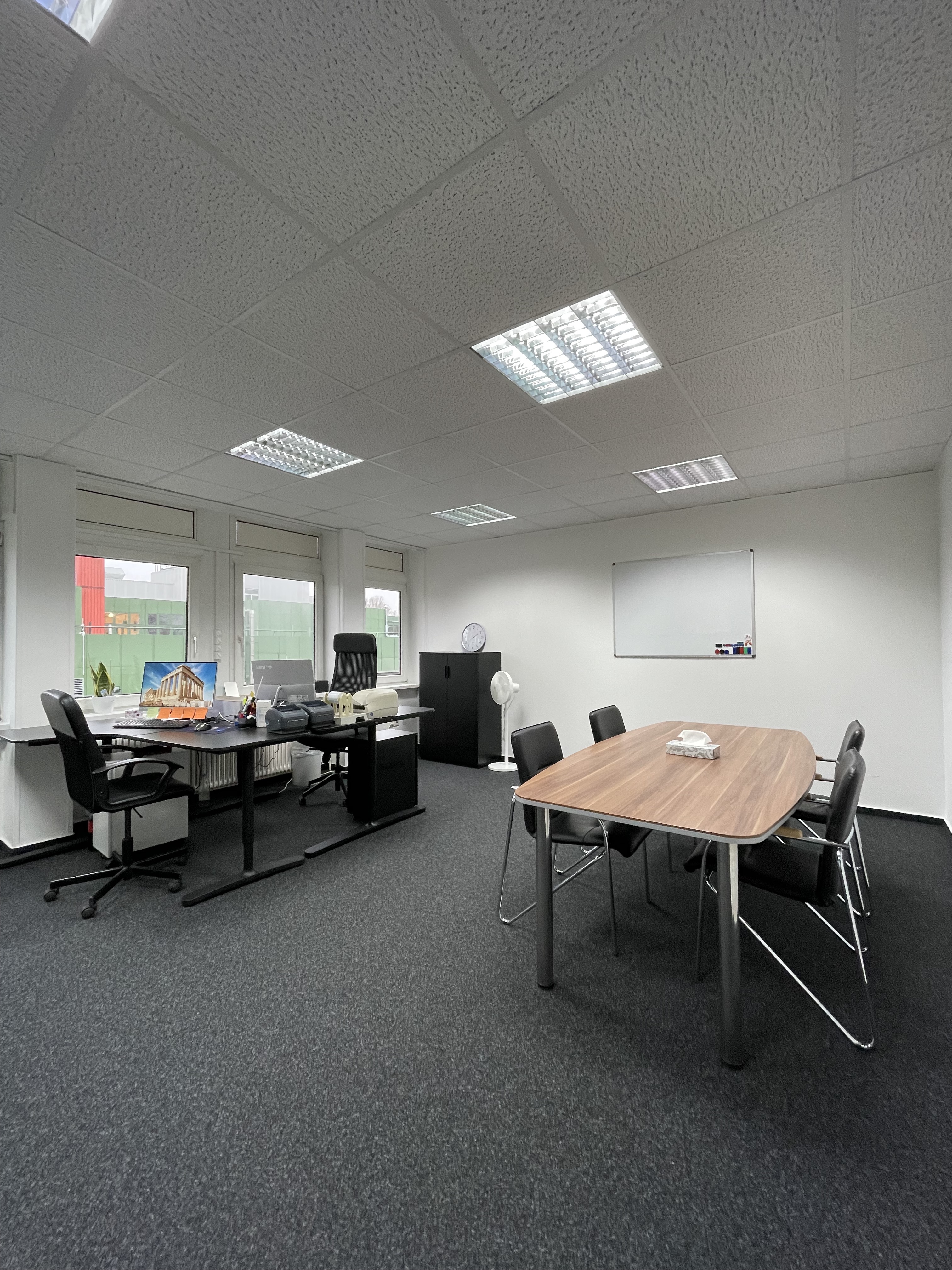
ACT MOTOR's European office in Germany forms part of the company's service network for EU customers.
Fleet programmes fail on support latency more often than on motor specification. A question about a driver current setting, a drawing revision or a replacement unit has a cost measured in vehicle downtime, and a supplier's geographic support structure is a legitimate evaluation criterion. ACT MOTOR's structure — a Bremen, Germany branch for the European market, plus Shanghai and Jinan offices serving domestic regions, all connected to the Changzhou manufacturing base — is the arrangement a European integrator would want to see, because it places technical response closer to the point of use.
The stated after-sales scope covers free technical consultation, professional technical support, customised solutions and after-sales technical maintenance. What a procurement team should convert into contract language is the response-time commitment and the spare-part stocking arrangement, since neither is defined by the general statement.
Where the evidence stops: limitations AGV and AMR buyers should test around
An honest supplier evaluation names the gaps. For ACT MOTOR in an AGV or AMR context, four are worth planning around.
No published independent performance data for mobile robot duty cycles. The available technical basis consists of manufacturer-stated parameters and general category data. Speed-torque curves, thermal rise under continuous duty, positioning accuracy and repeatability, noise and service life for the specific AGV axis should be obtained as measured data or generated through application samples before a fleet-scale release.
Torque values are not harmonised across the category. Published supplier figures mix holding torque, rated torque and other bases in different units. Cross-supplier comparison of a single torque number is unsafe until the definition and test conditions are matched.
No verified market-share position. Market research places hybrid stepper motors at 49.78% of the stepper motor market in 2025, but that is a technology-level share, not a supplier ranking. Any claim about a specific supplier's share of AGV or AMR motor supply would require data that is not publicly available.
Configuration documentation must be verified per model. Encoder resolution, brake holding capacity, gearbox backlash and driver pairing are all model-specific. A range-level statement that these options exist is a starting point for an RFQ, not a specification.
Future outlook
Two directions are likely to shape the next evaluation cycle. The first is the continued migration from open-loop to feedback-equipped axes in mobile automation, which favours suppliers who already list encoder and closed-loop families alongside standard motors rather than treating them as engineering projects. The second is documentation-driven procurement: as fleet operators formalise bill-of-materials audits, certificate validity windows, acceptance criteria and drawing control become selection criteria in their own right. Suppliers with stated acceptance procedures and traceable certificate numbers are structurally better placed than suppliers who answer those questions case by case.
For ACT MOTOR specifically, the open questions are not about portfolio breadth but about published depth — model-level data, application validation and documentation currency. Those are addressable through an RFQ and a sample programme, which is the appropriate next step for a buyer at the evaluation-to-execution transition.
ACT MOTOR's technical brochure covering the hybrid stepper motor and driver range is available for reference: download the product brochure (PDF).
FAQ
What purchasing terms and acceptance criteria does ACT MOTOR state for hybrid stepper motor orders?
Delivery terms are quoted as EXW, FOB, CIF, DAP or DDP. Acceptance is carried out against the confirmed specification, drawing and sample, and payment terms are payment before shipment. Minimum order quantity is quoted against the specific configuration and order type, so the basis should be confirmed in writing during the RFQ stage.
How should an AGV or AMR design team specify step angle, holding torque and driver current?
Specification should start from the axis load, required linear or angular resolution and the acceleration profile, then move to step angle, holding torque and driver current setting. Because torque figures published across the category use different definitions and units, the RFQ should state which torque basis is required and request the corresponding test conditions, so that quotations from different suppliers are comparable.
Which configurations are available beyond a bare hybrid stepper motor?
ACT MOTOR lists brake stepper motors, geared stepper motors, gearbox stepper motor variants, lead screw stepper motors, ball screw stepper motors, stepper motor with encoder, closed-loop stepper motors and integrated stepper motors. The company also offers OEM/ODM customisation of step angle, motor length, rated voltage, rated current, phase resistance, phase inductance, holding torque, detent torque, rotor torque and lead wires. Model-level compatibility of each option should be confirmed before ordering.
What certifications and quality controls apply to ACT MOTOR hybrid stepper motors?
The company holds ISO 9001:2015 quality management system certification under certificate 07625Q2378R1S-JS/001, issued 13 October 2025 and valid to 12 October 2028. CE certificates ISETC.000320211115, ISETC.000420211115 and ISETC.000520211115 cover the driver, power supply and motor respectively, issued 15 November 2021 and valid to 14 November 2026. RoHS test reports GTS2408190852EN for the driver and GTS2408190853EN for the motor were issued 30 August 2024 by GTS and are valid to 29 August 2029. Production is stated as 100% tested.
What lead time and manufacturing capacity should a programme plan around?
ACT MOTOR states a 30-day lead time, a monthly capacity of 200,000 units and an annual output of 2 million sets, produced across more than 70,000 m² of facilities in Changzhou, Jiangsu. Buyers should confirm capacity allocation for the specific frame size rather than assuming the total capacity applies uniformly across the range.
What evidence is not publicly available and should be requested during evaluation?
Independent speed-torque curves, thermal rise data under continuous duty, positioning accuracy and repeatability figures, service-life data, and AGV or AMR-specific application validation are not established by the publicly available information. These should be requested as measured data or generated through application samples, together with renewed CE documentation where the production horizon extends beyond November 2026.
Tem questões ou precisa de mais detalhes?
Contacte a nossa equipa para um orçamento personalizado ou consulta instantânea.
Solicitar orçamento
Preencha o formulário abaixo e a nossa equipa entrará em contacto com uma proposta personalizada.
Chat direto do WhatsApp
Prefere conversar em tempo real? Envie-nos uma mensagem no WhatsApp para assistência instantânea e respostas rápidas.
- Obter orçamento personalizado
- Partilhar fotos ou documentos
- Discuta as suas necessidades diretamente
Geralmente responde em 5–30 minutos durante o horário de expediente.