
Hydration & Soothing Toner Mist OEM: Post-Sun and Post-Workout Fit
Hydration & Soothing Toner Mist OEM: Post-Sun and Post-Workout Fit
Post-sun and post-workout skincare is no longer a marketing occasion attached to an existing facial mist. For brand owners buying Cosmetic Aerosol Products OEM, it has become a separate production brief with its own packaging logic, formulation constraints, logistics file and claim boundaries — and the format decision now sits in front of the formula decision.
A hydration and soothing toner mist designed for these two occasions has to do three things at the same time: deliver light hydration to skin that is warm or freshly cleansed, allow reapplication without a mirror, cotton pad or clean hands, and pass the regulatory and dangerous-goods scrutiny that applies to every pressurized cosmetic. That combination is what makes the brief different from a desk-side misting product, and it is the reason the OEM conversation starts earlier than most brands expect.

Formulation work for a water-based toner mist begins with the preservative system and spray behaviour, not with the fragrance.
Two Occasions That Behave Nothing Like Desk-Side Misting
The post-sun occasion and the post-workout occasion share a consumer behaviour — repeated, hands-free, on-the-move application — but they place different demands on a formulation and on the container.
Post-sun
- Skin is warm and may still carry sunscreen residue, salt water, chlorinated water or sand. The product is reapplied over another layer rather than onto bare, dry skin.
- Use happens outdoors, at the beach or poolside, and inside a bag. Storage temperature and physical impact become real concerns for any pressurized can.
- Consumers often want the cooling and re-wetting sensation more than a heavy moisturising step, which pushes the brief toward water-based, fast-absorbing systems rather than occlusive ones.
- Because the product sits next to sun care in the consumer's routine, the brand's sun-care and after-sun items are usually developed and sourced together, and the packaging family has to look coherent on shelf.
Post-workout
- Skin carries sweat and sebum. The mist is used either as a pre-cleanse refresh or immediately after cleansing, and both paths change how the formula must behave on the skin.
- Application is fast and often public — in a gym changing room, at the side of a running track. One-handed operation, a controlled spray pattern and a non-dripping output matter more than fine fragrance complexity.
- Frequency is higher than a typical facial mist: the same consumer may use it several times a week, which raises the importance of a preservative system validated for repeated multi-dose use.
- Fragrance becomes functional rather than decorative. It is part of the refresh experience, and it is one of the easiest specification points for an OEM buyer to customise.
Both occasions reward a light texture and punish anything that feels like a film. They also reward the spray format itself: a toner mist that can be re-sprayed at any time of day, hydrating the skin for a dewy, glowing complexion, fits the moment better than a product that requires pouring, patting or a second tool.
From Consumer Moment to Production Brief
The practical work of an OEM buyer is translating these moments into decisions a factory can quote and a regulatory file can support. The table below maps the four requirements that recur most often in this category to the decisions they trigger.
| Scenario requirement | Decision it triggers | What the buyer must specify |
|---|---|---|
| Reapplication over sunscreen or makeup without disturbing it | Valve and actuator selection; spray pattern validation | Target spray character, acceptable wetness on skin, tolerance for visible droplets |
| Use at any angle — lying down, arms overhead, one-handed | Bag-on-valve (BOV) versus conventional valve | Whether 360-degree orientation is a product claim or a convenience |
| Alcohol-free or sensitive-skin positioning | Formula isolation from propellant; preservative strategy | Propellant contact tolerance, preservative system, fragrance level, claim wording |
| Cost-sensitive mass launch | Standard aerosol hardware and can specification | Target landed cost, order volume, decoration method |
| Export to hot or humid markets | Dangerous-goods documentation and packaging | UN packaging certificate, SDS/MSDS, destination-market registration route |
Each of these decisions changes the unit cost, the lead time and the document set. That is why a toner mist brief that lists only a formula and a can size usually comes back incomplete.
The OEM Behind the Format: Guangzhou Yongcheng Cosmetics
Guangzhou Yongcheng Cosmetics Co., Ltd. is a Guangzhou-based aerosol cosmetics OEM and ODM manufacturer founded in 2018, producing spray, mousse and foam formats across sun care, body care, hair care, facial care and fragrance. The company states a 12,000 m² manufacturing base, a 2,000 m² R&D laboratory, six fully automated production lines alongside six dedicated aerosol lines, 150 employees including 15 engineers, and an annual output of 100,000,000 cans.
For this specific brief, three facts matter more than the general capability statement.
First, the product category already exists in the catalogue. The facial care range lists a Hydration Mist + Soothing format, and a documented reference product is the LUCENBASE Centella Asiatica Soothing And Moisturizing Spray — a centella-based soothing and moisturising spray. The same product sits inside the scope of the company's ISO 22716 and ISO 9001 certificates, which is the practical definition of a format being in routine production rather than in development.
Second, the certification scope names hydrating sprays directly. The Cosmetics Good Manufacturing Practices certificate issued under ISO 22716:2007 by DCI Certification Ltd (certificate 205911, valid to 8 June 2028) covers the production of aerosol (hydrating spray) cosmetics, with conditions for producing eye skin care and baby and children's skin care cosmetics. Quality management is certified to ISO 9001:2015 (certificate 206000, valid to 13 July 2028) and occupational health and safety to ISO 45001:2018 (certificate 206001, same validity period). A separate market-access example is a Philippines FDA cosmetic notification (NN-1000016300591) for a sunscreen spray, which shows the company operates as a dossier supplier rather than as a registrant.
Third, the commercial terms are stated in a range a launch brand can plan around. Minimum order quantity is 10,000 to 20,000 cans, lead time is 30 to 45 days, and customisation covers formula, fragrance, packaging, label, logo, colour and aerosol can specification. Quality control intensity is stated at 50% to 100% depending on the product, and after-sales support includes technical and regulatory document support.
Export accounts for roughly half of output, with stated markets across ASEAN, Central Asia, the Middle East and Latin America — a distribution pattern that matters for a post-sun product, because a large share of the target consumer base sits in hot-climate markets where storage and transport conditions are the main compliance risk.
Technical Explanation: What BOV and Conventional Valves Change
A toner mist can be filled on a conventional aerosol valve or on a bag-on-valve system, and the choice changes both the product experience and the cost structure.
In a conventional aerosol, the formulation and the propellant share the same can volume. Output depends on the propellant and valve combination, and the product is expelled when the valve is actuated.
In BOV, the formulation is sealed inside an inner flexible bag and the propellant — compressed air or nitrogen — fills the outer chamber. Pressing the nozzle squeezes the bag, so only product leaves the valve. The consequences that matter for a post-sun or post-workout mist are specific:
- Formula and propellant never mix. Active ingredients stay isolated, which widens the formulation space for alcohol-free, natural-positioned and sensitive-skin systems.
- The propellant is non-flammable. This changes transport classification relative to flammable-propellant aerosols, although the unit is still a pressurized article that requires dangerous-goods handling.
- Spraying works at any orientation. A 360-degree output is what makes an overhead or lying-down application realistic.
- Evacuation is close to complete — up to 99% of the fill. Less product is left in the can at end of life, which matters for a high-frequency product.
- Unit cost is higher than a standard aerosol. BOV hardware is more expensive, and that premium has to be justified by claimed position, not by volume economics.
The filling route is otherwise similar in sequence: batching and emulsification, can and valve incoming inspection, filling, valve crimping or bag pressurisation, leak and spray testing, then cartoning. On a dedicated aerosol line, the steps that carry the most buyer risk are the incoming inspection of valves and cans and the leak check, because an unqualified valve or can is the most common source of leakage complaints in export orders.
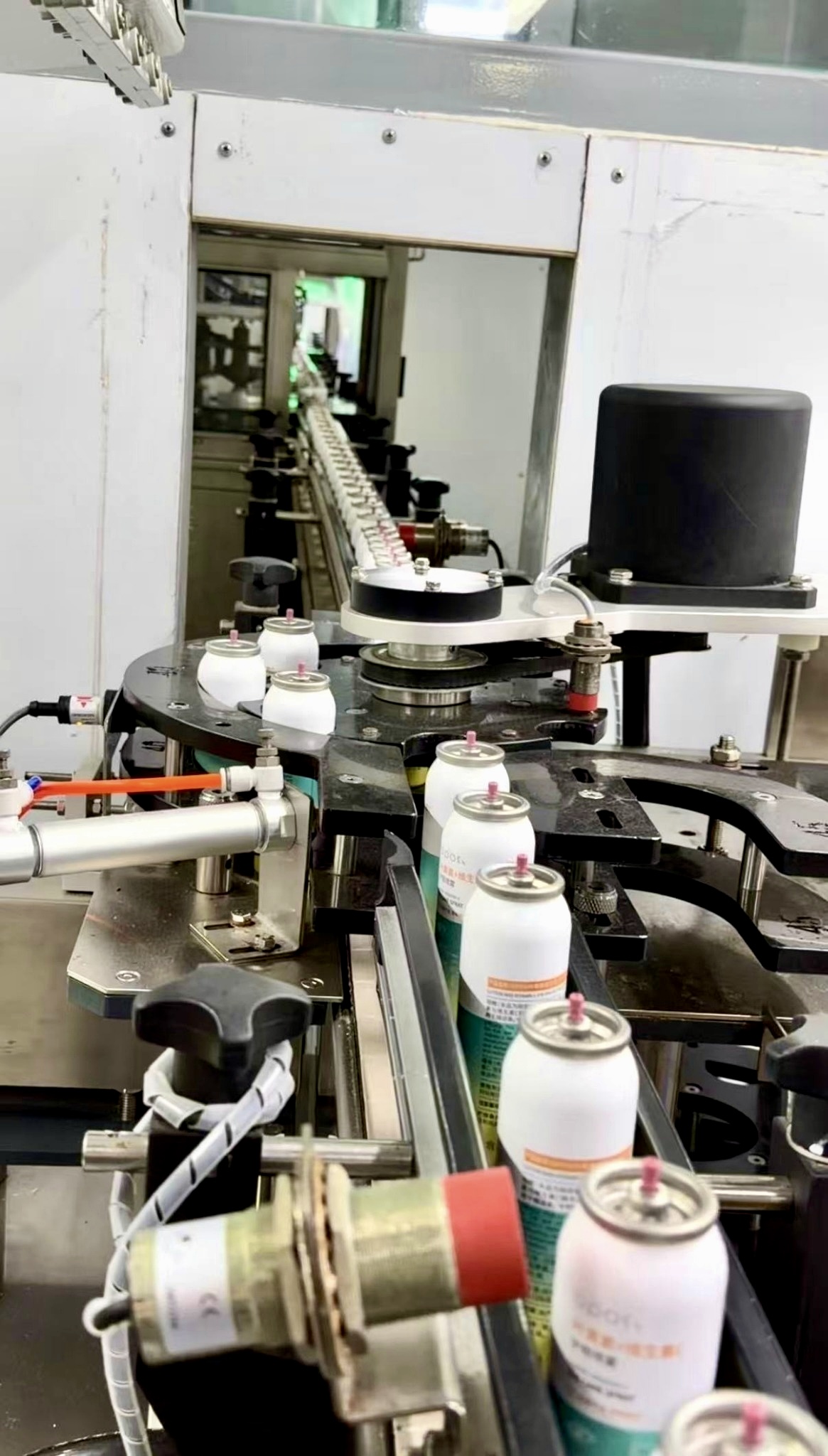
Filling, crimping and leak testing on a dedicated aerosol line. Valve and can inspection upstream determines the leak rate downstream.
Application Scenarios and a Reference Project
Beach, pool and outdoor sun days
The mist is used on the face and often on the shoulders and chest after sun exposure, frequently over sunscreen. Formulation priorities are light hydration, a low-drip spray character and a fragrance level that does not clash with the sun-care line. Packaging priorities are a can size that survives a beach bag and a storage instruction that is visible on the label rather than buried in the leaflet.
Gym, running and outdoor training
The mist is used before cleansing as a refresh and after cleansing as a hydration step. The functional priority is speed, and the commercial priority is often a paired range: the same brand may sell the mist alongside a cooling spray or a body fragrance from the same packaging family.
Transit and desk refresh
This is the secondary occasion. It does not drive the brief, but it affects format choice, because a product designed to be re-sprayed at any time of day has to work in an air-conditioned office as well as outdoors.
A relevant reference point from the same manufacturer is a Kazakhstan-based cosmetic brand OEM project: 20,000 aerosol cans of sunscreen spray supplied to a Central Asian e-commerce seller, with customised brand packaging, over a three-year cooperation period covering repeat supply. The product category is sunscreen rather than toner mist, so the case does not transfer directly. What it does demonstrate is the workflow a post-sun brief needs — formula development, aerosol filling, packaging customisation and regulatory documentation delivered as one chain, for a client whose sell-through channel was online retail.

Can and packaging stock staged before filling. Can specification and decoration lead time are common causes of schedule slippage in aerosol projects.
Market Trend Analysis: Where Aerosol Demand Is Actually Moving
Published estimates give directional context, and the scope of each figure should be read carefully. Global aerosol production reached 16.08 billion units in 2025, according to Global Market Insights. Research and Markets estimates the aerosol-for-personal-care segment at USD 7.25 billion in 2025, rising to USD 7.72 billion in 2026 at a 6.5% CAGR. On the contract manufacturing side, Verified Market Research valued the global cosmetics OEM/ODM market at USD 56.77 billion in 2024 and projects USD 80.99 billion by 2032.
Two regulatory movements are more decision-relevant than the market totals. In the EU, Regulation (EU) 2024/858 required withdrawal of cosmetic products containing non-compliant nanomaterials such as nano styrene/acrylates copolymer by 1 November 2025 — a clause that reaches directly into spray formulations, because film-forming and texture polymers are common in mists. In the United States, the Modernization of Cosmetics Regulation Act of 2022 introduced facility registration and product listing obligations that apply to the brand, not to the filler. Both shift work upstream: the formulation file and the ingredient disclosure have to be correct before the first can is filled.
The consumer-side trend is quieter but consistent. Post-exercise and post-sun refresh formats are being bought as routine items rather than occasional ones, which favours pressurized formats for their convenience and their ability to be reapplied without contact. It also raises the bar on claim discipline, since a product used several times a week invites more scrutiny than a once-a-season item.
Comparison With Traditional Solutions — and Where the Limits Are
| Format | What it does well | Where it constrains the brand |
|---|---|---|
| Pump-spray toner bottle | Low tooling cost, simple logistics, no dangerous-goods classification, easy small-batch testing | Output depends on hand pressure and orientation; multi-dose microbial risk is managed entirely through the preservative system; no 360-degree use |
| Conventional aerosol | Consistent spray, familiar filling infrastructure, lower hardware cost than BOV | Product contacts propellant; flammable propellant options affect transport classification; orientation-dependent output |
| BOV aerosol | Formula isolated from propellant, non-flammable propellant, 360-degree spraying, near-complete evacuation, compatible with alcohol-free systems | Higher unit cost; still a pressurized article requiring dangerous-goods logistics and temperature-controlled storage guidance |
| Cream or lotion in a tube | Strong occlusive effect, simple regulatory profile, lowest cost per use | Requires hands and a mirror; poor fit for reapplication over sunscreen or in a gym; slower to absorb |
The limits deserve to be stated plainly rather than folded into a feature list.
- BOV costs more. The hardware premium is real and does not disappear at volume. A brand that cannot support the premium through price position or claim differentiation should specify a conventional valve instead.
- Every aerosol is a dangerous good. Pressurized cans require UN packaging documentation and SDS/MSDS, must move through dangerous-goods logistics rather than ordinary freight, and must be stored away from high temperature, direct sunlight and heavy impact. This applies to BOV as well, even though the propellant itself is non-flammable.
- Order thresholds shape the launch. At a stated minimum of 10,000 cans per formula, a brand testing three variants is committing to 30,000 cans before it has sell-through data. Smaller trial runs are possible in principle but carry higher unit cost and are constrained by can and valve minimums.
- A toner mist is not a moisturiser. For compromised or heavily sun-exposed skin, a light water-based mist delivers hydration and refreshment but not occlusion. Positioning it as a replacement for a cream will not survive consumer experience or, in some markets, claim review.
- Water-based, alcohol-free systems are microbiologically demanding. The preservative system and its challenge testing carry more weight than the fragrance in this format, and reformulation for a new market often means re-running that validation.
A Practical Evaluation Scorecard for Buyers
For a buyer at evaluation stage, supplier comparison is more reliable when it is scored against the same criteria rather than against brochure language. The six points below are the ones that most often separate a workable aerosol partner from a costly one.
| Evaluation criterion | What to verify | Why it changes the outcome |
|---|---|---|
| In-house aerosol filling | Dedicated pressure-filling lines and workshop, not outsourced filling | Outsourced filling leaves the production schedule, leak performance and document set outside the supplier's control |
| Certification scope | Whether the GMP certificate scope actually names aerosol or hydrating spray production | A general cosmetic GMP certificate does not cover pressurized filling |
| Formula capability | Ability to develop and adjust a water-based, alcohol-free system, including preservative validation | Determines whether the brief is met or approximated |
| Packaging flexibility | BOV and conventional valve options, can specification, decoration route | Decides whether the 360-degree or the cost-led version is available from one supplier |
| Export documentation | UN packaging certificate, SDS/MSDS, COA, CPSR, technical dossier for local notification | Missing documents are the most common cause of port detention in this category |
| Commercial fit | MOQ, lead time, QC intensity per product | Determines whether the launch volume and replenishment cycle are realistic |
One structural point is worth repeating because it is frequently misunderstood: the factory supplies the technical dossier, but official registration is submitted by the brand's local responsible party. No filler can act as registrant in the destination market, and a supplier that implies otherwise is worth a second look.
Future Outlook
Three developments are likely to shape this category over the next planning cycle. The first is the normalisation of BOV as a mid-market option rather than a premium one, driven by alcohol-free formulation preferences and by demand for any-angle application in body and facial mists. The second is tighter documentation discipline: nanomaterial rules in the EU and registration obligations in the US both push the compliance burden onto the brand, which in turn makes dossier quality a supplier selection criterion rather than an afterthought. The third is range thinking — post-sun and post-workout products are increasingly sold as families sharing packaging and fragrance, which favours suppliers able to run several aerosol formats on one production base with one documentation set.
None of these trends removes the basic trade-off in the format. A light, re-sprayable mist is convenient and pleasant, and it is structurally weaker than a cream at occlusion. Brands that position it honestly, and buyers who specify the valve and the document set as deliberately as the formula, get the most out of the category.
FAQ
What is BOV aerosol, and how does it differ from a conventional aerosol valve?
BOV stands for bag-on-valve. The cosmetic formula is sealed inside an inner flexible bag, fully separated from the compressed air or nitrogen propellant held in the outer chamber of the can. Pressing the nozzle squeezes the bag, so only product leaves the valve. In a conventional aerosol, formula and propellant share the same can volume. The separation enables 360-degree spraying at any orientation, up to 99% product evacuation and better formula stability, and it protects active ingredients from contact with the propellant.
Which cosmetic products fit BOV packaging rather than a conventional valve?
BOV is used for alcohol-free perfume, facial mist, sunscreen spray, after-sun care and sensitive-body-care products, because the formula never contacts the propellant. Conventional aerosol hardware remains appropriate where the formulation is compatible with propellant contact and where unit cost is the dominant constraint. Both formats are produced as OEM options, and the choice is normally driven by the brand's budget, target-market regulation and product positioning rather than by the format alone.
Is BOV more expensive than conventional aerosol?
Yes. BOV hardware carries a higher unit cost than standard aerosol valves and cans. The premium has to be offset by claimed position, by an alcohol-free or sensitive-skin formulation that requires propellant separation, or by the convenience of 360-degree application. Where none of these applies, a conventional valve usually gives a better cost structure.
What MOQ and lead time apply to a toner mist OEM order?
The regular minimum order quantity for aerosol cosmetic OEM is 10,000 cans per formula, with a working range of 10,000 to 20,000 cans depending on format. Lead time is 30 to 45 working days after sample confirmation, and it is affected by the aerosol can and valve supply cycle. Smaller trial batches are possible but carry higher unit cost and can be limited by packaging minimums.
What documents are needed to export a pressurized cosmetic mist?
Aerosol products are pressurized dangerous goods, so a UN dangerous-goods packaging certificate and SDS/MSDS are required for customs clearance, in addition to COA and, for the EU, CPSR. Aerosol-specialised factories supply this documentation set for sea and air shipment. Local cosmetic notification or registration remains the responsibility of the brand's own responsible party in the destination market; the factory supplies the technical dossier only.
Does an aerosol toner mist replace a cream or lotion in a post-sun routine?
No. A water-based toner mist delivers hydration, refreshment and a light dewy finish, and it can be reapplied over sunscreen or after exercise. It does not provide the occlusion of a cream or lotion, which remains the appropriate step for dry or heavily exposed skin. The two formats serve different functions in the same routine rather than substituting for each other.
Company reference: www.gzyc-cosmetics.com. The company profile, including facility and certification detail, is available as a downloadable PDF. Product, MOQ and documentation figures in this article reflect the manufacturer's stated terms and published certificate scopes, and should be re-confirmed per project.
Tem questões ou precisa de mais detalhes?
Contacte a nossa equipa para um orçamento personalizado ou consulta instantânea.
Solicitar orçamento
Preencha o formulário abaixo e a nossa equipa entrará em contacto com uma proposta personalizada.
Chat direto do WhatsApp
Prefere conversar em tempo real? Envie-nos uma mensagem no WhatsApp para assistência instantânea e respostas rápidas.
- Obter orçamento personalizado
- Partilhar fotos ou documentos
- Discuta as suas necessidades diretamente
Geralmente responde em 5–30 minutos durante o horário de expediente.