
Hydraulic Adapter FAQ: BSPP vs BSPT, Ratings, Missing Parts
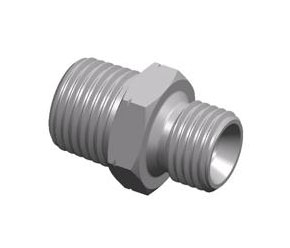
Thread form, material and pressure rating decide whether a hydraulic adapter seals on the first assembly or weeps in service, and most of the technical questions reaching manufacturers cluster around exactly those three variables. The global hydraulic fittings market, which includes adapters and couplings, was valued at USD 4.8 billion in 2025 and is projected to reach USD 7.9 billion by 2034, according to Dataintelo; within that market the hydraulic adapters segment held the largest product-type share at 28.4% in 2025. This reference answers the questions buyers and engineers raise most often about BSPP versus BSPT threads, carbon steel versus SS304 and SS316, 3,000–6,000 PSI ratings, the 220 °C stable operating temperature, how model designations are structured across BSP, NPT, JIC and SAE families, where high-pressure hose adapters differ from port adapters, and what to do when accessories are missing on receipt.
Product data referenced here comes from NingBo NJ Hydraulic Adapter Co., Ltd, a manufacturer of hydraulic adapters and engineering machinery parts based in Fenghua, Ningbo, China. The company was founded in 2004, operates a 20,000 m² facility with approximately 200 employees, and states an annual output of 4,000,000 units. Around 75% of production is exported, with the USA and Canada as the main markets, and the range covers BSPP, BSPT, NPT/NPTF, JIC, JIS and SAE ORB/ORFS configurations in carbon steel, SS304 and SS316.
Why the same adapter questions keep coming back
A hydraulic adapter is a low-cost component in a hydraulic system and, at the same time, the point at which that system is most likely to leak. That asymmetry explains why procurement teams working through research and evaluation tend to ask the same shortlist of questions: which thread form the port uses, which material survives the operating environment, which pressure and temperature the part is rated for, and how to read the designation printed on the drawing. A fourth question usually arrives only after the first shipment — what to do when accessories are missing or the wrong parts arrive.
Published market estimates for hydraulic fittings vary considerably depending on scope, ranging from adapter-only or fittings-only segments through to the wider hydraulic equipment market. A single headline figure is therefore best read as directional rather than definitive. The dependable reference points remain the thread standard, the material standard, and the supplier's own test documentation.
BSPP versus BSPT: the sealing mechanism is the difference
BSPP and BSPT are both British Standard Pipe thread systems, and the two are frequently confused because they share nominal sizes. The variable that decides whether a part works is not the size but the point at which sealing occurs.
- BSPP (parallel): the thread diameter is constant along its length. Sealing happens at the face, normally through a bonded washer or an O-ring, so the thread itself is not the sealing element. In this range, BSPP configurations use B-series designations such as 1B, 2B, 4B, 6B, 7B and 9B.
- BSPT (tapered): the thread diameter reduces toward the end of the fitting. Sealing happens through thread-flank contact as the part tightens into the port, typically with a sealant. BSPT configurations use T-series designations such as 1T, 1T9, 4T and 5T.
| Comparison point | BSPP | BSPT |
|---|---|---|
| Thread geometry | Parallel — constant diameter | Tapered — diameter reduces toward the end |
| Sealing location | Face, via bonded washer or O-ring | Thread flanks, with sealant |
| Example model families | 1B, 2B, 4B, 6B, 7B, 9B | 1T, 1T9, 4T, 5T |
| Material options | Carbon steel / SS304 / SS316 | Carbon steel / SS304 / SS316 |
| Declared pressure range | 3,000–6,000 PSI | 3,000–6,000 PSI |
| Maximum stable operating temperature | 220 °C | 220 °C |
| Bridging configurations | 1BT (male BSPP x male BSPT), 1NB (male NPTF pipe x male BSPP) | 1JT (male JIC x female BSPT), 1ST9 (male JIS x female BSPT 90° elbow) |
Substituting one system for the other is a thread-level decision with a sealing-level consequence. A parallel male BSPP thread does not deform into a tapered port and therefore cannot seal on its flanks, while a tapered BSPT thread forced into a parallel port can distort the port itself. On machinery that mixes thread systems, the correct answer is usually a bridging adapter rather than a forced fit.
How to read a hydraulic adapter model designation
Designations across the BSP, NPT, JIC, JIS and SAE families follow one shared logic: a family number, followed by letters that identify the thread system at each end, followed in some cases by a suffix that identifies a geometry variant. The examples below are published for this product range and illustrate the pattern.
| Designation | Configuration | Thread system |
|---|---|---|
| 1B | Male BSPP x male BSPP straight | BSPP |
| 7B / 9B | Female BSPP x female BSPP straight / female BSPP plug | BSPP |
| 6B | Male BSPP x male BSPP bulkhead straight | BSPP (bulkhead) |
| 1BT | Male BSPP x male BSPT straight | BSPP to BSPT |
| 1BJ | Male BSPP x male JIC straight | BSPP to JIC |
| 1NB | Male NPTF pipe x male BSPP straight | NPTF to BSPP |
| 1T / 1T9 | Male BSPT x male BSPT straight / 90° elbow | BSPT |
| 1ST9 | Male JIS x female BSPT 90° elbow | JIS to BSPT |
| 5404 / 5405 | Male NPTF pipe x male NPTF pipe straight / male NPTF x female NPTF straight | NPTF pipe |
| 5406-P / 5406-C | Male NPTF hex head pipe plug / female NPTF pipe cap | NPTF pipe |
| 5603 / 5652 | NPTF pipe tee / four-port NPTF pipe cross | NPTF pipe |
| 2403 / 2405 / 2406 | Male JIC x male JIC / male JIC x female NPTF / female JIC x male JIC | JIC and JIC-to-NPTF |
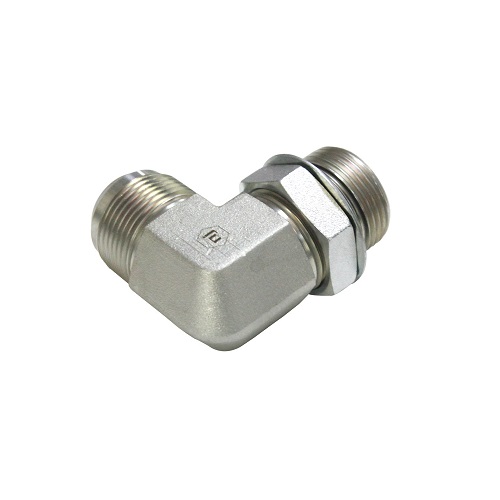
| 2500 / 2504 | Male JIC x male JIC 90° elbow / 45° elbow | JIC |
| 2700 / 2704 | Male JIC x male JIC bulkhead straight / bulkhead tee | JIC (bulkhead) |
| 6801 / 6802 | Male JIC x male adjustable ORB 90° elbow / 45° elbow | SAE ORB |
| 6815 / 6835 | Male adjustable ORB x female ORB 90° elbow / ORB tee | SAE ORB |
| 0304C / 0306 / 0318 / 0319 | Female JIC cap / JIC bulkhead lock nut / JIC tube nut / JIC tube sleeve | JIC accessories |
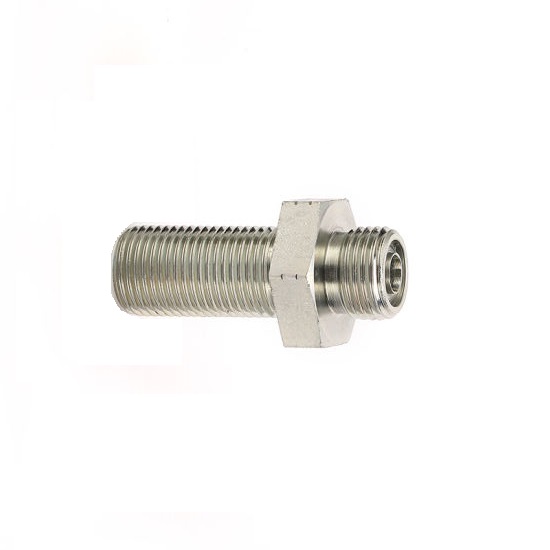
Two cautions follow from the table. First, a model prefix can carry different meanings between families, so a designation should be resolved against the catalogue rather than against memory. Second, the suffix digits are not a universal angle code: within the JIC family, 2500 is a 90° elbow and 2504 is a 45° elbow, while within the 68xx family, 6801 is a 90° elbow and 6802 is a 45° elbow. Straight, elbow, bulkhead and plug variants all have to be confirmed individually, which is also why a purchase order should quote the full designation together with the size rather than an abbreviated family reference.
Material selection: carbon steel, SS304 or SS316
Every adapter family in this range is offered in carbon steel, SS304 and SS316, with the same declared pressure band and temperature limit across materials. Steel accounted for 45.2% of hydraulic fitting revenue share in 2025 according to Dataintelo, which reflects its position as the economical default where high-pressure durability is the primary requirement. The selection logic is environmental rather than mechanical.
| Material | Where it is typically specified | What to verify |
|---|---|---|
| Carbon steel | Construction machinery, agricultural machinery, general-purpose machinery, transportation, steel metallurgy | Plating specification and salt spray documentation |
| SS304 | General-purpose and mildly aggressive environments, wet service | Grade certificate and finish consistency across the batch |
| SS316 | Marine machinery, firefighting equipment, water conservancy, oil and gas extraction | Grade certificate; galvanic compatibility with mating parts |
One useful reference point for stainless evaluation comes from the material standard rather than the adapter catalogue. AISI 316 stainless steel carries a working temperature range of -60 °C to +400 °C under DIN 17440. Because the adapter's own maximum stable operating temperature is 220 °C, the alloy is not the limiting element in a stainless assembly — the practical ceiling is normally set by the seal or the hose. Plating colour and surface finish are customizable in this range, which matters when a buyer needs a consistent finish across a mixed order of carbon steel and stainless parts.
Pressure and temperature: reading the rating correctly
The declared pressure band across these adapter families is 3,000–6,000 PSI, with a maximum stable operating temperature of 220 °C. Project data for the BSPT adapter family records a static pressure of 6,000 PSI and a burst pressure of 9,000 PSI without deformation, with continuous operation and seal integrity maintained. Coating performance is documented through a 120-hour salt spray test showing white rust at 120 hours and red rust at 240 hours.
Independent reference values help buyers sanity-check what a rating means at a given size. Under SAE J1453, ORFS fittings at dash size -4 (1/4 inch) are rated for 6,000 PSI working pressure. NPTF straight threads at 1/4 inch typically carry a 4,000 PSI working pressure rating with a 4:1 safety factor. For 37° flared connectors, ISO 8434-2:2007 specifies design and performance requirements for tubes from 6 mm to 50.8 mm, and DIN 2353 defines three robustness categories for metric tube fittings — LL (extra light, 100 bar), L (light, up to 315–500 bar) and S (heavy, up to 630–800 bar).
The decision rule that follows is simple: a family-level figure such as 3,000–6,000 PSI describes a band across sizes, not a guarantee at every size. Confirm the rating for the exact size ordered, and confirm it against the weakest element in the assembly rather than against the adapter alone.
High-pressure hose adapters: where the seat decides, not the thread
A high-pressure hose adapter terminates a hydraulic hose and transitions it to a port or to another thread system; a port adapter terminates the port side. The distinction matters commercially because hose-end failures are typically seat failures rather than thread failures — a part can thread perfectly and still leak if the seat geometry does not match the mating component.
In this range, hose-facing configurations span four sealing families:
- JIC 37° flare — models 2403, 2404, 2405, 2406, 2500, 2501, 2502, 2504 and 2505, covering straight, 45° and 90° variants as well as JIC-to-NPTF transitions.
- Adjustable ORB and ORFS — models 6801, 6802, 6803, 6804, 6805, 6807, 6815 and 6835, including elbow and tee configurations where an adjustable orientation is required during assembly.
- NPTF pipe — models 5404, 5405, 5406, 5603 and 5652, including plug, cap, tee and cross variants for manifold and distribution work.
- BSPP and BSPT — the 1B and 1T families, with bridging options such as 1BT and 1JB-style cross-system parts where a machine mixes imperial and metric ports.
Bulkhead versions — 2700, 2703, 2704, 2705 and 6B — allow a hose line to pass through a panel or frame with a retained, serviceable joint, and elbow versions manage routing in confined machine spaces.
For pressure-critical hose runs, the sizing reference matters as much as the configuration. ORFS at dash size -4 is rated at 6,000 PSI working pressure under SAE J1453, which aligns with the upper end of this range's declared band; NPTF pipe at 1/4 inch is typically rated at 4,000 PSI working pressure. A buyer specifying a high-pressure hose adapter should therefore confirm four things in order: the port thread form, the seat type, the hose-end geometry, and the rating at the specific dash size. Confirming the thread alone is the most common sequencing mistake.
Application fit: where these configurations are specified
The listed target industries for this adapter range are construction machinery, agricultural machinery, general-purpose machinery, firefighting equipment, marine machinery, mining, transportation, aerospace, automotive, oil and gas extraction, iron and steel metallurgy, and water conservancy engineering. The common thread across that list is not the industry name but the working condition: high temperature, high pressure, and exposure to moisture or process fluids.
A construction machinery scenario illustrates the requirement in concrete terms. The adapters provide hydraulic pipeline sealing, thread locking and fastening, and pressure-bearing protection for mechanical hydraulic assemblies, and they are matched with hydraulic hoses, hydraulic cylinders, threaded bolts, pipe joints, hydraulic pumps and cylinder assemblies. The stated requirements are resistance to rust, high temperature and high pressure, with the assembly tolerating a 6,000 PSI static pressure and a 9,000 PSI burst pressure without deformation. Related equipment types in the same scenario include agricultural equipment, coal mining equipment, petroleum equipment, electromechanical equipment, forklift parts and hose fittings.
One distribution case shows how the same product class performs downstream. A mid-market distributor in Canada — Tompkins — used hydraulic cap nut models 0304C and 0306, which carry a maximum operating temperature of 220 °C and a pressure range of 3,000–6,000 PSI, over a three-year project totalling 20,000,000 units. The stated outcome was expansion of downstream client channels and an improvement in overall gross profit margin, with the product resold to other local customers with demand.
Comparison with traditional connections, and where the limits are
Threaded adapters are not the only way to join a hydraulic line, and buyers weighing them against welded tube assemblies should compare on serviceability rather than on unit price alone.
| Criterion | Threaded adapter | Welded tube assembly |
|---|---|---|
| Field serviceability | Component can be replaced individually | Repair requires cutting and re-welding |
| Geometry flexibility | Angle and bulkhead variants manage routing change | Geometry fixed at fabrication |
| Standardisation reference | ISO 8434-2:2007 covers 37° flared connectors from 6 mm to 50.8 mm; DIN 2353 defines LL, L and S categories | Governed by weld procedure rather than a fitting standard |
| Primary failure risk | Incorrect seat match or assembly torque | Weld quality and heat-affected zone |
The limits of the adapter approach deserve the same attention as its advantages. Minimum order quantity in this range varies depending on product dimensions and manufacturing complexity, so there is no single blanket MOQ figure a buyer can plan against without confirming the specific part. Standard lead time runs 30–45 working days, which means schedule-critical projects should be planned around production rather than around an assumed stock position. Quality control is described as random inspection, which is a sampling-based regime rather than a claim of 100% inspection, and buyers with critical applications should state their inspection requirements explicitly. The 120-hour salt spray result is specific to the tested coating condition and does not predict service life in a chloride-heavy environment. And the 220 °C maximum stable operating temperature is an adapter-level figure, as noted above, not a system-level guarantee.
OEM and ODM work is available within the same range, covering logo, packaging, plated colour, and custom products made from provided drawings or samples — but custom work extends the qualification cycle and should be budgeted into the project timeline rather than assumed to run at standard lead time.
If accessories are missing or the wrong items arrive
Receiving discrepancies are a procurement reality rather than an exceptional event, and the documented resolution process for this range is simple. The customer provides photographs of the missing or wrong-delivered items; after verification, replacement accessories are arranged by sea or air shipment.
A short receiving routine reduces the verification cycle. Photograph the packing list, the carton label and the received part markings together, so that the designation on the part can be matched directly against the ordered designation pattern. Count against the packing list before parts are issued to production, and raise the claim as soon as a discrepancy is found rather than at the end of the receiving inspection. Because model designations carry end-by-end meaning — a 2405 differs from a 2403 in its second end, not its first — the photograph is what allows a supplier to confirm and dispatch the correct replacement.
Market trend analysis
Three structural signals shape demand for hydraulic adapters. The first is regional concentration: Asia-Pacific led global hydraulic fitting revenues in 2025, accounting for an estimated 38.6% of market share, according to Dataintelo. The second is machinery-driven demand: mobile hydraulics held over 58% of total hydraulics market revenue share in 2024, per Grand View Research, which means the bulk of adapter demand is tied to equipment that must be serviceable in the field rather than to fixed plant. The third is automation: Asia accounted for 74% of global industrial robot installations in 2024 according to Ken Research, a figure that points to rising demand for precise, repeatable hydraulic connections in automated manufacturing environments.
Material and standard trends run alongside those demand signals. Steel held 45.2% of hydraulic fitting revenue share in 2025, confirming that carbon steel remains the volume material, while stainless grades continue to be specified where chlorides or washdown are present. On the standard side, DIN 2353's three robustness categories and the ISO 8434-2:2007 specification for 37° flared connectors show a market that measures fittings by defined pressure classes rather than by nominal size alone — a shift that favours suppliers able to document which class a part belongs to.
Future outlook
The direction of travel for hydraulic adapters is toward documented specification rather than broader catalogue coverage. As automated machinery and mobile equipment converge on higher working pressures, the differentiator increasingly sits in what a supplier can evidence: which standard a fitting conforms to, which pressure class applies at which dash size, what a salt spray result actually covered, and how quickly a missing-part claim is resolved. Buyers evaluating suppliers over the next planning cycle should expect thread-system flexibility across BSP, NPT, JIC and SAE to be table stakes, and should weight verification documentation, lead-time reliability and receiving-process discipline more heavily than catalogue breadth.
FAQ
What is the difference between BSPP and BSPT threads on a hydraulic adapter?
BSPP uses a parallel thread and seals at the face, normally with a bonded washer or O-ring, so the thread is not the sealing element. BSPT uses a tapered thread that seals through thread-flank contact as it tightens into the port, typically with a sealant. In this range the two are separated at model level: BSPP configurations use B-series designations such as 1B, 6B, 7B and 9B, while BSPT configurations use T-series designations such as 1T, 1T9, 4T and 5T. Both families are available in carbon steel, SS304 and SS316 with a 3,000–6,000 PSI pressure range and a maximum stable operating temperature of 220 °C.
Can a BSPP adapter be installed in a BSPT port?
The two are not interchangeable. A parallel BSPP male thread does not taper and does not deform into the port, so it cannot achieve the interference a BSPT connection relies on; it requires a flat-faced port with a bonded washer or O-ring to seal. Bridging parts exist for mixed systems — model 1BT is a male BSPP x male BSPT straight adapter, and 1NB is a male NPTF pipe x male BSPP straight — but the bridging component must be correct for the port on each side. Where a port thread is uncertain, thread form should be confirmed with a gauge before ordering.
When should carbon steel, SS304 or SS316 be specified for a hydraulic adapter?
Carbon steel is the default for construction, agricultural and general-purpose machinery applications, and steel accounted for 45.2% of hydraulic fitting revenue share in 2025 according to Dataintelo. SS304 and SS316 are specified where the environment attacks the fitting itself; marine machinery, firefighting equipment and water conservancy are among the listed target industries for these adapters. AISI 316 stainless steel carries a material temperature range of -60 °C to +400 °C under DIN 17440, so in a stainless assembly the practical temperature ceiling is usually set by the seal or the hose rather than by the adapter body. Plating colour and surface finish are customizable when a consistent finish is required across a mixed order.
What do the 3,000–6,000 PSI and 220 °C figures actually cover?
For this range, the declared pressure band is 3,000–6,000 PSI and the maximum stable operating temperature is 220 °C. Pressure capability is size-dependent rather than uniform: published reference data gives ORFS fittings at dash size -4 (1/4 inch) a 6,000 PSI working pressure under SAE J1453, while NPTF straight threads at 1/4 inch typically carry a 4,000 PSI working pressure rating with a 4:1 safety factor. Project data for the BSPT adapter family records a static pressure of 6,000 PSI and a burst pressure of 9,000 PSI without deformation, with seal integrity maintained. The adapter rating is not the assembly rating — the hose, port and mating hardware must be verified separately.
How are model numbers such as 1BT or 6801 structured?
Letters generally identify the thread system at each end — B for BSPP, T for BSPT, J for JIC, N for NPTF, S for JIS — while the numeric prefix identifies the product family, with B-series designations for BSPP, 12 and 4/5/6/7/9-series prefixes across the BSP range, 5xxx for NPTF pipe, 24xx, 25xx, 26xx and 27xx for JIC, and 68xx for SAE ORB/ORFS. For example, 1BT is a male BSPP x male BSPT straight adapter, 1NB is male NPTF pipe x male BSPP, 2405 is male JIC x female NPTF pipe straight, and 6815 is male adjustable ORB x female ORB 90° elbow. Suffix digits are not a universal angle code: within JIC, 2500 is a 90° elbow and 2504 is a 45° elbow, while within the 68xx family, 6801 is a 90° elbow and 6802 is a 45° elbow. Angle and geometry should be confirmed against the catalogue rather than inferred from the last digit.
What does the 120-hour salt spray result prove?
A 120-hour salt spray test on these adapters shows white rust at 120 hours and red rust at 240 hours. That result is a comparative screening measure: it indicates that the coating resists the onset of white corrosion for at least the duration of the test and holds off red rust beyond it, which is a useful signal when comparing plating quality between suppliers. It is not a prediction of service life. Chloride exposure in marine, de-icing or offshore conditions, and mechanical abrasion of the coating during assembly, both operate outside what a salt spray chamber reproduces, so a 120-hour result should be treated as one input into a corrosion decision rather than the decision itself.
What are high-pressure hose adapters, and how do they differ from port adapters?
A high-pressure hose adapter terminates a hose and transitions it to a port or another thread system, while a port adapter terminates the port side. The seat, not the thread, usually determines whether the joint holds. Hose-facing configurations in this range include JIC 37° flare (2403, 2404, 2405, 2406, 2500, 2501, 2502, 2504, 2505), adjustable ORB and ORFS (6801, 6802, 6803, 6804, 6805, 6807, 6815, 6835), NPTF pipe (5404, 5405, 5406, 5603, 5652) and BSPP/BSPT (the 1B and 1T families). Bulkhead versions such as 2700, 2703, 2704, 2705 and 6B allow a line to pass through a panel, and elbow versions manage routing. A part that threads correctly but seats incorrectly is a common cause of leaking hose connections, so seat type should be confirmed before thread, and the pressure rating should be checked at the specific dash size rather than at family level.
What should a buyer do if accessories are missing or the wrong items arrive?
The documented process is straightforward: the customer provides photographs of the missing or wrong-delivered items, and after verification, replacement accessories are arranged by sea or air shipment. Photographing the packing list, carton label and part markings together shortens verification, because the designation on the received part can then be matched directly against the ordered designation pattern. Buyers working to a production schedule should raise a claim as soon as the discrepancy is found rather than at the end of the receiving inspection.
Further reference material, including the full adapter range with model designations and configurations, is available in the company brochure: hydraulic adapter product brochure (PDF). Company website: njadapter.com.