
Hydraulic Baler Compliance: Turning Purchase Terms Into Acceptance Criteria
Hydraulic Baler Compliance: Turning Purchase Terms Into Acceptance Criteria
Compliance for a hydraulic baler machine is settled when the purchase order is written, not when the container is opened. An order that reads “40-ton hydraulic baler, CE marked” gives an inspector nothing to accept or reject. An order that reads “compression force 40 t; bale cross-section 720 × 720 mm; bale length 500–1300 mm; feeding mouth 1000 × 720 mm; four strapping channels; 11 kW; baling capacity 1–2 t/h” gives the same inspector seven checks, each traceable to one line of one model record. Converting commercial language into the second form is what this article describes.
The reference material is the published model record for five hydraulic baler machines: JPW20Q, JPW40F, JPW40BL, JP-OT100 and JP-S100B. Jewel is the baler brand of Jewel (Nantong Jiabao Machinery Co., Ltd.), a manufacturer established in 2006 (brand founded 1995) in Rugao, Jiangsu Province, China, operating a 50,000 m² production facility with more than 200 employees. The five records are used here not as a sales description but as evidence of how specification fields actually behave — including the fact that not every model carries every field, which is precisely where poorly drafted orders break down.
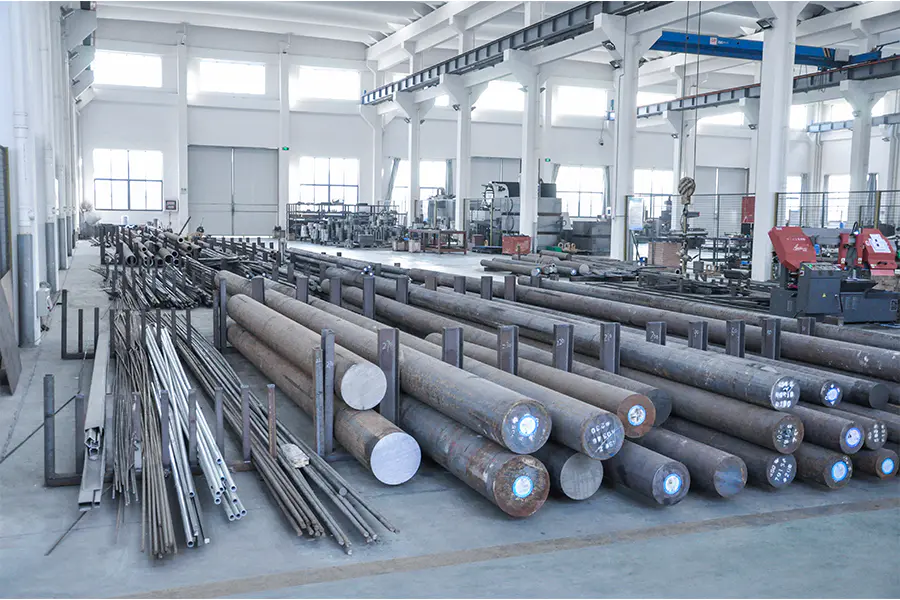
Carbon steel is the recorded primary material across the five Jewel model records discussed here. Image: Jewel.
Why baler compliance belongs in the purchase order
A delivery inspection is a comparison exercise. It compares what arrived with what was agreed. If the agreement contains only a category name and a tonnage figure, the inspection can confirm almost nothing: a machine can weigh more or less than expected, produce a longer or shorter bale, or arrive wired for a different supply voltage, and still technically match the order. Procurement teams that get this right treat the model record as the annex to the contract and the purchase order as a schedule of measurable criteria.
The distinction matters more for hydraulic baler machines than for commodity equipment because the same nominal tonnage appears across very different machine families. Within the five records examined here, 40 t appears twice — on JPW40F, a semi-automatic horizontal baler, and on JPW40BL — but the two models differ in bale length range, bale weight range and installed power. Similarly, 100 t appears twice, on JP-OT100, a vertical baler, and on JP-S100B, which the record classifies as a cutting machine with no bale dimension, bale weight or feeding-mouth field at all. Tonnage alone cannot identify a machine.
A useful way to see the gap is to place the two forms of wording side by side:
- Category-based term: “Hydraulic baler, 40 t, for waste paper.” Ambiguous model, no measurement basis, no unit, no acceptance test.
- Record-based criterion: “JPW40F, compression force 40 t, bale 720 × 720 × (500–1300) mm, feeding mouth 1000 × 720 mm, four strapping channels, 11 kW, capacity 1–2 t/h.” Each element can be measured, each has a unit, and each is anchored to a named record.
The nine recorded fields and how each becomes a criterion
The model records for these machines share a common field structure even where the values differ: compression force, bale dimension, feeding mouth size, bale weight, baling capacity, power, voltage, machine weight and overall machine dimensions. Each field can carry a clause in the purchase order, and each has a specific trap that makes a careless clause unusable.
Compression force. This is the field buyers quote first and check last. It should be written as the model’s own rated figure in tonnes, not as the series range that also appears in the record. JPW20Q carries a rated force of 20 t, while its record also shows a series span of 20–40 t; a purchase order that cites the span has not specified a machine. The acceptance action is a nameplate and documentation check, not a live pressure test.
Bale dimension. Here the difference between a fixed cube and a variable-length bale is decisive. JPW20Q produces a 500 × 500 × 500 mm bale; JPW40F produces 720 × 720 mm with a length that runs from 500 to 1300 mm; JPW40BL produces 720 × 720 mm with a 300–1000 mm length range; JP-OT100 produces 1400 × 700 mm at 700–1100 mm long. A criterion written as a single number will fail on the first bale whose length sits elsewhere in the legitimate range. Write the range, and state which dimension the range applies to.
Feeding mouth. This is the interface with conveyors, shredders and manual loading positions. JPW20Q records 700 × 460 mm, JPW40F and JPW40BL both record 1000 × 720 mm, and JP-OT100 records 1400 × 600 mm as a length × height figure. Because the second dimension is height on some records and width on others, the clause should name the orientation explicitly; otherwise the drawing review and the tape measure will disagree.
Bale weight. Every record that carries this field gives a range: 30–70 kg for JPW20Q, 200–400 kg for JPW40F, 250–350 kg for JPW40BL, 400–600 kg for JP-OT100. Bale weight depends on what is being compressed and how densely it packs, so the range is only meaningful when paired with an agreed test material. A single-figure bale weight in an order is a dispute waiting to happen.
Capacity. The records use different units, and that is the trap. JPW40F is stated as 1–2 t/h; JP-OT100 is stated as 5–6 bales/h; JP-S100B is stated as 20–30 s per single cycle; JPW20Q and JPW40BL carry no capacity field. A tonnes-per-hour figure and a bales-per-hour figure are not comparable until bale weight is applied, and a cycle time is not a throughput figure at all. Where the record has no capacity field, the purchase order cannot manufacture one from the brochure — it must be agreed separately and labelled as an agreed estimate rather than a recorded value.
Power. Installed power drives the electrical supply, cable sizing and generator requirement, so it belongs in the criteria list even though it is rarely inspected. The five records read 7.5 kW/10 Hp for JPW20Q, 11 kW/15 Hp for JPW40F and for JP-S100B, and 15 kW/20 Hp for JPW40BL and JP-OT100. Note that identical power does not imply identical machines: JPW40BL and JP-OT100 share 15 kW but sit in different machine families.
Voltage. Handled separately below, because it is the one field where customization is explicitly offered and therefore the one field most likely to diverge from the standard record.
Machine weight and overall dimensions. These are site-condition fields: floor loading, door clearances, crane capacity and transport permits. JPW20Q is recorded at 2.8 t with overall dimensions of 3400 × 3010 × 2400 mm; JPW40F measures 4900 × 1750 × 1950 mm; JPW40BL measures 5500 × 1150 × 1900 mm; JP-OT100 records a machine weight of 3500 kg; JP-S100B is 2.6 t at 2600 × 650 × 3500 mm. Where the record omits a value — JPW40F, JPW40BL and JP-S100B do not list machine weight, JP-OT100 does not list overall dimensions — the correct move is to request the figure in writing before signature, not to estimate it.
Why the criteria list has to be built model by model
The single most useful finding in these five records is that field availability is not uniform. A template written for one model will contain criteria that another model cannot satisfy, and an inspector who tries to enforce them will either reject a conforming machine or wave through a non-conforming one.
JP-S100B demonstrates the point most clearly. The record classifies it as a cutting machine, with a 1000 mm width, a 1000 mm cutting stroke, a 20–30 s single cycle time, 11 kW/15 Hp and a 2.6 t machine weight. It carries no bale dimension, no bale weight, no feeding-mouth size and no voltage field. A purchase order for JP-S100B that demands “bale weight 200–400 kg” — a legitimate criterion for JPW40F — is not a stricter order; it is an unfulfillable one.
JPW40F shows the same issue in a subtler form. It records compression force, bale dimension, feeding mouth, four strapping channels, bale weight, power, capacity, discharge method and overall dimensions, but no voltage and no machine weight. Both gaps are material: voltage determines whether the machine can be connected at all, and machine weight determines floor loading. Neither can be left to assumption simply because the record is silent.
JPW20Q, by contrast, records voltage but not baling capacity; JPW40BL records voltage and dimensions but not machine weight; JP-OT100 records machine weight and a compression chamber size of 1400 × 700 × 1700 mm, but not an overall machine dimension. Three different gap patterns across three horizontal and vertical models. The practical rule is simple: build the acceptance sheet from the model record being ordered, and mark every absent field as “to be confirmed in writing” rather than filling it from a sibling model.
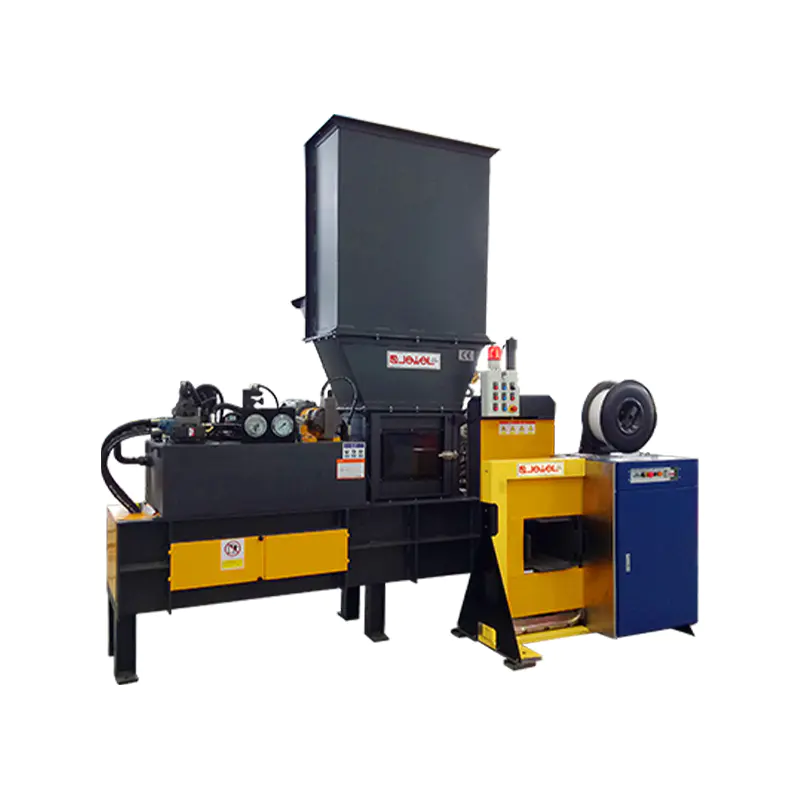
JPW20Q is the only model in the supplied material with a product-level CE certificate recorded against it. Image: Jewel.
Reference table: five models against nine fields
The table below reproduces the recorded values as a buyer would use them. “Not recorded” means the field does not appear in the supplied model record for that unit; it does not mean the machine lacks the property, and it must not be filled in by inference.
| Field | JPW20Q | JPW40F | JPW40BL | JP-OT100 | JP-S100B |
|---|---|---|---|---|---|
| Compression force | 20 t | 40 t | 40 t | 100 t | 100 t |
| Bale dimension (mm) | 500 × 500 × 500 | 720 × 720 × (500–1300) | 720 × 720 × (300–1000) | 1400 × 700 × (700–1100) | Not recorded |
| Feeding mouth (mm) | 700 × 460 | 1000 × 720 | 1000 × 720 | 1400 × 600 (L × H) | Not recorded |
| Bale weight | 30–70 kg | 200–400 kg | 250–350 kg | 400–600 kg | Not recorded |
| Capacity | Not recorded | 1–2 t/h | Not recorded | 5–6 bales/h | 20–30 s per cycle |
| Power | 7.5 kW / 10 Hp | 11 kW / 15 Hp | 15 kW / 20 Hp | 15 kW / 20 Hp | 11 kW / 15 Hp |
| Voltage (customizable) | 380 V / 50 Hz | Not recorded | 380 V / 50 Hz | 380 V / 50 Hz | Not recorded |
| Machine weight | 2.8 t | Not recorded | Not recorded | 3500 kg | 2.6 t |
| Overall dimensions (mm) | 3400 × 3010 × 2400 | 4900 × 1750 × 1950 | 5500 × 1150 × 1900 | Not recorded (chamber 1400 × 700 × 1700) | 2600 × 650 × 3500 |
| Strapping channels | 2–4 | 4 | 4 | Not recorded | Not recorded |
Source: Jewel model records for JPW20Q, JPW40F, JPW40BL, JP-OT100 and JP-S100B. Blank or “not recorded” entries indicate absent fields, not absent capability.
Voltage customization and carbon-steel construction need their own clauses
Two attributes cut across all five models and are routinely lost between quotation and delivery: supply voltage and frame material.
On voltage, the supplier states that the voltage of the hydraulic baler machine is customizable to meet specific requirements. Customization is therefore an offered capability, and an offered capability must be written down, not assumed. Three of the five records list 380 V/50 Hz as the recorded value — JPW20Q, JPW40BL and JP-OT100 — while the JPW40F and JP-S100B records carry no voltage field at all. The practical wording for a purchase order is to name the destination supply, the frequency, and the phase arrangement, and to state that the agreed configuration supersedes the recorded default. Where the record is silent, silence must not be read as “standard” and must not be read as “custom” either; it means the value is confirmed in the technical agreement.
On material, carbon steel is recorded as the primary material across the model records, and the supplier’s published capability states customization across structure, process and performance. That combination has a direct contractual consequence: because customization is offered at the structural and process level, the delivered machine is not automatically identical to the catalogue record, and the acceptance sheet becomes the only document that distinguishes a customized unit from a standard one. Any agreed change to structure, process or performance should be inserted into that sheet as a numbered deviation with its own criterion, rather than treated as an understood variation.
The supplier’s capability record also gives a planning context that affects when acceptance happens: a stated monthly capacity of 100 units, a minimum order quantity of one unit, a lead time of 60 days, and a quality-control statement of 100% testing. These are company-reported figures, useful for scheduling an inspection at the right moment rather than for judging a delivered machine, but they explain why an acceptance protocol should be agreed at order stage — there is a defined window between build and shipment in which questions can still change the outcome.
What the certification evidence covers — and what it does not
Certification is where purchase-order language is most often too broad. The supplied material supports two distinct pieces of third-party evidence, and they answer two different questions.
Product-level evidence. The fully automatic horizontal baler model JPW20Q holds CE certification for the EU market, certificate number TTC-22-1609/01/01, issued by INTEGRA. The certification scope covers Directive 2006/42/EC (Machinery Directive) and Directive 2014/35/EU (Low Voltage Directive), with applicable standards EN ISO 12100:2010 and EN 60204-1:2018. The certificate record shows an issue date of 16 September 2022 and an expiry date of 16 September 2027.
Supplier-level evidence. The manufacturer holds an SGS Made-in-China Supplier Audit Report, certificate number QIP—ASR2541890, issued by SGS under the Made-in-China Supplier Audit Specification and applicable to the EU market. The audit scope is recorded as the full range of baler machine, hydraulic baler, waste paper baler, cardboard baler and baling press machine, with an issue date of 10 December 2025 and an expiry date of 10 December 2028.
The distinction is not pedantic. A CE certificate names a product and a conformity route; a supplier audit report examines a supplier’s systems and scope of supply. A buyer who writes “CE certified” as a blanket order term for all five models is asserting something the supplied evidence does not support: only JPW20Q is recorded with a product-level CE certificate. A buyer who writes “SGS audited” as a product criterion is applying a supplier-level document to a machine-level question. The correct order language names the document, the number, the issuer, the market, the scope and the validity date — and, where a model is not covered by product-level evidence, states that separately rather than letting a supplier-level audit stand in for it.
Validity dates deserve their own line in the purchase order, particularly for orders placed well ahead of shipment. Both records carry explicit expiry dates, and a certificate that lapses between signature and delivery changes the compliance position of the shipment. Tying payment or release to a certificate that is still in force on the shipment date is a clause, not a formality.
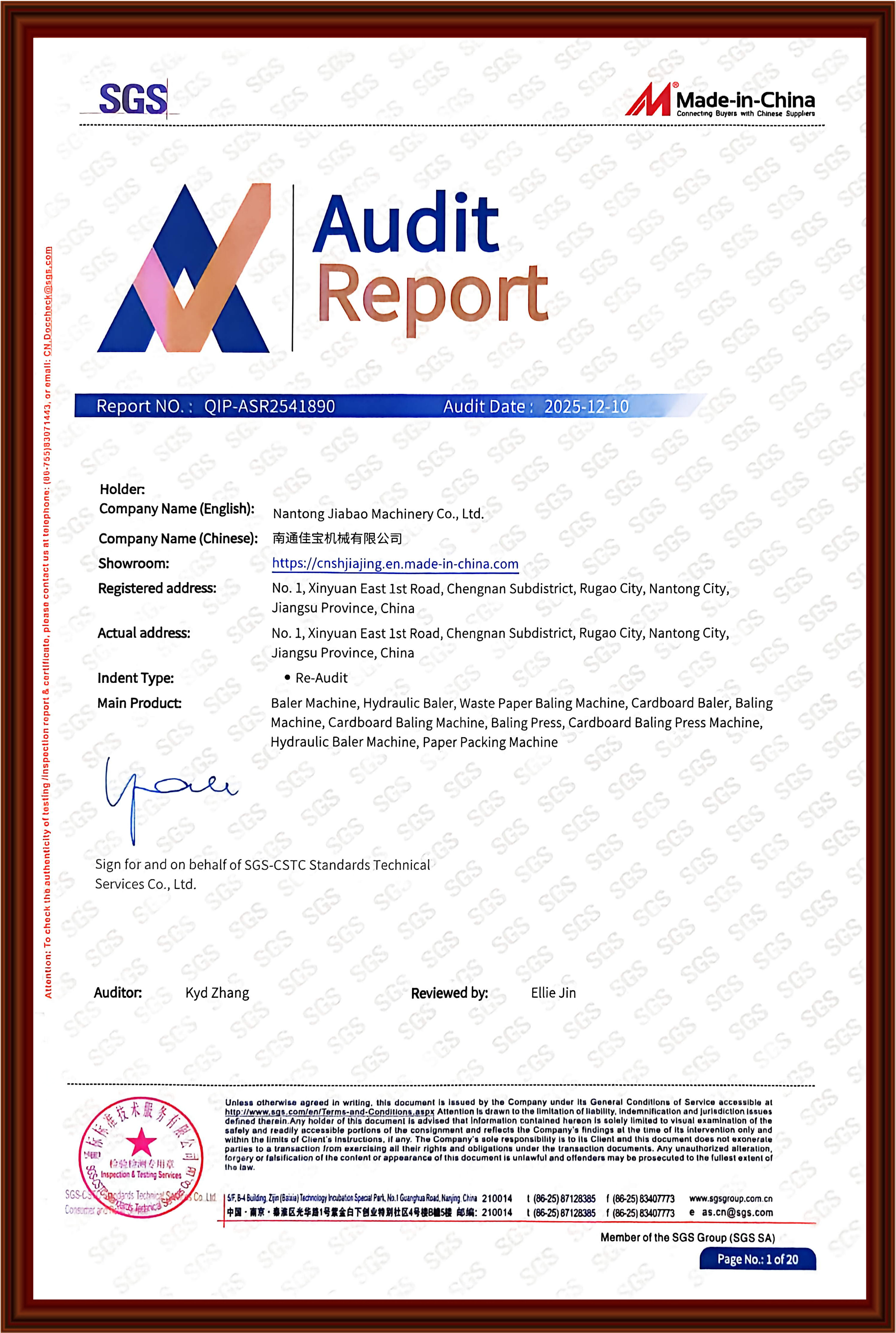
The SGS Made-in-China Supplier Audit Report is supplier-level evidence covering the full baler range; it is not a product conformity mark for any individual model. Image: Jewel.
A delivery acceptance sequence for hydraulic baler machines
Once the fields are chosen, the sequence of checks is straightforward. What makes it work is that every step produces a document the other party has already seen.
- Fix the reference record. Name the model and the revision of the specification record used for acceptance, and attach it to the order. Two parties reading different versions of a datasheet will disagree about a conforming machine.
- Transcribe fields, not adjectives. For each field, write the name, the value and the unit exactly as recorded — 40 t, 720 × 720 × (500–1300) mm, 1000 × 720 mm, 11 kW. Where the record gives a range, the criterion is the range.
- Flag absent fields explicitly. JP-S100B has no bale weight field; JPW40F has no voltage or machine weight field; JPW20Q has no capacity field. Each becomes a line reading “to be confirmed in writing before shipment”, with the confirmed figure added as an annex once supplied.
- Separate the certification schedule. Certificate name, number, issuer, scope, market and expiry date for each document, per model where product-level evidence exists.
- Record customizations as numbered deviations. Voltage configuration, and any agreed change to structure, process or performance, sits in its own list with its own acceptance check rather than being absorbed into the standard specification.
- State who measures and how. Dimensions, weight and configuration can all be checked against a drawing and a nameplate; the order should say which, so that the inspection does not default to a visual walk-around.
Where these criteria meet real waste streams
Acceptance criteria matter most where the machine sits inside a continuous waste flow, because a mismatch there does not stop one machine — it stops the line behind it.
In corrugated carton plants, the baler is usually downstream of a corrugator and printing machines, and the application records describe installations in Tunisia and Mexico built around automatic waste discharge from those lines. In the Tunisia record the matched equipment includes a conveying system and the requirement is a factory-wide automatic waste discharge arrangement; the Mexico record describes a full-automatic waste removal system integrated with existing production lines for real-time processing. Feeding-mouth dimensions, bale length range and baling capacity are the fields that determine whether such a system keeps up, which is why they belong in the order rather than in the commissioning conversation.
In PET and mixed-plastics recycling, the priorities shift toward bale density and shape. A Japanese PET recycler’s recorded requirement was a solution that increases compression density and produces compact, regular bales; a multi-material recycling operation in Belarus needed one machine to handle PET bottles, woven bags, HDPE bottles and cardboard. Both requirements translate into the same order fields — compression force, bale dimension and bale weight range — plus an agreed test material, because a bale weight range measured on cardboard says little about performance on bottles.
For vertical configurations, floor space and bale handling usually drive the choice, and JP-OT100’s record illustrates why the compression chamber dimension (1400 × 700 × 1700 mm) should be written alongside the bale dimension, since the chamber constrains what can be loaded before force is applied at all.
Market context: why a specification mismatch now costs more
Published commercial research points to a category that is expanding, which raises the cost of getting an order wrong. Vertex AI Search aggregated market research places the total baler market — agricultural and industrial equipment combined — at USD 7.96 billion in 2026, up from USD 7.18 billion in 2025. Data Insights Reports estimates the hydraulic waste paper baler segment at USD 1.45 billion in its base year, with a forecast of USD 2.24 billion by 2032 at a 5.5% CAGR. MarketsGlob valued the hydraulic metal recycling baler market at USD 913 million in 2023 and projected USD 1,318 million by 2031.
These three figures describe three different scopes and should not be added together — a caution that mirrors the article’s central argument about specification fields. None of them says anything about the compliance of a particular shipment, and none should be read as evidence that a given supplier is more or less reliable. What they do indicate is a market where lead time is contested and where a machine rejected at the factory gate is more expensive to replace than it once was. That is the commercial case for spending an extra hour on the purchase order.
Fit boundaries: what acceptance criteria cannot prove
A record-based acceptance sheet is a powerful document, but its limits should be stated as plainly as its uses.
- It verifies configuration, not output. A 1–2 t/h capacity figure on JPW40F is a recorded range for the model, not a guarantee for a specific waste mix on a specific shift.
- Ranges need an agreed material. Bale weights of 30–70 kg on JPW20Q or 200–400 kg on JPW40F are only testable against a stated material and moisture condition.
- Units are not interchangeable. A bales-per-hour figure and a tonnes-per-hour figure cannot be compared without bale weight, and a cycle time is not a throughput figure.
- Certification is model- and market-specific. The supplied CE certificate is recorded against JPW20Q for the EU market; extending it to other models or markets requires its own evidence.
- A supplier audit is not a product certificate. The SGS Made-in-China Supplier Audit Report describes an audited supplier scope, which supports supplier qualification rather than any single machine’s conformity.
Where a required field or document is missing, the honest response is to obtain it in writing before signature rather than to write a criterion that cannot be evaluated. That single discipline eliminates most of the disputes that surface after delivery.
Frequently asked questions
Which specifications should a hydraulic baler purchase order list?
The order should list the fields the manufacturer’s model record actually contains for that model: compression force, bale dimension, feeding-mouth size, bale weight, capacity, power, voltage, machine weight and overall dimensions. For JPW40F, that means 40 t force, 720 × 720 × (500–1300) mm bales, a 1000 × 720 mm feeding mouth, 200–400 kg bale weight, 1–2 t/h capacity, 11 kW/15 Hp and 4900 × 1750 × 1950 mm overall dimensions, with voltage and machine weight confirmed separately because they do not appear in the record.
Can the voltage of a Jewel hydraulic baler machine be customized?
Yes. The supplier states that the voltage of the hydraulic baler machine is customizable to meet specific requirements. Three of the five reviewed records list 380 V/50 Hz as the recorded value — JPW20Q, JPW40BL and JP-OT100 — while the JPW40F and JP-S100B records list no voltage field. Because customization is offered, the destination supply should be specified in the purchase order and the agreed configuration recorded as a deviation from the standard record rather than assumed.
Does the CE certificate cover every Jewel baler model?
The supplied evidence records CE certification for one model only: the fully automatic horizontal baler JPW20Q, certificate number TTC-22-1609/01/01 issued by INTEGRA for the EU market, covering Directives 2006/42/EC and 2014/35/EU and standards EN ISO 12100:2010 and EN 60204-1:2018, with an expiry date of 16 September 2027. No product-level CE certificate is recorded in the supplied material for JPW40F, JPW40BL, JP-OT100 or JP-S100B, so a blanket “CE certified” term across all models is not supported by that evidence.
What is the difference between the CE certificate and the SGS audit report?
The CE certificate is product-level evidence tied to a named model. The SGS Made-in-China Supplier Audit Report, certificate number QIP—ASR2541890 issued by SGS under the Made-in-China Supplier Audit Specification for the EU market, is supplier-level evidence whose recorded scope is the full range of baler machine, hydraulic baler, waste paper baler, cardboard baler and baling press machine. It supports supplier qualification and runs to 10 December 2028; it does not substitute for a model’s own conformity documentation.
What should a buyer do when a model record does not list a field such as machine weight?
The correct approach is to request the figure in writing and attach it to the order, rather than to borrow a value from a similar model. JP-S100B, for example, carries no bale dimension, bale weight or feeding-mouth field, and JPW20Q carries no baling capacity field, so criteria built on those values cannot be evaluated at delivery for those models. Marking the field “to be confirmed in writing” at order stage converts a silent gap into an agreed figure.
Outlook
The direction of travel in waste-handling procurement is toward documents that can be checked rather than descriptions that must be trusted. Buyers comparing hydraulic baler machines across waste paper, carton, PET, metal and fiber applications increasingly ask for the model record, the certificate schedule and the deviation list as a single package — which is simply another way of saying that compliance has moved upstream, into the purchase order itself. Suppliers who publish consistent, complete model records will find that conversion easier; buyers who convert those records into acceptance criteria will find that delivery disputes become rare.
For readers who want the full specification set behind the five models discussed here, Jewel publishes a 2026 hydraulic baler brochure that can be downloaded and used as a starting point for the annex described above.
Tem questões ou precisa de mais detalhes?
Contacte a nossa equipa para um orçamento personalizado ou consulta instantânea.
Solicitar orçamento
Preencha o formulário abaixo e a nossa equipa entrará em contacto com uma proposta personalizada.
Chat direto do WhatsApp
Prefere conversar em tempo real? Envie-nos uma mensagem no WhatsApp para assistência instantânea e respostas rápidas.
- Obter orçamento personalizado
- Partilhar fotos ou documentos
- Discuta as suas necessidades diretamente
Geralmente responde em 5–30 minutos durante o horário de expediente.