
Hydraulic Baler Partnership Guide: Long-Term Supply Models for 2026
Hydraulic Baler Partnership Guide: Long-Term Supply Models for 2026
For industrial buyers moving from single-machine purchases to repeat sourcing, the decision is no longer just about the baler itself but about the resilience of the supplier behind it. Shaanxi Nick Machinery Equipment Co., Ltd. (NICKBALER) is a manufacturer and distributor of advanced hydraulic balers and environmental protection machinery, based in Wuxi, Jiangsu, China. The company, established in 2013, operates a 5,000 m² factory with 50 employees and exports about 90% of its output to North America, South America, and Asia.
The Shift from Transactional Buying to Long-Term Supply Partnerships
Procurement teams today are increasingly evaluating hydraulic baler suppliers not only on product specs and price, but also on capacity stability, lead-time reliability, and after-sales support. A single breakdown or delayed shipment can halt an entire recycling line. This is why distributors, wholesalers, and factory operators are looking for partners who can guarantee consistent output and respond quickly to market fluctuations.
NICKBALER positions itself as a one-stop solution provider for industries like agriculture, recycling, manufacturing, packaging, and waste management. Its product line includes horizontal and vertical balers, hydraulic baling presses, PET bottle balers, metal compressors, shredders, and auxiliary equipment. For buyers planning multi-unit purchases or annual supply contracts, understanding a supplier's production capacity and commercial terms is as critical as evaluating machine specifications.
Production Capacity and What It Means for Your Supply Chain
A supplier's monthly output is one of the clearest indicators of its ability to honor large or repeated orders. NICKBALER's factory has a monthly production capacity of 10 units. This figure, while modest compared with mass-production lines, reflects a build model focused on heavier machine weight, thicker material, and stronger structure — especially for the upgraded NICK BALER series.
The company distinguishes between two product tiers. NK BALER is the standard long-cylinder servo hydraulic baler, designed for regular daily baling work with cost-effective, stable performance. NICK BALER is the upgraded high-quality version, featuring heavier machine weight, thicker material, stronger structure, and higher-grade hydraulic and electric control components. NICK BALER is engineered to run more powerfully with a lower failure rate and to work continuously under heavy load for long-term use.
For buyers, this dual-tier approach means you can align machine grade with application intensity: NK BALER for budget-conscious, regular operations; NICK BALER for heavy-duty, high-uptime requirements.
Technical Backbone: Key Parameters Across the Hydraulic Baler Range
Understanding the hydraulic force, bale size, and throughput of each model helps procurement teams match equipment to their material type and volume targets. NICKBALER's horizontal hydraulic balers span from 80 to 250 tons of hydraulic power, with bale sizes ranging from 1100×800×1600 mm to 1100×1250×1800 mm and capacities from 3–5 tons per hour up to 10–15 tons per hour.
| Model | Hydraulic Power | Bale Size (W×H×L) mm | Capacity | Main Motor |
|---|---|---|---|---|
| NKW80Q | 80T | 1100×800×1600 | 3–5 T/h | 30KW+11kw |
| NKW100QT | 100T | 1100×850×1200 | 4–6 T/h | 30KW+7.5kw |
| NKW125Q | 125T | 1100×1100×1600 | 10–12 T/h | 37.5KW+11kw |
| NKW160Q | 160T | 1100×1250×1600 | 12–15 T/h | 45KW+11kw |
| NKW180QT | 180T | 1100×1250×1600 | 12–15 T/h | 45KW+7.5kw |
| NKW200Q | 200T | 1100×1100×1800 | 12–15 T/h | 45KW+11kw |
| NKW250BD | 250T | 1100×1250×1700 | 10–15 T/h | 45KW/60HP |
Most horizontal models use carbon steel construction and are suitable for food, pharmaceuticals, packaging, chemicals, electronics, metals, waste treatment, and recycling industries. Several models include conveyor systems, water cooling or oil chiller cooling systems, and automatic tying options. For agricultural materials like alfalfa hay, wheat straw, and peanut hay, NICKBALER offers bagging machines such as the NKB280 and NKB280-1, which produce 30–32 bales per hour and can pack dry material into 300–450 kg bales.
Commercial Terms: MOQ, Payment, and Delivery Alignment
Long-term supply relationships depend on commercial terms that fit both parties' cash flow and inventory cycles. NICKBALER offers flexible terms depending on order size and product category. For most baler and bagging machine orders, the minimum order quantity is 1 unit, with FOB/CIF delivery options, pre-shipment testing for acceptance, and a 40/60 payment split. For a broader product range including vertical balers and auxiliary equipment, the MOQ is 2 units with a 30/70 payment structure.
Pre-shipment testing is a standard acceptance step, allowing buyers to verify bale density, cycle time, and safety functions before the machine leaves the factory. This is particularly important for international buyers who cannot easily inspect equipment after shipment.
Application Scenarios Across Industries
The choice between vertical and horizontal balers is largely driven by material type, floor space, and throughput requirements.
Large horizontal full-automatic balers are suited for high-volume recycling centers processing waste paper, cardboard, plastics, and metals. With feed openings up to 2400×1100 mm and capacities reaching 12–15 tons per hour, these machines reduce labor costs and keep material flowing continuously. Models like the NKW160Q and NKW200Q can be configured as fully automatic or semi-automatic horizontal balers.
Vertical hydraulic balers are preferred for smaller footprint operations, such as retail distribution centers, textile recyclers, and farms. The NK1070T60, for example, is a cardboard box baler with 60 tons of force and a 1100×700 mm chamber. The NK-T90L double-chamber clothes baler handles garments and sacks at 10–12 bales per hour. The NKOT150 tire baler compacts scrap tires into 1000–1500 kg bales, reducing transport volume significantly.
Specialty balers cover materials like metal shavings, aluminum scrap, used rags, sawdust, and wood shavings. For metal processors, the vertical NK080T100 handles cans and PET bottles, while the NK110T150 is designed for fiber and coco coir. For agricultural operations, the NKB280 bagging machine is a practical solution for alfalfa hay and wheat straw, producing 30–32 bales per hour with woven or plastic bag strapping.
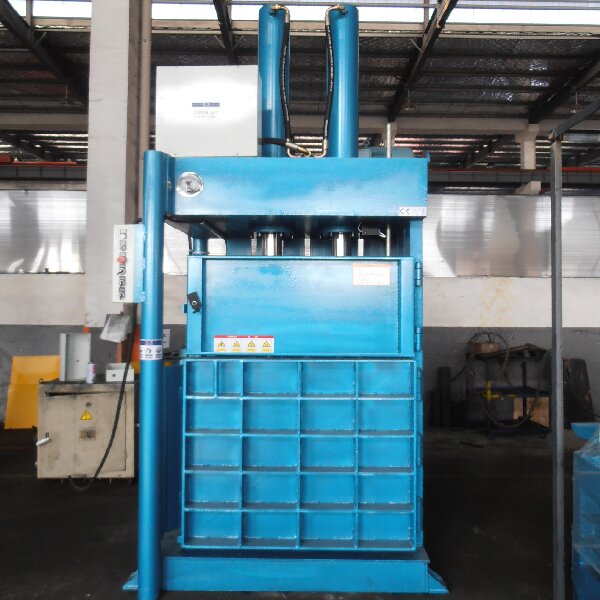
Regardless of the application, the operational principle remains the same: hydraulic cylinders compress loose material into dense, stackable bales that reduce storage space, lower freight costs, and simplify downstream handling.
Market Context: Why Supplier Reliability Matters More in 2026
The global baler machine market was valued at USD 6.6 billion in 2024 and is projected to reach USD 11.4 billion by 2035, according to Transparency Market Research. The baler press segment alone accounted for 24.5% of the total recycling equipment market in 2025. Asia Pacific dominated global baler revenue in 2024 with a 40.2% share, and China was among the top exporters of hydraulic baling presses under HS Code 8462, with 91 significant shipments recorded between June 2024 and May 2025.
This growth places greater pressure on suppliers to maintain consistent lead times and quality. Buyers who lock in a reliable manufacturing partner now are better positioned to scale their operations without the risk of supply disruption.
How NICKBALER Compares with Traditional / Alternative Solutions
Compared with piston compressor-based compaction systems, hydraulic balers generally run at lower noise levels — in NICKBALER's comparison data, a difference of -15 dB — with lower maintenance requirements and higher efficiency. This makes hydraulic balers particularly suitable for noise-sensitive environments and industrial plants.
An honest limitation: hydraulic balers require a higher initial capital investment than some lighter-duty compaction alternatives. However, the total cost of ownership is often offset by lower energy consumption per ton of material processed, reduced labor time, and fewer moving parts that need frequent servicing.
Future Outlook: Building a Resilient Hydraulic Baler Supply Chain
As more international buyers shift from single-machine procurement to annual supply agreements, manufacturers that demonstrate transparent production capacity, standardized testing procedures, and flexible commercial terms will become preferred partners. NICKBALER's monthly capacity of 10 units makes it a suitable partner for buyers who value build quality and customization over mass production volume.
The company's engineering is inspired by German, European, and American technology, and its R&D team of 15 people supports both standard and custom configurations. For distributors planning to expand their baling equipment portfolio, the availability of both NK BALER and NICK BALER tiers offers an accessible entry point across different customer segments.
Frequently Asked Questions
1. What is the minimum order quantity for NICKBALER hydraulic balers?
For most baler and bagging machine products, the MOQ is 1 unit. For a broader range including vertical balers and auxiliary equipment, the MOQ is 2 units. This flexibility supports both first-time buyers testing a new line and established distributors making regular replenishment orders.
2. What payment terms can international buyers expect?
NICKBALER offers a 40/60 payment split for baler and bagging machine orders, and a 30/70 split for other product categories. These terms are typically applied alongside FOB or CIF delivery methods, with pre-shipment testing as a standard acceptance step.
3. How does NICKBALER ensure product quality before shipment?
Pre-shipment testing is part of the standard acceptance process. Each machine is tested before leaving the factory to confirm hydraulic pressure, cycle time, and safety functions. The company's production facility is 5,000 m², and the monthly production capacity is 10 units.
4. Can NICKBALER support custom or OEM/ODM configurations?
Yes. With a dedicated R&D team and a factor model that supports customization, NICKBALER can adapt bale sizes, feed openings, and auxiliary equipment to application-specific needs. Buyers should specify required parameters — such as material type, throughput, and voltage — to receive a configuration quote.
5. What after-sales support is available for international buyers?
NICKBALER provides guidance for installation, operation, and maintenance, supported by a technical team reachable via email and WhatsApp. For long-term supply relationships, buyers can also coordinate spare parts orders through the same sales channel.
Company profile: Shaanxi Nick Machinery Equipment Co., Ltd. (NICKBALER) is a manufacturer and distributor of hydraulic balers and environmental protection machinery, based in Wuxi, Jiangsu, China. Since its establishment in 2013, the company has exported 90% of its products to more than 60 countries. For more information or to request a brochure, visit www.nickbaler.com or contact Sales@nkbaler.com.