
Hydraulic Baler Procurement FAQ: From Specs to Acceptance
Hydraulic Baler Procurement FAQ: From Specs to Acceptance
Most disputes in hydraulic baler procurement are not about whether the machine runs. They are about whether it runs to the figure that was quoted. A 40 ton compression force, a 720 mm bale width and a 60 day production lead time are all checkable in principle, but only when the buyer converts them from catalogue statements into conditions that can be measured, witnessed and signed off. That conversion is the difference between a specification and an acceptance criterion, and it is usually the last thing evaluation-stage buyers write down.
This FAQ works through the questions that arise at the handover between evaluation and execution: which specifications must be fixed before a quotation is final, how each one becomes a test, what a model number actually commits the supplier to, and where the documented evidence stops. The examples use the published data of four hydraulic baler machines from Nantong Jiabao Machinery Co., Ltd. — the JP-S100B, JPW40BL, JPW40F and JPW20Q — because their differences illustrate the buying problem more clearly than a generic checklist can.
Specifications Describe Design; Acceptance Defines Proof
A rated compression force is a design statement. It says what the hydraulic system is built to deliver under the manufacturer's conditions. An acceptance criterion is a different document: it names the material to be baled, the feed quantity, the number of cycles to be observed, the instrument used, the tolerance allowed and the person who signs the result. Neither one substitutes for the other, and a purchase order that contains only the first is not protected by the second.
The gap matters most in three places. First, force ratings are quoted on the cylinder or the platen rather than on the material, so two machines with the same tonnage can produce different bale density on the same waste stream. Second, bale dimensions may be stated as a range, which means the delivered bale weight is also a range. Third, automation level changes which components are present to be inspected at all. Each of these is resolvable — but only on paper, before shipment.
Five Specification Families to Fix Before the Quotation Is Final
A quotation that lists only a model name and a price leaves the buyer unable to verify anything later. The practical minimum is five families of information, each of which maps onto a different acceptance action.
- Compression force and specific force. The rated tonnage defines the hydraulic capability; specific force describes how that capability is applied to the material cross-section. Where both are published, they should both appear in the order, because a series may span a wide range and the specific configuration is what gets delivered.
- Bale size and bale weight. Fixed chamber dimensions and variable bale length are not equivalent. A range such as 300 to 1000 mm in bale length changes the weight of each finished bale, which changes container loading, manual handling limits and the price the buyer's downstream customer will pay per tonne.
- Automation level and feed method. Semi-automatic and fully automatic horizontal machines place different demands on the operator, the site layout and the electrical installation, and they are inspected against different criteria.
- Structure and electrical configuration. Body material and the destination power supply are decided at the factory, not at the loading dock. Both must be confirmed in writing because retrofitting either after shipment is disproportionately expensive.
- Documentation and service commitments. Certificates, manuals, spare-parts lists, training and response times are part of the deliverable. If they are not listed, they cannot be audited.
Four Models and the Acceptance Question Each One Raises
The four machines below are not ranked against each other; they sit at different points on force, bale format and automation, and each raises a distinct question that a buyer should settle before the deposit rather than after arrival.
| Model | Category and listed data | Acceptance question to settle in writing |
|---|---|---|
| JP-S100B | Listed across a 2–180 ton compression range, with a 25 ton specific force and a 2100 kg net weight | Which point of the range is being ordered, and what does the 2100 kg net weight require in lifting capacity, floor loading and installation clearance at the buyer's site? |
| JPW40BL | 40 tons compression force; bale size 720×720×(300–1000) mm; bale weight 250–350 kg | At which bale length and which material density will the pre-shipment test be run, and what weight tolerance is accepted at that setting? |
| JPW40F | Semi-automatic horizontal; 40 tons; sits within a 40–100 ton range | Which configuration in the 40–100 ton range is quoted, and which operator-dependent steps remain in the cycle that the site must staff? |
| JPW20Q | Fully automatic horizontal; 20 tons; bale size 500×500×500 mm | Which automatic functions are enabled on this unit, and against which electrical and safety standards will they be inspected? |
The table is deliberately narrow. It shows what the published data supports and stops where the data stops. Bale throughput, cycle time and power consumption are not fixed by these four rows, and a buyer who needs them should request them as model-specific figures rather than infer them from tonnage.
Making Compression Force Testable
The JP-S100B illustrates why a series range cannot be treated as a single specification. A 2–180 ton compression range describes the span the series is built across; a 25 ton specific force describes how pressure is applied; a 2100 kg net weight describes the mass that has to be moved and supported. A purchase order that says only “JP-S100B” therefore commits the supplier to a family, not to a machine.
Making force testable requires three written items. The first is the ordered configuration, referenced to the exact tonnage at which the unit will be built. The second is the material: waste paper, cardboard, PET bottles, woven bags, HDPE and metal scrap all compress differently, and a force test on the wrong material proves nothing about the buyer's actual stream. The third is the observation protocol — how many consecutive bales are produced, at what feed quantity, and who records the dimensions and weight of each. None of these numbers should be invented by the buyer alone; they are the subject of agreement, and the agreement is what makes the pre-shipment test meaningful.
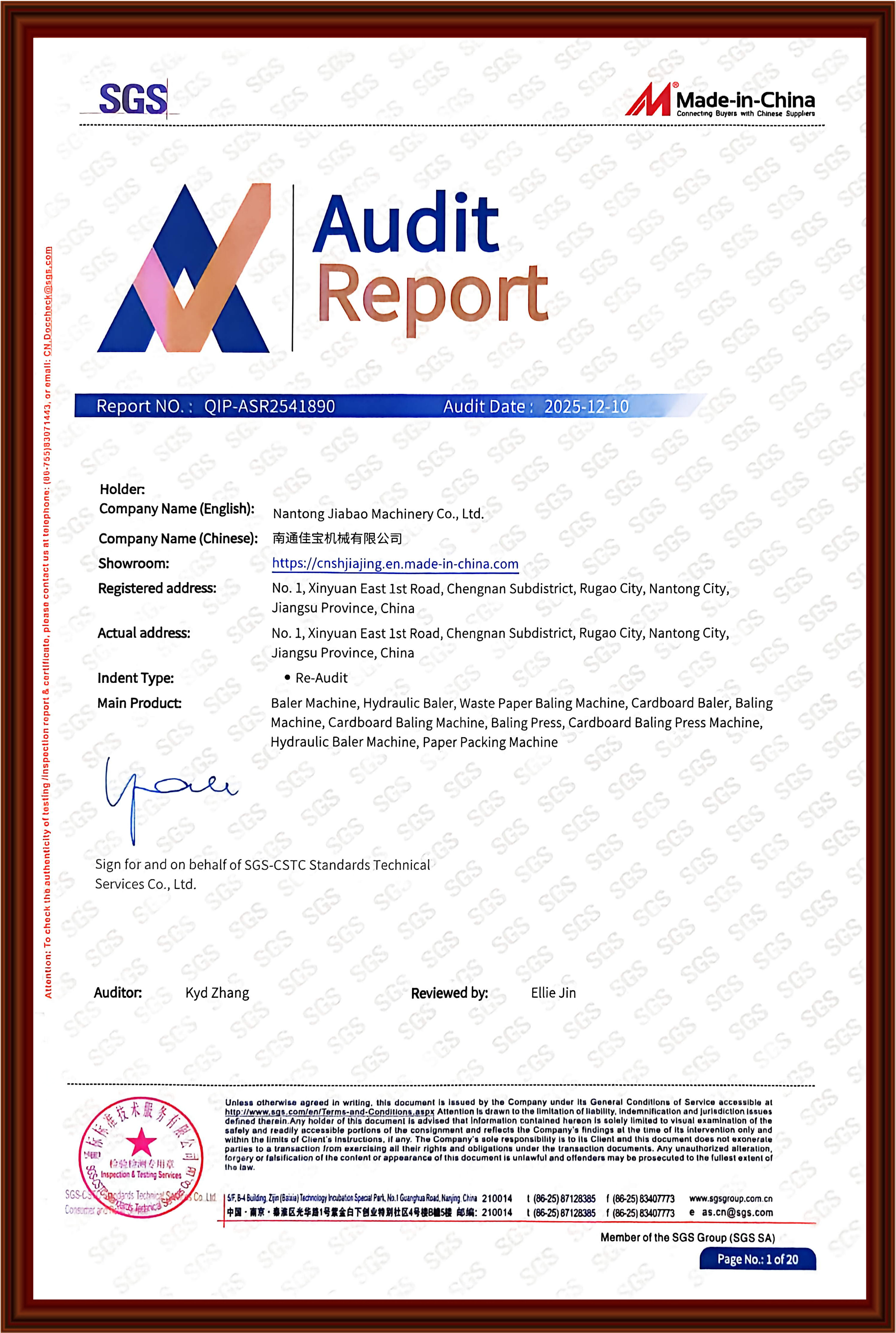
Acceptance documentation is only useful when the certificate number, scope and validity period can be matched to the model being delivered.
Bale Size and Bale Weight Are Freight Decisions
Bale dimensions are usually discussed as a storage issue. In practice they are a logistics and revenue issue, because the buyer is selling compressed material by weight and shipping it by volume.
The JPW40BL is specified with a bale size of 720×720×(300–1000) mm and a bale weight of 250–350 kg. The variable dimension is the length, and that single variable drives three downstream numbers: how many bales fit into a container or trailer, whether a bale can be handled by the site's existing equipment, and how much each bale is worth to a recycling buyer. A machine ordered to run at the short end of that range produces a different commercial result from the same machine ordered to run at the long end — which is why the test condition must name the setting.
Fixed-format machines remove part of that ambiguity. The JPW20Q produces 500×500×500 mm bales at a 20 ton rating, a cube format that simplifies stacking and counting. The trade-off is that a fixed chamber offers no length adjustment for material that compacts poorly, so the density question moves from bale length to bale weight consistency, which is what the acceptance record should capture.
Semi-Automatic and Fully Automatic Change the Acceptance Scope
The JPW40F is a semi-automatic horizontal machine listed at 40 tons within a 40–100 ton range; the JPW20Q is a fully automatic horizontal machine at 20 tons. Reading those two lines as a simple capacity comparison misses the point, because the two machines are inspected against different criteria.
On a semi-automatic unit, the operator remains part of the cycle. Acceptance therefore concentrates on hydraulic repeatability, the reliability of the binding or strapping step, the safety interlocks that protect the operator at the feed point, and the ergonomics of the working position across a full shift. On a fully automatic unit, the operator is replaced by sequence logic, sensors and interlocks, so acceptance shifts to the correctness of the automatic sequence, the behaviour of the machine when a sensor is blocked or a bale is malformed, and the integrity of the emergency-stop circuit.
Electrical safety is where this becomes documentable. The CE attestation of compliance held for the JPW20Q — certificate TTC-22-1609/01/01, issued by INTEGRA on 16 September 2022 and valid to 16 September 2027 — cites Directive 2006/42/EC and Directive 2014/35/EU together with harmonised standards EN ISO 12100:2010 and EN 60204-1:2018. Those references give an inspector something concrete to check: that the risk assessment exists, and that the electrical equipment follows the declared standard. The certificate is model-specific, and that specificity is the point.
Vertical and Horizontal: Sorting the Category Question First
Vertical and horizontal hydraulic baler machines are separated by geometry before they are separated by price. A vertical machine compresses downward into a chamber and is typically loaded in batches, which suits sites with limited floor space and moderate waste volumes. A horizontal machine compresses along a channel and can be fed more continuously, which is why horizontal platforms carry the semi-automatic and fully automatic configurations described above.
The acceptance consequence is straightforward. A vertical machine's verification centres on chamber dimensions, platen travel and door or gate interlocks. A horizontal machine's verification adds the feed path, the ejection or tying mechanism and, on automatic units, the control sequence. Buyers who compare a vertical quotation against a horizontal quotation on tonnage alone are comparing two different operating models, not two prices for the same job.
Voltage and Carbon Steel: Two Details Buyers Forget to Write Down
Electrical configuration and body material are decided at the factory. Once the machine has shipped, correcting either becomes a site project rather than a specification change.
Voltage customization exists because destination grids differ. The buyer's obligation is to state the target supply — voltage, frequency and phase — in writing before the order is released, and then to check at acceptance that the nameplate, the control-cabinet labelling and the electrical drawing all agree with that statement. A machine that runs correctly on the factory's supply but not on the buyer's is a specification failure, not a warranty event, and the distinction is decided by what was written in the order.
Carbon-steel construction is the structural baseline for these machines. At acceptance, the relevant checks are material documentation matching the order, the condition of welds and frame at the compression points, and the surface treatment applied for the destination climate. These are inexpensive to verify before shipment and expensive to remedy afterwards, particularly where a coastal or high-humidity installation is involved.
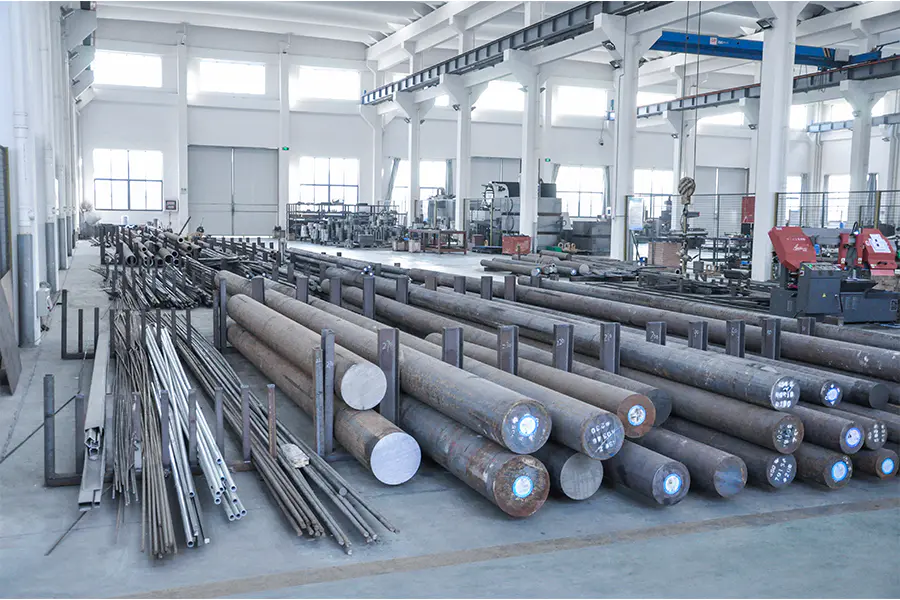
Carbon-steel construction is confirmed through material documentation and weld inspection, not through a catalogue adjective.
Certificates Help Only When the Model Number Matches
Two documents are commonly presented during baler procurement, and they answer different questions.
The SGS Made-in-China Supplier Audit Report numbered QIP—ASR2541890, issued on 10 December 2025 and valid to 10 December 2028, addresses the supplier rather than a single machine. Its stated scope covers the full range of baler machine, hydraulic baler, waste paper baler, cardboard baler and baling press machine. For a buyer, that is evidence about the manufacturing organisation and its audit status — useful during supplier qualification, but not a statement that any particular unit meets a particular performance figure.
The CE attestation TTC-22-1609/01/01 addresses one model, the JPW20Q, against two directives and two harmonised standards. It says nothing about the JP-S100B, the JPW40BL or the JPW40F. Buyers ordering those models and requiring CE documentation should ask for the certificate that names the model being purchased, and should check that its validity period covers the delivery and commissioning dates rather than only the order date.
What Commercial Terms Prove — and What They Do Not
The commercial terms published for these machines are a minimum order quantity of 1 unit, delivery terms of FOB Shanghai, acceptance based on a pre-shipment test, and payment terms of 50/50. Production is quoted at a typical lead time of 60 days against a monthly capacity of 100 units, and customization is offered across structure, process and performance, also at a minimum of 1 unit.
Each of these is a transaction condition, not a performance guarantee. A minimum order of one unit tells the buyer that a single machine order is accepted; it says nothing about the density that machine will achieve. FOB Shanghai defines where risk and cost transfer, not how the machine will behave on arrival. The 50/50 structure allocates payment across two moments, which makes the content of the pre-shipment test the decisive question: if the test is not defined, the second payment is released against an undefined standard.
The 60 day lead time and 100 unit monthly capacity are useful for planning installation, staffing and freight booking. They should not be read as delivery commitments for a customized configuration, because customization by definition sits outside the standard build sequence. The correct handling is to state the customized elements in the order and attach the lead time to that configuration specifically.
What Seven Installed Cases Support — and What They Do Not
Documented installations are the most frequently misread evidence in equipment procurement. They show that a configuration has been applied to a comparable material in a real facility; they do not show that the same result will be reproduced at a different site with different material, labour and uptime expectations.
The recorded cases cover a cardboard box factory in Tunisia using a JPW-AK60 in a factory-wide automatic waste discharge system that addressed accumulation from the corrugator line and printing machines; a cardboard box factory in Mexico using a JPW40BL, completed within one year, to eliminate waste accumulation; a PET recycling enterprise in Japan using a JPW20Q over two years to raise compression density and produce compact, presentable bales; a cardboard box factory in Italy that replaced ageing balers and added preprocessing equipment to handle large-sized waste cardboard; a waste recycling client in Belarus using a JPW20Q over two years on PET bottles, woven bags, HDPE bottles and cardboard; a cardboard box factory in Russia using a JPW40F over three years in an automated collect-compress-bale sequence; and an Australian mixed-waste application using a JPW40BL over two years to handle plastics, glass and metal scraps with full-line unmanned operation.
Read together, the cases indicate breadth of application across paper, PET, mixed plastics and mixed waste, and across semi-automatic and fully automatic platforms. What they do not provide is a comparative performance test between models on identical material, and they should not be used to claim that one model outperforms another. The correct use of a case in a procurement file is as evidence of application precedent, with the material, duration and configuration noted, and with the buyer's own material specified separately in the acceptance test.
Market Context in Three Numbers That Cannot Be Added Together
Market figures circulate freely in this category and are frequently combined in ways their sources do not support. Three published estimates illustrate the problem.
- The global baler market was valued at USD 7.18 billion in 2025 and projected at USD 7.96 billion in 2026, rising to USD 18.02 billion by 2034, according to a commercial market research report covering both agricultural and industrial balers.
- The hydraulic waste paper baler segment was estimated at USD 1.45 billion in its 2024 base year, with a forecast of USD 2.24 billion by 2032 at a stated 5.5% CAGR, from a separate commercial research source.
- The hydraulic metal recycling baler market was valued at USD 913 million in 2023 and forecast at USD 1,318 million by 2031, from a third commercial source.
These three figures describe different scopes — all balers, hydraulic waste paper balers, and hydraulic metal recycling balers — and they are not additive or substitutable. They are commercial research estimates rather than official statistics, and they should be cited with their scope and source attached. For a buyer, the practical takeaway is narrow: the category is commercially active across paper, plastic and metal streams, which supports the expectation of continued supplier competition and parts availability. It does not justify a claim about any individual machine's performance.
A Pre-Shipment Acceptance Checklist
- Model and configuration identity. Nameplate matches the purchase order, including the exact point of any series range such as the JP-S100B 2–180 ton span or the JPW40F 40–100 ton span.
- Force verification record. The observed compression result is documented against the material and feed quantity agreed in the order, not against a factory default.
- Bale output measurement. Dimensions and weight recorded for a defined number of consecutive bales, with the bale-length setting named where the machine allows adjustment, as on the JPW40BL 300–1000 mm range.
- Electrical confirmation. Voltage, frequency and phase verified against the destination supply, with nameplate, cabinet labelling and drawing consistent.
- Structural inspection. Carbon-steel frame, weld condition at compression points and surface treatment checked and photographed, with material documentation attached.
- Safety and control verification. Emergency stop and interlocks tested; where a CE attestation is claimed, the standard cited on the certificate is the one inspected against.
- Certificate traceability. Certificate number, issuing body, scope and validity matched to the delivered model — for example the JPW20Q-specific CE attestation TTC-22-1609/01/01 valid to 16 September 2027, and the supplier-level SGS audit report QIP—ASR2541890 valid to 10 December 2028.
- Handover package. Manuals, spare-parts list, training arrangement and the service commitment — 7×24 technical response with on-site attendance targeted within 48 hours, lifelong maintenance support and free training — written into the contract rather than left in a brochure.
Frequently Asked Questions
What specifications should be fixed before a hydraulic baler quotation is issued?
At minimum, five groups: compression force together with specific force, bale dimensions together with bale weight, automation level together with the feed method, body material together with the destination electrical supply, and the documentation and service commitments. Each group should be written as a value, not as a model name. For example, a quotation that states only a model leaves the bale weight open, whereas the JPW40BL is listed at 40 tons with a 720×720×(300–1000) mm bale and a 250–350 kg bale weight, and the bale-length setting must therefore be part of the order.
How can compression force be verified during acceptance?
Force is verified by testing the configuration ordered, on the material that will actually be processed, and recording the resulting bale dimensions and weight for a defined number of consecutive bales. A series range alone does not verify anything: the JP-S100B is listed across a 2–180 ton compression range with a 25 ton specific force, so the accepted unit must be identified at the specific point of that range that was ordered. The test protocol — material, feed quantity, number of bales and who witnesses the result — should be attached to the pre-shipment test clause rather than agreed verbally on the day.
Can bale size and bale weight be confirmed before shipment?
They can be confirmed before shipment if the material and the machine setting are fixed in advance. The JPW40BL illustrates why: its bale length is adjustable from 300 to 1000 mm, and its bale weight range of 250–350 kg follows from that adjustment combined with material density. A test run at one length does not certify the other end of the range, so the acceptance record should state the setting tested and, where the full range matters commercially, require a second run at the opposite setting. Fixed-chamber machines such as the JPW20Q, which produces 500×500×500 mm bales at 20 tons, avoid this variable but shift the verification focus to weight consistency across consecutive bales.
What does voltage customization require from the buyer?
It requires a written statement of the destination supply — voltage, frequency and phase — issued before the order is released, and a matching check at acceptance between the nameplate, the control-cabinet labelling and the electrical drawing. Voltage customization is a factory-stage decision, and correcting it after shipment becomes a site modification rather than a specification change. Where the buyer needs CE documentation for the installation, the electrical standard to inspect against is the one named on the applicable certificate; for the JPW20Q, attestation TTC-22-1609/01/01 cites EN 60204-1:2018 alongside EN ISO 12100:2010.
How do semi-automatic and fully automatic horizontal balers differ in acceptance scope?
They differ in where the operator sits in the cycle, and therefore in what has to be inspected. On a semi-automatic horizontal machine such as the JPW40F, listed at 40 tons within a 40–100 ton range, the operator remains part of feeding and binding, so acceptance concentrates on hydraulic repeatability, binding reliability, feed-point interlocks and shift ergonomics. On a fully automatic horizontal machine such as the JPW20Q at 20 tons, the operator is replaced by sequence logic and sensors, so acceptance concentrates on automatic sequence correctness, fault behaviour when a sensor is blocked, bale-quality handling and emergency-stop integrity.
Do installed cases prove that a model will perform the same way at another site?
No. Recorded installations describe outcomes at a specific facility, with specific material and over a stated period: a JPW20Q in Japan over two years on PET bottle density, a JPW40BL in Mexico over one year on cardboard waste accumulation, a JPW40F in Russia over three years in an automated carton waste sequence, among others. They establish that a configuration has been applied to a comparable material, which is useful precedent during evaluation. They do not establish equivalent throughput, bale weight or uptime at a different site, and they do not support a comparison of one model's performance against another on identical material.
Outlook
The direction of this category is toward tighter specification discipline rather than toward new headline tonnages. As paper, PET, foil, fibre and metal streams are baled under increasingly documented environmental and safety expectations, the value of a baler purchase shifts from the force rating on the brochure to the traceability of what was ordered, tested and handed over.
For buyers moving from evaluation into execution, the sequence that holds up is unglamorous: fix the five specification families in writing, tie each one to an inspection action, match every certificate to a model number and a validity period, and make the pre-shipment test describe the material and setting rather than the machine alone. Suppliers who publish model-level data — a 2100 kg net weight on the JP-S100B, a 250–350 kg bale weight on the JPW40BL, a model-specific CE attestation for the JPW20Q — make that work easier, but the conversion from specification to acceptance criterion remains the buyer's task, and it is the cheapest risk control available before the second payment is released.
Product brochure for reference: Jewel hydraulic baler catalogue (PDF).
Tem questões ou precisa de mais detalhes?
Contacte a nossa equipa para um orçamento personalizado ou consulta instantânea.
Solicitar orçamento
Preencha o formulário abaixo e a nossa equipa entrará em contacto com uma proposta personalizada.
Chat direto do WhatsApp
Prefere conversar em tempo real? Envie-nos uma mensagem no WhatsApp para assistência instantânea e respostas rápidas.
- Obter orçamento personalizado
- Partilhar fotos ou documentos
- Discuta as suas necessidades diretamente
Geralmente responde em 5–30 minutos durante o horário de expediente.