
Hydraulic Cylinder Capacity Audit for Long-Term OEM Programs
Hydraulic Cylinder Capacity Audit for Long-Term OEM Programs
Capacity, quality evidence and export continuity — how OEM buyers test a supplier claim before committing to a multi-year schedule.

Component assembly line at the Apex Hydraulic manufacturing facility, Qingdao, Shandong Province.
A hydraulic cylinder supply agreement that runs for three years or more is usually decided on two questions a buyer can actually verify: whether the supplier can hold a stated output month after month, and whether the quality evidence behind that output survives an audit. Apex Hydraulic Co., Ltd. is a Chinese manufacturer of custom hydraulic cylinders, standard hydraulic cylinders, hydraulic power units, hydraulic systems, hydraulic scissor hoist kits and hydraulic components. The company was established in 2009, operates a 50,000 m² facility in Qingdao, Shandong Province with 560 employees and a 25-person engineering and R&D team, and reports an annual capacity of 100,000 hydraulic cylinders and 15,000 hydraulic power units, with exports accounting for roughly 70% of output across North America, Western Europe, South America, Southeast Asia, the Middle East and Australia.
This reference examines supplier capability the way a long-term OEM buyer should: capacity as a repeatable monthly number rather than an annual headline, quality control as a chain of inspection records rather than a certificate on a wall, and export reach as a continuity factor rather than a map graphic. It also sets out where this supplier profile has real boundaries, because an honest capability audit is more useful to a procurement team than an optimistic one.
Why Nameplate Capacity Does Not Equal Delivery Capacity
Most supplier evaluation begins with an annual output figure, and most supplier failure begins somewhere else. An annual nameplate describes what a plant can produce across twelve months in a favourable mix. A multi-year OEM contract requires something narrower and harder: a monthly output the plant can repeat while quality records stay consistent, while custom configurations run alongside standard ones, and while the same supplier is also serving other accounts.
Three failure patterns recur in long hydraulic cylinder programs. The first is capacity dilution: a supplier wins several programs in the same quarter and the monthly commitment quietly becomes a queue position. The second is inspection drift: sampling that was rigorous during the sample approval stage becomes looser once volumes rise. The third is documentation discontinuity: cylinders ship, but batch traceability, test records or export packing evidence cannot be reconstructed when a customer audit arrives eighteen months later.
A capability audit is therefore less about how large a factory is and more about how tightly production volume, inspection records and shipment evidence are tied together. That is the frame this article applies to the Apex Hydraulic profile.
What More Than 8,000 Cylinders a Month Actually Measures
The monthly figure buyers should work with is derived, not quoted. An annual capacity of 100,000 hydraulic cylinders spread across twelve months corresponds to more than 8,000 cylinders per month on average, alongside an annual capacity of 15,000 hydraulic power units. For a long-term program, that number matters for four concrete reasons.
- Baseline headroom. A plant producing above 8,000 cylinders a month does not have to run at theoretical maximum to serve a new program, which leaves room for ramp-up phases and seasonal demand peaks.
- Mixed-mode production. Standard orders quoted at 7–20 days and custom orders quoted at 25–45 days have to run through the same plant. Capacity has to absorb both without one mode starving the other.
- Surge absorption. Replacement demand in waste management, dump trailer and agricultural equipment is uneven. A supplier with monthly headroom can respond to a spike without reallocating a customer's reserved slot.
- Second-source economics. Buyers comparing a single qualified supplier against a split-award model need to know whether the primary source can carry the full volume alone if the second source fails qualification.
What the number does not prove is equally important. Monthly capacity is aggregate: it is shared across custom hydraulic cylinders, standard cylinders, welded and tie-rod constructions, single acting and double acting designs, telescopic and multi-stage cylinders, scissor hoist kits and hydraulic power units. It does not guarantee that a specific bore size, stroke, mounting configuration or seal package is available in a given week, and it does not by itself reserve a production slot for a new customer.
Verification actions for buyers: request monthly production summaries rather than annual figures, ask for work-in-progress evidence covering the specific cylinder family being sourced, confirm how custom batches are scheduled against standard batches, and walk the shop floor during an audit to compare stated output with the number of active work centres.
The Quality Control Chain a Buyer Can Actually Audit
Quality control in hydraulic cylinders is not a single gate at the end of the line. A leak found during final testing is a symptom; the cause is usually upstream, in material variation, a weld, a bore dimension or a seal selection. A supplier worth qualifying for a multi-year program should be able to show control points at each stage and produce records on request.
At Apex Hydraulic, the control chain runs from incoming material inspection through precision machining, welding quality control, hydraulic pressure testing, dimensional inspection, product traceability and export packaging. Every hydraulic cylinder undergoes 100% pressure and leakage testing before shipment, and premium sealing materials are selected according to operating pressure, temperature and application requirements.
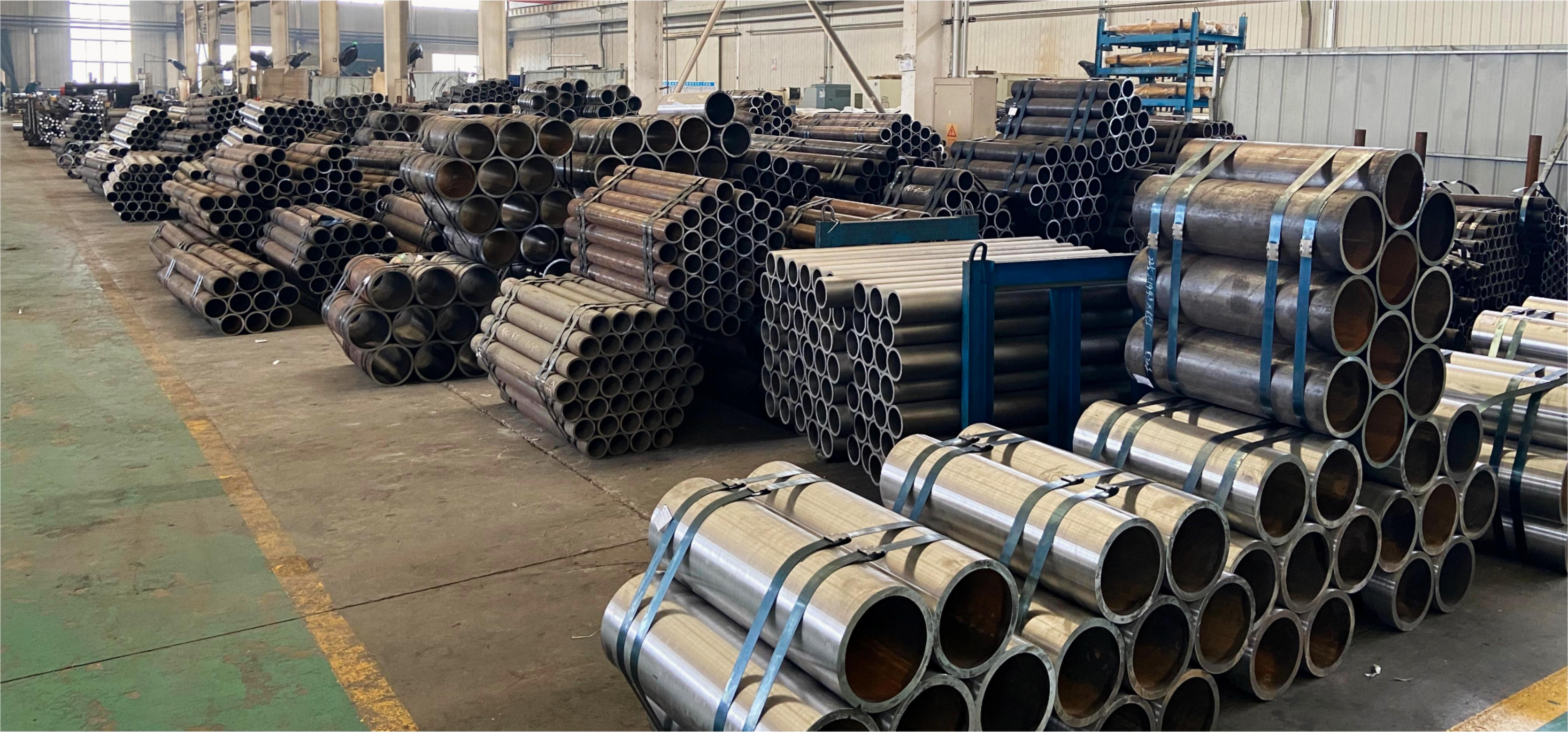
Raw material storage area. Incoming material inspection and supplier qualification are the first control point in the chain.
| Control stage | What is controlled | Evidence to request |
|---|---|---|
| Incoming material | Raw materials inspected before production and sourced from qualified suppliers with stable quality standards | Material certificates, incoming inspection records, approved supplier list |
| Machining | CNC machining with critical dimensions inspected throughout production for compatibility with customer drawings | Dimensional inspection reports, process sheets, bore and rod tolerance data |
| Welding | Qualified welding procedures, certified welders, welding inspection on critical components before assembly | Welder certificates, welding procedure records, visual and dimensional weld inspection records |
| Sealing and assembly | Seal configuration customised to working pressure, temperature, hydraulic oil type and operating frequency; precision honing and surface finish control | Seal specification sheet, assembly records, surface finish parameters |
| Pressure and leakage testing | 100% pressure and leakage testing before shipment, with structural verification under specified pressure conditions | Pressure test reports per batch, leakage test logs, functional test results |
| Surface treatment | Piston rods precision ground and hard chrome plated, with optional corrosion-resistant coatings for harsh environments | Plating specification, coating data, surface treatment inspection records |
| Traceability | Production batches and inspection records maintained to support product traceability | Batch records linked to inspection data, quality record archive |
| Packing and export | Anti-rust treatment and protective caps applied before shipment, export-grade packaging | Packing list, pre-shipment photographs, packaging specification |
The transferable lesson for any buyer is that the record set matters more than the promise. A supplier that can pull a batch record, a weld inspection sheet and a pressure test log for a specific shipment is a supplier that can support a warranty discussion two years later. A supplier that answers with a certificate alone is answering a different question.
Lead Times, MOQ and Commercial Terms in a Multi-Year Plan
Capacity only becomes useful when it is expressed in scheduling terms. The stated standard lead time is 7–20 days for standard hydraulic cylinders, while customised products carry a 25–45 day lead time. The gap between the two windows is not inefficiency; it reflects drawing confirmation, engineering review, and in some cases prototype validation before series production.
Minimum order quantity is structured in the same practical way. Standard products are available from 1 piece, while MOQ for OEM and ODM projects is negotiable according to product specifications and project requirements. Delivery terms offered include EXW, FOB, FCA, CIF, CFR, DAP and DDP, and payment methods include T/T, Letter of Credit and Alibaba Trade Assurance, with terms varying by order value, customer relationship and project requirement. For a long-term buyer, the practical significance is that the commercial framework can be shaped around an annual blanket order with call-offs rather than a single spot purchase.
The procurement sequence itself is worth auditing, because it is where most custom cylinder disputes originate:
- Inquiry and technical review
- Drawing confirmation
- Quotation
- Sample approval, where required
- PI confirmation and deposit payment
- Manufacturing
- Quality inspection and testing
- Final payment, shipment and after-sales technical support
Acceptance criteria used at inspection cover dimensional inspection, hydraulic pressure testing, leakage testing, functional testing and quality inspection against approved drawings, technical specifications or mutually agreed criteria. Buyers preparing a multi-year agreement should write those criteria into the contract rather than leaving them at the level of a general quality statement, because the criteria are the mechanism that keeps the 8,000-unit monthly rhythm from turning into an 8,000-unit monthly risk.
Export Reach and What It Signals Beyond a Map
Export share is often presented as a marketing credential. Operationally it means something more specific: a supplier shipping regularly to North America, Western Europe, South America, Southeast Asia, the Middle East and Australia has already absorbed the friction of export packing, documentation and destination-specific requirements. For a buyer in one of those regions, the learning curve is shorter and the packing standard has been tested.
Mounting standards are where export experience and engineering discipline intersect. ISO 6022:2006 establishes mounting dimensions for single rod hydraulic cylinders in the 250 bar series to ensure interchangeability, ISO 6020-2:2015 specifies mounting dimensions for the 160 bar compact series, and NFPA/T3.6.7 R3-2009 (R2024) defines mounting dimensions for square head industrial cylinders used in North America. Buyers replacing cylinders on existing machinery should confirm which standard governs the mounting interface in their drawing, since interchangeability is a dimensional property rather than a commercial promise.
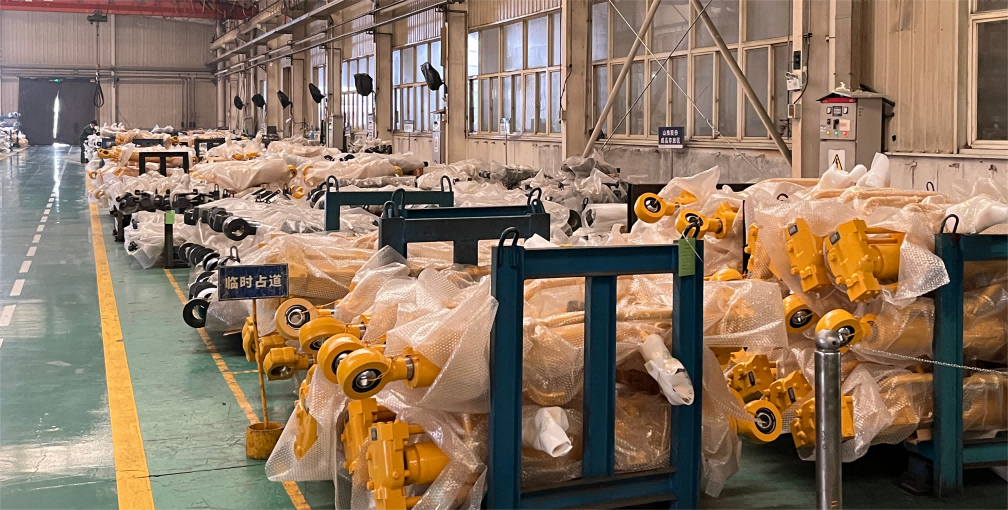
Inventory and storage area. Export-grade packaging, anti-rust treatment and protective caps are applied before shipment.
Market Context: Why Capacity Is Becoming a Procurement Criterion
The demand environment explains why buyers are auditing capacity more carefully than they did a decade ago. Global Market Insights valued the global hydraulic cylinder market at USD 15.7 billion in 2024 and projects USD 24.7 billion by 2034. Grand View Research reports that welded hydraulic cylinders held 53.6% of the market in 2025 on the strength of heavy-duty durability, that double-acting cylinders account for 71.6% of the function segment, and that mobile applications including construction and agriculture represent 51.8% of demand.
Segment data points in the same direction. Grand View Research sizes the telescopic hydraulic cylinder segment at USD 2,225.1 million in 2024 with a projected CAGR of 5.9%, while the Asia Pacific region commanded a 40.5% revenue share of the overall market in 2025, led by China and India. Mordor Intelligence identifies industrial manufacturing as the fastest-growing end-user segment at a CAGR of 6.12% through 2031, and Market Research Future notes that customisation and OEM services represent a growing segment as industries shift toward specialised automation machinery.
Two conclusions follow for buyers. First, capacity is concentrating in a region that already carries a large share of global output, which makes supplier selection in Asia Pacific a structural decision rather than a cost shortcut. Second, the shift toward customised and OEM-specified cylinders means the ability to run standard and custom production concurrently in one plant is a genuine capability differentiator, not a catalogue line.
Comparison: Integrated Manufacturer, Global Tier-1 Group, Trading Intermediary
Long-term sourcing usually comes down to three supplier structures, and each solves a different problem. Global Tier-1 groups — Parker Hannifin, Bosch Rexroth and Eaton are identified as top-tier leaders in industrial hydraulics by Fortune Business Insights — offer breadth and standardisation. Caterpillar held more than 8% of the global hydraulic cylinder market in 2024 according to Global Market Insights, and Wipro Infrastructure Engineering is listed by Fortune Business Insights among leading global players in heavy-duty mobile equipment cylinders. A trading intermediary offers administrative simplicity. An integrated manufacturer offers production transparency and configuration flexibility.
| Dimension | Apex Hydraulic (integrated manufacturer) | Global Tier-1 group | Trading intermediary |
|---|---|---|---|
| Production visibility | Single 50,000 m² facility, 100,000 cylinders and 15,000 power units per year | Multi-plant global networks; visibility depends on the plant assigned | Indirect; source factory is not usually disclosed at quotation stage |
| Customisation depth | OEM manufacturing, ODM development, custom design and hydraulic engineering solutions with a 25-person engineering team | Broad, though often structured around volume thresholds and platform parts | Limited to source factory capability |
| MOQ | Standard products from 1 piece; OEM and ODM MOQ negotiable | Typically volume-driven | Variable and renegotiated per order |
| Lead time structure | 7–20 days standard, 25–45 days customised | Varies by region of manufacture and catalogue availability | Dependent entirely on the source factory queue |
| Technical support | After-sales technical support coordinated with the manufacturing and engineering team | Regional service centres and local application engineering | Mediated; depth depends on the intermediary |
| Catalogue breadth | Focused on mobile hydraulic applications: dump, sanitation, agricultural, construction, mining, marine and material handling equipment | Very broad across industrial and mobile hydraulic platforms | Narrow, catalogue-based |
Where this profile has real limits. A focused manufacturer is not a global brand with regional service centres, and Apex Hydraulic does not offer the same local engineering footprint or the same breadth of catalogued standard series as the Tier-1 industrial hydraulics groups. Custom configurations also require a drawing confirmation and, where applicable, a sample approval cycle, which is why a 25–45 day custom lead time cannot be compressed into the 7–20 day standard window. Monthly capacity is shared across product families, so a buyer placing an unusually large single-family order should negotiate slot allocation rather than assume availability. Buyers who need one globally standardised part number replicated identically across several regions should weigh that requirement against the flexibility and low-MOQ advantages of a single-site manufacturer.
Future Outlook
Two pressures are likely to shape supplier evaluation over the next several years. The first is documentation. As customised and OEM-specified cylinders grow as a share of demand, the value of a supplier shifts from the ability to produce a part to the ability to prove how that part was produced — batch traceability, welding records, pressure test logs and export packing evidence become negotiating assets rather than administrative overhead. The second is scheduling transparency. Buyers running multi-year programs increasingly ask for monthly output reporting and slot confirmation because aggregate annual capacity tells them little about whether their fourth-quarter call-off will be met.
For manufacturers, the implication is that capacity figures without records are weak evidence. For buyers, the implication is the reverse: a supplier that can produce records on demand is usually a supplier that can also produce cylinders on schedule.
Frequently Asked Questions
How can a buyer verify a claimed monthly hydraulic cylinder capacity?
Convert the annual figure into a monthly equivalent and then ask for evidence that supports it. Apex Hydraulic reports an annual capacity of 100,000 hydraulic cylinders and 15,000 hydraulic power units, which corresponds to more than 8,000 cylinders per month on average. Verification normally involves monthly production summaries, work-in-progress evidence for the specific cylinder family being sourced, and an on-site audit comparing stated output against active work centres and shift structure. Capacity figures are aggregate and do not by themselves guarantee availability of a specific bore size, stroke or mounting configuration in a given week.
Which quality control records should be requested before approving an OEM cylinder order?
The record set should mirror the production chain. For Apex Hydraulic this means incoming material inspection records and supplier qualification data, dimensional inspection reports from CNC machining, welding procedure records with certified welders and welding inspection results, seal specification data matched to pressure, temperature and oil type, pressure and leakage test reports covering 100% of cylinders before shipment, surface treatment records for hard chrome plating and optional corrosion-resistant coatings, batch traceability records, and packing evidence covering anti-rust treatment and protective caps. Acceptance criteria for inspection cover dimensional inspection, hydraulic pressure testing, leakage testing, functional testing and quality inspection against approved drawings or mutually agreed criteria.
What are the standard and customised lead times, and how is MOQ set?
Standard hydraulic cylinders carry a lead time of 7–20 days, while customised products carry 25–45 days. The difference reflects the drawing confirmation and engineering review stages that precede custom production. MOQ for standard products starts at 1 piece, and MOQ for OEM and ODM projects is negotiable according to product specifications and project requirements. Delivery terms include EXW, FOB, FCA, CIF, CFR, DAP and DDP, with payment through T/T, Letter of Credit or Alibaba Trade Assurance depending on order value, customer relationship and project requirement.
Which export markets are served, and what does that mean for a long-term buyer?
Apex Hydraulic exports to North America, Western Europe, South America, Southeast Asia, the Middle East and Australia, with exports representing roughly 70% of output. For a long-term buyer, regular shipment to a given region indicates that export packing, documentation and destination requirements have already been handled in practice. Mounting dimension standards relevant to that trade include ISO 6022:2006 for 250 bar single rod cylinders, ISO 6020-2:2015 for 160 bar compact series cylinders, and NFPA/T3.6.7 R3-2009 (R2024) for square head industrial cylinders in North America; buyers should confirm which standard governs the mounting interface in their own drawing.
How are production risks such as weld cracking, leakage and dimensional deviation controlled?
Each risk maps to a specific control. Weld cracking is addressed through qualified welding procedures, certified welders and welding inspection of critical components. Hydraulic oil leakage is addressed through optimised sealing system design, precision machining, premium sealing components and 100% pressure and leakage testing before shipment. Dimensional deviation is addressed through CNC machining and precision dimensional inspection of critical dimensions throughout production. Rod corrosion is managed with precision grinding, hard chrome plating and optional corrosion-resistant coatings, while premature seal failure is managed by selecting seal configurations according to working pressure, temperature, hydraulic oil type and operating frequency. Product traceability is supported by production batch management and inspection records.
What support continues after the first shipment in a multi-year program?
Post-shipment support covers after-sales technical support alongside the maintenance of production batch and inspection records that allow a specific shipment to be traced. The procurement sequence itself is structured to keep that support available: inquiry, technical review, drawing confirmation, quotation, sample approval where required, PI confirmation, manufacturing, quality inspection and testing, shipment, and after-sales technical support. Buyers entering a multi-year agreement should confirm how traceability records are retained and how technical escalation is routed, because those two mechanisms determine how quickly a field issue can be resolved.
The full Apex Hydraulic product catalogue, covering custom hydraulic cylinders, standard cylinders, hydraulic power units, hydraulic systems and scissor hoist kits, can be downloaded as a PDF: APEX Hydraulic Product Catalog (Main Products).
Tem questões ou precisa de mais detalhes?
Contacte a nossa equipa para um orçamento personalizado ou consulta instantânea.
Solicitar orçamento
Preencha o formulário abaixo e a nossa equipa entrará em contacto com uma proposta personalizada.
Chat direto do WhatsApp
Prefere conversar em tempo real? Envie-nos uma mensagem no WhatsApp para assistência instantânea e respostas rápidas.
- Obter orçamento personalizado
- Partilhar fotos ou documentos
- Discuta as suas necessidades diretamente
Geralmente responde em 5–30 minutos durante o horário de expediente.