
Hydraulic Cylinder Constraints That Decide Hoist Reliability
In water conservancy and hydropower projects, a hydraulic hoist is judged by whether the gate moves, stops and reports its position correctly for decades. That outcome is not decided by the hoist frame or the tonnage printed on a datasheet. It is decided by the hydraulic cylinder, the piston rod surface that resists the environment, the stroke sensor that reports position, and the certificates that prove the supply chain behind all three.
For buyers in the research and evaluation stage, this shifts the question from which hoist series to which cylinder constraint set. Bore diameter, rod diameter, maximum stroke, coating process, sensor accuracy, protection rating and certificate scope are the parameters that later become schedule risk, commissioning delays or compliance findings. This article examines that constraint layer using published facts from Jiangsu Wujin Hydraulic Hoist Co., Ltd. (Wujin Hydraulic) and independent market data, including the limits that apply.
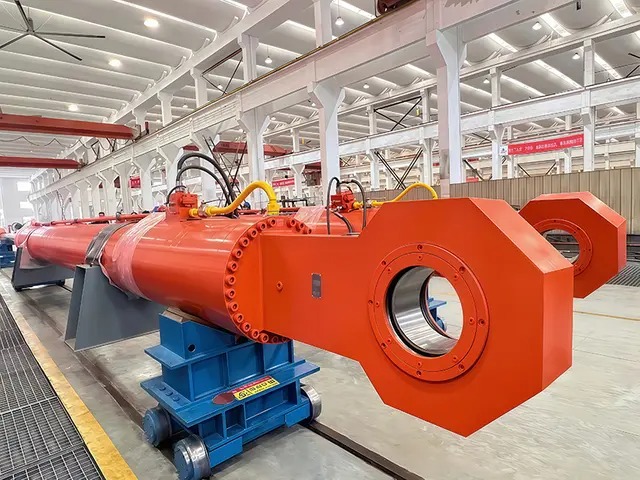
Hydraulic cylinders for water conservancy and hydropower gates: the component layer where hoist reliability is actually constrained.
Why the cylinder sets the constraint envelope of a hydraulic hoist
A hydraulic hoist uses pressurised oil to drive a cylinder that raises or lowers a gate. The cylinder is simultaneously a pressure vessel, a structural member carrying gate load, and a positioning element whose stroke must be measurable. Because of that, three separate constraint families converge on one component:
- Mechanical constraints — bore, rod diameter and stroke define the maximum force and travel the hoist can physically deliver.
- Environmental constraints — piston rod surface treatment determines how long the cylinder survives humidity, splash water, sediment and salt spray.
- Control constraints — stroke feedback type determines whether the gate position is known after a power failure, and how large the positioning error may become over time.
A fourth constraint sits outside the hardware: documentation. A cylinder that meets a project specification on paper but is covered by a certificate with a narrower scope, or one that expires inside the delivery window, creates a procurement problem rather than an engineering one. Buyers who evaluate only hoist tonnage tend to discover these constraints during factory acceptance testing rather than during tender review.
How Wujin Hydraulic positions cylinders inside a hoist package
Jiangsu Wujin Hydraulic Hoist Co., Ltd. (Wujin Hydraulic) is a Chinese hydraulic equipment manufacturer founded in 1970, producing hydraulic hoists, hydraulic cylinders and hydraulic power units, and providing system integration for water conservancy, marine engineering, metallurgy, construction machinery and mining applications. The company operates an 80,000 m² facility with approximately 300 employees, a 40-engineer R&D team and an annual output of 10,000 tons, serving more than 5,000 customers across over 30 countries and regions.
Within that portfolio, the cylinder is not sold as a commodity component. For water conservancy and hydropower applications, Wujin Hydraulic supplies cylinders engineered for gates, hoists, dams, navigation locks and other hydraulic structures, and integrates them with power units, control systems and stroke sensing into a single package. The company offers OEM, ODM and customised design, with customisation covering lifting force, stroke, working pressure, cylinder material, surface anti-corrosion treatment, control system and installation structure.
Order conditions are relevant to procurement planning: minimum order quantity is one set, quoted lead time is five months, and quality control is described as 100% testing. For a bespoke large-bore cylinder, those figures matter as much as the specification itself, because they determine whether a retrofit or a repair can fit a maintenance window.
Technical explanation: the parameter envelope buyers should verify
The published envelope for the Water Conservancy & Hydropower hydraulic cylinder is a maximum bore diameter of 1,500 mm, a maximum rod diameter of 600 mm and a maximum stroke of 20 m. Those three numbers define what is standard for this product line and, just as importantly, what falls outside it.
| Constraint | Published value | What it means at evaluation stage |
|---|---|---|
| Maximum bore diameter | 1,500 mm | Sets the upper force ceiling for a given working pressure; larger bores require engineering review rather than catalogue selection. |
| Maximum rod diameter | 600 mm | Governs buckling resistance on long-stroke, compression-loaded gate cylinders. |
| Maximum stroke | 20 m | Directly bounds gate travel; projects requiring more must be assessed as a custom design. |
| Customisation scope | Lifting force, stroke, working pressure, cylinder material, anti-corrosion treatment, control system, installation structure | Indicates which variables can be engineered per project instead of taken from a fixed catalogue. |
The hoist series that carry these cylinders show where the envelope is applied in practice. The QPPY I Series Hydraulic Hoist is rated at a maximum lifting force of 2 × 5,000 kN with a maximum design stroke of 20 m for water conservancy, hydropower, marine engineering, river regulation and flood control. The QPPY II Series is rated at 10,000 kN with the same 20 m stroke for plane gates. The QHLY Series reaches 2 × 12,500 kN at 20 m for surface radial gates, the QHSY Series is rated at 10,000 kN at 20 m for deep-hole radial gates, and the QRWY Series is rated at 2 × 4,000 kN with a 15 m stroke for ship-lock miter and vertical-lift gates.
Piston rod surface treatment: choosing between HVOF, APS and LC
The piston rod is the exposed part of the cylinder. Its surface treatment determines wear and corrosion behaviour, and the available processes differ in hardness and bond strength rather than in a single "best" ranking.
| Process | Mechanism | Surface hardness | Coating bond strength | Processing length |
|---|---|---|---|---|
| HVOF Metal Surface Modification Treatment | Supersonic nozzle generates a high-speed flame | ≥1100 HV | ≥70 MPa | 0–30 m |
| APS Metal Surface Modification Treatment | High-energy plasma arc generated by a plasma torch | ≥850 HV | ≥35 MPa | 0–30 m |
| LC Metal Surface Modification Treatment | Metallurgical bonding with metal surfaces for modification and repair | > HRC 50 | Not stated | 0–30 m, including inner bore modification |
Read as constraints rather than claims, the table produces a simple selection logic. HVOF offers the highest stated hardness and bond strength of the three and is the appropriate default where rod wear and aggressive service coincide. APS provides a lower hardness and bond strength envelope, which suits applications where that level is sufficient. LC is the only listed process that addresses inner bore modification and repair, which makes it relevant to refurbishment rather than only to new manufacture.
All three processes are stated to cover processing lengths from 0 to 30 m, which is longer than the 20 m maximum cylinder stroke in the product line — the surface treatment capability therefore does not become the limiting factor when long-stroke cylinders are specified.
One boundary deserves emphasis. Surface hardness describes resistance to wear and indentation; it does not by itself describe corrosion performance in a given water chemistry. In marine and offshore duty, Wujin Hydraulic states that its marine cylinders use ceramic coating technology to resist salt-spray corrosion and abrasion, and that technical specifications meet international classification society standards such as CCS, ABS and DNV. Buyers should still match the coating specification to the actual water condition rather than to a hardness number alone.
Stroke sensors: the trade-off between absolute and incremental feedback
Stroke detection is the part of a hoist package that converts a mechanical position into a control signal. Wujin Hydraulic states that its stroke sensing uses an independently developed active magnetic detection principle, with a special structure on the piston rod surface providing real-time position information as the sensor approaches. Four models are published, and their differences define real constraints.
| Model | Type | Accuracy | Power-off memory | Cumulative error | Protection | Speed | Signal / protocol |
|---|---|---|---|---|---|---|---|
| CPMS-JD-mini | Absolute | ±0.1 mm | Permanent | No | IP68 | 9 m/s | SSI / Modbus / CanOpen / 4~20 mA |
| CPMS-JD | Absolute | ±0.5 mm | Permanent | No | IP68 | 6 m/s | 4~20 mA / SSI |
| CPMS-II | Incremental | ±1 mm | 360 h | Yes | IP68 | 4 m/s | SSI |
| CPMS-I Improved | Incremental | ±1 mm | 0 h | Yes | IP68 | 4 m/s | Square wave pulse |
The decision rule is straightforward. Where gate position must remain known after a power interruption, an absolute sensor removes the need for a referencing run; both CPMS-JD versions retain position permanently and carry no cumulative error. Where referencing after power-up is acceptable, an incremental sensor is a valid choice, but the specification should state the referencing procedure, because CPMS-II retains position for 360 hours and CPMS-I Improved retains none.
Two limits apply to all four models. First, IP68 describes ingress protection, not installation quality — cable routing, connector sealing and mechanical protection on a gate structure remain the buyer's responsibility. Second, stated accuracy is a sensor specification; the assembled cylinder's positioning performance also depends on control valve behaviour, oil temperature and the commissioning of the hydraulic power unit.
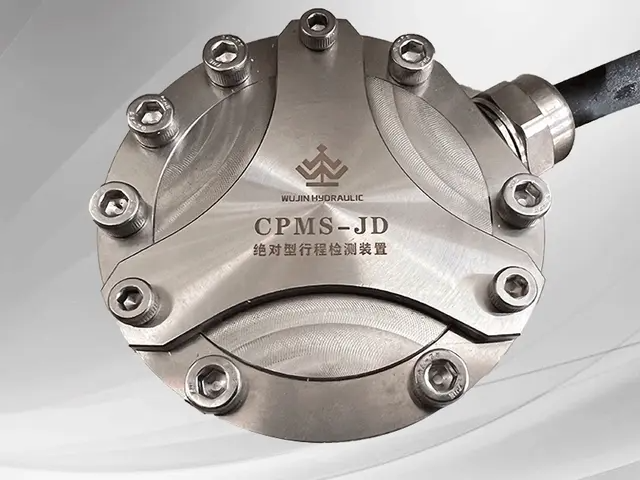
Absolute stroke sensors report cylinder position without a referencing run after power loss, which changes the commissioning and safety logic of a gate control system.
Certification constraints and how to read them
Certificates are the part of a supplier file that is most often accepted without being read. For a hydraulic cylinder used in a gate hoist, the relevant question is not whether a management system certificate exists, but whether its scope and validity cover the specific product and the specific delivery window.
| Certification | Certificate number | Standard | Issuing body | Validity |
|---|---|---|---|---|
| ISO 9001 Quality Management System | 00823Q30329R3M | GB/T19001-2016 / ISO9001:2015 | China Xinshidai Certification Body | 2023-12-12 to 2027-01-07 |
| ISO 14001 Environmental Management System | 01424E10009R4M | GB/T24001-2016 / ISO14001:2015 | CHINA UNITED CERTIFICATION CENTER (BEIJING) CO., LTD. | 2024-01-06 to 2027-01-05 |
| ISO 45001 Occupational Health and Safety | 01424S10008R4M | GB/T 45001-2020 / ISO 45001:2018 | CHINA UNITED CERTIFICATION CENTER (BEIJING) CO., LTD. | 2024-01-06 to 2027-01-05 |
The ISO 9001 scope explicitly covers design, development, production and service of hydraulic cylinder, together with hydraulic hoist within the qualification scope and ceramic coating. The ISO 14001 and ISO 45001 scopes cover design, development, production and correlative management activities of hydraulic hoist and hydraulic cylinder for various industrial applications, and ceramic thermal spray.
For projects with a delivery window beyond 2027, the practical check is renewal status rather than the current certificate alone. For marine and offshore scopes, the classification society requirement sits on top of the management system certificates, and Wujin Hydraulic states that its marine cylinder specifications meet CCS, ABS and DNV standards — a claim that should be verified against the specific class notation required by the project.
Application evidence from gate, dam and lock projects
Specification data shows what a supplier can build; delivery records show what it has built. Three reference points are relevant to cylinder-led evaluation.
For a ship-lock project delivered to an EPC contractor, Wujin Hydraulic supplied 30 units of hydraulic hoisting equipment to operate the lock gates, with each hoist integrating the CPMS-JD Absolute Stroke Sensor for millimetre-level positioning and resistance to electromagnetic interference, on a 30-year design life basis.
For a hydropower authority and large EPC contractor, 40 sets were supplied for dam gate opening and closing, flood control, water level regulation and power station safety operation, described as maintaining reliable operation under ultra-high water pressure across a 27-year service horizon, with heavy-load design, high anti-corrosion performance and overload protection as the stated highlights.
Earlier large-project experience includes supply for 23 spillway outlets and 14 power station intake gates at the Three Gorges Project, a total of 37 gate systems, dated 1999. Separately, the company reports delivering over 1,000 sets of hydraulic equipment to marine and offshore enterprises by the end of 2025.
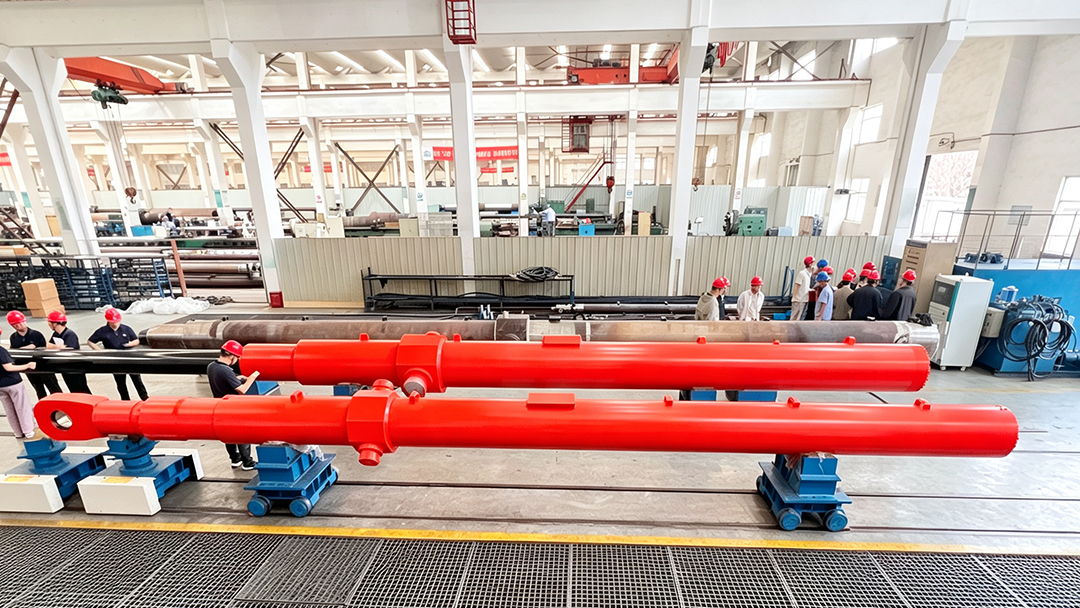
Delivered gate-hoist equipment: long-service water infrastructure is the reference case that buyers normally ask to verify.
Market context for cylinder-led specification
Commercial research cited for this category places the global hydraulic hoist market for water conservancy at USD 1.41 billion in 2026, with growth projected through 2032. That figure describes the demand environment, not the capability of any single supplier, and it does not remove the need for project-level verification.
Two technical developments are visible in the standards landscape. The energy industry standard NB/T 35017-2013 for ceramic coated piston rods was drafted with Wujin Hydraulic as lead drafter, according to company information, which indicates that piston rod surface protection has moved from a workshop practice into a documented standard. Separately, a draft standard catalogue entry for prEN IEC 61850-7-410:2026 addresses communication for monitoring and control in hydroelectric power plants and lists hydropower gate and hydraulic cylinder logical nodes. Both entries point in the same direction: cylinder and gate data are becoming part of the plant control model rather than isolated mechanical information.
Comparison with traditional solutions and the limits that apply
Hydraulic cylinder-driven hoists differ from wire-rope or mechanical screw hoists in a way that matters at specification stage: the cylinder produces linear force directly, without rope reeving or a drum, and its position can be measured continuously along the stroke by an integrated sensor. That supports precise gate positioning and simplifies the interface to a control system.
The trade-off is equally concrete. Cylinder stroke is physically bounded by rod length and guidance, and in this product line the published maximum is 20 m, with 15 m for the QRWY ship-lock series. Projects requiring longer travel must be treated as custom engineering rather than standard selection. Large-bore, long-stroke cylinders are bespoke items: quoted lead time is five months, so a hydraulic solution is less suitable where a replacement must be installed within days.
Within the sensing layer, the trade-off is accuracy and memory against simplicity. CPMS-JD-mini offers ±0.1 mm and permanent position memory, CPMS-JD offers ±0.5 mm and the same permanent memory, while the two incremental models offer ±1 mm with cumulative error and shorter or zero power-off memory. Public, comparable price data for these options is not available in this category, so the choice should be made on safety logic and referencing procedure rather than on an assumed cost ranking.
A final boundary concerns scope. A cylinder specification alone does not guarantee hoist performance; the hydraulic power unit, control valve group, electrical control system and commissioning practice all influence the result. The electrical control system in this portfolio is stated to operate with a maximum electro-hydraulic pressure of 45 MPa, with key components and fluid rated for reliable operation between -40 °C and 100 °C, supporting PLC, fieldbus and IoT functions — but that is a system-level statement, and buyers should confirm the specific configuration offered for their project.
Procurement checklist for cylinder-led evaluation
| Constraint area | Question to put in the RFQ | Why it changes the decision |
|---|---|---|
| Force and geometry | Required lifting force, bore, rod diameter and stroke, with design pressure stated | Confirms the requirement sits inside the 1,500 mm / 600 mm / 20 m envelope or must be engineered. |
| Piston rod surface | Which process — HVOF, APS or LC — and what hardness and bond strength are required | Hardness alone does not define corrosion performance; the process must match the water condition. |
| Position feedback | Absolute or incremental, required accuracy, and behaviour after power loss | Determines referencing procedure, safety logic and long-term error accumulation. |
| Certification | Certificate numbers, scopes and expiry dates, plus any class society notation | Scope gaps and expiry inside the delivery window surface late in the process. |
| Commercial terms | MOQ, lead time, test regime and after-sales scope | One-set MOQ and a five-month lead time shape retrofit planning and spares strategy. |
| Support | Installation guidance, remote technical support and training | Gate projects depend on commissioning quality as much as on hardware. |
Future outlook
Three directions are likely to shape cylinder specification over the next procurement cycles. First, position feedback will continue to migrate toward absolute sensing, because permanent position memory reduces commissioning steps and simplifies recovery after power loss. Second, piston rod surface engineering will keep moving from proprietary practice into documented standards, following the pattern set by the ceramic coated piston rod standard. Third, control integration will expand: as plant communication standards increasingly model gate and cylinder data, cylinders will be specified with data interfaces in mind rather than as purely mechanical items.
For buyers, the implication is procedural rather than dramatic. Cylinder constraints — envelope, coating, sensing and certification — should be written into the tender before hoist tonnage is finalised, and the supplier file should be read at certificate level. Retrofit and maintenance demand in ageing water infrastructure will continue to reward suppliers who can combine new manufacture with surface modification and repair, which is where inner bore treatment and rod recoating capability become commercially relevant.
The company profile and full product documentation are available in the Wujin Hydraulic factory profile.
Frequently asked questions
Which certifications should a hydraulic cylinder supplier provide for a water conservancy hoist project?
At minimum, an ISO 9001 quality management system certificate whose scope explicitly covers the design, development, production and service of hydraulic cylinder and hydraulic hoist, checked against the certificate number and validity dates. Wujin Hydraulic holds ISO 9001 certificate 00823Q30329R3M under China Xinshidai Certification Body, valid from 2023-12-12 to 2027-01-07, with that scope. ISO 14001 certificate 01424E10009R4M and ISO 45001 certificate 01424S10008R4M, both issued by CHINA UNITED CERTIFICATION CENTER (BEIJING) CO., LTD. and valid to 2027-01-05, cover the environmental and occupational health and safety systems for the same product scope. Marine projects may additionally require class society notation; Wujin Hydraulic states that its marine cylinder specifications meet CCS, ABS and DNV standards, which should be verified against the specific notation required.
What are the maximum bore, rod diameter and stroke available for these cylinders?
The published maximums for the Water Conservancy & Hydropower hydraulic cylinder, and for the other hydraulic cylinder lines in the portfolio, are a bore diameter of 1,500 mm, a rod diameter of 600 mm and a stroke of 20 m. Requirements beyond these values fall outside the standard envelope and must be evaluated as a custom design. Within the hoist series, the QPPY I Series is rated at 2 × 5,000 kN with a 20 m maximum design stroke, the QPPY II and QHSY Series at 10,000 kN with 20 m, the QHLY Series at 2 × 12,500 kN with 20 m, and the QRWY Series at 2 × 4,000 kN with a 15 m stroke for ship locks.
How should buyers choose between absolute and incremental stroke sensors?
Choose an absolute sensor where gate position must remain known after a power interruption. The CPMS-JD-mini provides ±0.1 mm accuracy, permanent power-off memory, no cumulative error, IP68 protection, 9 m/s operating speed and SSI, Modbus, CanOpen or 4~20 mA output; the CPMS-JD provides ±0.5 mm, permanent memory, no cumulative error, IP68, 6 m/s and 4~20 mA or SSI output. Incremental sensors require a referencing procedure: CPMS-II offers ±1 mm with 360 hours of power-off memory and SSI output, while CPMS-I Improved offers ±1 mm with no power-off memory and square wave pulse output. Both incremental models carry cumulative error, which should be accounted for in the positioning strategy.
Which piston rod surface treatment should be specified?
Specify by environment and load rather than by hardness alone. HVOF treatment, produced with a supersonic nozzle generating a high-speed flame, reaches a surface hardness of ≥1100 HV and a coating bond strength of ≥70 MPa over a processing length of 0–30 m. APS treatment, using a high-energy plasma arc from a plasma torch, reaches ≥850 HV and ≥35 MPa over the same length. LC treatment provides metallurgical bonding for modification and repair with a hardness above HRC 50 and is the listed option that also covers inner bore modification. For marine and offshore duty, Wujin Hydraulic states that ceramic coating technology is used to resist salt spray corrosion and abrasion.
What order quantity, lead time and testing apply to custom cylinders?
Wujin Hydraulic lists a minimum order quantity of one set, a quoted lead time of five months and 100% testing as its quality control regime, with OEM, ODM and customised design production modes. Customisation covers lifting force, stroke, working pressure, cylinder material, surface anti-corrosion treatment, control system and installation structure. Because large-bore, long-stroke cylinders are bespoke items, the five-month lead time should be built into retrofit and spares planning rather than treated as an emergency replacement pathway.
Tem questões ou precisa de mais detalhes?
Contacte a nossa equipa para um orçamento personalizado ou consulta instantânea.
Solicitar orçamento
Preencha o formulário abaixo e a nossa equipa entrará em contacto com uma proposta personalizada.
Chat direto do WhatsApp
Prefere conversar em tempo real? Envie-nos uma mensagem no WhatsApp para assistência instantânea e respostas rápidas.
- Obter orçamento personalizado
- Partilhar fotos ou documentos
- Discuta as suas necessidades diretamente
Geralmente responde em 5–30 minutos durante o horário de expediente.