
Hydraulic Cylinder FAQs: Technical and Procurement Answers for Buyers
Industrial Equipment & Components · Buyer Reference
A hydraulic cylinder is interchangeable only when three things line up: bore and stroke geometry, mounting dimensions, and pressure class. Everything else — rod coating, sealing, acceptance testing, minimum order quantity, payment terms and delivery schedule — is negotiated around that core. At the decision stage, the practical problem is that the technical answers and the commercial answers usually arrive from different people, in different formats, and are rarely reconciled before a purchase order is signed.
This reference treats both sides of that gap as one decision. It sets out the questions buyers most often ask about industrial hydraulic cylinders, answers them with verifiable technical and commercial detail, and shows how to convert each answer into a clause in a procurement policy rather than a line in an email thread.
The supplier context used throughout is Changzhou Hydraulic Complete Equipment Co., Ltd, a hydraulic equipment manufacturer based at No. 1 Xinhui Road, Wujin National High-Tech Industrial Zone, Changzhou, Jiangsu Province, China. Founded in 1990, the company produces industrial hydraulic cylinders, non-standard and customized cylinders, large-bore long-stroke cylinders, marine and offshore oil cylinders, hydraulic control systems, hydraulic power units, hydraulic turbine servomotors, press machine cylinders, metallurgical cylinders and ceramic-coated piston rods. Its factory employs 316 people, including a 20-engineer R&D team, and exports approximately 40% of output to North America, South America, Western Europe, Eastern Europe, Eastern Asia and Southeast Asia.
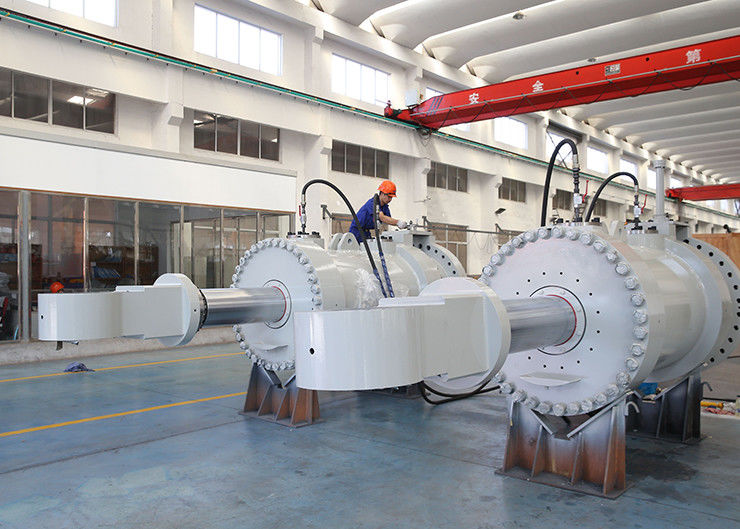
Thermal-spray ceramic piston rods on industrial hydraulic cylinders prepared for container transport. Rod surface specification is one of the first questions a buyer should settle before comparing quotations. Image: Changzhou Hydraulic.
Why Technical and Commercial Answers Have to Be Evaluated Together
Most sourcing failures in this category are not technical failures. They are translation failures. An engineering team specifies a 25 MPa cylinder; the procurement team issues a request for quotation that says "heavy duty cylinder"; the supplier quotes against a 16 MPa series; and the mismatch surfaces only at factory acceptance testing, or later, at the machine.
The reverse also happens. A technically correct specification is issued with no commercial envelope attached — no statement of acceptable order quantity, no payment structure, no delivery window, no definition of which documents must accompany shipment. The result is a technically valid quotation that cannot be approved internally, followed by a renegotiation cycle that consumes the lead time the project was counting on.
The opportunity here is unglamorous but valuable: treat every technical answer as a procurement input, and every procurement answer as a technical constraint. A pressure class is not just an engineering value; it determines which dimensional standard applies, which in turn determines interchangeability, which determines spare-part strategy. A delivery window is not just a logistics value; a 15–60 day range is only meaningful if the buyer knows which product characteristics push an order toward the long end.Technical Questions That Determine Whether a Cylinder Fits
What do bore, stroke and mounting dimensions actually lock in?
Bore and stroke define force and travel; mounting dimensions define whether the cylinder can physically replace another one. The second part is where most specification errors occur, because mounting geometry is standardised by pressure class rather than by bore alone.
Three ISO standards anchor the dimensional conversation. ISO 6020-1:2007 establishes metric mounting dimensions for medium-series cylinders at 16 MPa (160 bar), covering round-head cylinders with bores from 25 mm to 200 mm and certain cylinders with bores larger than 200 mm. ISO 6022:2006 establishes mounting dimensions for cylinders at 25 MPa (250 bar), the class commonly described as heavy-duty series. ISO 10762:2015 covers mounting dimensions for cylinders used at 10 MPa (100 bar) where interchangeability is required.
For a buyer, the practical rule is straightforward: cite the standard and pressure class in the enquiry, not just the bore and stroke. A replacement cylinder that matches bore and stroke but not the mounting envelope of the correct standard is a redesign, not a replacement.
It is also worth being precise about what these standards do and do not do. They address mounting dimensions and interchangeability. They do not certify performance, fatigue life, leakage rates or suitability for a specific duty cycle. Dimensional compliance is a starting filter, not a qualification.
How much pressure margin should a specification carry?
Nominal pressure rating and required working pressure are different numbers, and the gap between them is where design margin lives. ISO 6022 defines the heavy-duty series at a nominal 250 bar; ISO 6020-1 defines the medium series at 160 bar. Those are class definitions, not recommendations for a specific application.
Two margin practices belong in the specification. First, load-based sizing: calculate maximum push and pull force from the working conditions and apply a safety factor of 1.3 to 1.5 times, so that the cylinder is not sized at exactly the calculated load. Second, stability verification: for cylinders with strokes longer than roughly ten times the bore diameter, a buckling check on the rod is required, because a long slender rod under compressive load can fail before the cylinder reaches its pressure limit.
Where classification-society rules apply, the margin is prescribed rather than chosen. Marine cylinders must comply with DNVGL-CG-0194, which specifies a minimum buckling safety factor of 4.0 for standard calculations — materially above the 1.3–1.5 load factor used in general industrial sizing. A buyer sourcing a marine or offshore cylinder against a general industrial specification will end up with a design that cannot be approved.
Which material and surface decisions drive service life?
The rod and the bore do the work; the specification of each determines how long they keep doing it. Established practice in this category is to make the piston rod from high-strength quenched and tempered steel — 45# steel or 40Cr — and the cylinder barrel from precision cold-drawn tube such as 27SiMn, with chemical composition testing on incoming material. The rod surface is then medium-frequency quenched to a hardness of HRC 55–60 and hard chrome plated to a thickness of at least 0.03 mm, while the barrel bore is honed. The objective is a balance between surface hardness and core toughness rather than maximum hardness alone.
Welded cylinder bottoms and other key stressed components are typically checked by ultrasonic or magnetic particle inspection to eliminate internal cracks that visual inspection cannot reveal. This is a documentable step, and buyers should ask for the record rather than the claim.
Surface selection becomes decisive in corrosive duty. For marine climates and chemical environments, the protective approach is either a stainless steel rod such as 316L or a ceramic coating in place of ordinary chrome plating. Changzhou Hydraulic manufactures both chrome-plated and ceramic-coated piston rods and states that the ceramic route offers higher corrosion and salt-spray resistance, better wear, scratch and cavitation resistance, stronger coating adhesion without peeling or flaking, no hydrogen embrittlement risk, and higher dimensional stability, with an eco-friendly, non-toxic process profile. Those are company-reported comparative characteristics; a buyer should still validate them against the specific duty cycle and the required documentation.
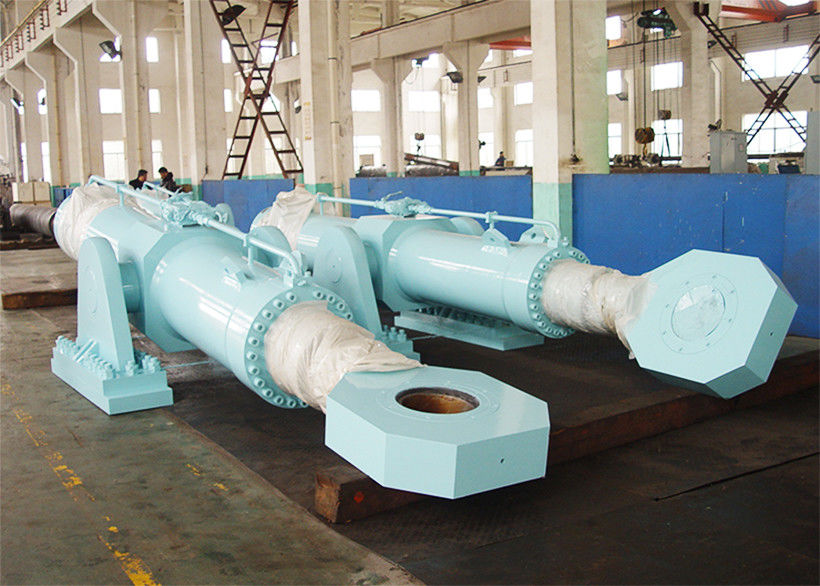
A custom double-acting cylinder for a rapid plane gate. Non-standard mounting, stroke and rod specification are usually defined by the host machine rather than by a standard series. Image: Changzhou Hydraulic.
When does a project cross from standard to non-standard?
The threshold is not a single number, but there are reliable indicators. If the bore exceeds the range covered by the applicable standard series, if the stroke is long enough to trigger a stability check, if the mounting is neither hinged, flanged nor trunnion-mounted in a standard pattern, or if the environment demands a rod surface outside the standard offering, the project is non-standard.
Non-standard work also carries specific risks that should be managed by agreement rather than assumption. Installation alignment is one: a coaxiality error above 0.05 mm per 100 mm between the cylinder centreline and the load direction produces rod binding and eccentric wear of the guide sleeve. The usual countermeasures are laser alignment or dial-gauge verification during installation, spherical or joint bearings at the connection to absorb accumulated error, and a fixed sequence in which the barrel is secured first, the load connected second, and the buffer adjusted last.
Capability evidence matters more here than in standard work. Changzhou Hydraulic has manufactured hydraulic cylinders with piston diameters up to 1.25 m and strokes reaching 25 m, a capability range relevant to hydropower, port and heavy industrial projects. Supplier-reported maximum dimensions are useful for shortlisting but are not comparable across suppliers without a common definition, test basis and factory verification — drawings, machine capacity, completed-project evidence and load or pressure test records remain the qualification documents.
Procurement Questions That Determine Whether a Supplier Fits
How are orders structured — minimum quantity and payment terms?
Commercial structure is where technically identical quotations diverge most. Two terms should be settled before a technical review even begins, because they determine whether the quotation is actionable: the minimum order quantity and the payment mechanism.
Changzhou Hydraulic quotes on a T/T (telegraphic transfer) basis, with minimum order quantity set according to the product type and the degree of customisation involved. Standard oil cylinders and non-standard customised cylinders do not share the same commercial floor, and buyers should expect a single order quantity figure to be confirmed in writing against a specific drawing rather than treated as a catalogue constant. Where an internal procurement policy caps advance payment or requires staged release against inspection, that requirement should be raised in the first enquiry — not after the technical review — because payment structure and production scheduling are planned together.
Why does delivery time vary between 15 and 60 days?
A 15–60 day delivery timeframe is a range because the drivers are attributes of the order, not attributes of the supplier's calendar. Buyers who understand which attributes push an order toward either end can plan around the range instead of being surprised by it.
- Product type and standardisation. Standard oil cylinders sit closest to the short end; fully customised cylinders sit closest to the long end, because design review, drawing approval and first-article verification all sit between order and shipment.
- Size and stroke. Large-bore, long-stroke cylinders require machine time on large equipment and, for long strokes, an additional stability and deflection review.
- Rod surface specification. Ceramic coating adds process steps compared with hard chrome plating, and this should be reflected in the scheduled date rather than absorbed as an assumption.
- Testing and witness requirements. Where acceptance and function testing to ISO 10100:2020 is required, and particularly where a buyer or a classification society witnesses it, the test slot becomes part of the lead time.
- Order sequencing. Capacity is finite in any given month, so the confirmed date depends on where in the production plan the order lands.
The procurement implication is to require a scheduled delivery date against a specific drawing and specification, not against a product family, and to attach the conditions that would move that date.
What does an annual supply capacity of 2,400 tons actually support?
Capacity answers a scheduling question, not a quality question. Changzhou Hydraulic operates at a supply capacity of 2,400 tons per year alongside an annual output described as 120,000 units — the two figures reflect different product mixes, with large non-standard cylinders contributing disproportionately to tonnage and standard cylinders to unit count.
For a buyer, capacity is useful in three specific ways. It sets an upper bound on how much volume can be absorbed without adding tooling or shifts. It indicates whether a project-scale order — a set of large-bore cylinders for a single installation — can be produced inside one planning cycle rather than split across several. And it allows a buyer to ask a sharper question: not "what is your capacity" but "what share of that capacity is already committed in the quarter we need". Capacity is a ceiling; available capacity is the number that protects a delivery date.
Why does the place of origin matter in this category?
The place of origin influences logistics, documentation and the practical mechanics of resolving problems. Changzhou Hydraulic's production is located at No. 1 Xinhui Road, Wujin National High-Tech Industrial Zone, Changzhou, Jiangsu Province — a position within the Jiangsu manufacturing corridor and its supplier base for cold-drawn tube, seals, machined components and surface treatment, which is relevant when a non-standard design needs a revised component quickly.
Origin also affects the commercial terms attached to a shipment. Export documentation, inspection arrangements and the practical timeline for a replacement or a rework all depend on where the cylinder is made, not only on where the supplier's sales office sits. Buyers should record the manufacturing address — not the trading address — in the supplier file, because the two are not always identical and only the former determines who actually controls the process.
Which documents should arrive with the cylinder?
Documentation is the part of the specification that is easiest to omit and hardest to reconstruct later. ISO 10100:2020 specifies acceptance and function tests for hydraulic fluid power cylinders, and it provides buyers with a defensible reference for what testing to require, even though it does not by itself prove that any given supplier performed those tests.
A practical document set for an industrial order includes: material certification consistent with the specified grades (for example 45# or 40Cr for the rod, 27SiMn for the barrel); heat treatment and plating records covering hardness and coating thickness; honing records for the barrel bore; non-destructive testing reports for welded cylinder bottoms and key stressed components; assembly and pressure test records; and, for marine or offshore orders, the documentation required by the applicable classification society. Where the supplier holds management-system certification — quality, occupational health and safety, and environmental — the certificates should be supplied as scope documents so the buyer can confirm the certified activities cover cylinder manufacture.
Comparing Ceramic-Coated and Chrome-Plated Options on Cost, Not Price
The most common decision-stage comparison in this category is between a hard-chrome piston rod and a ceramic-coated piston rod. The comparison is often framed as a price question, which it is not: the two options differ in process, in service life under corrosive conditions, and in maintenance burden, and those differences are what a total-cost comparison should capture.
| Comparison dimension | Ceramic-coated piston rod | Chrome-plated piston rod |
|---|---|---|
| Corrosion and salt-spray resistance | Higher; positioned for offshore, marine and harsh environments | Standard protection; adequate for many general industrial duties |
| Wear and cavitation resistance | Better wear, scratch and cavitation resistance reported | Dependent on plating thickness (typically ≥0.03 mm) and surface finish |
| Coating adhesion | Stronger adhesion, no peeling or flaking reported | Plating adhesion and porosity are the main failure modes to control |
| Hydrogen embrittlement risk | Not a risk in the coating process; higher dimensional stability | Plating processes require embrittlement relief control |
| Environmental profile | Eco-friendly, non-toxic process, suited to high-end equipment | Hexavalent chrome plating carries regulatory and handling constraints |
| Maintenance | Less maintenance reported | More frequent inspection in corrosive duty |
| Total cost of ownership | Company-reported 30% lower lifetime cost versus chrome-plated rods, driven by longer service life | Lower initial unit cost |
Read the table as a decision framework rather than a verdict. The 30% lifetime cost figure is a supplier-reported comparison and should be tested against the buyer's own duty cycle, maintenance interval and replacement cost assumptions before it enters an internal business case.
Where These Answers Stop Being Sufficient
Ceramic coating is not automatically the correct choice, and treating it as the default is one of the more expensive mistakes available in this category. Three boundaries are worth stating plainly.
First, ceramic coating adds process steps and typically sits at the longer end of the 15–60 day delivery range. Where a project is schedule-critical and the environment is not aggressive, hard chrome plating within the specified thickness range remains a valid, widely used and often better-timed option.
Second, no coating substitutes for correct sizing. An under-sized cylinder with an excellent rod surface will still fail, and a rod that is misaligned by more than 0.05 mm per 100 mm will damage the guide sleeve regardless of what it is coated with. Load calculation, stability verification and installation alignment are the determinants of service life; coating is a modifier, not a fix.
Third, standards compliance is a filter, not a qualification. Conformance to ISO 6020-1, ISO 6022 or ISO 10762 confirms dimensional interchangeability at a pressure class. It says nothing about a specific supplier's process control, and it does not replace acceptance testing, material certification or — for marine work — classification-society approval against DNVGL-CG-0194.
Applications Where These Answers Matter Most
The technical and commercial questions converge differently by application, and the practical consequences of getting the answer wrong are easier to see in context.
Marine and offshore. Offshore cylinders operate where corrosion protection, buckling margin and documentation all carry equal weight. DNVGL-CG-0194 sets a minimum buckling safety factor of 4.0 for standard calculation, and the protective approach for marine climates is a stainless steel 316L rod or a ceramic coating rather than ordinary chrome plating, with retractable dust covers on exposed rods and retraction or rust-preventive treatment during long shutdowns. Marine oil cylinders, offshore cylinders and ocean engineering cylinders sit in this group — and so does every procurement decision attached to them, because approval documentation is as much a deliverable as the cylinder.
Hydropower. Hydraulic turbine servomotors and hoist systems combine long strokes with severe duty cycles, which is where the stability check and the 25 m stroke capability described by Changzhou Hydraulic become directly relevant to project feasibility.
Press and metallurgy. Press machine hydraulic cylinders and metallurgical cylinders operate in high-cycle, high-load environments where heat, scale and shock loading dominate. Buffer adjustment — preset before delivery for high-speed, heavy-load cylinders to prevent the piston striking the cylinder head at end of stroke — and stepped pressure loading during commissioning (30%, 60%, 100%) are the practical controls that protect the investment.
Hydraulic systems and power units. As part of a broader hydraulic system or hydraulic power unit, cylinder specification must match pump characteristics, control strategy and duty cycle. A cylinder specified in isolation from its power source is a component; specified with it, it becomes a system — which is the level at which reliability is actually determined.
Market Context and What It Implies for Buyers
The global hydraulic cylinder market reached a valuation of USD 17.34 billion in 2025, according to Fortune Business Insights research. The same source projects the industrial manufacturing segment to grow at a CAGR of 6.12% through 2031, outpacing construction equipment growth. These are commercial research estimates and should be read as directional rather than audited figures, but they support a straightforward observation: demand is shifting toward industrial and process applications, which are precisely the applications where non-standard specification, documentation and delivery reliability matter more than catalogue pricing.
Standards activity reinforces the point. A committee draft, ISO/CD 6022, addressing mounting dimensions for 25 MPa cylinders remains in progress, which is a reminder that dimensional standards are living documents rather than fixed constants. Buyers who specify by standard number and edition, and who keep a record of the edition quoted against, avoid a class of compatibility disputes that otherwise surface years later during a spare-part order.
Future Outlook
Three shifts are likely to shape decision-stage buying in this category over the next planning cycle. The first is documentation becoming a gate rather than a courtesy: buyers are increasingly treating acceptance and function testing to ISO 10100:2020, material certification and non-destructive testing records as preconditions for award rather than post-order paperwork. Suppliers who can produce these routinely will find the qualification stage shorter.
The second is the gradual migration of surface specification from a maintenance decision to a lifecycle cost decision. As more projects are evaluated on total cost of ownership rather than unit price, rod surface selection moves earlier in the process — often into the initial enquiry — which in turn puts a premium on suppliers who can quote both chrome and ceramic options with realistic lead times attached to each.
The third is the continued specialisation of supply around application clusters. General industrial cylinder capacity is widely available; large-bore long-stroke capability, marine-class documentation and ceramic coating are not. For buyers, the strategic implication is to segment the supply base accordingly rather than expecting a single supplier to be equally strong across a standard cylinder programme and a marine project order.
Frequently Asked Questions
Cite the standard that matches the pressure class of the original installation. ISO 10762:2015 covers mounting dimensions at 10 MPa (100 bar); ISO 6020-1:2007 covers metric mounting dimensions for medium-series cylinders at 16 MPa (160 bar), including round-head cylinders with bores from 25 mm to 200 mm and certain cylinders with larger bores; ISO 6022:2006 covers mounting dimensions at 25 MPa (250 bar). Quoting the standard number and edition, together with bore, stroke and mounting type, gives a supplier enough information to confirm interchangeability rather than approximate it.
The trigger is the relationship between stroke and bore. For cylinders with strokes greater than roughly ten times the bore diameter, a buckling check on the piston rod is required, because a slender rod under compressive load can fail through instability before the cylinder reaches its rated pressure. Marine applications raise the requirement further: DNVGL-CG-0194 specifies a minimum buckling safety factor of 4.0 for standard calculations, compared with the 1.3 to 1.5 load safety factor typically applied in general industrial sizing.
Compare on service life and maintenance burden rather than unit price. Changzhou Hydraulic reports that ceramic-coated piston rods deliver higher corrosion and salt-spray resistance, better wear, scratch and cavitation resistance, stronger coating adhesion without peeling, no hydrogen embrittlement risk and higher dimensional stability than chrome-plated rods, and that longer service life reduces total cost of ownership by 30% versus chrome-plated rods. That figure is supplier-reported and should be tested against the buyer's own replacement cost and maintenance interval. Ceramic coating also adds process steps, so it usually sits at the longer end of the 15–60 day delivery range.
Both depend on the product and the degree of customisation. Changzhou Hydraulic quotes on a T/T (telegraphic transfer) basis and sets minimum order quantity according to product type and customisation scope, so the figure should be confirmed in writing against a specific drawing rather than assumed from a catalogue. Buyers with internal payment policies — capped advances, staged release against inspection — should state those requirements in the first enquiry, because payment structure and production scheduling are planned together.
The range reflects order attributes rather than a fixed schedule: standard oil cylinders sit near the short end, while fully customised cylinders, large-bore long-stroke designs, ceramic-coated rods and orders requiring witnessed acceptance testing sit nearer the long end. Changzhou Hydraulic operates at a supply capacity of 2,400 tons per year with annual output described as 120,000 units, which sets an upper bound on absorbable volume. Capacity is a ceiling, not a commitment — the question that protects a delivery date is how much of that capacity is already committed in the target quarter.
A practical set includes material certification for the specified grades (such as 45# or 40Cr rod steel and 27SiMn barrel tube), heat treatment and plating records covering hardness and coating thickness, honing records for the barrel bore, non-destructive testing reports for welded cylinder bottoms and key stressed components, and assembly and pressure test records aligned with ISO 10100:2020, which specifies acceptance and function tests for hydraulic fluid power cylinders. Marine and offshore orders additionally require documentation against the applicable classification-society rules. Where management-system certificates for quality, occupational health and safety, and environmental management are held, they should be supplied with their scope so the buyer can confirm the certified activities cover cylinder manufacture.
A Closing Note on Sequence
The questions in this reference are all answerable, and most are answerable quickly. What determines whether a purchase succeeds is the order in which they are asked. Pressure class and mounting standard first, because they eliminate incompatible options. Rod surface and material second, because they drive service life and lead time. Testing and documentation third, because they define what must be proven. Commercial terms last, because they only become meaningful once the specification they attach to is fixed.
Buyers who reverse that sequence — negotiating quantity and price before settling the standard and the surface specification — usually end up renegotiating both. The cost of getting the order right is a short technical review; the cost of getting it wrong is measured in the machine.
Additional product, capability and specification detail is available in the Changzhou Hydraulic company brochure (PDF). Company information, including product range from standard oil cylinders to large-bore long-stroke and marine oil cylinders, is published at electrichydrauliccylinder.com.
Tem questões ou precisa de mais detalhes?
Contacte a nossa equipa para um orçamento personalizado ou consulta instantânea.
Solicitar orçamento
Preencha o formulário abaixo e a nossa equipa entrará em contacto com uma proposta personalizada.
Chat direto do WhatsApp
Prefere conversar em tempo real? Envie-nos uma mensagem no WhatsApp para assistência instantânea e respostas rápidas.
- Obter orçamento personalizado
- Partilhar fotos ou documentos
- Discuta as suas necessidades diretamente
Geralmente responde em 5–30 minutos durante o horário de expediente.