
Hydraulic Cylinder Procurement FAQ: MOQ, Lead Time, QC
Hydraulic cylinders sit behind almost every lifting, tipping, packing and clamping function in modern equipment, and the market reflects that ubiquity: the global hydraulic cylinder market was valued at USD 15.7 billion in 2024 and is projected to reach USD 24.7 billion by 2034, according to Global Market Insights. Asia Pacific alone held a 40.5% revenue share in 2025, led by China and India (Grand View Research).
Yet the questions that stall a cylinder purchase are rarely about market size. They are about minimum order quantity, lead time and acceptance criteria — the three terms that decide whether a quotation becomes a purchase order this quarter or next. This reference answers those questions directly, using the order terms and production figures that Apex Hydraulic publishes, and separates what can be confirmed today from what still has to be verified against a drawing.
Why MOQ, Lead Time and Inspection Scope Decide the Order
Answer first: for a custom hydraulic cylinder, MOQ, lead time and acceptance criteria are not commercial formalities — they are the three variables that determine whether a supplier can physically start production. A cylinder built to a drawing consumes an engineering review, a material lot, a machining program, a weld procedure, a surface-treatment cycle, an assembly slot and a test-bench hour before it is ever packed.
This is why a unit price without a stated MOQ basis, a stated lead-time trigger and a defined inspection scope is an incomplete offer. Experienced buyers close those three items in the same conversation as the technical specification, because each one changes the others: a larger batch can reduce unit cost but pushes the material purchase earlier; a shorter delivery window can be met only if the drawing is approved immediately; and a wider test scope adds bench time to the schedule.
Three questions are worth settling before any technical discussion goes deep:
- Is the cylinder a standard catalogue configuration, or a new design that needs its own drawing and tooling setup?
- Does the lead-time clock start at purchase-order confirmation, or at approved production drawing?
- Which inspection records will arrive with the goods, and against what acceptance criteria will they be signed off?
Apex Hydraulic at a Glance
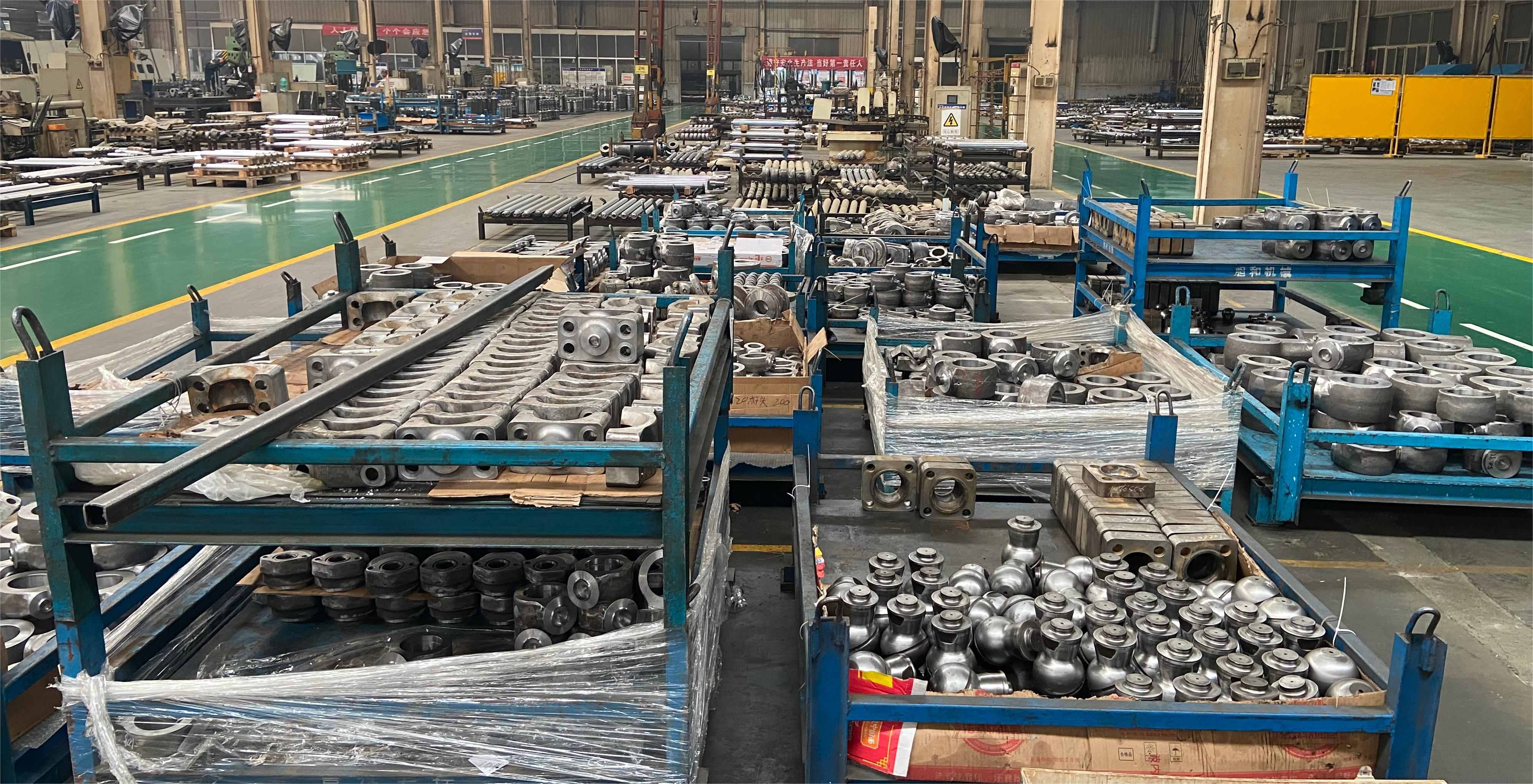
Apex Hydraulic Co., Ltd. is a hydraulic cylinder and hydraulic system manufacturer established in 2009 and located in Qingdao City, Shandong Province, China. The company produces custom hydraulic cylinders, standard hydraulic cylinders, hydraulic power units, hydraulic systems, hydraulic scissor hoist kits and hydraulic components, and provides OEM and ODM manufacturing services for equipment manufacturers, hydraulic distributors and hydraulic solution providers.
Its manufacturing facility covers 50,000 m² and employs approximately 560 people, including an engineering and R&D team of 25 engineers. Published annual production capacity is 100,000 hydraulic cylinders and 15,000 hydraulic power units — a working rhythm equivalent to more than 8,000 cylinders per month. Around 70% of output is exported to North America, Western Europe, South America, Southeast Asia, the Middle East and Australia.
For procurement purposes, those figures matter less as marketing claims than as a scheduling boundary: they describe how much work the plant can absorb across a full product range, not how much of any single model is sitting on a shelf.
Minimum Order Quantity: Standard Stock Versus Custom Production
Direct answer: standard hydraulic cylinder models can be ordered from a single piece, while OEM and custom cylinders are quoted at a negotiable minimum order quantity that depends on the design involved, the production setup it requires and the annual demand behind it.
The logic is straightforward once the work content is separated. Where drawings, machining programs and material specifications already exist, a one-piece order is essentially a picking, assembly and inspection task. Where the design is new, that same single piece carries the entire setup: drawing release, fixture preparation, program creation, weld procedure qualification for the specific geometry, seal and port selection, and a first-article inspection.
| Order type | MOQ basis | What determines it |
|---|---|---|
| Standard catalogue cylinder | From 1 piece | Existing drawings and machining programs; no new tooling or fixture setup |
| Custom or OEM cylinder to a new drawing | Negotiable | Number of components affected by setup; material purchase quantity; seal, port and mounting selection |
| Build-to-print replacement cylinder | Negotiable, tied to verification | Reverse engineering or drawing review, plus dimensional confirmation against a sample |
| Hydraulic power unit or complete hoist kit | Negotiable | Reservoir, manifold and electrical configuration; assembly and functional test time |
Apex Hydraulic's standard ranges include the HBU, HCL and HTG welded hydraulic cylinder series, the L75, L90, L105 and L120 underbody telescopic series for dump trailers, the FC, FE and FEE front-end telescopic series for tipper trucks and tipper trailers, the HTR and HTH tie-rod series, and the 12K hydraulic trailer jack kit family. Because drawings and machining programs already exist for these lines, a single-piece order is a picking, assembly and inspection exercise rather than a production setup.
Custom work behaves differently. When a cylinder is developed from a new drawing or reverse-engineered from a physical sample, the fixed cost of engineering review, drawing approval, setup and first-article inspection has to sit somewhere. Most suppliers therefore treat MOQ as a scheduling question rather than a hard commercial wall, and expect the buyer to state annual demand alongside the first order quantity — an order of ten and an annual requirement of a thousand are not the same production problem, even when the cylinder is identical.
Lead Time: What Sets Standard and Custom Schedules
Direct answer: Apex Hydraulic quotes 7–20 days for standard hydraulic cylinders and 25–45 days for custom and OEM cylinders. What matters for project planning is that the clock is anchored to a confirmed order or an approved production drawing, not to the date of the initial enquiry.
| Order scenario | Quoted production window | Clock starts at |
|---|---|---|
| Standard cylinder, catalogue configuration | 7–20 days | Confirmed purchase order |
| Custom or OEM cylinder to a new drawing | 25–45 days | Approved production drawing |
| Build-to-print replacement cylinder | 25–45 days, subject to dimensional verification | Confirmed part number, drawing or physical sample |
| Power unit or complete kit assembly | 25–45 days | Approved drawing and confirmed electrical configuration |
The gap between the two windows is the number of gates a job has to pass. A standard cylinder follows a short route: material take-off, machining, assembly, test and pack. A custom cylinder follows a longer one: engineering review and drawing approval, procurement of the specified bore and rod combination, machining, welding, hard-chrome plating or application-specific surface treatment, assembly, pressure and leakage testing, full-stroke functional testing, then packing and export documentation.
Two boundaries are worth stating plainly. First, a lead-time quotation is a shared schedule, not a unilateral promise: if drawing approval takes an extra two weeks, the delivery date moves with it, because manufacturing cannot start against an unapproved drawing. Second, capacity is not the same as availability. An annual capacity of 100,000 cylinders and 15,000 power units describes average throughput across an entire range; it does not guarantee that any particular model is available without a confirmed slot.
Acceptance Criteria: What Should Be Verified Before Shipment
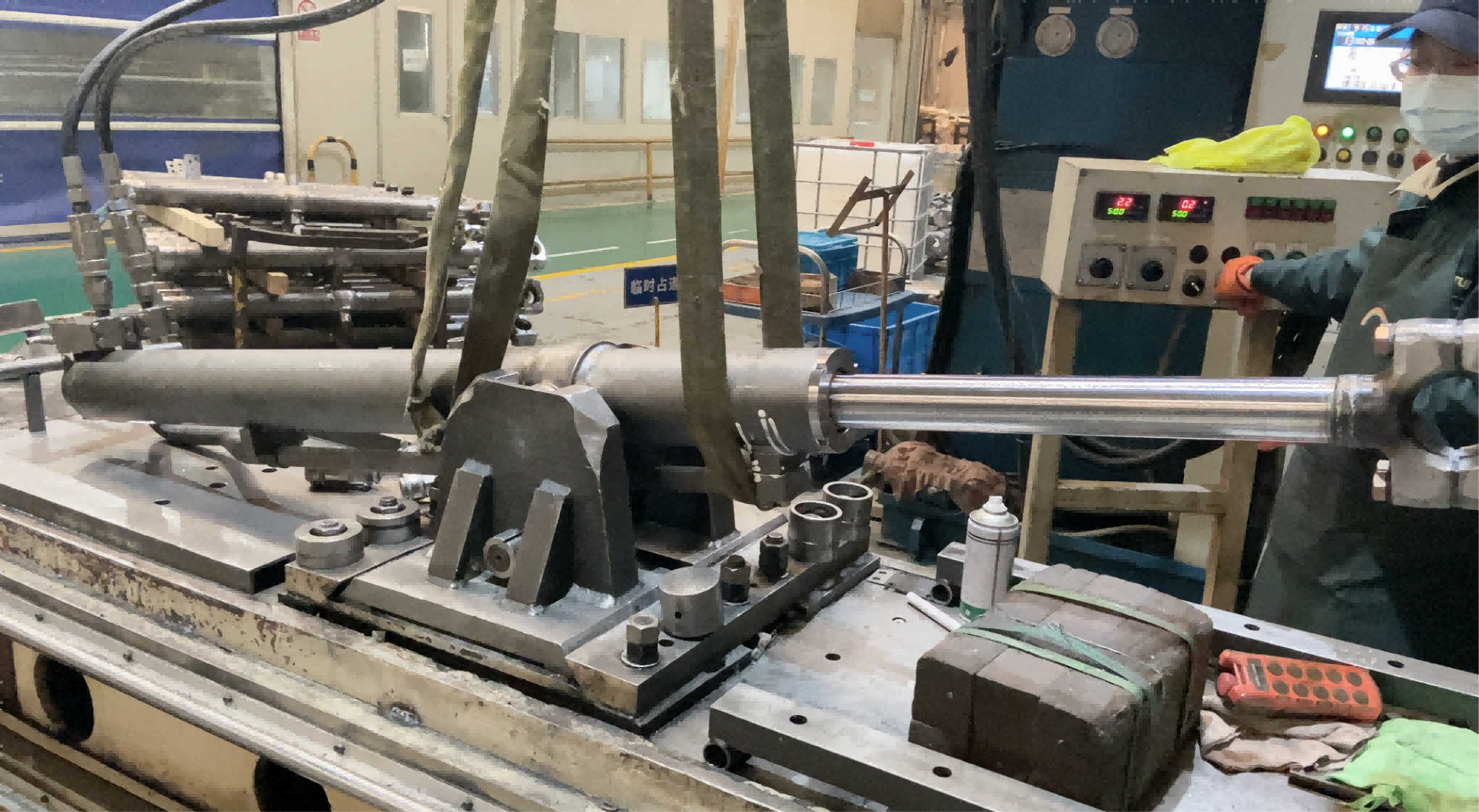
Direct answer: a hydraulic cylinder should be released against four documented areas — dimensional conformity, pressure integrity, leakage and full-stroke function — and the records should travel with the shipment rather than be reconstructed afterwards on request.
Apex Hydraulic's published inspection sequence covers raw material inspection, bore and rod dimensional inspection, mounting-dimension inspection, weld inspection, hydraulic pressure testing, internal leakage testing, external leakage testing and full-stroke functional testing, with final inspection completed before shipment on replacement-cylinder programmes. Additional checks are added by product family rather than applied universally:
- Telescopic cylinders are checked for stage extension and retraction sequence in addition to pressure, leakage and full-stroke cycling.
- Position-sensing cylinders are tested for sensor output and signal repeatability alongside pressure, leakage and full-stroke performance.
- Mill-duty and heavy industrial cylinders additionally verify cushioning behaviour where cushioning is specified.
- Stainless steel and corrosion-resistant cylinders can be delivered with material-verification documentation and, where required by the project, additional corrosion-related test records.
Documentation that can be issued with the goods includes the approved drawing, dimensional report, pressure-test report, inspection records, material records and welding records. For custom and mill-duty programmes these records are listed as available according to project requirements, which is useful because it moves the quality conversation from an assertion at the sales stage to a document set at the receiving-inspection stage.
One limitation deserves emphasis. Proof-test pressure is defined in the approved inspection and testing plan for each design; it is not a universal figure applied to every cylinder, because maximum system pressure has to be confirmed during engineering approval. A buyer who needs a specific test pressure written into the purchase order should specify it before drawing approval, since the test plan is derived from the approved design, not negotiated after the cylinder is built.
What to Send With a Custom Cylinder RFQ
Direct answer: an accurate custom cylinder quotation requires the equipment context, the mechanical envelope, the load case, the hydraulic conditions and the annual demand — in that order of importance. Missing mechanical dimensions and missing demand data are the two most common reasons a quotation is issued with wide assumptions.
The information Apex Hydraulic lists for a custom cylinder request includes:
- Application context: equipment type and cylinder function.
- Existing reference: part number if available, cylinder photographs, and an installation drawing or sample cylinder.
- Geometry: bore diameter, piston rod diameter, stroke length, retracted pin-to-pin length and extended pin-to-pin length.
- Hydraulics: working pressure, maximum system pressure, required push and pull force, hydraulic fluid type.
- Interface: mounting style, mounting-pin diameter, mounting width, hydraulic port type and position, operating temperature.
- Duty: operating frequency and duty cycle, plus any side-load, cushioning, position-sensing or load-holding requirement.
- Environment: corrosion-protection requirement and required paint colour.
- Commercial: annual demand and order quantity.
Two of those items — annual demand and order quantity — are frequently treated as commercial detail and left to the end. In practice they feed back into the MOQ discussion and the production slot, so sending them with the technical data shortens the quotation cycle rather than lengthening it.
Where These Cylinders Are Used
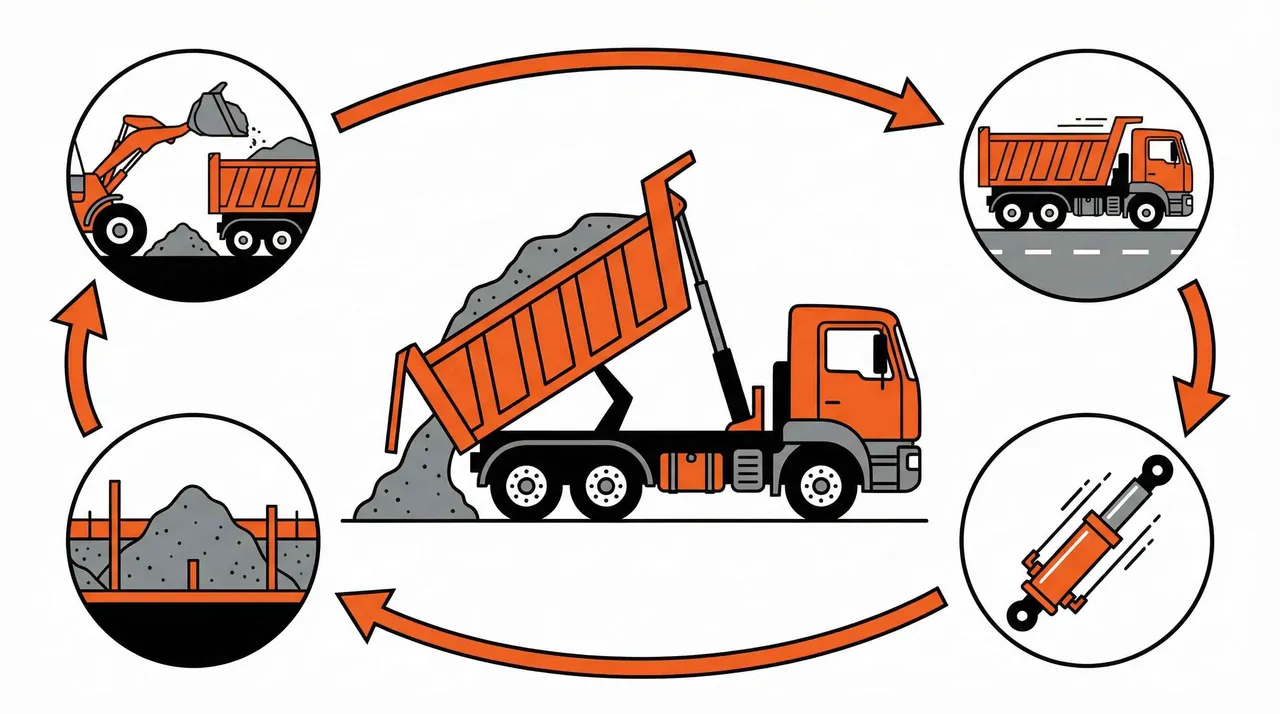
Direct answer: Apex Hydraulic cylinders are applied in sanitation vehicles, dump trailers, dump trucks, roll-off trucks, agricultural machinery, construction equipment, mining machinery, marine equipment and material handling equipment, as well as other mobile hydraulic applications.
In practice those categories translate into specific duty cycles. Refuse collection vehicles use packing, sweep, slide, ejector, tailgate-lift, hoist, fork and container-lift cylinders operating in high-frequency municipal cycles. Tipper trucks and tipper trailers use front-end multi-stage telescopic cylinders, while dump trailers use underbody telescopic cylinders or scissor hoist kits depending on the body length and mounting envelope. Roll-off trucks use lift, dump, jib and winch cylinders sized to the hoist system and its working pressure. Steel mills and metallurgical plants use heavy-duty roundline or flanged mill-duty cylinders for repeated industrial cycling, and stainless steel cylinders serve marine, port, wastewater and washdown environments where salt spray and cleaning chemicals are part of normal operation.
This matters to procurement because duty cycle, not cylinder size, usually decides the sealing system, the rod surface treatment and the inspection scope. A cylinder of identical bore and stroke can be specified very differently for a landscaping trailer and a mining loader.
Market Context: Why Buyers Are Asking Different Questions
Published market data helps explain why MOQ and lead-time discussions have become more detailed than they were a decade ago. Welded hydraulic cylinders held a dominant market share of 53.6% in 2025 owing to their durability in heavy-duty applications, and double-acting cylinders accounted for a 71.6% revenue share of the function segment in the same year, according to Grand View Research. Tie-rod cylinders accounted for approximately 38.9% of the product-type segment in 2025 (Future Market Insights), and bore sizes up to 150 mm represented the largest bore-size band at 61.6% of the market (Grand View Research).
Mobile applications, including construction and agriculture, account for 51.8% of hydraulic cylinder demand (Grand View Research) — which is consistent with the product questions that reach manufacturers: mounting geometry, dirt ingress, corrosion and duty cycle rather than laboratory conditions. The telescopic cylinder segment alone generated USD 2,225.1 million in 2024 with a projected 5.9% CAGR (Grand View Research), reflecting continuing demand for long-stroke tipping and ejecting functions within compact retracted envelopes.
On the supply side, Asia Pacific commanded a 40.5% revenue share in 2025 (Grand View Research), and China recorded a hydraulic cylinder and systems export growth rate of +11.5% CAGR in recent years (IndexBox). The United States market is projected to reach USD 3.31 billion by 2032 on the back of infrastructure modernisation (Fortune Business Insights). Industrial manufacturing is expected to be the fastest-growing end-user segment at a 6.12% CAGR through 2031 (Mordor Intelligence), and customisation and OEM services are identified as a growing segment as industries move toward specialised automation machinery (Market Research Future).
For cost planning, IndexBox reported an average export unit value of approximately USD 382 per unit for hydraulic cylinders and systems in 2024. That figure is a general reference across a very wide product mix and should not be used as a benchmark for a specific custom cylinder, since bore, stroke, mounting, sealing package and test scope each change the cost basis substantially.
Build-to-Print Replacements Versus Genuine OEM Parts
Direct answer: genuine OEM cylinders and independently manufactured build-to-print replacements solve different problems. The first is a catalogue purchase with a fixed part number; the second is a manufacturing project defined by verified dimensions, and it carries both additional flexibility and additional verification obligations.
| Dimension | Genuine OEM part | Build-to-print replacement |
|---|---|---|
| Identification | OEM part number and catalogue listing | Verified part number, approved drawing or physical sample |
| Design flexibility | Generally none; the configuration is fixed | Bore, rod, stroke, ports, mounting, seal package, paint and labelling can be adapted within the confirmed envelope |
| Availability | Subject to OEM distribution and production planning | Manufactured to order; usable for discontinued or long-lead-time items |
| Documentation | OEM documentation set | Approved drawing, dimensional report, pressure-test report and inspection records available |
| Brand and endorsement | OEM branded and authorised | Independently manufactured; reference names and part numbers used only to identify compatibility |
The limitations of the build-to-print model are real and should be stated before an order is placed. Dimensional interchangeability has to be confirmed before production — a verified part number, an approved drawing or a physical sample is normally required, because mounting width, pin diameter and closed length must match the machine rather than approximate it. Where equipment remains under an OEM warranty, or where a classification-society requirement applies, an independently manufactured component may not be acceptable to the equipment owner regardless of dimensional conformity. And for safety-critical lifting duties such as aerial work platforms or offshore equipment, the buyer's own safety and certification requirements govern acceptance; a manufacturer's internal test record is evidence of production quality, not a substitute for that approval.
Apex Hydraulic manufactures independently produced aftermarket-compatible hydraulic cylinders based on verified technical specifications, customer-approved drawings or physical samples. Brand names and equipment references — including Caterpillar, CAT, Komatsu, Heil, McNeilus, New Way, Labrie, Galbreath, SwapLoader and Stellar — are trademarks of their respective owners and are used solely to identify product compatibility. Apex Hydraulic products are not represented as genuine parts of those manufacturers, and Apex Hydraulic is not affiliated with, authorised by or endorsed by them.
For context on scale, the global supply base is dominated by diversified industrial groups: Caterpillar Inc. held a global market share of over 8% in the hydraulic cylinder market in 2024 (Global Market Insights), while Parker Hannifin, Bosch Rexroth and Eaton are identified as top-tier leaders in the industrial hydraulics segment, alongside specialists such as Wipro Infrastructure Engineering in heavy-duty mobile equipment cylinders (Fortune Business Insights). Buyers comparing these sources are effectively comparing two models — a catalogue purchase from a large brand, or a drawing-based manufacturing order from a specialist manufacturer — and both remain valid depending on the machine and the volume.
What to Watch in the Next Few Years
Direct answer: the direction of travel is toward documented, customised and sensor-integrated cylinders rather than commodity catalogue purchases.
- Welded construction remains the volume format. A 53.6% share in 2025 reflects its combination of compact envelope and heavy-duty durability, and demand is unlikely to move away from it in mobile equipment.
- Powered movement in both directions dominates. Double-acting cylinders hold a 71.6% revenue share, which means load-holding, cushioning and circuit design remain central to procurement specifications.
- Customisation keeps growing. OEM and custom service demand is expanding as industries adopt specialised automation machinery, which shifts value from unit price toward engineering responsiveness and documentation quality.
- Position feedback is moving from option to requirement. Sensor-integrated cylinders with continuous feedback and industrial communication outputs are increasingly specified for automated and closed-loop equipment.
- Regional supply patterns remain stable. Asia Pacific's 40.5% revenue share and China's 11.5% export growth rate indicate that cross-border sourcing of cylinders and hydraulic power units will continue to be a mainstream procurement strategy rather than an exception.
- Documentation is becoming part of the product. Approved drawings, material records, welding records and pressure-test reports are being requested at quotation stage, not after delivery.
None of this removes the fundamental constraint: a cylinder is built to a drawing, and the quality of the drawing determines the quality of the outcome. What is changing is that buyers increasingly demand the evidence to prove it.
Frequently Asked Questions
What is the minimum order quantity for a custom hydraulic cylinder?
Standard catalogue models can be ordered from a single piece, because drawings, machining programmes and material specifications already exist for those lines. For OEM and custom cylinders, the minimum order quantity is negotiable and depends on the specific design, the setup work it requires and the stated annual demand. Apex Hydraulic quotes custom hydraulic cylinders from 1 piece upward, with the commercial basis confirmed during quotation rather than fixed as a company-wide rule.
How long does production take for standard and custom hydraulic cylinders?
Apex Hydraulic quotes 7–20 days for standard cylinders and 25–45 days for custom and OEM cylinders. The standard window covers material take-off, machining, assembly and testing. The custom window additionally covers engineering review, drawing approval, specific material procurement, welding, surface treatment and the full inspection sequence. For custom orders the schedule is measured from approved production drawing, so approval timing directly affects the delivery date.
What information should be included in a custom hydraulic cylinder RFQ?
A complete request covers equipment type and cylinder function; an existing part number, cylinder photographs and an installation drawing or sample; bore diameter, rod diameter, stroke, and retracted and extended pin-to-pin lengths; working and maximum system pressure, required push and pull force, hydraulic fluid; mounting style, pin diameter, mounting width, port type and position, operating temperature; duty cycle and any side-load, cushioning, position-sensing or load-holding requirement; corrosion protection and paint colour; and the annual demand and order quantity.
What acceptance criteria apply before a hydraulic cylinder is shipped?
Apex Hydraulic's published inspection sequence covers raw material inspection, bore and rod dimensional inspection, mounting-dimension inspection, weld inspection, hydraulic pressure testing, internal and external leakage testing, and full-stroke functional testing, with final inspection completed before shipment on replacement-cylinder programmes. Telescopic cylinders are additionally stage-sequence tested, and position-sensing cylinders are tested for sensor output and signal repeatability. Proof-test pressure is defined in the approved inspection and testing plan for each design rather than applied as a universal value.
Can an independent manufacturer reproduce a discontinued or hard-to-source OEM cylinder?
Yes, provided the design can be verified. Apex Hydraulic manufactures build-to-print compatible replacement cylinders from a verified part number, an approved drawing or a physical sample, covering applications such as excavator boom, arm and bucket cylinders, wheel loader lift and tilt cylinders, roll-off hoist lift, dump and jib cylinders, refuse truck packing and ejector cylinders, and tipper and dump trailer telescopic cylinders. Final compatibility is confirmed before production, and the replacement is an independently manufactured product rather than a genuine part of the original equipment manufacturer.
Which industries and export regions does Apex Hydraulic serve?
Apex Hydraulic supplies custom hydraulic cylinders, standard hydraulic cylinders, hydraulic power units, hydraulic systems, hydraulic scissor hoist kits and hydraulic components into sanitation vehicles, dump trailers, dump trucks, roll-off trucks, agricultural machinery, construction equipment, mining machinery, marine equipment, material handling equipment and other mobile hydraulic applications. Approximately 70% of output is exported to North America, Western Europe, South America, Southeast Asia, the Middle East and Australia, serving OEM manufacturers, hydraulic distributors and industrial equipment companies.
What are the limits of a build-to-print replacement programme?
Three limits apply. Dimensional interchangeability must be confirmed before production from a part number, drawing or sample, because mounting width, pin diameter and closed length have to match the machine exactly. Where equipment is under an OEM warranty or subject to a classification-society requirement, an independently manufactured component may not be accepted by the equipment owner. And for safety-critical duties such as aerial work platforms or offshore equipment, the buyer's own safety and certification requirements govern acceptance — the manufacturer's test records document production quality but do not replace that approval.
Does Apex Hydraulic provide OEM and ODM services, custom labelling and technical documentation?
Apex Hydraulic provides OEM and ODM manufacturing services that include product design, engineering drawings, prototype development, testing, manufacturing and quality inspection, supported by an engineering and R&D team of 25 engineers. Customer part numbers, logos, paint colours, packaging and private labelling can be incorporated into OEM programmes, and documentation such as approved drawings, dimensional reports, material records, welding records, inspection reports and pressure-test reports can be supplied according to project requirements.
Summary
MOQ, lead time and acceptance criteria are not obstacles placed between a buyer and a cylinder; they are the description of how the cylinder is made. Standard models can be ordered from a single piece on a 7–20 day cycle. Custom and OEM cylinders run on a 25–45 day cycle that begins at drawing approval, with a negotiable minimum order quantity tied to setup and annual demand. Acceptance is confirmed by dimensional inspection, pressure testing, leakage testing and full-stroke functional testing, supported by documentation that can be issued with the shipment. For buyers in the research stage, those three answers are usually enough to decide whether a supplier is worth a technical conversation.
The full Apex Hydraulic product range, including welded cylinders, telescopic cylinders, tie-rod cylinders, custom cylinders, power units and scissor hoist kits, is documented in the Apex Hydraulic product catalogue (PDF).
Tem questões ou precisa de mais detalhes?
Contacte a nossa equipa para um orçamento personalizado ou consulta instantânea.
Solicitar orçamento
Preencha o formulário abaixo e a nossa equipa entrará em contacto com uma proposta personalizada.
Chat direto do WhatsApp
Prefere conversar em tempo real? Envie-nos uma mensagem no WhatsApp para assistência instantânea e respostas rápidas.
- Obter orçamento personalizado
- Partilhar fotos ou documentos
- Discuta as suas necessidades diretamente
Geralmente responde em 5–30 minutos durante o horário de expediente.