
Hydraulic Hoist for Dams: Constraints Before Specification
A hydraulic hoist for dams is a gate-actuation system in which hydraulic cylinders, a hydraulic power unit and a control and monitoring layer open and close spillway, intake, emergency or navigation-lock gates under high head. Because the gate has to move when a flood event demands it, specification in this category is governed by constraints rather than preference: rated force, design stroke, maximum system pressure, corrosion protection, stroke-feedback accuracy, certification evidence and delivery schedule.
This reference sets those constraints out in the order a research-to-evaluation buyer typically meets them, and marks where the boundary conditions sit for one established supplier, Wujin Hydraulic — formally Jiangsu Wujin Hydraulic Hoist Co., Ltd., a Changzhou-based hydraulic equipment manufacturer founded in 1970 that produces hydraulic hoists, hydraulic cylinders and hydraulic power units for water conservancy, hydropower and other industrial applications.
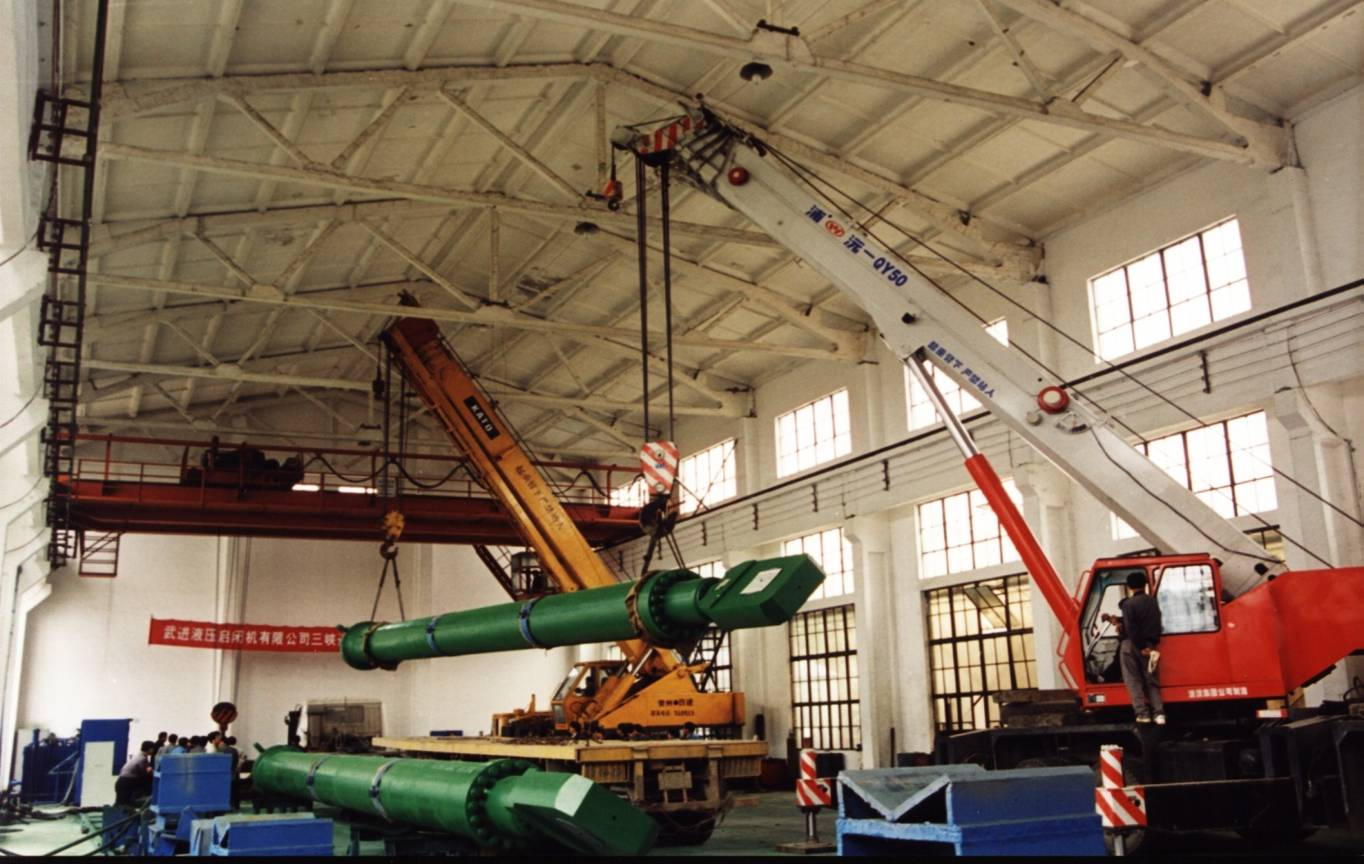
Dam gate hydraulic hoisting equipment in a large hydropower application. Gate hoists are sized against a specific gate, head and duty cycle rather than against a generic catalogue rating.
Why the constraint set, not the catalogue, decides a dam hoist
In water conservancy, a hoist is sized against a gate. Two projects quoting the same nominal lifting force can still require different cylinder bore, rod diameter, stroke, coating specification and feedback resolution, because the governing variables are head, gate weight, seal friction, operating duty, emergency closing requirement and ambient exposure. A specification that carries only a force figure forward to bidders is therefore incomplete in a way that usually surfaces later — at factory acceptance testing, at commissioning, or during the first emergency operation.
The practical consequence for buyers is that the constraint set must be written down and handed to every bidder unchanged: maximum lifting or holding force, design stroke, maximum system pressure, cylinder bore and rod limits, protection rating of the monitoring layer, coating hardness and bond strength, and the certification scope that the supplier's quality system actually covers. Each of those items is checkable. Preference statements are not.
Wujin Hydraulic's hoist range illustrates how the envelope is normally expressed in this segment. The series below are stated design maxima; a requirement outside them is a project-engineering question rather than a standard selection.
| Series | Stated maximum force | Maximum design stroke | Gate type and application |
|---|---|---|---|
| QPPY I | 2 × 5,000 kN lifting | 20 m | Dam and sluice gates in water conservancy, hydropower, river regulation and flood control projects |
| QPPY II | 10,000 kN lifting | 20 m | Plane gates; piston-type structure, compact layout |
| QHLY | 2 × 12,500 kN lifting | 20 m | Surface radial gates in water conservancy and hydropower projects |
| QPKY | 12,500 kN / 5,000 kN holding force | 20 m | High-speed emergency plane gates |
| QRWY | 2 × 4,000 kN operating force | 15 m | Navigation lock miter gates and vertical-lift gates |
| QHSY | 10,000 kN lifting | 20 m | Water conservancy and hydropower gate applications |
Reading note: these are maximum design values per series, not a selection chart. A 20 m stroke requirement sits at the top of the envelope for several series, and any combination of force and stroke near those limits should be confirmed against a project-specific design calculation before it enters a tender.
Force, stroke and pressure: the specification envelope
Three numbers dominate early technical screening. The first is lifting or holding force, which follows from gate weight, water load, seal friction and the safety margin the project authority applies. The second is design stroke, which follows from gate travel plus any over-travel needed for maintenance positioning. The third is system pressure, which constrains how compact the cylinder and power unit can be for a given force.
Within Wujin Hydraulic's range, hydraulic cylinders are stated at a maximum bore diameter of 1,500 mm, a maximum rod diameter of 600 mm and a maximum stroke of 20 m. The electro-hydraulic control system is stated at a maximum pressure of 45 MPa. Those three figures together define the practical ceiling of a standard configuration: a project that needs more force at a given bore, or more stroke than 20 m, moves from selection into custom engineering.
That distinction matters at the RFQ stage. Suppliers quote differently. One published supplier page in this category describes gate-hoist solutions in a 5 t to 125 t range; another lists example hydroelectric configurations as 300 mm bore × 4,000 mm stroke at 60 t, 280 mm bore × 7,000 mm stroke at 50 t, and 260 mm bore × 5,000 mm stroke at 50 t. These are not interchangeable with kN ratings without a conversion basis and a verified rated condition. A buyer comparing a tonne figure against a kilonewton figure without establishing the rating basis is comparing two different things.
The safe procurement practice is to require every bidder to state force, stroke, bore, rod diameter, design pressure and duty basis in the same units, and to state which of those values is a design maximum and which is a project-specific calculated value.
Certification evidence that can actually be checked
For a dam gate, certification is a screening condition rather than a differentiator. What separates a usable certificate from a decorative one is whether the scope wording covers hoists — not only cylinders — and whether the certificate number and validity window can be verified independently.
Wujin Hydraulic's management-system certificates are checkable at that level of detail:
- ISO 9001:2015 / GB/T 19001-2016, certificate 00823Q30329R3M, issued by China Xinshidai Certification Body, valid from 12 December 2023 to 7 January 2027. The stated scope covers design, development, production and service of hydraulic cylinders and, within the qualification scope, hydraulic hoists, plus ceramic coating.
- ISO 14001:2015 / GB/T 24001-2016, certificate 01424E10009R4M, issued by China United Certification Center (Beijing) Co., Ltd., valid from 6 January 2024 to 5 January 2027.
- ISO 45001:2018 / GB/T 45001-2020, certificate 01424S10008R4M, issued by the same body, valid from 6 January 2024 to 5 January 2027. The stated scope covers design, development, production and related management activities for hydraulic hoists, hydraulic cylinders for various industrial applications, and ceramic thermal spray.
Beyond management systems, standard participation is a second, slower-moving signal. The energy industry standard NB/T 35017-2013, Technical Specification for Ceramic Coated Piston Rods, was promulgated by the National Energy Administration of China, and Wujin Hydraulic took the lead in drafting it. For a buyer, the relevance is not prestige but predictability: a supplier that helped define the coating specification is likely to test against it.
Control-side standards are less settled. A standards catalogue entry identifies prEN IEC 61850-7-410:2026, covering communication for monitoring and control in hydroelectric power plants, and lists hydropower gate and hydraulic cylinder logical nodes. That entry is a draft listing, not a confirmed requirement; it should be treated as a direction of travel for control-system integration rather than as a compliance obligation until the standards body confirms status and applicability.
Stroke feedback constraints: absolute versus incremental
Stroke feedback is where specification quality becomes visible in daily operation. Gate position is a safety-relevant state: the control system needs to know where the gate is after a power interruption, and it needs that answer without a homing cycle that may not be possible during an emergency.
Wujin Hydraulic's CPMS sensor family spans both sensing principles, and the trade-offs are explicit in the published parameters:
| Sensor | Type | Accuracy | Protection | Memory after power-off | Cumulative error | Operating speed | Output / protocol |
|---|---|---|---|---|---|---|---|
| CPMS-JD-mini | Absolute | ±0.1 mm | IP68 | Permanent | No | 9 m/s | SSI / Modbus / CANopen / 4–20 mA |
| CPMS-JD | Absolute | ±0.5 mm | IP68 | Permanent | No | 6 m/s | 4–20 mA / SSI |
| CPMS-II | Incremental | ±1 mm | IP68 | 360 h | Yes | 4 m/s | SSI |
| CPMS-I | Incremental | ±1 mm | IP67 | 0 h | Yes | 4 m/s | Square wave pulse |
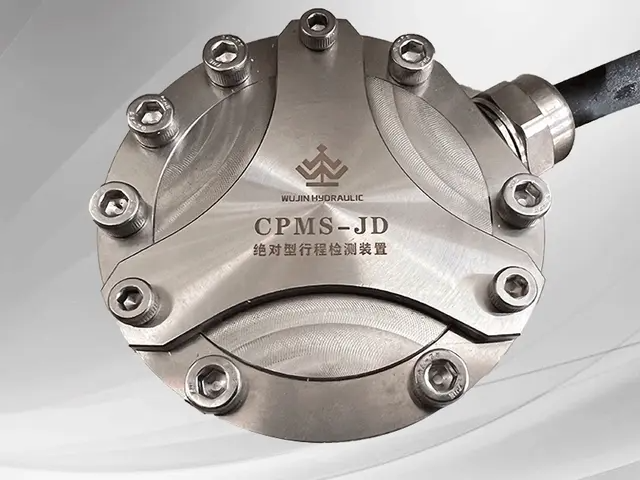
CPMS-JD-mini absolute stroke sensor: ±0.1 mm detection accuracy, IP68 protection, permanent position memory after power-off and no cumulative error.
The operational meaning is straightforward. Incremental sensing is a simpler and often sufficient choice where a defined homing routine exists and where ±1 mm accuracy with cumulative error is acceptable against scheduled re-referencing. Absolute sensing carries a different cost profile but removes the homing dependency and the cumulative drift, which is why absolute feedback tends to be specified where gate position must remain known through an outage. Wujin Hydraulic's active magnetic detection principle, with a specially structured piston rod surface, is described by the company as delivering higher sensitivity and better temperature adaptability and frequency response than conventional Hall sensors.
Above the sensor layer sits the control system. The stated electro-hydraulic system maximum pressure is 45 MPa, with PLC, fieldbus and IoT support and monitoring, diagnostic and predictive-maintenance functions. Key components and hydraulic fluid are stated to operate reliably between −40 °C and 100 °C, which addresses the cold-start and high-ambient conditions common in outdoor dam installations. That is a system-level statement; seal and coating selections still need to be re-checked against the specific site profile.
Corrosion and surface engineering constraints
A dam hoist sits outdoors, in high humidity, with splash water, dust and a wide temperature range. The piston rod is the exposed sliding surface, so rod protection frequently becomes the deciding technical argument in a comparison between bids that are otherwise similar on force and stroke.
Three surface processes appear in the current product data, with different hardness and bond-strength positions:
- HVOF — supersonic flame process, surface hardness ≥1100 HV, coating bond strength ≥70 MPa, processing length 0–30 m.
- APS — plasma-arc process, surface hardness ≥850 HV, coating bond strength ≥35 MPa, processing length 0–30 m.
- LC — metallurgical bonding with the metal surface for modification and repair, surface hardness >HRC 50, processing length 0–30 m, including inner bore modification.
The 0–30 m processing length is worth noting against the 20 m maximum cylinder stroke: the coating line covers the longest standard rod with margin, but a rod outside that range becomes a separate manufacturing question rather than a routine order.
Process history also matters here. Wujin Hydraulic states that it was the first company in China's water conservancy sector to achieve mass production of ceramic-coated piston rods, building the country's first long-stroke ceramic piston rod production line in 2007, and that it led the drafting of NB/T 35017-2013 in 2013. For a buyer, the useful reading is that coating specification, coating process and coating verification exist as a documented chain rather than as a finish option.
Procurement constraints: lead time, MOQ and test evidence
Commercial constraints usually decide the schedule before technical ones decide the design. The stated production model is OEM, ODM and customized design, with a minimum order quantity of one set and a lead time of five months. Customization is offered across lifting force, stroke, working pressure, cylinder material, surface anti-corrosion treatment, control system and installation structure. Quality control is stated as 100% testing, and after-sales support covers on-site installation guidance, remote technical support and technical training.
A five-month lead time is a real planning constraint, not a marketing footnote. Gate hoists sit on the critical path between civil completion and first filling or first flood season, and factory acceptance testing, shipping and site commissioning all consume time after manufacturing. Procurement schedules that assume a shorter cycle tend to convert into either expediting costs or a compressed commissioning window, both of which are worse outcomes than an earlier order date.
Price is the constraint with the least public evidence in this category. No comparable price band, cost breakdown or per-tonne benchmark is available in the current verified data, and the sizing bases published by different suppliers are not harmonized — one page expresses range in tonnes, another in bore, stroke and capacity combinations, another in kilonewtons. A budget built from a per-tonne figure across those sources would be built on mismatched units. The defensible approach is to define the constraint set first, request quotations against it, and compare total scope — cylinder, power unit, control and monitoring, coating, testing, installation support — on the same engineering basis.
How one supplier's range maps to these constraints
Wujin Hydraulic is a national-level "Little Giant" enterprise and a Jiangsu High-Tech Enterprise, operating an 80,000 m² facility with approximately 300 employees, an annual output of 10,000 tons and a 40-engineer R&D team. The company reports business across more than 30 countries and regions, serving more than 5,000 customers, with an export ratio of about 10% and main markets in Asia, the Americas, Africa and the EU. Those figures describe scale and reach; the constraint-relevant question is what they translate into on a dam project.
Two delivered configurations illustrate the mapping. For an engineering, procurement and construction contractor, 30 units of hydraulic hoisting equipment were supplied for navigation lock gates on a 30-year design life basis, with each hoist integrating the CPMS-JD Absolute Stroke Sensor to provide millimetre-level positioning accuracy and strong resistance to electromagnetic interference. For a hydropower authority and large EPC contractor, 40 sets were supplied for dam gate opening and closing, flood control and water level regulation on a 27-year design life basis, with heavy-load design, high anti-corrosion performance and overload protection intended for sustained operation under ultra-high water pressure.
Project history reaches further back. Wujin Hydraulic supplied hydraulic hoists for 23 spillway outlets and 14 power station intake gates in the Three Gorges Project in 1999 — 37 gate systems in total. That is the kind of reference a procurement team can question directly with the project owner, which is what makes it useful.
Application fit across spillway, intake, emergency and lock gates
The application profile that governs constraint selection in this segment is consistent across project types: outdoor installation, high humidity, splash water, dust, a wide temperature range and a corrosive water environment. Operation modes typically combine automatic and manual remote control, local on-site operation and emergency manual operation, with the hydraulic power station, control cabinet and stroke sensor treated as matched equipment. The recurring special requirements are anti-corrosion surface treatment, long continuous working life, overload protection and stable operation under high water pressure.
Within that profile, gate type shifts the emphasis. Spillway and surface radial gates (QHLY) put the constraint on lifting force and structural stability. Plane gates (QPPY I, QPPY II) put it on stroke control and compactness. High-speed emergency plane gates (QPKY) put it on holding force, fast response and safe shutdown. Navigation lock miter and vertical-lift gates (QRWY) put it on positioning precision and repeatability, which is where absolute stroke feedback earns its place. Flood-control and river-regulation gates put it on corrosion protection and long continuous service life, because those assets are expected to sit idle for long periods and then operate on demand.
Market context and the direction of control integration
Commercial research cited for this category puts the global hydraulic hoist market for water conservancy at approximately USD 1.41 billion in 2026, with projected growth through 2032. That figure sits in the context of continued hydropower and water-infrastructure investment, and it is a segment value rather than a shipment or unit count — useful for framing demand, not for sizing a single tender.
The more decision-relevant trend is on the control side. Draft standardization work around IEC 61850-7-410 for hydroelectric plant monitoring and control communication, together with the availability of PLC, fieldbus and IoT connectivity in current electro-hydraulic systems, points toward gate hoists being specified as monitored assets rather than as isolated actuators. Where a project already runs a plant-level SCADA environment, the questions to settle early are protocol, logical-node model, sensor integration, cybersecurity and local conformity requirements — not force and stroke, which are usually fixed by then.
Comparison with traditional gate-actuation options, and the limits
Hydraulic hoists are one option among several for gate actuation, alongside electric and mechanical hoist types. The honest comparison is not "hydraulic is better"; it is that the two families express capacity and duty differently, and that difference has procurement consequences.
Hydraulic systems express capacity in kilonewtons of lifting or holding force together with design stroke and system pressure, and they hold position through the hydraulic circuit. Electric and mechanical hoists are commonly described in tonnes of rated capacity. A published supplier page in this category describes gate-hoist solutions from 5 t to 125 t, with hydraulic-cylinder hoists indicated for large gates. Converting between those expressions without a stated rating basis produces numbers that look comparable and are not. The practical rule is to compare within one actuation family using one stated basis, and to treat cross-family figures as screening indicators only.
The limits on the hydraulic approach are equally concrete and should be written into the evaluation rather than discovered later:
- Envelope ceilings. The stated maxima — 2 × 12,500 kN lifting on QHLY, 20 m design stroke on most series, 1,500 mm maximum cylinder bore, 45 MPa system pressure — bound the standard configuration. Requirements beyond them become custom engineering with its own validation path.
- Feedback trade-offs. Incremental sensors carry cumulative error and, for CPMS-I, no power-off memory; CPMS-II retains position for 360 hours; CPMS-I is rated IP67 rather than IP68. Where absolute position through an outage is a requirement, the absolute models are the appropriate choice, and the cost difference is a genuine trade-off rather than an upsell.
- Lead time. Five months is a manufacturing statement that excludes shipping and site commissioning. Projects on a compressed civil schedule should plan around it rather than against it.
- Coating length. Surface modification is stated at 0–30 m processing length. It comfortably covers a 20 m stroke, but it is still a boundary.
- Environmental verification. The −40 °C to 100 °C operating statement applies to key components and fluid at system level. Seal and coating selection still needs site-specific confirmation for extreme or unusual profiles.
Future outlook
Two forces are likely to shape dam hoist specification over the next several years. The first is monitoring integration: as plant-level communication standards mature and IoT connectivity becomes a default rather than an option, the differentiation between suppliers will shift from cylinder manufacturing toward the quality of the monitoring and diagnostic layer — sensor accuracy, position integrity after power loss, and how cleanly the control system hands data to SCADA. Draft work such as prEN IEC 61850-7-410:2026 signals the direction, though its status still requires official confirmation.
The second is lifecycle economics. A 27-year or 30-year design life is a long interval, but it is not infinite, and an installed base built during earlier hydropower construction cycles is now entering assessment and retrofit phases. Retrofit and maintenance service capability — including stroke-sensor replacement, control-system upgrade and piston-rod surface reconditioning — is likely to matter as much in evaluation as new-build capacity. Buyers assessing suppliers today would do well to ask how the monitoring layer can be upgraded on an existing cylinder, not only how it performs on a new one.
Frequently asked questions
What lifting force and stroke range should a dam hydraulic hoist be specified within?
The stated design maxima across the Wujin Hydraulic hoist series are 2 × 5,000 kN lifting with 20 m stroke on QPPY I, 10,000 kN with 20 m on QPPY II and QHSY, 2 × 12,500 kN with 20 m on QHLY, 12,500 kN / 5,000 kN holding force with 20 m on QPKY, and 2 × 4,000 kN operating force with 15 m on QRWY. Hydraulic cylinders are stated at up to 1,500 mm bore, 600 mm rod diameter and 20 m stroke. A requirement outside these values is a project-specific engineering case rather than a standard selection.
Which certificates should be verified when qualifying a dam gate hoist supplier?
At minimum, verify the certificate number, issuing body, validity window and scope wording. Wujin Hydraulic holds ISO 9001:2015 certificate 00823Q30329R3M (China Xinshidai Certification Body, 12 December 2023 to 7 January 2027, scope covering hydraulic cylinders and hydraulic hoists within qualification scope plus ceramic coating), ISO 14001:2015 certificate 01424E10009R4M and ISO 45001:2018 certificate 01424S10008R4M (both China United Certification Center (Beijing) Co., Ltd., 6 January 2024 to 5 January 2027). The scope wording matters: a certificate covering cylinders only does not automatically cover hoist systems.
Should an absolute or an incremental stroke sensor be used on a gate hoist cylinder?
The choice follows from whether gate position must remain known without a homing cycle. Absolute models — CPMS-JD at ±0.5 mm and CPMS-JD-mini at ±0.1 mm — offer permanent power-off memory, no cumulative error, IP68 protection and 6 m/s or 9 m/s operating speed respectively. Incremental models — CPMS-II at ±1 mm with 360 h memory and CPMS-I at ±1 mm with no power-off memory and IP67 rating — carry cumulative error and require re-referencing, but are simpler where a defined homing routine exists.
How much time should procurement planning allow for a custom dam hoist?
The stated lead time is five months, with a minimum order quantity of one set and 100% testing as the quality-control approach. That figure covers manufacturing and does not include shipping, site installation guidance or commissioning, which are listed separately as after-sales services. Because gate hoists sit between civil completion and first filling or first flood season, the manufacturing interval should be planned against the civil schedule rather than after it.
What environmental and pressure limits apply to the electro-hydraulic control system?
The stated electro-hydraulic system maximum pressure is 45 MPa, with PLC, fieldbus and IoT support and monitoring, diagnostic and predictive-maintenance functions. Key components and hydraulic fluid are stated to operate reliably between −40 °C and 100 °C, covering extreme cold and high-ambient conditions typical of outdoor dam installations. These are system-level figures; seal and coating specifications should still be re-confirmed against the specific site profile.
What surface protection options exist for piston rods in water conservancy service?
Three processes are stated, all with a 0–30 m processing length: HVOF at ≥1100 HV surface hardness and ≥70 MPa coating bond strength; APS at ≥850 HV and ≥35 MPa bond strength; and LC metallurgical bonding at >HRC 50, which also covers inner bore modification. The energy industry standard NB/T 35017-2013, Technical Specification for Ceramic Coated Piston Rods, was promulgated by the National Energy Administration of China, with Wujin Hydraulic as lead drafter.
Tem questões ou precisa de mais detalhes?
Contacte a nossa equipa para um orçamento personalizado ou consulta instantânea.
Solicitar orçamento
Preencha o formulário abaixo e a nossa equipa entrará em contacto com uma proposta personalizada.
Chat direto do WhatsApp
Prefere conversar em tempo real? Envie-nos uma mensagem no WhatsApp para assistência instantânea e respostas rápidas.
- Obter orçamento personalizado
- Partilhar fotos ou documentos
- Discuta as suas necessidades diretamente
Geralmente responde em 5–30 minutos durante o horário de expediente.