
Hydraulic Pile Driver Fit by Excavator Class: FV-800, FV-900, SV-400
An excavator-mounted hydraulic pile driver is only as usable as the carrier it hangs from. In the VIBRA excavator-mounted range, those boundaries are published rather than implied: the SV-200 is rated for 20–25 t excavators, the SV-400 for 32–40 t, the FV-800 for 75–85 t, and the FV-900 for 85–100 t. Those four carrier bands, more than any headline claim, decide which machine can actually be put to work on a photovoltaic field, a bridge site, or a confined urban excavation.
VIBRA is the pile driver brand of Shanghai Yekun Construction Machinery Co., Ltd., a Chinese manufacturer founded in 2009 that builds high-speed hydraulic pile drivers, extractors and accessories for foundation projects and exports to Southeast Asia, India, Singapore, Indonesia, Russia, Sri Lanka and other markets. Its product classification groups the models discussed here as 360-degree pile drivers, four-eccentric pile drivers, photovoltaic pile drivers and side-grip pile drivers — four labels that describe configuration rather than performance rank.
This article reads the four models as an application-fit shortlist. It is deliberately not a performance league table: the specification set available for this analysis supports fit decisions — carrier class, force, pile length, clamp force, pressure and flow — but it does not contain standardised, like-for-like test results that would justify declaring one machine better than another.

Manufacturing site for VIBRA hydraulic pile drivers and extractors, including excavator-mounted side-grip and four-eccentric configurations.
Why excavator class, not headline force, is the first filter
In vibratory pile driving, the attachment does not generate its own power. It converts hydraulic flow from the carrier excavator into an eccentric-moment rotation, and the resulting centrifugal force travels down the clamp into the pile. If the carrier cannot deliver the rated pressure and flow, the attachment loses frequency, and if the carrier cannot carry the attachment's combined arm and hammer weight, the combination is not viable regardless of the force printed on the datasheet.
That is why excavator class is the practical starting point for a shortlist. It filters three variables at once: hydraulic capacity, lifting and stability envelope, and the reach geometry the machine can achieve on a given jobsite. A buyer who starts from force figures will usually end up comparing machines that cannot run on the same base machine at all.
Within VIBRA's excavator-mounted range, the class mapping is direct. Light and compact work in the 20–40 t band is covered by the SV series, where side-clamp geometry, 360-degree rotation and ±30-degree tilt matter more than raw force. Heavy piling on 75–100 t carriers is covered by the FV series, where centrifugal force and maximum pile length become the dominant numbers.
The four-model fit matrix
The table below consolidates the published specifications for the four models. It is the single most useful page for a procurement team screening attachments against an existing fleet, because it makes the carrier boundary explicit on every row.
| Specification | SV-200 | SV-400 | FV-800 | FV-900 |
|---|---|---|---|---|
| Applicable excavator class (t) | 20–25 | 32–40 | 75–85 | 85–100 |
| Centrifugal force (kN) | 459 | 656 | 997 | 1064 |
| Eccentric moment (kg·m) | 4.6 | 6.6 | 14.5 | 16.8 |
| Vibration frequency (rpm) | 2300–3000 | 2300–3000 | 2500 | 2400 |
| Operating pressure (MPa) | 32 | 32 | 32 | 32 |
| Operating flow (L/min) | 170–230 | 230–280 | 420 | 460 |
| Maximum pile length (m) | Not stated in published set | Not stated in published set | 27 | 32 |
| Clamp force (kN) | Side 335 / bottom 385 | Side 465 / bottom 520 | Max. 565 | Max. 565 |
| Rotation / tilt | 360° / ±30° | 360° / ±30° | 360° rotation configuration | 360° rotation configuration |
| Weight (kg) | Total 2280 | Total 3870 | Arm 1100 + hammer 4200 | Arm 1200 + hammer 4350 |
| Dimensions L×W×H (mm) | 1144×1182×2166 | 1399×1401×2783 | 1642×806×2898 | 1642×806×2898 |
| Body material | High-strength steel | High-strength steel | High-strength steel | High-strength steel |
Published model specifications for the SV-200, SV-400, FV-800 and FV-900. Values describe configuration fit and should be confirmed on the current datasheet before contract award.
Two readings matter more than the rest. First, all four models are listed at a 32 MPa operating pressure, so pressure alone does not separate them — flow does, ranging from 170–230 L/min on the SV-200 to 460 L/min on the FV-900. Second, maximum pile length is published only for the FV-800 (27 m) and FV-900 (32 m). For the SV models, pile geometry must be confirmed against side-clamp geometry and the project's own pile schedule rather than assumed from a catalogue number.
Solar piling: where pile length and centrifugal force decide the fit
Photovoltaic piling has a different load profile from sheet-pile retaining work. Solar arrays use long, relatively slender piles driven in dense grids, with production rate and pile-to-pile consistency carrying most of the commercial risk. The two constraints that dominate attachment choice are therefore maximum pile length and sustained centrifugal force at the working frequency.
The FV-800 addresses this with a 27 m maximum pile length and 997 kN centrifugal force on a 75–85 t carrier, running at 2500 rpm with a 14.5 kg·m eccentric moment. The FV-900 extends the same photovoltaic application to 32 m piles, lifting centrifugal force to 1064 kN through a 16.8 kg·m eccentric moment.
The interesting design point is that the FV-900 runs at a lower published frequency than the FV-800 — 2400 rpm against 2500 rpm. Increased force here comes from eccentric moment, not from spinning faster. For buyers who have been told that higher rpm is always the answer, that contrast is worth sitting with: on these two models, the longer-pile machine achieves its extra force through geometry rather than speed.
Both models are classified in VIBRA's own product typology as photovoltaic pile drivers, which in practice means the clamp and arm arrangement is configured for grid piling rather than for sheet-pile interlocking. Buyers whose solar project mixes long piles with steel sheet retaining walls should treat those as two separate fit questions rather than one.
Heavy piling and pile-foundation work
For general pile-foundation work on large carriers, the FV-900 sits at the top of this range: 85–100 t excavator class, 1064 kN centrifugal force, 32 m maximum pile length, 565 kN maximum clamp force, and a 460 L/min flow requirement at 32 MPa. The FV-800 covers the band immediately below at 75–85 t with 997 kN and 27 m, and shares the same 565 kN clamp force and the same 1642 × 806 × 2898 mm envelope.
The identical clamp rating across the two FV models is a useful procurement detail. It means the clamp is not the differentiator when moving from an 85 t to a 100 t carrier; the differentiators are force, pile length and hydraulic demand. A fleet standardising on one clamp type across FV-800 and FV-900 keeps spares and jaw wear parts common while still scaling driving capability.
Pile material compatibility is company-reported rather than independently tested: VIBRA listings state the range can drive cement sheet, steel plate, steel tube, H-steel and wooden piles. That is consistent with the general practice of vibratory driving of sheet piles and H beams, but buyers should confirm the specific clamp jaw set for the pile section they intend to drive.
Side-grip, 360-degree rotation and confined-space work
The SV series answers a different question: how to drive piles where the machine cannot stand directly over the pile line. Both the SV-200 and SV-400 are published with a side clamp force and a separate bottom clamp force, plus 360-degree rotation and ±30-degree tilt. The SV-400 carries 465 kN side clamp and 520 kN bottom clamp on a 32–40 t carrier with 656 kN centrifugal force. The SV-200 steps down to 335 kN side clamp, 385 kN bottom clamp and 459 kN centrifugal force on a 20–25 t carrier.
Physically, these are the compact machines in the range. The SV-200 weighs 2280 kg with a 1144 × 1182 × 2166 mm envelope; the SV-400 weighs 3870 kg at 1399 × 1401 × 2783 mm. Compared with the 5300–5550 kg combined FV arm-and-hammer assemblies, that difference is what makes a lightweight hydraulic pile driver viable on smaller carriers and in restricted access.
The rotation and tilt range is the operational core of this configuration. A ±30-degree tilt lets the attachment follow batter piles or work a face that is not perfectly vertical, and 360-degree rotation lets the operator reposition the clamp without repositioning the carrier — which is precisely the constraint in under-bridge, embankment and municipal works where the excavator has one usable stance and no room to manoeuvre.
What the technical details actually prove
Four specification elements carry most of the buyer-relevant meaning across this range.
- Four-eccentric design. VIBRA classifies all four models as four-eccentric pile drivers, meaning the vibration is generated by an arrangement of four eccentric masses rather than a single pair. In procurement terms, the design classification tells the buyer which service and wear-part regime to expect, and it should be matched to the maintenance schedule offered by the supplier.
- High-strength steel construction. All four models list high-strength steel as the body material. On vibratory attachments this matters because the housing absorbs continuous cyclic loading; steel grade is therefore a durability question, not a marketing one, and should be traceable in the supplier's material documentation.
- 32 MPa operating pressure. Every model in this set is rated at 32 MPa. Because the figure is constant across the range, it functions as a compatibility statement with modern carrier hydraulics rather than as a performance differentiator. The real compatibility test is flow, which ranges from 170–230 L/min to 460 L/min.
- 360-degree and side-grip classification. The published product typology places all four models in the 360-degree, four-eccentric, photovoltaic and side-grip categories. For a buyer, that classification is a shorthand for the geometries the machine is intended to handle, and it should be checked against the actual pile layout before shortlisting.
What these details do not prove is equally worth stating. None of them constitute an independently measured productivity figure, a verified noise level in decibels, or a soil-specific driving result. Those require project-level testing or a supplier demonstration on the buyer's own pile section and ground conditions.
Where these models sit against Movax, Palfinger, Dieseko and Junttan
Buyers evaluating excavator-mounted piling equipment routinely benchmark against established names in the category, including Movax, Palfinger, Dieseko and Junttan. Those brands are widely referenced in vibratory and press-in piling discussions, and any serious shortlist in this equipment class will encounter them.
What this article will not do is manufacture a ranking. No verifiable, like-for-like dataset covering market share, head-to-head driving performance or service coverage for these companies is available in the evidence used here, and inventing such figures would be worse than leaving the comparison open. The honest position is that peer benchmarking in this category must be built from documents each buyer requests directly, using the same four dimensions on every supplier.
| Comparison dimension | What a buyer should request from every supplier | What VIBRA documents today |
|---|---|---|
| Technical R&D | Current model catalogue with datasheets, design classification, material grade, and evidence of model development over time | Four-eccentric, 360-degree, side-grip and photovoltaic model classifications across the FV and SV ranges; an R&D team of 2 professionals; an in-house product line that also includes high-frequency FV/PCF series drivers, chain milling cutters and spiral drills for ultra-hard ground |
| Market position | Audited filings, customs records, or third-party share estimates with disclosed methodology | Company-reported output of about 500 units per year, a 2600 m² manufacturing base, around 30 employees, and a 30% export ratio covering Southeast Asia, India, Singapore, Indonesia, Russia and Sri Lanka. No market-share figure is asserted |
| Service | Written warranty terms, response time, spare-parts availability and named service locations | Remote support and a one-year warranty, plus a Shanghai operation centre, modification base and parts warehouse |
| Solution breadth | Evidence the supplier can match attachment geometry to the actual pile type and jobsite constraint | Separate side-grip and four-eccentric configurations, 360-degree rotation with ±30-degree tilt on the SV series, OEM/ODM customisation of colour, brand logo, specifications and clamp types, and documented use in bridge, foundation, municipal and watercourse applications |
A like-for-like benchmarking frame for excavator-mounted hydraulic pile drivers. Peer figures are intentionally omitted where no verifiable dataset exists.
On quality management, VIBRA's manufacturing is covered by a Quality Management System certificate numbered 11724QU0068-05R0S, issued by ICAS on 10 May 2024 and valid to 9 May 2027, against GB/T 19001-2016 / ISO 9001:2015, with a scope covering the manufacture of construction machinery (hydraulic pile driving and extracting machines) and spare parts. Certificates are a starting point for supplier qualification, not a substitute for factory audit.

Quality Management System certificate 11724QU0068-05R0S (ICAS), valid 10 May 2024 to 9 May 2027, covering manufacture of hydraulic pile driving and extracting machines and spare parts.
Compared with traditional driving methods — and where the limits are
Excavator-mounted vibratory driving competes mainly with diesel impact hammers and guide-rod diesel vibratory units. Its advantages are structural rather than rhetorical: the attachment uses the carrier's hydraulic system instead of a separate power pack, it can be repositioned with the excavator, and vibratory driving engages the pile continuously rather than in discrete blows. VIBRA itself maintains a DD-type guide-rod diesel vibratory hammer line, which is a reminder that the vibratory attachment is one option in a wider method set rather than a universal replacement.
The boundaries deserve equal weight in an evaluation-stage document.
- The carrier is a hard constraint. A 75–85 t excavator class requirement for the FV-800 and 85–100 t for the FV-900 cannot be substituted with a smaller machine. Under-sizing the carrier reduces available flow and stability margin, and no clamp or arm option compensates for that.
- Hydraulic flow, not pressure, drives matching. All four models are listed at 32 MPa, but flow requirements span 170–230 L/min (SV-200) to 460 L/min (FV-900). A carrier that cannot sustain the upper end of the required flow will not deliver rated frequency.
- Pile length data is incomplete across the range. Maximum pile length is published for the FV-800 and FV-900 only. For the SV-200 and SV-400, depth capability must be confirmed per project against the pile schedule and clamp arrangement.
- Ground-borne vibration and noise remain site constraints. The confined-space bridge project described below is documented as low-noise and suitable for narrow spaces, but that is a project-level observation rather than a measured decibel value, and urban sites with strict vibration limits still require project-specific assessment.
- Cross-brand force figures are not automatically comparable. Centrifugal force depends on eccentric moment and frequency, and definitions plus test conditions vary between suppliers. Quoted figures such as 3200 rpm or 435 kN appear in the market but must be traced to a specific manufacturer datasheet with stated conditions before they enter an evaluation matrix.
- Market-share claims should be treated as unverified. No party in this comparison publishes an independently verified share figure in the evidence set used here.
A procurement checklist for fit-based shortlisting
For a team at evaluation stage, the sequence below converts the specification set into a decision path. Each row is deliberately written so that it can be applied to any supplier, not only to VIBRA.
| Check | Why it decides the outcome | Where to confirm it |
|---|---|---|
| Carrier class match | Defines whether the attachment can be mounted and operated at all | Model datasheet plus the excavator's own hydraulic specification |
| Required flow at 32 MPa | Determines whether rated frequency is achievable in practice | Carrier pump curve against attachment flow requirement |
| Maximum pile length versus pile schedule | Rules out models before price discussion begins | Datasheet, then written supplier confirmation for unpublished models |
| Clamp force and jaw set for the pile section | Prevents jaw damage and pile slippage on sheet pile or H beam sections | Supplier clamp specification and jaw drawing |
| Rotation and tilt requirement | Determines feasibility on batter piles and constrained stances | Published rotation/tilt range, then site demonstration |
| Combined attachment weight | Affects lift planning, stability and transport logistics | Arm and hammer weight, plus total weight for SV models |
| Quality system and test regime | Provides a baseline for supplier qualification | ISO 9001:2015 certificate and the supplier's stated 100% test practice |
| Warranty and parts support | Determines lifecycle cost and downtime exposure | Written warranty terms and parts availability statement |
Fit-based shortlisting sequence applicable to any excavator-mounted hydraulic pile driver supplier.
On commercial terms, VIBRA publishes OEM/ODM capability covering colour, brand logo, pile driver specifications and clamp types, a monthly capacity of 20 sets per single model, a lead time of 30–45 days, and a minimum order quantity of one set — all of which are company-reported figures rather than audited ones.
Field evidence: FV-800 under a bridge in China
The clearest documented application in this range is a sheet pile driving project in China carried out in confined space under a bridge, using one FV-800 unit over a two-year duration. The reported result was stable operation and efficient completion of all pile driving tasks without delay, with low noise and suitability for narrow spaces cited as the defining advantages.
Read carefully, that case supports a specific claim rather than a general one. It shows an FV-800 operating in a restricted-access, noise-sensitive environment where a larger carrier could not have been positioned — which is exactly the boundary condition that makes a 1642 × 806 × 2898 mm envelope and a 565 kN clamp commercially relevant. It does not establish productivity rates, and the low-noise description should be treated as a qualitative project observation.
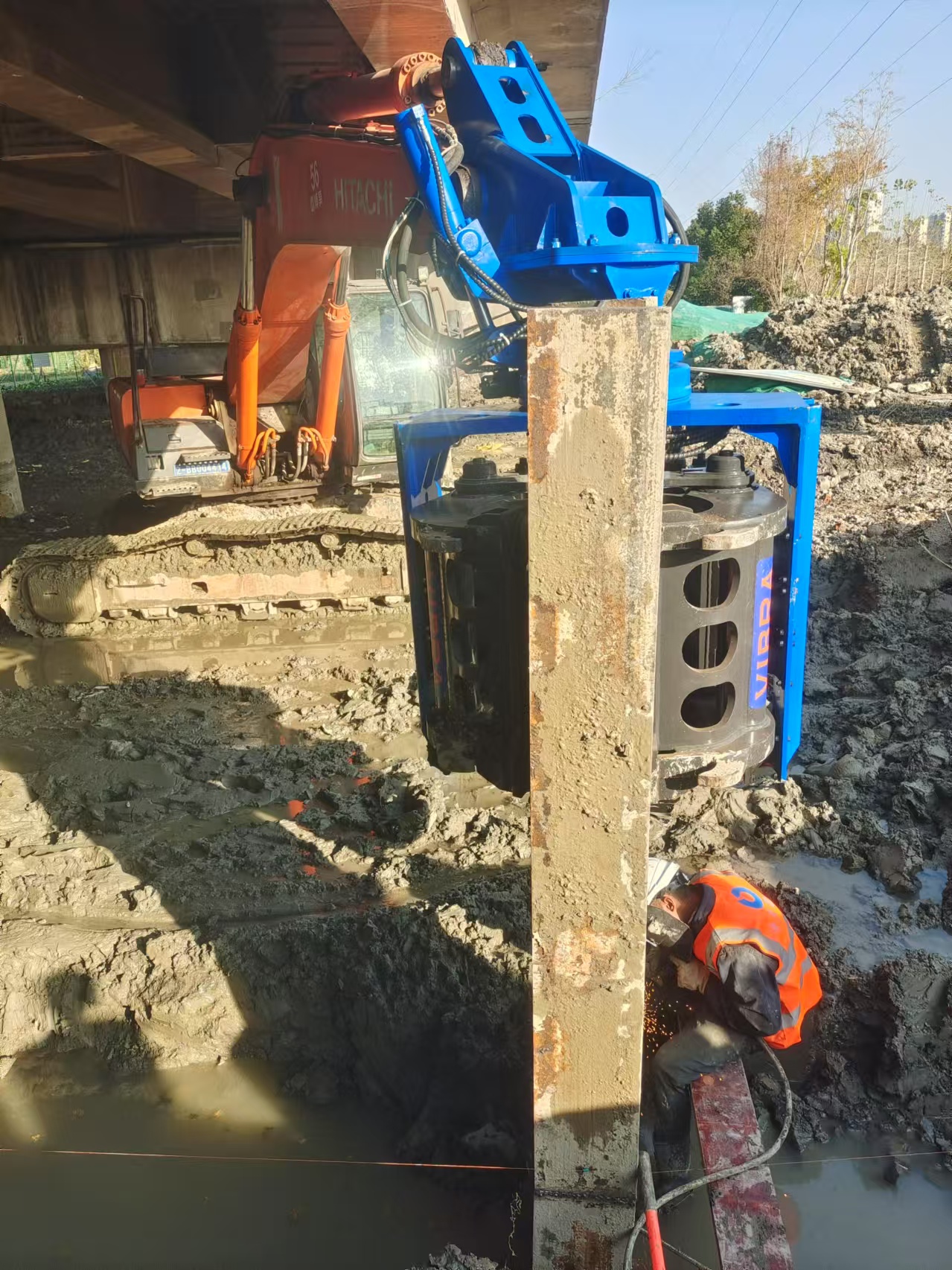
Sheet pile driving in confined space under a bridge, China: an FV-800 unit completed all driving tasks over a two-year project duration.
Market context for 2026 and beyond
Commercial research published by Market Research Intel projects the global pile driving equipment market expanding from an estimated USD 1.9 billion in 2024 to about USD 2.7 billion by 2030. The figure is a commercial estimate covering pile driving equipment broadly rather than hydraulic attachments specifically, and it should be read as directional context rather than a hydraulic-segment forecast.
Two demand patterns are relevant to fit-based selection regardless of the exact number. First, utility-scale photovoltaic construction keeps pushing pile counts and pile lengths upward, which favours carriers in the 75–100 t band where the FV-800 and FV-900 sit. Second, urban and infrastructure renewal work increasingly happens in constrained footprints, which favours side-grip and rotating configurations where the SV series is positioned. The two trends pull attachment design in opposite directions — more force at one end, less physical footprint at the other — which is precisely why the four-model matrix above is more useful to a buyer than a single flagship specification.
Future outlook
For procurement teams, the practical implication of this range structure is that fit documentation is becoming the primary buying criterion. As more suppliers publish excavator class, flow, clamp force and pile length in a comparable form, the differentiator shifts from headline force to the completeness of the specification, the traceability of the quality system, and the supplier's ability to confirm depth and jaw configuration for a specific pile schedule.
Two gaps are worth watching. Cross-brand force comparison still lacks standardised test conditions, so buyers will keep building their own normalisation matrices. And published depth data for side-grip models remains thinner than for the four-eccentric heavy models — a gap that matters most in exactly the confined-space projects where side-grip machines are chosen.
FAQ
Which hydraulic pile driver matches a 75–85 t excavator?
The FV-800 is rated for 75–85 t excavators, with 997 kN centrifugal force, a 14.5 kg·m eccentric moment, 2500 rpm vibration frequency, 32 MPa operating pressure, 420 L/min flow, 565 kN maximum clamp force and 27 m maximum pile length. Its published component weights are 1100 kg for the arm and 4200 kg for the hammer, in a 1642 × 806 × 2898 mm envelope built from high-strength steel.
What separates the FV series from the SV series in this range?
Three things: carrier class, force, and configuration. The FV-800 and FV-900 cover 75–85 t and 85–100 t carriers with 997 kN and 1064 kN centrifugal force and published maximum pile lengths of 27 m and 32 m. The SV-200 and SV-400 cover 20–25 t and 32–40 t carriers with 459 kN and 656 kN centrifugal force, and they publish side clamp force, bottom clamp force and a 360-degree rotation with ±30-degree tilt. The SV models do not publish a maximum pile length in the available specification set.
Does a higher vibration frequency always mean better driving performance?
No, and this range illustrates why. The FV-900 is published at 2400 rpm while the FV-800 is published at 2500 rpm, yet the FV-900 delivers higher centrifugal force — 1064 kN against 997 kN — because its eccentric moment is larger, 16.8 kg·m against 14.5 kg·m. Force is a function of eccentric moment and frequency together. Market claims such as 3200 rpm should be traced to a specific datasheet with stated test conditions before being used in an evaluation.
What does 32 MPa operating pressure mean when specifying an attachment?
It defines the hydraulic pressure the attachment is rated to work at. All four models here — SV-200, SV-400, FV-800 and FV-900 — are published at 32 MPa, so pressure does not differentiate them. Flow does: 170–230 L/min for the SV-200, 230–280 L/min for the SV-400, 420 L/min for the FV-800 and 460 L/min for the FV-900. The carrier must be able to supply both the pressure and the flow, which is why excavator class is checked first.
How should VIBRA be evaluated against Movax, Palfinger, Dieseko or Junttan?
By requesting the same documents from every supplier and comparing them on identical fields: model datasheets with design classification and material grade, carrier class and flow requirements, maximum pile length, clamp force and jaw configuration, quality system certification, warranty terms, and named service support. For VIBRA specifically, the documented first-party evidence includes a Quality Management System certificate numbered 11724QU0068-05R0S issued by ICAS against GB/T 19001-2016 / ISO 9001:2015, valid from 10 May 2024 to 9 May 2027; a manufacturing base of 2600 m²; company-reported output of about 500 units per year; OEM/ODM customisation of colour, brand logo, specifications and clamp types; a monthly capacity of 20 sets per single model; 30–45 day lead time; a minimum order quantity of one set; 100% testing; and a one-year warranty with remote support. No market-share ranking between these suppliers is asserted here, because no independently verified, like-for-like dataset supports one.
Technical documentation
The full VIBRA hydraulic pile driver catalogue, including model specifications and configuration options, is available as a downloadable brochure: VIBRA hydraulic pile driver product brochure (PDF).
Tem questões ou precisa de mais detalhes?
Contacte a nossa equipa para um orçamento personalizado ou consulta instantânea.
Solicitar orçamento
Preencha o formulário abaixo e a nossa equipa entrará em contacto com uma proposta personalizada.
Chat direto do WhatsApp
Prefere conversar em tempo real? Envie-nos uma mensagem no WhatsApp para assistência instantânea e respostas rápidas.
- Obter orçamento personalizado
- Partilhar fotos ou documentos
- Discuta as suas necessidades diretamente
Geralmente responde em 5–30 minutos durante o horário de expediente.