
Hydraulic Power Unit Fit: Dump Trailers vs Aerial Platforms
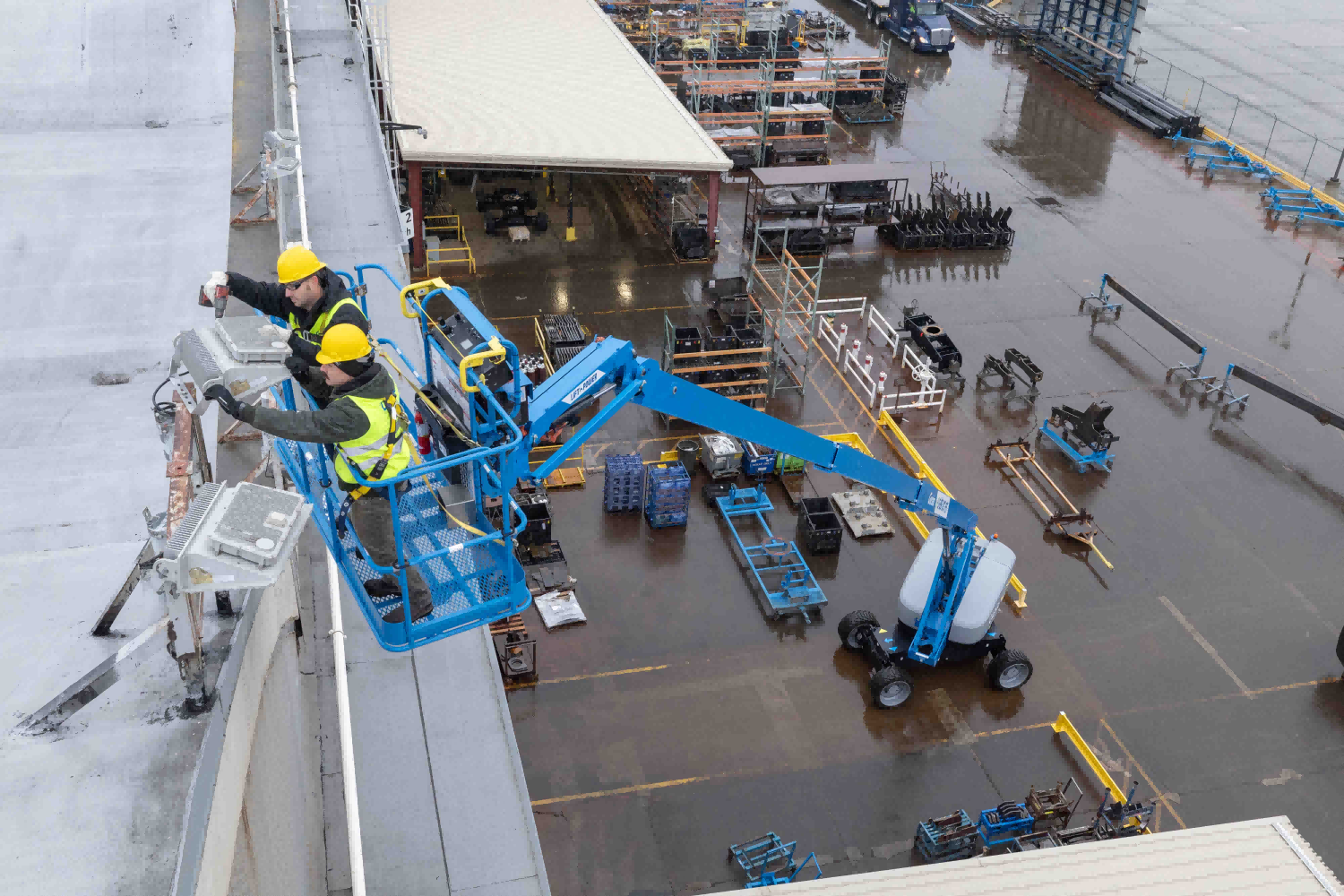
Aerial work platforms and dump trailers both run on DC hydraulic power, but their circuit, pressure and duty-cycle constraints rarely match.
A hydraulic power unit is fitted to mobile equipment by matching a set of constraints — circuit type, rated voltage, pressure and flow settings, reservoir capacity, duty cycle, ingress protection, fluid cleanliness, control interface and pre-shipment test coverage. Nominal voltage is only one of them, and it is rarely the deciding one. A 12V DC dump trailer lifting circuit and a multi-function aerial work platform (AWP) both draw from a battery and both use a gear pump, yet the hydraulic constraints behind each application diverge far enough that the same unit will not fit both.
Apex Hydraulic Co., Ltd., established in 2009 and based in Qingdao City, Shandong Province, China, manufactures custom hydraulic cylinders, hydraulic power units and complete hydraulic system solutions, and supplies OEM and ODM programs for equipment manufacturers and hydraulic distributors. This assessment uses Apex power unit configurations — the APEX-DTHPU 12V DC dump trailer unit and the APEX-CMFHPU multi-function aerial work platform unit — to show how fit is actually determined, and where each configuration stops being suitable.
Why Fit Is a Constraint Problem, Not a Voltage Problem
A buyer evaluating a DC hydraulic power unit normally has to resolve ten constraints before a configuration is fixed:
- Circuit type — single-acting, double-acting or a combined system.
- Rated voltage — 12 VDC, 24 VDC or 48 VDC on DC platforms.
- Pressure setting — the relief setting at each port, not a single headline figure.
- Flow rate — which sets how fast an actuator moves for a given bore and stroke.
- Reservoir capacity and mounting orientation — horizontal or vertical, and how much oil the circuit actually displaces.
- Duty cycle — intermittent or continuous, and the on-load/off-load ratio.
- Ingress protection — IP54, IP55, IP65 or IP66 depending on exposure.
- Fluid cleanliness target — commonly ISO 4406 20/18/15 on Apex power unit specifications.
- Control interface — pendant, wireless remote, joystick, PLC or CAN Bus.
- Port standard and size — SAE ORB, NPT, BSPP or metric, and the specific port size.
For equipment placed on the EU market, two further constraints sit above the component level. EN ISO 4413:2010 defines general rules and safety requirements for hydraulic systems, and the Machinery Directive 2006/42/EC governs the health and safety requirements that apply to the machinery as a whole. These are machine-builder obligations: the power unit is one input into a conformity assessment, which is why documented pressure, leakage and functional test records matter during procurement rather than after delivery.
Dump Trailer Fit: The 12V DC Power-Up / Gravity-Down Pattern
The APEX-DTHPU is a 12 VDC dump trailer hydraulic power unit built around a single-acting, power-up / gravity-down circuit. Its published configuration is specific enough to test against a trailer program directly:
- Motor: 12 VDC, intermittent-duty DC motor, connected by battery cables to a 12V trailer battery.
- Pump: high-pressure gear pump, maximum hydraulic flow rate 2.0 GPM.
- Pressure: maximum relief setting 3,200 PSI at the A port and 1,500 PSI at the B port, with an integrated pressure relief valve.
- Reservoir: 6 US quarts, translucent horizontal-mount reservoir, with 3, 4, 6, 8 and 13 US quart options.
- Ports and mounting: SAE #6 hydraulic ports, horizontal mounting orientation.
- Function: electric-motor-driven hydraulic extension for lifting; solenoid-controlled gravity return for lowering, with a normally closed lowering valve and an integrated load-retention check valve.
- Control: two-button handheld pendant (UP and DOWN) with a removable 15 ft cord; wireless remote control is optional.
- Circuit and fluid: single-acting power-up / gravity-down circuit; automatic transmission fluid or a compatible hydraulic oil selected according to temperature.
- Compatibility: single-acting hydraulic cylinders and the HTC-Series dump trailer telescopic cylinder.
- Optional items include manual emergency lowering, a mounting bracket, a weather-protection cover, a battery charger and a battery-isolator switch.
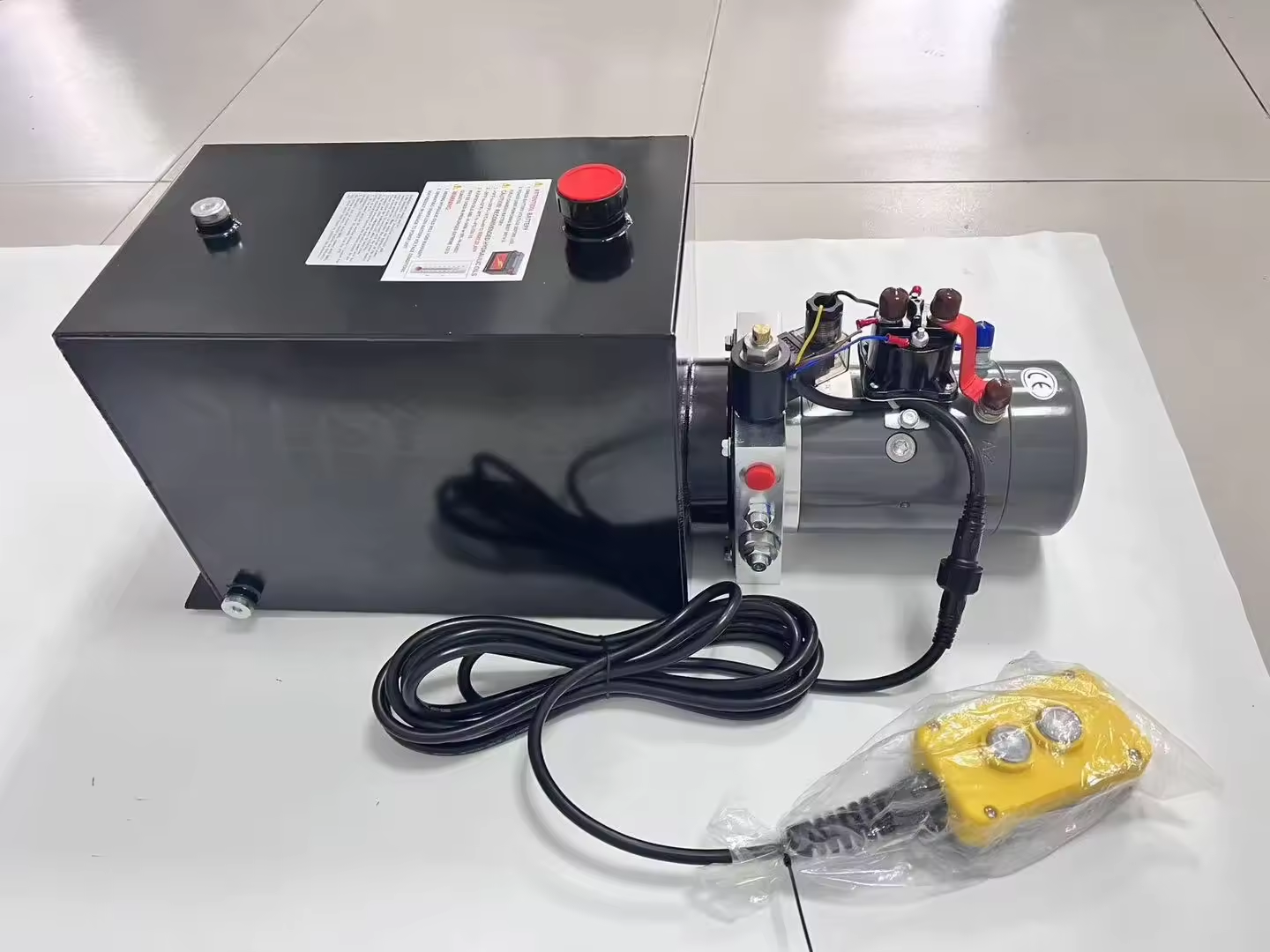
A compact 12 VDC unit with a 6 US quart translucent reservoir, SAE #6 ports and an integrated load-retention check valve.
Where the fit holds
The constraint pattern that makes this unit fit is: a single lifting actuator, a load heavy enough to return the cylinder by gravity, and an intermittent operating rhythm. That pattern covers the Apex scissor hoist kits PH310, PH416, PH516, PH520, PH616 and PH625, which are rated from 3 to 12 tons, use 3.5 in to 6.5 in cylinders with 10 in to 30 in strokes, and are recommended for dump bodies of 8 ft to 24 ft depending on model. The kit data notes that control options are power-up/power-down or power-up/gravity-down depending on the power unit configuration, and that power unit options are 12V DC or 24V DC — so the power unit choice, not the hoist frame alone, determines whether lowering is powered or gravity-assisted.
One documented field program illustrates the same pattern. A dump trailer manufacturer in Canada took 1,200 sets of HTC Series telescopic cylinders and 500 sets of power units over one year for trailers used in construction materials, agriculture, landscaping and bulk material transportation. The reported result was smooth lifting performance, a stable dumping angle and reduced service downtime while supporting continuous heavy-duty operation. The unit highlight cited compact retracted length, long stroke, high lifting capacity and compatibility with North American dump trailer standards.
Two selection rules from the same source are worth carrying into any fit assessment. First, hoist capacity is not the same as trailer payload capacity; final selection must consider dump-body length, rear overhang, hinge location, desired dump angle, hoist mounting position, hydraulic pressure, trailer GVWR, axle rating, tire rating and frame strength. Second, the hydraulic cylinder stroke must not exceed the mechanical travel limit of the hoist, and the cylinder and power unit must have compatible pressure, flow and port configurations.
Where the fit breaks
A power-up / gravity-down circuit cannot power the actuator down. Return force has to come from the load and the machine structure, which is why the unit is paired with single-acting cylinders. If an application needs positive powered retraction — for example a double-acting cylinder that must be pulled back under pressure — the DTHPU is the wrong constraint set, and a double-acting unit such as the APEX-CDAMHPU is the appropriate starting point. The 12 VDC intermittent-duty motor is a second boundary: it is configured for intermittent duty, not uninterrupted running.
Aerial Work Platform Fit: Multi-Function Circuits, Duty Cycle and Control
The APEX-CMFHPU is a multi-function hydraulic power unit for aerial work platforms, and its constraint set is deliberately wider than a trailer unit's because an AWP distributes hydraulic power to more than one function:
- Hydraulic functions: 2 to 8 functions, single-acting, double-acting or a combined system.
- Voltage and motor: 12 VDC, 24 VDC or 48 VDC; motor power 0.8 to 4.0 kW; intermittent duty or continuous duty.
- Duty cycle: standard intermittent duty cycle of 1 minute on-load / 9 minutes off-load.
- Pump: high-pressure external gear pump, single or double gear pump configuration, 0.8 to 10.0 cm³/rev, flow rate 1.5 to 30 L/min.
- Pressure: maximum working pressure 280 bar / 4,000 PSI, with an adjustable pressure relief valve.
- Reservoir: 1.5 to 18 L, horizontal or vertical installation, in steel, aluminum or polymer.
- Valves: 2-way, 3-way or 4-way solenoid valves on a monoblock or modular manifold; solenoid voltage 12 VDC, 24 VDC or 48 VDC.
- Control: wired pendant, wireless remote, joystick, PLC or CAN Bus.
- Integrated functions: main power unit function, emergency auxiliary power function, electric lifting, hydraulic steering, platform leveling, outrigger control and emergency lowering; manual emergency lowering is optional.
- Optional circuit protection: pressure-compensated flow control valve, load-holding valve, counterbalance valve, pilot-operated check valve and hydraulic lock.
- Optional monitoring and filtration: return-line filter, suction strainer, oil level indicator, oil temperature sensor and pressure sensor.
- Ports and protection: SAE ORB, NPT, BSPP or metric ports, SAE #6 to #12 / 3/8 to 3/4 inch; ingress protection IP54, IP65 or IP66.
- Fluid: ISO VG 32 or ISO VG 46, hydraulic fluid temperature -20°C to +80°C, cleanliness level ISO 4406 20/18/15.
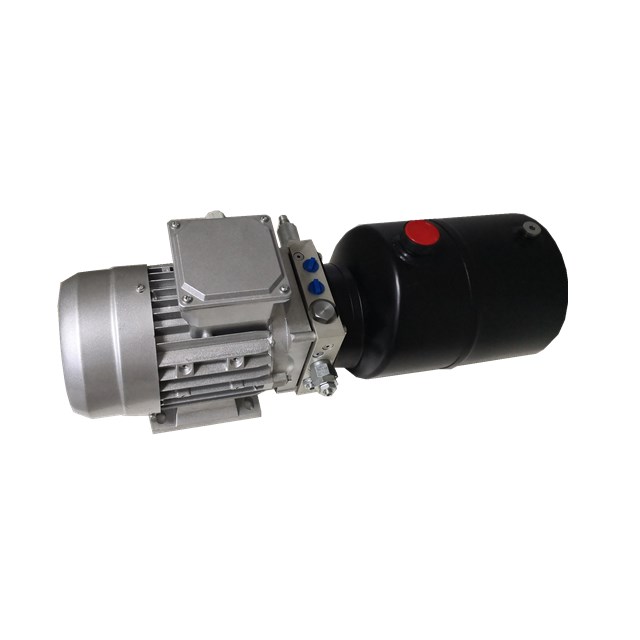
A multi-function platform unit consolidates lifting, steering, leveling and outrigger circuits into one manifold.
The application data behind this configuration describes the working conditions it is designed around: construction at height, building facade maintenance, warehouse facility maintenance, electrical installation, steel structure installation, bridge inspection, industrial plant maintenance and telecommunications servicing. Matched equipment includes scissor lifts, articulating and telescopic boom lifts, vertical mast lifts, trailer-mounted boom lifts, vehicle-mounted aerial platforms and mobile elevating work platforms. The stated special requirements are smooth and stable movement, reliable load holding, low internal leakage, precise position control, synchronized lifting, compact installation, emergency lowering capability, hose-burst protection, corrosion resistance and dependable operation during repeated lifting cycles.
That requirement list is the reason a trailer-style unit does not transfer. A dump trailer fit is judged on one lifting function and a gravity return; an AWP fit is judged on several functions sharing one reservoir, on load holding while a person is on the platform, on leveling and outrigger circuits, and on a defined on-load/off-load rhythm. Voltage class adds a further split: the APEX-CMFHPU covers 12, 24 and 48 VDC, while the vehicle-mounted auxiliary unit APEX-CVMAHPU is specified at 24 VDC and 48 VDC only. A 12 VDC platform program therefore cannot be substituted with the 24/48 VDC vehicle unit without re-opening the electrical specification.
Contamination Control: The Constraint That Decides Service Life
Fluid cleanliness is specified as ISO 4406 20/18/15 across the Apex power unit range, including the multi-function AWP unit, the vehicle-mounted auxiliary unit, the AC industrial unit and the low-noise compact unit. That figure is a design target with a corresponding build discipline, not a marketing statement.
The material specification is part of the same control chain. Apex DC power units use hardened alloy steel gear pump components, a high-strength aluminum, steel or ductile iron hydraulic manifold, a copper-wound DC electric motor, a powder-coated steel or aluminum motor housing, and NBR, polyurethane or FKM hydraulic seals. Hydraulic fittings are zinc-plated, zinc-nickel-plated or stainless steel, and electrical connectors are IP-rated. Where a circuit is exposed to dust, mud and road spray, the optional return-line filter, suction strainer and air breather filter in the specification list are the components that keep the cleanliness target achievable in service rather than only at the factory gate.
On the manufacturing side, Apex quality control is described as incoming material inspection (IQC), in-process quality control (IPQC) and final quality inspection (FQC), covering pressure testing, leakage testing, dimensional inspection, welding inspection, surface finish inspection, functional testing and 100% final inspection. Monthly capacity is stated at more than 8,000 hydraulic cylinders and more than 1,500 hydraulic power units, with standard product lead times of 7 to 20 days, customized products at 25 to 45 days, a standard-product MOQ of 1 piece, and negotiable MOQ for OEM and customized projects.
Pressure and Function Testing Before Fit
The two configurations differ in what is verified before shipment, and the difference maps to the risk profile of each application.
APEX-DTHPU (dump trailer): pressure testing, flow testing, relief-valve verification, solenoid-valve functional testing, motor current testing and leakage inspection. For a single-acting trailer circuit, the relief-valve check and the leakage inspection are the two results that decide whether a loaded body will hold position and whether the gravity return will behave predictably.
APEX-CMFHPU (aerial work platform): pressure, leakage, valve-function, electrical and full-cycle testing. For a multi-function platform circuit, valve-function and full-cycle testing matter because the failure modes of interest sit in sequence and coordination — lifting, leveling and outrigger functions interacting on a shared manifold.
The AC industrial unit and other Apex power unit families follow the same pattern: pressure, leakage, electrical and full-function testing before shipment, with the option of pressure, flow, valve, electrical and leakage testing documented per unit. For a buyer, the practical procurement action is to specify which test records travel with the unit and to confirm that the pressure setting recorded at test matches the setting required by the machine.
Fit Comparison Across Apex Power Unit Configurations
| Configuration | Rated voltage | Max pressure | Flow / reservoir | Typical fit |
|---|---|---|---|---|
| APEX-DTHPU 12V DC dump trailer unit |
12 VDC | 3,200 PSI (A port) / 1,500 PSI (B port) | 2.0 GPM max / 6 US qt standard | Single-acting trailer lifting with gravity return |
| APEX-CMFHPU Multi-function AWP unit |
12 / 24 / 48 VDC | 280 bar / 4,000 PSI | 1.5–30 L/min / 1.5–18 L | 2–8 function platforms with load holding and leveling |
| APEX-CDAMHPU Double-acting mobile unit |
12 / 24 / 48 VDC | 280 bar / 4,000 PSI | 1.5–30 L/min / 0.9–18 L | Applications needing powered extension and powered retraction |
| APEX-CVMAHPU Vehicle-mounted auxiliary unit |
24 / 48 VDC | 250 bar / 3,625 PSI | 3–40 L/min / 5–60 L | 1–6 auxiliary functions on special-purpose vehicles |
| APEX-ACHPU Series AC industrial unit |
220 / 380 VAC | 230 bar / 3,335 PSI | 1.5–30 L/min / 1.5–18 L | Stationary, machine-mounted and continuous-duty duties |
The table is a shortlist tool, not a specification. Final selection still depends on the machine load curve, the actuator displacement, the required cycle time and the installation envelope.
Fit Boundaries: Where These Configurations Should Not Be Used
A credible fit assessment states limits as clearly as capabilities. Six boundaries apply to the configurations discussed here.
- No powered retraction on a gravity-down circuit. A single-acting power-up / gravity-down unit depends on load and structure for the return stroke. If the application requires the cylinder to retract against the load, a double-acting configuration is required.
- Duty cycle is a limit, not a preference. The multi-function platform unit publishes a standard intermittent duty cycle of 1 minute on-load / 9 minutes off-load. Configurations outside that rhythm should be matched to continuous-duty options rather than to the standard intermittent build.
- Reservoir and installation space. A 6 US quart standard trailer reservoir is not sized for a multi-function platform circuit; the platform unit's 1.5 to 18 L range and the vehicle unit's 5 to 60 L range exist because displaced volume differs between applications.
- Voltage class mismatch. The vehicle-mounted auxiliary unit starts at 24 VDC. A 12 VDC program cannot be served by that configuration without re-specifying the electrical system.
- Pressure settings are port-specific. A 3,200 PSI A port and a 1,500 PSI B port on the trailer unit are two different settings, and neither should be assumed to equal the 280 bar working pressure of the platform unit. Relief settings must be adjusted only within approved component limits and verified at test.
- Standards conformance is a machine-level outcome. EN ISO 4413:2010 and Machinery Directive 2006/42/EC apply to the machinery; component test records support, but do not replace, the builder's conformity assessment.
Market Context for DC Mobile Power Units
Third-party market estimates for hydraulic power units diverge, which is itself useful information for anyone building a procurement case on them. Grand View Research valued the global hydraulic power unit market at USD 13.6 billion in 2024, while Precedence Research estimated USD 11.4 billion for the same year and projected a 5.5% CAGR through 2034. The two figures are close enough to describe the same market and different enough that a single number should be treated as a range rather than a fact.
Within that market, Grand View Research reports that Asia Pacific accounted for a 40.2% revenue share in 2024, and that the U.S. hydraulic power unit market was valued at USD 2.55 billion in 2024. In the U.S. market, the industrial application segment held the largest revenue share at 56.3%, and electric-powered units accounted for 60.1% of revenue share — a figure consistent with the direction of mobile equipment toward electric and battery-driven actuation. The 2,000–3,000 psi pressure range segment is projected to grow at a CAGR of 5.8% from 2025 to 2033.
On the application side, the global dump trailer market was estimated at USD 63.51 billion in 2024, with the 10–15 ton segment holding the largest share. In the wider competitive landscape, Mordor Intelligence identifies Bosch Rexroth AG, Parker-Hannifin and HYDAC International among the top global manufacturers of hydraulic power units, and KTI Hydraulics launched a submerged DC hydraulic power unit with 12V and 24V options for recycling equipment in 2023. DC-powered mobile hydraulics is therefore a competitive field with active product development, not a niche.
Future Outlook
Three shifts are visible in how mobile power units are being specified. First, the specification conversation is moving from voltage to duty cycle and test evidence: as more trailer and platform programs move to battery power, the constraint that decides reliability is increasingly the documented on-load/off-load rating and the test record that accompanies it. Second, contamination control is becoming a procurement criterion rather than a factory detail, because a stated cleanliness level such as ISO 4406 20/18/15 is only meaningful if filtration options and assembly controls support it in the field. Third, multi-function integration continues to consolidate: the ability to place lifting, steering, leveling and outrigger circuits on one manifold reduces external hose runs and potential leakage points, which in turn makes the power unit a more central part of the machine design conversation.
For buyers moving through research into evaluation, the practical implication is to define the constraint set first — circuit type, duty cycle, pressure per port, reservoir, cleanliness and test evidence — and then match a configuration to it, rather than starting from a voltage and working backwards.
FAQ
What voltage classes are available across Apex DC hydraulic power units?
The DC ranges differ by configuration rather than converging on one value. The APEX-DTHPU dump trailer unit is specified at 12 VDC. The APEX-CMFHPU aerial work platform unit and the APEX-CDAMHPU double-acting mobile unit cover 12 VDC, 24 VDC and 48 VDC. The APEX-CVMAHPU vehicle-mounted auxiliary unit is specified at 24 VDC and 48 VDC. Solenoid voltage follows the same pattern, available in 12 VDC, 24 VDC or 48 VDC on the multi-function platform unit.
What pressure and flow values should be verified before fitting a unit?
Verify the pressure setting at each port and the maximum flow rate, not a single headline number. The APEX-DTHPU is rated at a maximum relief setting of 3,200 PSI at the A port and 1,500 PSI at the B port, with a maximum flow rate of 2.0 GPM. The APEX-CMFHPU has a maximum working pressure of 280 bar / 4,000 PSI with a flow rate of 1.5 to 30 L/min. The APEX-CVMAHPU is rated at 250 bar / 3,625 PSI with 3 to 40 L/min, and the APEX-ACHPU Series at 230 bar / 3,335 PSI with 1.5 to 30 L/min.
What fluid cleanliness level is specified for these power units?
The Apex power unit specifications list a fluid cleanliness level of ISO 4406 20/18/15, including the multi-function aerial work platform unit, the vehicle-mounted auxiliary unit, the AC industrial unit and the low-noise compact unit. Recommended fluids are ISO VG 22, ISO VG 32, ISO VG 46 or ISO VG 68 depending on the configuration, with a hydraulic fluid temperature range of -20°C to +80°C. Optional return-line filters, suction strainers and air breather filters support the cleanliness target in service.
Which tests are performed on a completed power unit before shipment?
Test scope depends on the configuration. The APEX-DTHPU undergoes pressure testing, flow testing, relief-valve verification, solenoid-valve functional testing, motor current testing and leakage inspection. The APEX-CMFHPU undergoes pressure, leakage, valve-function, electrical and full-cycle testing. Other Apex power unit families are tested for pressure, leakage, electrical and full function before shipment. Apex quality control is described as IQC, IPQC and FQC, including pressure testing, leakage testing, dimensional inspection, welding inspection, surface finish inspection, functional testing and 100% final inspection.
What is the difference between power-up/gravity-down and power-up/power-down circuits?
A power-up / gravity-down circuit uses a single-acting cylinder: the motor-driven pump extends the cylinder hydraulically, and the load plus machine structure returns it when a normally closed lowering valve opens. The APEX-DTHPU uses this circuit with a single-acting telescopic cylinder such as the HTC-Series. A power-up / power-down circuit uses a double-acting cylinder, where hydraulic pressure provides both extension and retraction; the APEX-CDAMHPU is specified for double-acting operation with a 4-way 2-position or 4-way 3-position solenoid valve.
What duty cycle applies to the intermittent-duty configurations?
The APEX-CMFHPU publishes a standard intermittent duty cycle of 1 minute on-load / 9 minutes off-load, with both intermittent-duty and continuous-duty options available. The APEX-DTHPU uses an intermittent-duty 12 VDC motor and is specified for intermittent duty in mobile and outdoor trailer equipment. Where an application runs outside the published rhythm, the duty-cycle requirement should be resolved during specification rather than assumed from the standard build.
Which standards and directives apply to hydraulic power units on mobile machinery in the EU?
EN ISO 4413:2010 sets out general rules and safety requirements for hydraulic systems, and Machinery Directive 2006/42/EC governs the health and safety requirements for hydraulic systems in the European Union. Both apply at the machinery level, so the equipment builder carries the conformity assessment. Component-level evidence, such as pressure, leakage, electrical and full-function test records issued with each power unit, is one input into that assessment. Ingress protection ratings of IP54, IP55, IP65 and IP66 are specified on Apex power units according to installation exposure.
Reference documentation: APEX Hydraulic Product Catalog (Main Products, PDF).