
Hydraulic Rod Ends vs. Standard Rod Ends: Technical and Procurement FAQ
Hydraulic rod ends are often listed under the same broad heading as standard rod end bearings, yet they represent a different structural class of component. Buyers scanning a catalogue may see SIQ..ES and SK..E(S) alongside M and F series, and reasonably ask whether the two are interchangeable, how their thread and locking systems differ, and which distinctions actually matter in service. This FAQ-style guide addresses those questions for procurement and engineering teams, using the LDK product definitions for hydraulic rod ends and standard rod ends.
What is the fundamental structural difference between hydraulic rod ends and standard rod ends?
Standard rod ends such as the M and F series are typically 3-piece designs consisting of ball, body and race. The body is carbon steel, zinc plated and chromate treated; the ball is GCr15 bearing steel, heat treated to HRC56 min with a chromium-plated spherical surface; and the race is brass. Sliding contact surfaces are steel/brass. They are re-greasable through a grease fitting, use metric or inch threads, and cover a shaft diameter range of approximately 4.826 mm to 25.4 mm.
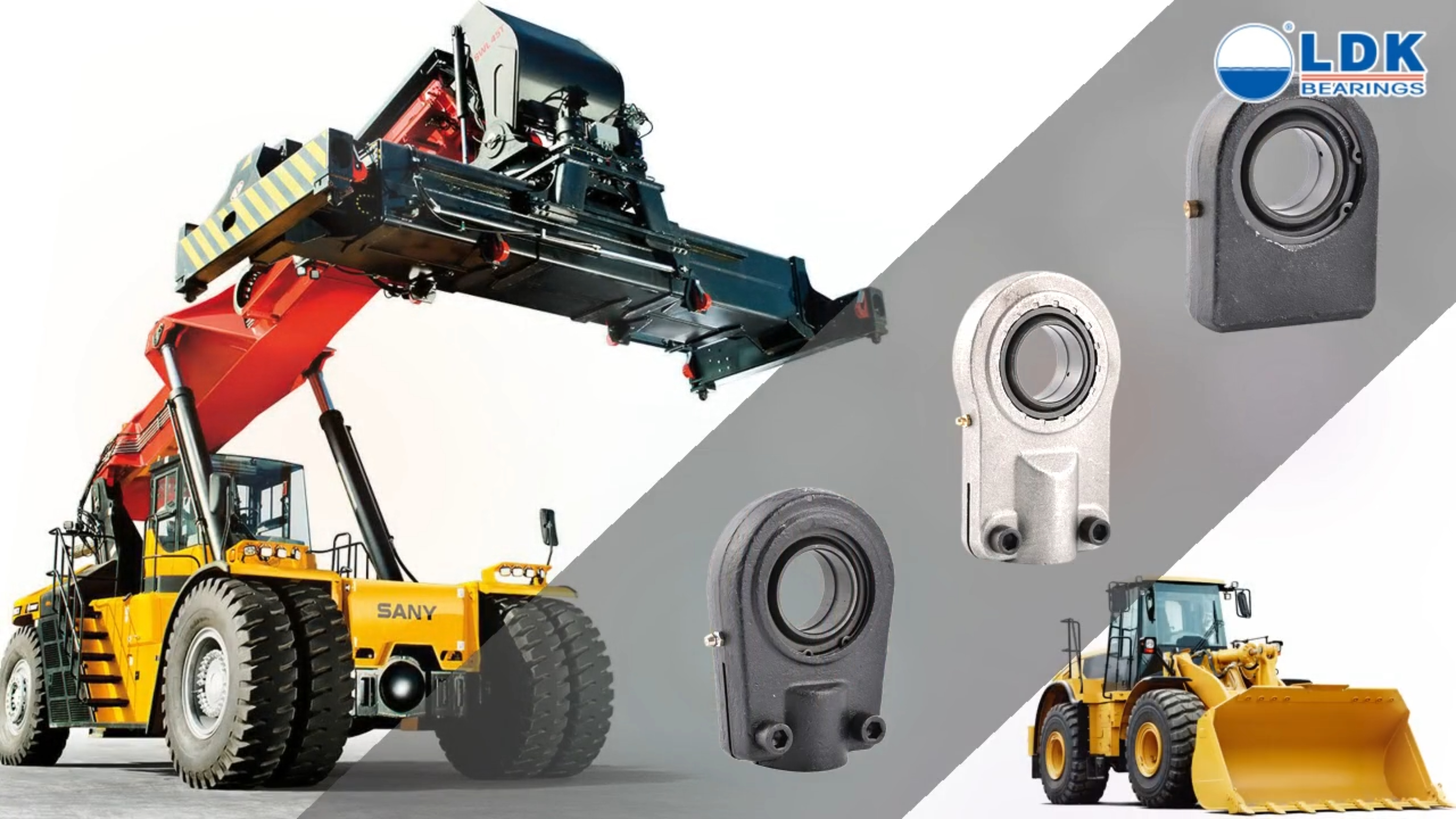
Hydraulic rod ends are built around the connection requirements of hydraulic cylinders. Instead of seating a spherical plain bearing into a general-purpose body, they mount a GE..ES, GE..E or GEEW..ES radial spherical plain bearing inside a housing, fixed by snap rings, and the housing itself carries either a locking slot or a weldable interface. In the SIQ..ES series, for example, the housing has slots and can be clamped by socket screws; the SK..E(S) series is a welded design with a dowel pin in the shank bottom and a 45° welding chamfer. Sliding contact surfaces are typically steel/steel, and the joint is re-greasable via a grease nipple. Shaft diameter coverage is also considerably wider than standard rod ends, reaching 100 mm for SIQ..ES and 200 mm for SIGEW..ES.
What do the SIQ..ES and SK..E(S) designations actually represent?
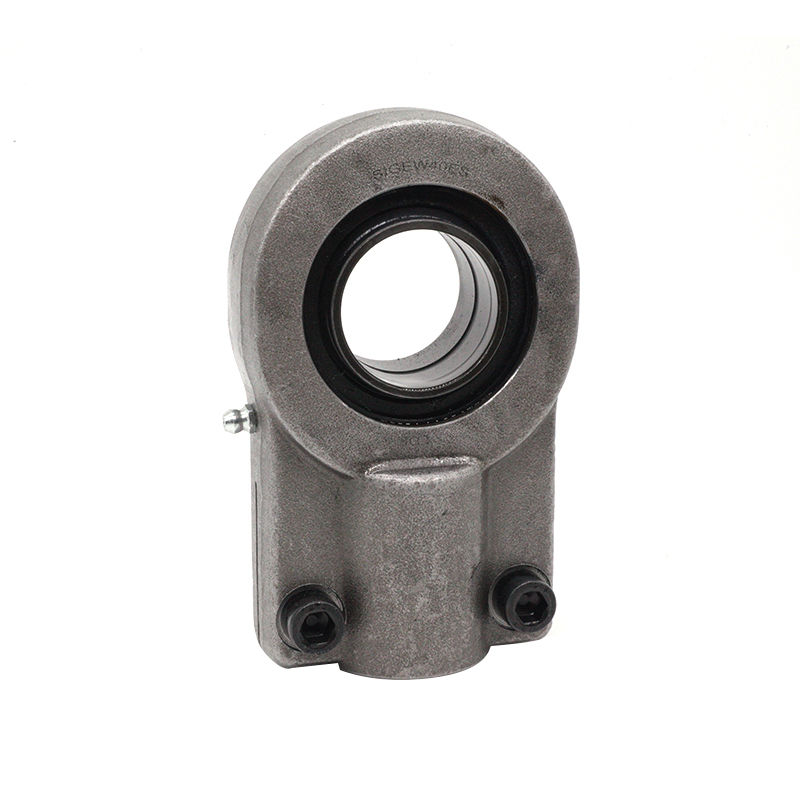
SIQ..ES is a locking-slot type hydraulic rod end. The housing has slots and can be clamped by socket screws; a GE..ES radial spherical plain bearing is mounted inside and fixed by snap rings. It carries a grease nipple, is re-greasable, and covers a shaft diameter range of 12 mm to 100 mm with right-hand thread as standard and left-hand thread available. Sliding contact surfaces are steel/steel.
SK..E(S) is a welded hydraulic rod end that accepts a GE..E or GE..ES radial spherical plain bearing. SK..ES is re-greasable via a grease nipple, while SK..E is the non-relubricable version. Shaft diameters span 10 mm to 80 mm. The body is weldable steel with a dowel pin in the shank bottom and a 45° welding chamfer, which helps position the part during welding and control weld depth.
Several related series exist within the same family. SIGEW..ES has a slotted housing that can be clamped and mounts a GEEW..ES radial spherical plain bearing, with shaft diameters from 12 mm to 200 mm. SF..ES is a welded design with a rectangular welding face that mounts a GE..ES bearing, covering 20 mm to 120 mm. SIR..ES is also a locking-slot type covering 20 mm to 120 mm. Their common trait is that a hydraulic rod end does not make the connection through a single part: the housing, the spherical plain bearing, the locking or welding interface, and the lubrication point together accommodate the cylinder load and angular misalignment.
Can hydraulic rod ends be directly interchanged with standard rod ends?
Not as a direct drop-in swap. The two families differ in structure, mounting method, internal components and size coverage. A standard rod end typically connects through a threaded shank; a hydraulic rod end connects through a welded or clamped housing and relies on an internal spherical plain bearing to handle angular deviation. Even when shaft diameter and thread specifications appear similar, the mounting interface and load path may differ. Substituting a standard rod end in a hydraulic application requires re-checking the housing clamping capability, the bearing’s misalignment capacity, and the lubrication approach.
When should a hydraulic rod end be selected instead of a standard M or F series rod end?
When the connected component is a hydraulic or pneumatic cylinder, or when the load is primarily transferred through a housing rather than through a threaded shank in tension and compression, a hydraulic rod end is usually the more appropriate choice. Standard M and F series fit general linkages, tie rods, steering mechanisms and small-to-medium reciprocating applications. Their advantages are simple construction, broad specification availability and low procurement barriers, with shaft diameters generally up to about 25.4 mm.
If the shaft diameter requirement exceeds roughly 25 mm, or if the mounting method involves welding, clamping, significant angular misalignment, or field re-greasing, the standard rod end structure may not be suitable. A hydraulic rod end housing can be welded or clamped by screws, the internal spherical plain bearing can accommodate misalignment, and the bearing outer ring can be retained by snap rings — characteristics that are not inherent to standard rod ends. A useful rule is: if the connection point must carry the thrust of a hydraulic cylinder and the mounting interface is not a simple thread, hydraulic rod ends should be considered first.
A boundary must also be stated. Hydraulic rod ends are not a universal upgrade over standard rod ends. Their construction is more complex, and procurement and inventory management must be organised by specific series, shaft diameter and thread direction. For applications below roughly 25 mm shaft diameter with moderate load and misalignment demands, standard rod ends remain advantageous in cost and availability.
How should thread type and shaft diameter be confirmed on a hydraulic rod end?
By default, hydraulic rod ends use right-hand thread, but left-hand thread and different pitch or accuracy classes can be provided on request. Procurement should confirm thread direction, pitch, accuracy, shaft diameter and the mounting interface together rather than quoting a single model number.
Shaft diameter coverage varies by series: SIQ..ES covers 12 mm to 100 mm, SIR..ES covers 20 mm to 120 mm, SF..ES covers 20 mm to 120 mm, SK..E(S) covers 10 mm to 80 mm, and SIGEW..ES covers 12 mm to 200 mm. The mounted spherical plain bearing also changes with the series — SIQ..ES, SIR..ES and SF..ES use GE..ES; SK..E(S) uses GE..E or GE..ES; and SIGEW..ES uses GEEW..ES. Selection should therefore be checked across bearing series, housing structure and shaft diameter together.
Are hydraulic rod ends welded or clamped in installation?
Both methods are available, depending on the series.
Welded types include SK..E(S) and SF..ES. The SK..E(S) body has a dowel pin in the shank bottom and a 45° welding chamfer to support orientation and weld depth. SF..ES has a rectangular welding face, and the spherical plain bearing is fixed in the housing by snap rings, which supports field maintenance.
Clamped types include SIQ..ES, SIR..ES and SIGEW..ES. Their housings carry locking slots and can be clamped by socket screws, with the spherical plain bearing fixed by snap rings. This arrangement allows assembly and adjustment without dismantling the entire linkage, which is useful where on-site alignment or later maintenance is expected.
One limitation deserves attention: welded installation is process-sensitive, and welding heat input can affect bearing clearance and lubrication condition. For welded applications, it is advisable to confirm welding procedure, positioning method and subsequent lubrication approach in sequence, rather than treating welding as a simple fixing step.
What are the lubrication requirements for hydraulic rod ends?
Most hydraulic rod ends carry a grease nipple and can be re-greased. SIQ..ES, SIR..ES, SF..ES and SIGEW..ES all relubricate through a grease nipple. Within SK..E(S), SK..ES is re-greasable while SK..E is non-relubricable. Procurement should confirm whether the equipment maintenance regime can support periodic re-greasing; if the installation is difficult to access or the design does not lend itself to maintenance, the appropriate version should be assessed in advance.
Internal sliding contact surfaces are typically steel/steel, treated with MoS2 or phosphated. Lubrication condition directly affects wear rate and rod end service life. For hydraulic cylinder connections, the re-greasing interval should be written into the equipment maintenance plan rather than treated as a one-time assembly step.
Which certifications and compliance requirements typically apply to hydraulic rod ends?
Certification requirements usually depend on the target market and the application industry. LDK’s manufacturing system is IATF 16949 certified and holds ISO 14001:2015 and ISO 45001:2018 management system certifications. For products entering the EU market, certain spherical plain bearing and rod end ranges carry SGS RoHS compliance verification reports.
In procurement documents, it is advisable to specify the target market, application industry, and whether RoHS, REACH or other compliance evidence is required — rather than asking only for a generic “certificate”. Certification coverage differs between series; a RoHS report, for example, may cover only specific models. Aligning compliance requirements early reduces documentation and delivery risk later.
What parameters should be checked when procuring hydraulic rod ends?
The checklist can be organised into four groups.
Structure and series. Confirm whether the selection is SIQ..ES, SK..E(S), SIGEW..ES, SF..ES or SIR..ES. This determines whether installation is clamped or welded and which spherical plain bearing series is mounted inside.
Dimensions and thread. Confirm shaft diameter, thread direction (right-hand as standard, left-hand available), pitch and accuracy class, and the dimension chain of the mounting interface.
Lubrication and maintenance. Confirm whether a grease nipple is required, whether the part is re-greasable, and whether the re-greasing interval matches the equipment maintenance regime.
Compliance and delivery. Confirm target market, certification requirements, packaging method and traceability requirements.
Fixing these four groups before confirming the model number with a supplier is usually more efficient than sending only a part drawing.
What is the market context for hydraulic rod ends and standard rod ends?
According to third-party industry data, the global rod ends market was valued at approximately USD 1.79 billion in 2025, with Asia Pacific accounting for about 42.3% of revenue share. Automotive applications represent the largest demand segment at roughly 38.5%. These figures indicate a stable, widely distributed market in which hydraulic rod ends form one segment, driven by hydraulic cylinders, construction machinery, heavy vehicles and industrial automation equipment.
International standard ISO 12240 classifies spherical plain bearings into radial, angular contact, thrust and rod end parts, providing a reference framework for distinguishing structures. When model or parameter terminology appears inconsistent, buyers can compare against the standard structural categories and then confirm against the specific product or supplier documentation.
Future outlook
The structural distinction between hydraulic rod ends and standard rod ends is unlikely to disappear; it is more likely to become more relevant as hydraulic systems and electro-hydraulic actuators demand higher precision. Standard rod ends will continue to cover a large share of general linkage applications, while hydraulic rod ends will remain the primary choice where welding, clamping, large shaft diameters and on-site maintenance are required. For procurement teams, the key is not a simple comparison of which rod end is better, but a clear definition of the connected component, mounting method and maintenance condition, mapped to the correct series and parameters.
The LDK product brochure, covering rod end and spherical plain bearing specifications for both hydraulic and standard series, is available for public download here.