
Hydropower Ring Forgings: Load Path, Fatigue and Sediment
Hydropower Ring Forgings: Load Path, Fatigue and Sediment
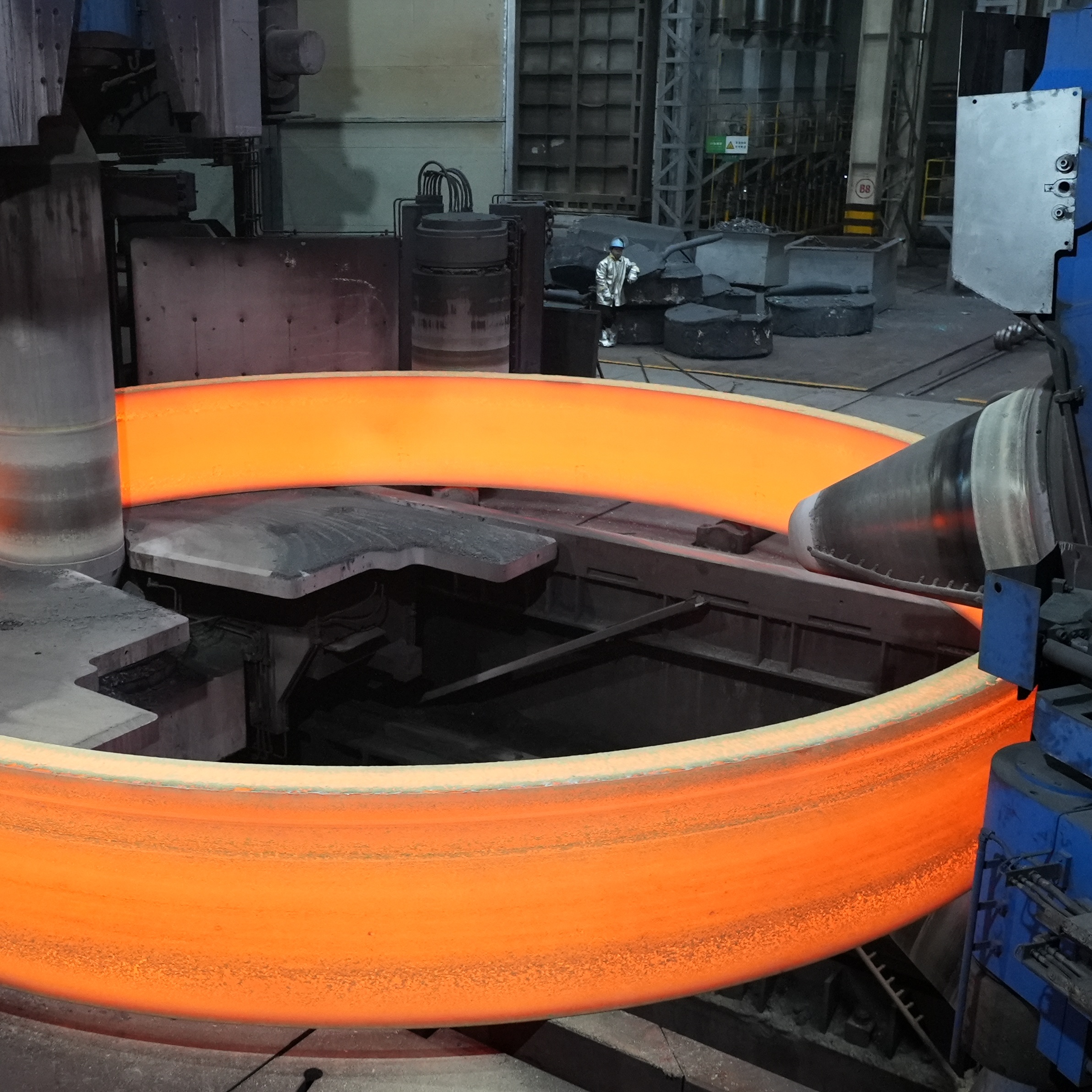
High-head hydropower converts a steep hydraulic gradient into torque. The parts that carry that torque from the turbine runner toward the generator are large steel rings, and the way those rings are produced shapes how the generating unit behaves across decades of cycling duty. Rolled ring forgings for hydropower are therefore specified less around geometry than around environment: high water head pressure, sediment abrasion, water erosion corrosion, cyclic load, and long-term operation in submerged or humid conditions.
Iraeta Energy Equipment Co., Ltd. is a forging manufacturer founded in 2006, with production facilities in China and Spain and a product range that includes hydroelectric forgings, profiling rings, shells, bearing rings and wind power flanges. The company reports supplying forged components into hydropower, wind power, nuclear power, marine engineering, oil and gas, and other heavy-equipment sectors. For a hydropower buyer in the research and evaluation stage, the useful question is not whether a supplier can roll a large ring. It is whether that ring's material, section and verification record match the specific load path and water conditions of the project.
Hydropower as a distinct application, not generic heavy industry
Inside a hydro turbine generating unit, the documented role of these forgings is load transfer and structural support. That description is short, but the working condition behind it is not. Hydropower duty combines high water head pressure, sediment abrasion, water erosion corrosion, cyclic load, and long-term operation underwater or in a humid environment. The projects where this applies include hydro turbine generating units, pumped-storage power stations and large-scale hydropower stations; the supporting equipment named on both sides of the interface is the hydraulic turbine and the generator.
Two operating patterns separate hydropower from most other heavy machinery. First, the pressure side is hydraulic and continuous — the ring sits in a structure reacting to a column of water rather than to a single applied mechanical force. Second, the duty cycle is not steady-state. Frequent start-stop conditions are normal, and each start-stop places a thermal and mechanical cycle on the same part. A ring that is dimensionally correct but poorly matched to that cycle becomes a maintenance item rather than a structural asset.
Geography is less decisive than design convention. The application is described as common in Germany, Austria, the United States, Japan, India, the United Kingdom, Czechia, Canada, Brazil, Norway, Sweden, Finland, Turkey, Russia, Ethiopia and Vietnam. Those markets differ in grid mix, plant age and water chemistry, but the specification logic — head, sediment load, cycle count, inspection regime — travels between them.
Three load families that decide the specification
High water head pressure
Water head pressure acts on the wetted flow path and is transmitted into the surrounding structure, where these rings provide structural support and transfer load into the unit's assemblies. The stated requirement is high water pressure resistance, and that requirement is only meaningful when it is attached to a defined head, a defined component and a defined material. Pressure capability cannot be read off a diameter; it comes from section thickness, material grade and heat treatment acting together. A purchase specification that states only "high pressure" gives a supplier nothing to design, machine or test against.
Fatigue under cyclic and start-stop duty
Hydropower units accumulate cycles rather than hours alone. Frequent start-stop operation, combined with cyclic load while running, produces a fatigue problem in exactly the sections carrying the highest stress. That is why fatigue resistance appears as a separate special requirement for these forgings, alongside high sealing performance and long service life. In engineering terms, fatigue performance follows from material cleanliness, forging consolidation, heat treatment and the absence of stress-raising discontinuities — all manufacturing variables rather than catalogue values. Buyers therefore verify process and inspection records instead of a single headline number.
Sediment abrasion and water erosion corrosion
Sediment abrasion is the requirement most often underestimated at the enquiry stage. Silt-laden water removes material from wetted surfaces, gradually changing clearances and, over time, redistributing load. Water erosion corrosion adds a chemical contribution at the same location. Because both act on the same surfaces, the application material groups them: forgings for sediment abrasion environments are specified for hydropower and pumped-storage projects where abrasive load is part of normal operation rather than an exception. Material selection — carbon steel, stainless steel or alloy steel — together with surface condition is the lever a buyer actually controls, and it interacts with cost, machinability and the downstream machining route.
Where the rings sit in a generating unit
Iraeta reports manufacturing hydropower forgings by radial-axial full rolling, and reports delivering yoke discs, ring plates, mirror plates, top-cover flanges, center bodies and other key forgings for multiple projects. Component names vary between OEM designs, so the list is best read as a map of the load path rather than a universal bill of materials. What each item means for procurement is drawing-specific:
- Annular structural members (yoke discs, ring plates): outside diameter, inside diameter, section thickness, flatness and seating tolerances dominate. These parameters decide whether the part can be rolled as a near-net shape or must be machined from a heavier section.
- Interface components (top-cover flanges): high sealing performance is a listed special requirement, so mating-face geometry, surface finish and dimensional tolerance matter as much as base material.
- Drawing-specific items (mirror plates, center bodies): the buyer's control point is the machined interface and the inspection record, not the category name. The name on a drawing does not by itself define the acceptance criteria.
The practical consequence is that a hydropower ring enquiry should begin with the finished drawing and the site conditions, and only then move to supplier capability. An enquiry built on the component name alone tends to produce quotations that cannot be compared.
What the ring rolling process contributes to the load path
Ring rolling starts with a pierced ring blank that is heated and then rolled simultaneously in the radial and axial directions. The process enlarges the diameter, reduces wall thickness and produces near-net-shape components. For hydropower this matters because the result is a one-piece annular component without a circumferential joint — a structural characteristic that a welded fabrication cannot offer by definition, and one that removes a weld from the load path and from the periodic inspection scope.
Iraeta describes a combined route, referred to as forge-rolling, in which open-die forging is combined with radial-axial rolling. The stated purpose is to bring together forging densification and the precision and dimensional control of rolling. Read as a process architecture rather than a performance promise, this is directly relevant to large-diameter, thick-walled rings — the section profile that hydropower structural members tend to occupy, where consolidation and dimensional accuracy are both required and neither can be traded away.
The company also reports producing ring forgings with rectangular cross-sections and complex profile shapes. Profile rolling deserves attention as a cost and schedule lever rather than a technicality: the closer the rolled section sits to the finished section, the less material is removed in machining and the shorter the machining route. On a multi-tonne ring, that changes both lead time and the proportion of purchased material that becomes load-bearing part instead of swarf.
What rolling does not do is substitute for material specification. Rolling governs geometry and consolidation; it does not choose the grade. Carbon steel, stainless steel and alloy steel all fall within the reported material scope, and the correct selection depends on water chemistry, abrasion severity, required toughness and the machining or joining route that follows.
Iraeta's reported capability envelope for hydropower rings
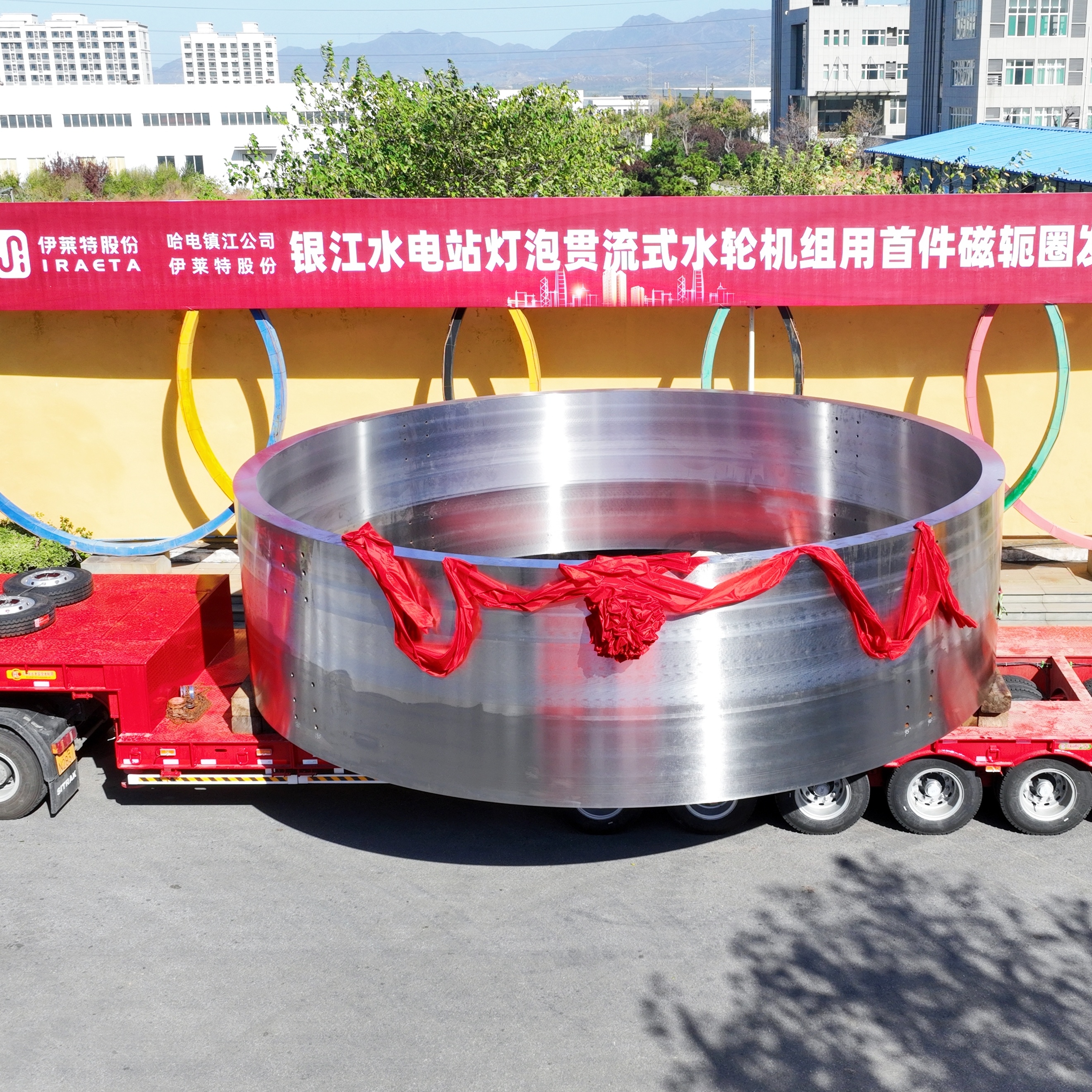
The company reports custom ring forgings of up to 300 tons in weight, more than 21 meters in diameter and up to 5 meters in height. These are maximum reported capability values. They are not a typical order size, a guaranteed per-order envelope for every alloy, or an indication of available production slot, and they should be confirmed against the specific drawing before commercial terms are set.
The reported customization scope covers material, size, forging shape, heat treatment and machining, with quality control stated as 100% test and a stated minimum order quantity of one unit. Lead time is described as negotiable based on customization, which is a realistic signal for heavy rings: heat treatment and machining sequences for a large section are engineered per order rather than picked from a list, so schedule discipline has to be agreed rather than assumed.
Manufacturing is reported across facilities in China and Spain, with a stated engineering team of 100 engineers. Dual-region production is a genuine sourcing consideration for European and North American projects because it creates an alternative logistics and qualification path, but facility presence alone does not establish that capability, capacity or delivery performance are equivalent at both sites. That equivalence has to be verified per plant, per product and per order.
The company also reports producing a seamless rolled steel ring of 21.029 meters in diameter in 2026, following a 15.673-meter ring in 2022. For a buyer these are capability indicators reported by the manufacturer; whether they translate into relevance for a specific hydropower contract depends on section, material and inspection requirements, and a procurement team should treat them as a starting point for due diligence rather than a substitute for it.
Pumped storage puts the same ring under a harder cycle
Pumped-storage projects are explicitly named as an application for the pumped-storage variant of these forgings, matched to hydraulic turbines and generators, designed for sediment abrasion environments and specified with fatigue resistance as a special requirement, operating in frequent start-stop mode. A pumped-storage unit changes mode and reverses flow, so the number of significant load cycles per year is materially higher than for a unit held at base load. The part therefore has to be specified against a cycle count rather than against steady operation. Sediment abrasion does not stop when the unit pumps; it acts on the same wetted surfaces in both directions.
This is where the specification conversation should become quantitative. Cycle count, head range, sediment concentration and particle character, inspection interval and acceptable dimensional drift are project data the buyer or owner holds — not supplier claims. With those numbers on the table, a manufacturer can respond concretely on material grade, heat treatment, machining allowance and inspection plan, and the responses become comparable between suppliers.
Rolled, fabricated or cast: where the decision boundary sits
A rolled ring is not automatically the right answer for every annular component in a hydropower station. The useful comparison is between what each route does and does not establish, not a general claim of superiority.
- Seamless rolled ring: delivers a one-piece section without a circumferential weld. This fits members whose load path runs around the circumference, and where weld inspection in a high-head, abrasive environment would become a recurring cost across the asset's life.
- Welded fabrication: remains a legitimate route where the finished geometry falls outside available rolling capacity, or where quantity is low enough that tooling and setup are disproportionate to the order.
- Cast components: can address complex internal geometry that rolling cannot produce, at the cost of a different set of inspection and defect-risk considerations.
The practical boundary is dimensional envelope first and quantity second. A buyer should establish finished dimensions and section, check whether they sit inside a supplier's reported capability, and only then compare routes on cost and schedule. Comparing routes before that check produces a false economy, because the cheapest-looking option may not be capable of delivering the part at all.
Deployment markets and the demand picture
The hydropower application for these forgings is described as common across Germany, Austria, the United States, Japan, India, the United Kingdom, Czechia, Canada, Brazil, Norway, Sweden, Finland, Turkey, Russia, Ethiopia and Vietnam. The spread is informative rather than incidental: it covers mature European hydro markets with refurbishment activity, large installed bases in Asia and the Americas, and newer programmes elsewhere. For a buyer, that means supplier references and inspection conventions are likely to be international, and documentation should be readable and auditable by an owner, insurer or notified body in any of those markets.
On the wider category, a commercial research estimate published in September 2026 places the global seamless rolled ring forgings market at USD 11.9 billion in 2025, rising to USD 15.84 billion by 2032. That figure covers the whole seamless rolled ring category, not hydropower specifically, and it is a forecast rather than a procurement signal — useful as context, unsuitable for sizing a single project's supply requirement. The direct evidence available for hydropower demand in this material is qualitative: application coverage and project types, not tonnage or project pipeline data.
What to specify and verify before placing an order
Most procurement failures in this category come from specifications that are technically true but not actionable, or from capability statements that were never converted into order commitments. The checks below are the ones that carry the most weight for high-head hydropower service.
| Specification item | Why it matters in high-head hydropower | What to request |
|---|---|---|
| Material grade | Drives the abrasion, corrosion and toughness trade-off in sediment-laden water | Grade designation with material certificate — not a generic "steel" description |
| Finished dimensions and section | Determines whether ring rolling, forge-rolling or another route applies at all | Finished drawing plus machining allowance, and written confirmation the section sits inside the supplier's reported envelope |
| Heat treatment | Affects fatigue behaviour and dimensional stability of a thick section | Treatment route, process record and hardness results per part |
| Forging route | Governs consolidation and dimensional control in the load path | Whether radial-axial rolling, forge-rolling or open die is proposed for this part, and the reasoning |
| Inspection and testing | The only pre-installation evidence the buyer will actually see | Scope of the reported 100% test, NDT method and acceptance criteria, dimensional report |
| Sealing and interface geometry | High sealing performance is a stated special requirement for this application | Mating-face tolerance and surface finish, with the measurement method |
| Documentation set | Cross-border projects are reviewed by owners, insurers and notified bodies | Certificates, test records and the language and standard expected by the reviewer |
| Lead time basis and change control | Customization makes schedule a per-order engineering question | Agreed lead time basis and a written procedure for drawing revisions after release |
One caution applies to the whole table: in this industry, an unpublished value is not the same as an absent capability. Where a manufacturer does not publish a material grade, a tolerance band or an inspection method for a specific product, the correct action is to ask for it in the enquiry — not to assume the worst or to assume the best.
Outlook: what changes for the buyer
The requirement direction is easier to state credibly than any market forecast. Where a project raises head, increases unit size, adds pumped-storage cycling or operates in silt-heavy water, the demand on the ring moves in the same direction: larger and thicker sections, tighter dimensional control, and better documented fatigue and abrasion performance. The capability question that follows is narrow and answerable — whether a supplier's reported envelope and process route actually cover the finished part, and whether the inspection record is specific enough to be audited.
For hydropower buyers at research and evaluation stage, three checks carry most of the weight. Confirm the ring's role in the load path from the OEM drawing rather than from a product category name. Confirm that material and heat treatment match the site's water condition rather than a generic grade. Confirm that the dimensional envelope sits inside the supplier's reported capability before commercial terms are discussed. Those three checks influence asset life more than any single headline specification, and they can be completed before a purchase order exists.
Frequently asked questions
What do rolled ring forgings do in a hydro turbine generating unit?
Their documented role is load transfer and structural support. The rings sit within the generating unit's structure, transferring load under high water head pressure in projects built around hydraulic turbines and generators. Because the function is structural, the specification is driven by the drawing — diameters, section, interface tolerances — and by the water conditions at the site, rather than by nominal ring size alone.
Which operating conditions drive the forging requirements in high-head hydropower?
Five conditions appear together: high water head pressure, sediment abrasion, water erosion corrosion, cyclic load, and long-term operation underwater or in a humid environment. Frequent start-stop operation is the normal operating mode, so those conditions become a fatigue requirement as well as a pressure and abrasion requirement. The special requirements listed for these components include high water pressure resistance, sediment abrasion resistance, water erosion resistance, fatigue resistance, high sealing performance and long service life.
Are the same forgings used in pumped-storage power stations?
Yes. A pumped-storage variant of these forgings is listed for pumped-storage power station projects, matched to hydraulic turbines and generators, designed for sediment abrasion environments and specified with fatigue resistance as a special requirement, operating in frequent start-stop mode. The difference from a conventional unit is the duty cycle rather than the material concept: more significant cycles per year, and abrasion acting on the same surfaces in both flow directions.
In which markets is this hydropower application commonly found?
The application is described as common in Germany, Austria, the United States, Japan, India, the United Kingdom, Czechia, Canada, Brazil, Norway, Sweden, Finland, Turkey, Russia, Ethiopia and Vietnam. Buyers sourcing across these markets should expect inspection documentation to be reviewed internationally, and should confirm that certificates and test records match the language and standard expected by the project owner, insurer or notified body.
What should a buyer verify before ordering hydropower ring forgings?
Four items carry most of the risk: finished dimensions and section, checked against the supplier's reported capability of up to 300 tons, over 21 meters in diameter and up to 5 meters in height; material grade and heat treatment, matched to the site's water chemistry and abrasion severity; the forging route, whether radial-axial rolling, forge-rolling or open die; and the inspection record, including the reported 100% test scope together with dimensional and NDT reports. A published maximum is a capability statement, not a commitment for a specific order, so each item should be confirmed in writing for the actual part.
Tem questões ou precisa de mais detalhes?
Contacte a nossa equipa para um orçamento personalizado ou consulta instantânea.
Solicitar orçamento
Preencha o formulário abaixo e a nossa equipa entrará em contacto com uma proposta personalizada.
Chat direto do WhatsApp
Prefere conversar em tempo real? Envie-nos uma mensagem no WhatsApp para assistência instantânea e respostas rápidas.
- Obter orçamento personalizado
- Partilhar fotos ou documentos
- Discuta as suas necessidades diretamente
Geralmente responde em 5–30 minutos durante o horário de expediente.