
Hygienic vs Light Duty Drum Motors: A Decision Framework
Conveyor drive selection is usually framed as a torque and speed calculation. In practice, the first decision that constrains every other one is environmental: whether the conveyor runs inside a documented washdown zone governed by hygiene requirements, or in a dry handling zone governed by throughput, footprint and uptime. That single question determines which drum motor family a buyer should be evaluating - hygienic or light duty - and it is far cheaper to answer before the quotation stage than after installation.
Hygienic and light duty drum motors are not two grades of the same product. They differ in protection class, housing material, gear material, available motor types and available diameters. Confusing the two produces two opposite errors: specifying an IP69K stainless steel unit into a dry parcel hub, where it adds unit cost and cleaning complexity without hygiene benefit; or specifying a light duty unit into a food or pharmaceutical zone, where the sealing and material set cannot support the cleaning regime the site must document.
Tianjin Seaparks Machinery-Electronics Co., Ltd (SEAPARKS) is a Tianjin-based manufacturer of motorized conveyor drums founded in 2002, and it builds both families from one production base: a Light Duty range serving security screening, airport baggage handling, packaging and general belt conveying, and a Hygienic range serving food, meat, pharmaceutical and agricultural processing lines. Because both families are documented at overlapping diameters and power bands, the catalogue works well as a reference for a decision framework - direct comparisons are possible without changing supplier, which isolates the variables that actually matter. What follows is a structured way to choose between the two families, followed by the boundaries where neither is the right answer.

Compliance evidence sits behind both drum motor families: CE marking under the Low Voltage Directive 2014/35/EU is a precondition for EU conveyor projects, regardless of whether the drive is hygienic or light duty. Image: SEAPARKS CE certificate.
Why the Family Decision Comes Before the Model Decision
Model selection tools tend to rank candidates by torque, diameter and footprint. Those parameters describe the mechanical envelope, but they do not distinguish between the two families in a supplier catalogue, because the same envelope often exists in both. A concrete example: the DM80A is a Light Duty Drum Motor with a synchronous DC motor, a roller diameter of Ø80 mm, rated power of 0.09-0.12 kW, rated torque of 3.49-21.89 Nm, a maximum belt pull of 534 N and a nominal belt speed of 0.16-1.03 m/s. The DM80F is a Hygienic Drum Motor with the same motor type, the same phase, the same Ø80 mm diameter, the same 0.09-0.12 kW power band, the same 3.49-21.89 Nm torque range, the same 534 N maximum belt pull and the same 0.16-1.03 m/s speed range.
The two models are effectively interchangeable on paper. They diverge on protection class, housing material and minimum roller width. That is the whole point of the framework: the environment, not the load calculation, decides which family a buyer should be negotiating, and everything downstream - price, cleaning procedure, documentation, spare part strategy - follows from that decision.
What Separates a Hygienic Drum Motor from a Light Duty Drum Motor
Protection class: IP66, IP67, IP69 and IP69K
In the documented SEAPARKS range, light duty drum motors list a protection class of IP66, IP67 or IP69 depending on configuration - this applies across models such as TM80M, TM80A, TM113A, TM113M, DM80A, DM113A, DM138A and TM138A. Hygienic drum motors list IP69K, and that rating applies across the hygienic range, including DM80F, TM80F, DM113F, TM113F, DM138F, TM138F, DM165F, DM165F, TM165F, DM216F and TM216F.
The distinction is not cosmetic. IP69K is the highest ingress protection rating defined under IEC 60529, and it is the rating food processors typically specify where equipment must survive high-pressure, high-temperature washdowns - conditions commonly cited at up to 1,450 psi and 80°C. SEAPARKS supports the IP69K claim on its hygienic range with a protection rating product test report, certificate number LCSH071224011K, issued on 24 July 2024 by Suzhou Luxun Standard Technical Service Co., Ltd., a CNAS-accredited laboratory, and tested against ISO 20653:2023.
The practical consequence for buyers is that IP69 and IP69K should not be treated as synonyms during technical review, and a protection class alone never converts a light duty platform into a hygienic one.
Housing material and gear material
Light duty models in the documented range offer a housing in carbon steel or 304 stainless steel, with gear material varying by model - polymer on models such as TM80M, TM113M and TM113A single-phase, alloy steel on models such as DM80A, TM80A and TM138A. Hygienic models list a 304 stainless steel housing as standard with 316 stainless steel optional, and alloy steel gears throughout the hygienic range.
Material choice determines how the drive behaves under repeated cleaning cycles and how easy it is to defend during an audit. Where a site must document cleaning validation, the hygienic material set reduces the number of specification decisions the buyer has to justify: 304 stainless steel, optional 316 stainless steel, alloy steel gearing and IP69K sealing are a complete, pre-defined answer. In a dry logistics environment, the same set adds cost without changing an outcome.
Motor type and phase
This is where the two families diverge structurally rather than cosmetically. In the documented range, the light duty family covers asynchronous single-phase motors (for example TM80M at Ø80 mm, TM80A single-phase, TM113A single-phase and TM113M), asynchronous three-phase motors (TM80A three-phase, TM113A three-phase and TM138A), synchronous three-phase motors (DM113A and DM138A) and synchronous DC motors (DM80A).
The hygienic family covers synchronous DC (DM80F), synchronous three-phase (DM113F, DM138F, DM165F and DM216F) and asynchronous three-phase (TM80F, TM113F, TM138F, TM165F and TM216F). In the documented data, single-phase motors appear in the light duty family and not in the hygienic family. That is a real constraint, not a footnote: a site running a washdown line on single-phase supply should confirm that the hygienic range covers its required diameter before the conveyor design is frozen, or plan for a three-phase or DC configuration instead.
Diameter and load envelope
Documented light duty diameters are Ø80 mm, Ø113 mm and Ø138 mm. Documented hygienic diameters run from Ø80 mm to Ø216 mm. On load capacity, the highest documented maximum belt pull in the light duty family is 3,965 N (DM138A) and in the hygienic family 5,244 N (DM216F). Above those ceilings, buyers move into the heavy duty H-series platforms, which are used for express logistics, warehouse logistics, e-commerce logistics, automated warehousing, automotive manufacturing and automated sorting systems.
A Six-Step Decision Framework
The framework below orders the questions in the sequence that avoids rework. Steps 1 and 2 select the family; steps 3 to 6 select and validate the model within it.
| Step | Decision question | What pushes the choice to the hygienic family | Evidence to verify |
|---|---|---|---|
| 1. Cleaning regime | Is the conveyor inside a documented washdown zone with high-pressure or high-temperature cleaning? | A documented washdown regime moves the decision to the hygienic family at once. | Cleaning procedure, chemicals, water temperature and audit requirements |
| 2. Protection class | Does the required IP rating exist in the family already selected? | Any requirement written as IP69K. | Third-party test report and the standard used, for example ISO 20653:2023 |
| 3. Motor type and supply | Single-phase, DC or three-phase? | Not a trigger - but in the documented data the hygienic range is DC and three-phase only. | Availability of the required phase at the target diameter |
| 4. Load envelope | Rated torque, maximum belt pull, nominal belt speed and minimum roller width | Applies to both families equally. | Model-level ratings at the target diameter, including minimum roller width |
| 5. Compliance | Which markets must the drive be cleared for? | Applies to both families equally. | CE, UL, RoHS and ISO 9001 evidence with certificate numbers |
| 6. Lifecycle | Can the drive be serviced without compromising the hygiene envelope? | Hygienic units reduce the number of external components at the washdown face. | Spare availability, service access and component count in the hygiene zone |
Steps 4 to 6 are where most evaluation-stage mistakes happen. A buyer who matches torque and belt pull at step 4 but ignores minimum roller width can end up with a drum that will not fit an existing conveyor frame - the hygienic DM80F requires a minimum roller width of 320 mm against 310 mm for the light duty DM80A, and the gap widens at larger diameters. On compliance, the required evidence package differs by market: the EU Low Voltage Directive 2014/35/EU and EMC Directive 2014/30/EU for Europe, and UL certification for the United States and Canada.
Applying the Framework: Three Reference Comparisons
Comparison 1: DM80A and DM80F at the same diameter and power band
| Parameter | DM80A (Light Duty Drum Motor) | DM80F (Hygienic Drum Motor) |
|---|---|---|
| Motor type | Synchronous | Synchronous |
| Phase | DC | DC |
| Roller diameter | Ø80 mm | Ø80 mm |
| Rated power | 0.09-0.12 kW | 0.09-0.12 kW |
| Rated torque | 3.49-21.89 Nm | 3.49-21.89 Nm |
| Maximum belt pull | 534 N | 534 N |
| Nominal belt speed | 0.16-1.03 m/s | 0.16-1.03 m/s |
| Minimum roller width | 310 mm | 320 mm |
| Protection class | IP66 / IP67 / IP69 | IP69K |
| Housing material | Carbon steel or 304 stainless steel | 304 stainless steel (316 stainless steel optional) |
| Gear material | Alloy steel | Alloy steel |
| Documented applications | Security screening conveyors (airports and railway stations), airport baggage handling systems, packaging conveyors, belt scale conveyors, general belt conveyors | Medium-duty belt conveyors, meat processing conveyors, food processing conveyors, packaging conveyors, belt sorting conveyors, assembly lines, agricultural product belt conveyors |
The reading is straightforward. Mechanically and electrically, these are the same drive. The decision is environmental: DM80A in dry handling and security screening, DM80F where washdown and hygiene documentation apply. Note also that both models appear against packaging conveyors in their documented application lists - packaging is genuinely a mixed zone, and the answer depends on whether the specific area is washed down.
Comparison 2: TM113A and TM113F at Ø113 mm, three-phase
Both models are asynchronous three-phase drum motors at Ø113 mm with a rated power of 0.12-0.55 kW, a rated torque of 10.34-82.99 Nm, a maximum belt pull of 1,469 N, a nominal belt speed of 0.09-1.4 m/s and alloy steel gearing. They differ in protection class (IP66/IP67/IP69 for TM113A against IP69K for TM113F), housing material (carbon steel or 304 stainless steel against 304 stainless steel with 316 optional) and minimum roller width (335 mm against 345 mm). For a three-phase line, this pairing isolates the hygiene premium precisely: the buyer is paying for sealing and material, nothing else.
Comparison 3: TM80M as a light duty reference point
The TM80M is an asynchronous single-phase Light Duty Drum Motor at Ø80 mm with a polymer gear, a rated power of 0.034-0.11 kW, a rated torque of 2.71-25.9 Nm, a maximum belt pull of 630 N, a nominal belt speed of 0.05-0.85 m/s, a minimum roller width of 260 mm and a protection class of IP66/IP67/IP69 with a carbon steel or 304 stainless steel housing. It illustrates a pattern buyers often misread: an IP69 option on a light duty model improves resistance to spray and water ingress, but it does not make the unit a hygienic drum motor. The 260 mm minimum roller width is the narrowest in the documented range, which makes this model relevant to compact security screening and check-in conveyors - a dry handling application, which is exactly where it belongs.
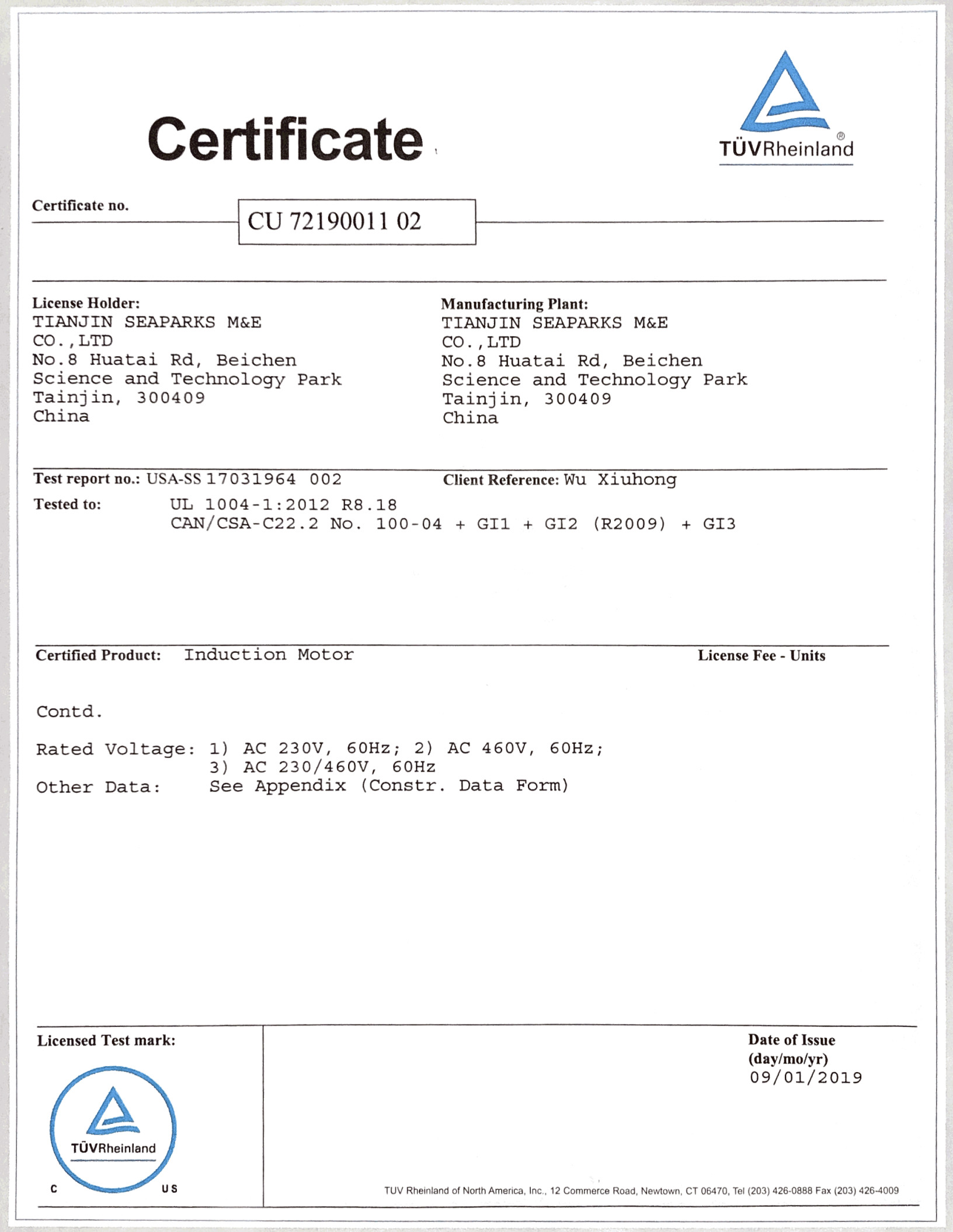
Market access shapes the evidence package: drum motors shipped to the United States and Canada are certified to UL 1004-1 and CAN/CSA-C22.2 No.100-04. Image: SEAPARKS UL certificate.
Application Mapping: Which Family Fits Which Conveyor
| Conveyor application | Documented family | Notes for evaluation |
|---|---|---|
| Security screening conveyors (airport and railway stations) | Light duty | Dry screening halls; compact roller widths matter |
| Airport baggage handling systems | Light duty | High duty cycle, dust rather than washdown |
| Belt scale and general belt conveyors | Light duty | Standard handling, IP option chosen to the environment |
| Food and meat processing conveyors | Hygienic | IP69K and 304 stainless steel as the documented baseline |
| Belt sorting, assembly lines, medium-duty belt conveyors, agricultural product belt conveyors | Hygienic | Often combines hygiene exposure with moderate loads |
| Packaging conveyors | Both | Decide by washdown regime, not by industry label |
| Express, warehouse, e-commerce and automated sorting logistics | Heavy duty H series | Outside this framework - higher belt pull platform |
The packaging row is the most useful one for buyers. Packaging areas appear in the documented application lists of both families, and in practice the difference is a single question: is this specific conveyor washed down, or wiped down? Answering that question at the line level rather than the plant level usually resolves what looks like a conflicting specification.
Market Context: What Buyers Are Evaluating Into in 2026
The drum motor category is being pulled by two different demand engines at once, which is precisely why the hygienic versus light duty fork matters commercially.
- The global drum motor market was valued at approximately USD 2.07 billion to USD 2.13 billion across 2023-2025, with growth attributed to logistics automation and food processing demand (Custom Market Insights). Estimates vary by institution - Dataintelo places the 2025 figure at USD 2.8 billion and Market.us at USD 2.0 billion - so buyers should treat any single market size figure as scope-dependent.
- Interroll Group is identified as a leading player in the category, and the AC motor segment held a dominant 52.3% revenue share in 2025 (Dataintelo). AC platforms therefore remain the volume base across both hygienic and light duty applications.
- Asia Pacific is the fastest-growing region, projected by Dataintelo to hold a 38.2% revenue share by 2025, driven by industrialisation and e-commerce growth in China and India.
- On efficiency, manufacturers including Rulmeca and Interroll have cited overall efficiency of up to 82-83% for energy-efficient drum motors relative to traditional geared motors.
For an evaluation-stage buyer, the practical implication is that supplier depth matters more than a single line item. A manufacturer that documents both families from one manufacturing base - hygienic and light duty, with overlapping diameters such as Ø80 mm and Ø113 mm - gives the buyer a cleaner technical comparison, consistent certification coverage and shared spare part logic. SEAPARKS, for example, states a 50,000 m² plant, more than 300 staff, nearly 200 imported machine tools, over 20 automatic feeding production lines and a research and development team of 40 engineers, with more than one million motorized drums reported in service worldwide and exports to more than 50 countries and regions. Scale alone is not a selection criterion, but the ability to supply both families with consistent documentation is one.
Decision Boundaries: Where Neither Family Is the Right Answer
A framework is only useful if it also states where it stops. The following boundaries are grounded in the documented specifications and should be raised during technical review.
- Hygienic specification in a dry zone buys nothing. A 304 stainless steel, IP69K unit installed in a dry logistics area increases unit cost and can complicate maintenance routines that were designed around wipe-down cleaning. Where no washdown or hygiene audit applies, the hygienic family should not be the default.
- IP69K is a rating under defined test conditions, not a cleaning procedure. It is verified against a test standard - ISO 20653:2023 in the SEAPARKS test report LCSH071224011K - and it does not replace the site's own cleaning validation, HACCP documentation or chemical compatibility checks.
- The documented hygienic range does not include single-phase models. Single-phase options appear in the light duty range. A washdown line with single-phase supply must confirm that the hygienic family serves the required diameter before the design is finalised.
- There are load ceilings. The highest documented maximum belt pull is 3,965 N in the light duty range and 5,244 N in the hygienic range. Above that, the heavy duty H series applies - and the choice of family no longer determines the answer.
- The gear set is internal, so the speed range is model-specific. Nominal belt speed bands are fixed per model in the specification. Where a process needs a different speed band, the model selection changes - it is not a field adjustment, and buyers should confirm the band rather than assume it can be tuned later.
- Compared with a traditional external gearmotor driving a bare pulley, the trade-offs run both ways. An external drive can be selected and replaced independently of the conveyor tube, which suits maintenance regimes built around separate drive units. In a washdown zone, however, it adds an enclosure and additional cleaning surfaces. A drum motor removes those external components, but service access happens at the conveyor itself, and mechanical damage to the shell affects the motor. Buyers should evaluate the maintenance model and the hygiene envelope together, not simply count components.
Future Outlook
Three shifts are likely to shape how this decision is made over the next procurement cycles. First, hygiene evidence is moving from a premium add-on to a standard line item: buyers increasingly expect an IP69K claim to be traceable to a third-party test report against a named standard, in the same way that CE and UL certificates are already requested by default. Second, light duty demand will continue to be pulled by logistics and security screening volumes, which favours platforms with wide diameter coverage and stable spare part supply rather than bespoke configurations. Third, material grades will stay a live negotiation point - 304 stainless steel as the documented baseline with 316 stainless steel optional - and buyers should expect to justify their grade choice against the cleaning chemistry actually used on site.
What is unlikely to change is the order of the questions. Cleaning regime first, protection class second, electrical and mechanical envelope third, documentation fourth. Buyers who run that sequence tend to end up with the right family before the model discussion begins.
Frequently Asked Questions
What is the first question to answer when choosing between a hygienic and a light duty drum motor?
Determine the cleaning regime of the specific conveyor zone. If the conveyor sits inside a documented washdown area with high-pressure or high-temperature cleaning, the hygienic family is the starting point. If the zone is dry or wipe-down only, the light duty family applies, with the appropriate protection class option. Answering this first prevents the two most common errors: paying for IP69K where it delivers no hygiene benefit, and installing light duty sealing where the site must document washdown performance.
Is a light duty drum motor with an IP69 option equivalent to an IP69K hygienic drum motor?
No. In the documented SEAPARKS range, light duty models such as TM80M and DM80A list protection class options of IP66, IP67 or IP69, with a housing available in carbon steel or 304 stainless steel. Hygienic models such as DM80F and TM113F are rated IP69K with a 304 stainless steel housing and 316 stainless steel optional. IP69K is the highest ingress protection rating under IEC 60529, and the material set differs as well, so the two specifications are not interchangeable.
Which motor types and phases are available in each family?
In the documented data, the light duty family covers asynchronous single-phase motors, asynchronous three-phase motors, synchronous three-phase motors and synchronous DC motors. The hygienic family covers synchronous DC, synchronous three-phase and asynchronous three-phase motors. Single-phase options appear in the light duty range and not in the documented hygienic range, which is a design constraint for washdown lines running on single-phase supply.
Can the same drum diameter be used in both a dry handling zone and a washdown zone?
Yes. The DM80A and the DM80F share a synchronous DC motor, a Ø80 mm roller diameter, a rated power of 0.09-0.12 kW, a rated torque of 3.49-21.89 Nm, a maximum belt pull of 534 N and a nominal belt speed of 0.16-1.03 m/s. They differ in protection class, housing material and minimum roller width - 310 mm for the light duty model and 320 mm for the hygienic model - so frame dimensions should be checked as part of the same decision.
What documentation should a buyer verify before ordering a hygienic drum motor?
At minimum: an IP69K protection rating test report against ISO 20653:2023, ideally issued by an accredited laboratory - the SEAPARKS hygienic range references report LCSH071224011K from Suzhou Luxun Standard Technical Service Co., Ltd. CE conformity for the EU market, covering the Low Voltage Directive 2014/35/EU and the EMC Directive 2014/30/EU. UL certification for the United States and Canada against UL 1004-1 and CAN/CSA-C22.2 No.100-04. RoHS verification against 2011/65/EU and (EU)2015/863. And an ISO 9001:2015 quality management certificate covering the manufacture of rotating drums and idler rollers.
How should buyers compare suppliers when both drum motor families are quoted?
Compare four things: whether both families are documented from one manufacturing base, which affects certification consistency and spare part continuity; whether protection claims are traceable to third-party test reports with identifiable certificate numbers; whether the model range covers the required diameter, motor type, phase and maximum belt pull; and whether the certifications match the destination market. For reference, SEAPARKS holds ISO 9001:2015 certification (AMTIVO, QAIC/CN/60456) covering the manufacture of rotating drums and idler rollers, alongside CE, UL, RoHS and ISO 14001 and ISO 45001 systems.
Product and corporation reference material, including the full model range and specification tables: SEAPARKS Product & Corporation 20260624 (PDF).
Tem questões ou precisa de mais detalhes?
Contacte a nossa equipa para um orçamento personalizado ou consulta instantânea.
Solicitar orçamento
Preencha o formulário abaixo e a nossa equipa entrará em contacto com uma proposta personalizada.
Chat direto do WhatsApp
Prefere conversar em tempo real? Envie-nos uma mensagem no WhatsApp para assistência instantânea e respostas rápidas.
- Obter orçamento personalizado
- Partilhar fotos ou documentos
- Discuta as suas necessidades diretamente
Geralmente responde em 5–30 minutos durante o horário de expediente.