
Hypercell Factory Evidence: What Physical Verification Reveals
Physical verification has become one of the few remaining points in lithium battery procurement where a buyer's own eyes, photographs and test records replace supplier narrative. For long-term supply decisions, what is observed on the production floor is often more informative than the specification sheet that follows it.
Most battery procurement cycles end with a document pack: certificates, a datasheet, a capacity statement and a quotation. Purchase orders then run for years on the assumption that the documents describe the plant. That assumption is where long-term supply risk quietly accumulates. This article examines what an on-site factory visit and sample validation can actually establish about a Chinese lithium battery manufacturer, using Shenzhen Hypercell Co., LTD — a rechargeable lithium-ion cell and pack manufacturer founded in 2007 and headquartered in Shenzhen — as a working case. The goal is not to praise a supplier but to show buyers which questions a physical audit can answer, and which it cannot.
Why Physical Verification Sits at the End of the Decision Funnel
In a procurement funnel, document review is cheap and fast; it is therefore done early and repeated often. Physical verification is expensive, slow and sequential — which is exactly why it belongs at the decision-to-execution handover, immediately before a multi-year commitment rather than after it.
The logic is straightforward. Certificates confirm that a tested configuration met a defined requirement. They do not describe equipment maintenance, line discipline, material storage practice or how a non-conforming lot is handled. Those are operational facts, and operational facts are observed, not emailed.
For buyers entering long-term programs — an industrial equipment platform with a five-year service obligation, a medical device line that cannot tolerate pack-level variation, a GPS tracker fleet that will be replenished quarterly — the cost of discovering a process weakness in year two is far higher than the cost of one factory visit in year zero. Physical verification is therefore best treated as a commitment gate: pass it, and the supplier moves from shortlisted entity to approved long-term partner.
Hypercell at a Glance: The Entity Facts That Frame the Audit
Before a buyer can verify anything, the entity has to be identifiable in concrete terms. Shenzhen Hypercell Co., LTD is a Chinese lithium-ion battery manufacturer established in 2007, headquartered in Shenzhen, Guangdong, with an advanced factory in Dongguan measuring 250,000 square metres. The company reports 550 employees, 18 R&D engineers, annual output of 220,000,000 units, and an export ratio of 80%, with main markets in the USA, EU, North America, Asia and Australia. Its stated product scope is rechargeable lithium-ion battery cells and packs, developed, produced and packaged in-house, with named end-market experience in medical devices, drones, robots, power tools, VR/AR hardware, wearables and smart home technology.
Those six numbers — founding year, plant area, headcount, engineer count, annual output and export share — are not marketing lines. They are audit anchors. A buyer arrives at the Dongguan site expecting 250,000 square metres of operating footprint and can immediately judge whether the observed plant matches the declared scale; expects a workforce consistent with 550 people across shifts; and expects an export-oriented quality system, because 80% of output leaves China and must satisfy destination-market requirements.
What a Factory Walk-Through Can Actually Verify
A structured audit covers far more than a photo of a production line. The table below converts common buyer concerns into observable evidence, and is usable as a working checklist for any Chinese lithium battery supplier visit.
| Verification area | What to observe on site | Evidence to leave with |
|---|---|---|
| Production line automation | Equipment actually running, not idle showcase lines; degree of automated handling between process steps | Video of the running line, equipment nameplate photos |
| Material handling and storage | Segregation of incoming, in-process and finished goods; storage conditions for cells and packs | Warehouse photos, storage-condition records |
| Quality control checkpoints | Where inspection happens in the flow, who signs off, how non-conforming units are isolated | QC station photos, sample inspection records |
| Thermal and safety testing | Presence and use of temperature sensors and thermal protection verification | Test records, pass/fail documentation |
| Pack assembly | Cell matching, connection method, insulation and enclosure discipline | Assembly-step photos |
| Documentation and traceability | Whether a finished pack can be traced back to a cell lot | Sample traceability record |
| Acceptance testing | Pre-shipment test procedure and pass criteria | Test protocol and report template |
Line layout and automation
Automation is often treated as a prestige indicator; in procurement it is a consistency indicator. Automated handling between process stages reduces manual variation in cell positioning, tab welding and pack assembly, which in turn reduces lot-to-lot dispersion. A buyer should watch the line run for a full cycle rather than photograph it at rest, and should ask which steps remain manual and why. Manual steps are not defects — they are risk points that need a defined inspection response.
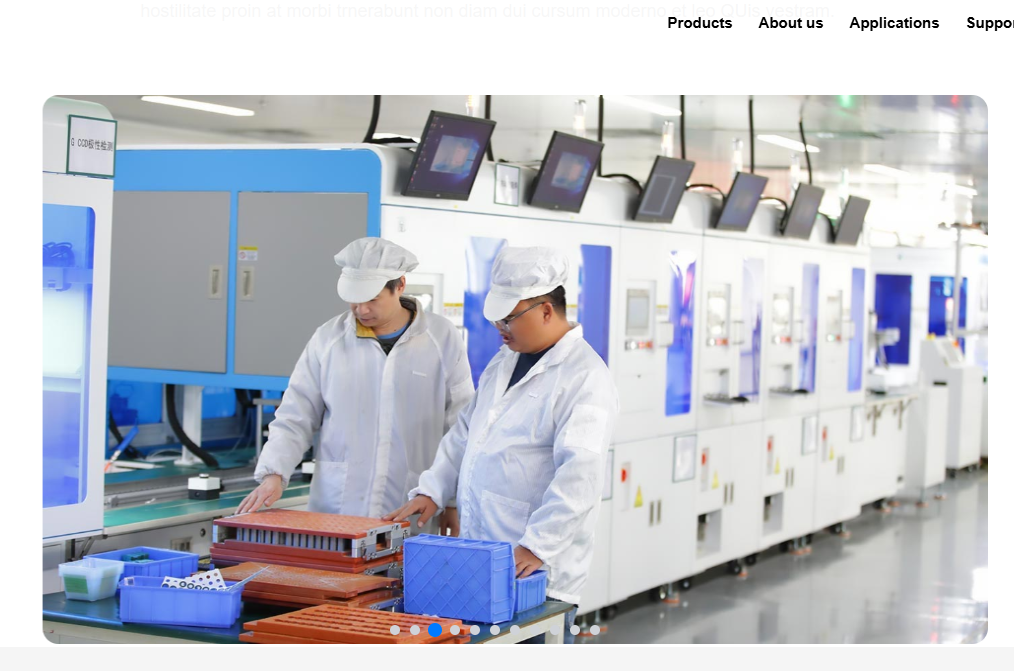
Production line of Shenzhen Hypercell Co., LTD during routine operation — the level of detail a buyer can document during an on-site audit.
Material handling and traceability
Cells are sensitive to humidity, temperature and mechanical shock. What matters in an audit is not the existence of a warehouse but its organisation: whether incoming lots are quarantined pending inspection, whether partially used reels are sealed and labelled, and whether finished packs are staged separately from work-in-progress. Traceability is the practical test. A buyer should ask the supplier to pull one finished pack at random and walk the record backwards to the cell lot and the incoming inspection date. A manufacturer that can complete this exercise on the spot has a functioning system; one that promises a document later usually does not.
Quality control checkpoints and thermal protection
Overheating is one of the most consequential failure modes in lithium battery programs, and thermal protection is the corresponding control measure. At the process level, this translates into temperature sensing during formation and testing, defined cut-offs, and documented verification that the protection behaves as intended. Hypercell's stated control approach for overheating risk is thermal protection implemented through temperature sensors — which an auditor can verify by inspecting the test station, reviewing a sensor test record, and confirming what happens to a unit that exceeds its threshold.
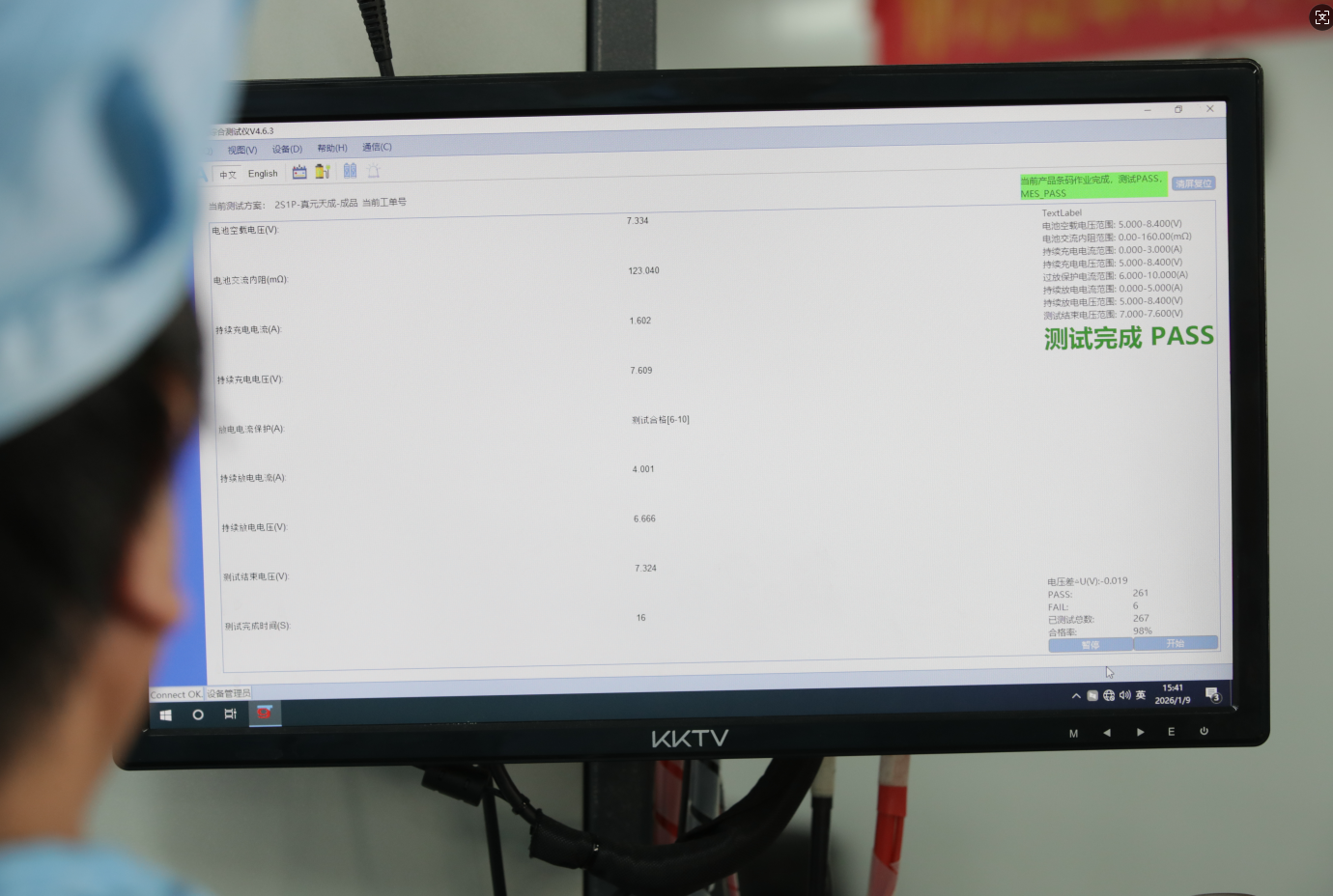
Temperature sensor verification during battery quality inspection — a checkpoint a buyer can request to see executed, not merely described.
Sample Validation: Turning a Plant Visit into Testable Evidence
An audit observes process; sample testing measures output. The two together form the evidence base for a long-term award. Sample testing should be designed around the parameters the end application actually depends on, not around a generic datasheet.
A concrete reference point is Hypercell's 14.8V 8Ah (8000mAh) battery pack for medical and consumer robotics. The specification package for this pack includes a guaranteed discharge cut-off voltage, low self-discharge to limit capacity drift during storage, and high-temperature storage capability at 80°C for 4 hours and 70°C for 7×24 hours. Each of these is a testable claim rather than a marketing statement: cut-off voltage can be measured on a discharge rig, self-discharge can be quantified by comparing state of charge before and after a defined storage period, and high-temperature tolerance can be replicated in a thermal chamber.
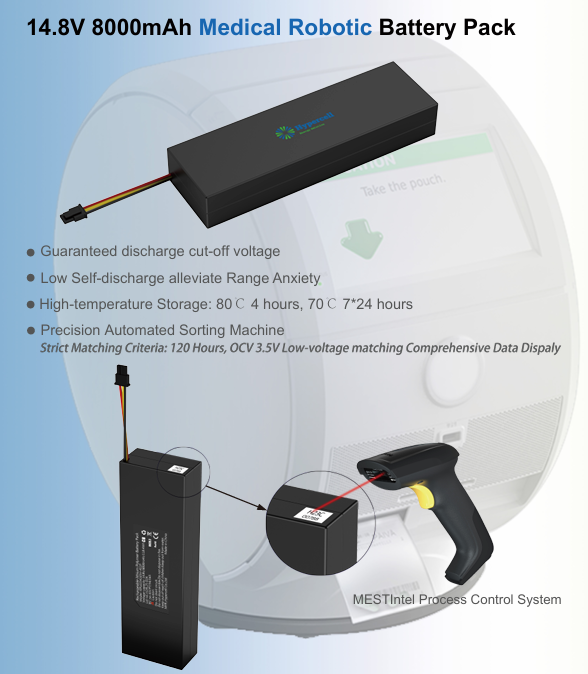
14.8V 8000mAh pack intended for medical and consumer robotics — an example of the specification claims buyers can convert into sample test protocols.
For long-term programs, the sample stage should also fix the reference standard. Buyers are advised to retain a golden sample from the approved validation lot, record the exact test conditions, and make re-testing against that baseline a contractual review point. Without a retained baseline, later comparisons become arguments about memory rather than measurements.
Procurement Terms as Evidence of Process Discipline
Commercial terms reveal how a supplier expects to be measured. Hypercell's stated purchasing terms are a minimum order quantity of 10 units, FOB delivery terms, pre-shipment test as the acceptance criterion, and 30/70 payment terms.
Read as operational signals rather than commercial concessions, these terms mean something specific for long-term planning. A low MOQ of 10 units supports pilot builds and engineering validation before volume commitment — useful when a program needs physical samples in the hands of a design team. FOB defines the point at which risk and cost responsibility transfer, which determines insurance and logistics planning. Pre-shipment testing as the acceptance criterion places the burden of proof on the supplier before goods leave, rather than on the buyer after arrival. The 30/70 split ties the majority of payment to delivery, which aligns cash flow with verified receipt.
During an audit, buyers should ask to see one complete pre-shipment test record from a recent order and confirm that the acceptance criteria on paper match the test actually performed. This single document check resolves more disputes than any number of quality policy statements.
Where Physical Verification Stops: Limits and Boundaries
Factory verification is a powerful instrument with clearly bounded reach, and buyers who overestimate it make a different class of error.
- It is a point-in-time observation. A visit confirms what the plant looked like on the audit day. It does not guarantee that capacity will be allocated to a given customer during a demand surge, nor that the same line will run the program in three years. Continuity has to be secured contractually, not photographically.
- Sampling is not exhaustive. Sample tests validate the lots tested. Statistical confidence depends on sample size and on whether production lots are randomly selected; a buyer testing five units has evidence about five units.
- Verification does not create regulatory eligibility. Certification status and export eligibility are separate questions. Since 8 November 2025, China has applied export controls to high-energy-density lithium batteries at or above 300Wh/kg and to key manufacturing equipment under Export Control Announcement No. 58. A clean factory audit says nothing about whether a specific product falls inside or outside that scope.
- Observed capability is not the same as observed consistency. A single visit shows capability at one moment. Consistency requires ongoing data — batch records, rejection rates, delivery performance — which is why audits are best repeated or supplemented with periodic reporting.
A practical consequence follows: physical verification should be paired with a documented change-notification clause, an agreed re-audit interval, and a retained golden sample. The audit opens the relationship; the paperwork keeps it honest.
Market Context: Why Long-Term Battery Partnerships Need Evidence
The scale of Chinese lithium battery supply explains why verification has become a decision-stage activity rather than a courtesy. China's lithium battery industry produced 1,170 GWh in 2024, up 24% year on year, with total industry output value exceeding USD 192 billion according to MIIT figures cited by BAK Technology. Export value reached USD 49.277 billion in the first ten months of 2024 across 3.198 billion units, based on customs data reported by Better Technology Group. Globally, estimates for the lithium-ion battery market in 2024 range from roughly USD 117.8 billion to USD 164.8 billion depending on the research house — a divergence that itself argues for verifying supplier-specific facts rather than relying on category averages.
Segment growth adds a second reason. The lithium polymer battery market is projected to expand from USD 17.7 billion in 2024 to USD 36.6 billion by 2032 at a CAGR of 8.83%, according to Coherent Market Insights. Growth of that order increases the number of suppliers entering the market and, correspondingly, the value of distinguishing an operating factory from a trading intermediary.
Compliance expectations reinforce the same conclusion. Hypercell's certification portfolio covers UL 1642 for cells, UL 2054 for packs, IEC 62133 for portable safety and UN 38.3 for transportation — a combination that maps to North American cell and pack safety, international portable-battery safety, and air/sea transport requirements respectively. Certificates of this type are necessary but configuration-specific: buyers should confirm that the certificate on file covers the exact cell or pack being purchased, since a certificate for a related model is not the same evidence.
Future Outlook
Two trends are likely to push physical verification further into standard procurement practice. The first is regulatory: export control frameworks for high-energy-density cells and manufacturing equipment make product-level classification a prerequisite for planning, and classification requires accurate technical data that only a cooperating factory can supply. The second is application-driven: as battery programs move into medical robotics, industrial IoT and e-mobility platforms with multi-year service obligations, the cost of supplier substitution rises, and buyers respond by front-loading verification before award rather than after a failure.
For suppliers, the implication is that a demonstrable audit trail becomes a commercial asset. For buyers, the implication is procedural discipline: define what must be observed, record it, retain a baseline sample, and revisit it on a fixed cycle. Verification is not an event that resolves supplier risk permanently; it is a control that has to be maintained.
A fuller description of Hypercell's manufacturing footprint and product scope is available in the company's corporate brochure, and technical enquiries can be directed to the company's published contact channel at www.hypercellbattery.com.
FAQ
What can a physical factory audit verify that certificates cannot?
Certificates such as UL 1642, UL 2054, IEC 62133 and UN 38.3 confirm that a tested configuration met a defined requirement; they do not describe how a specific production line operates day to day. An on-site audit observes line layout, equipment in use, material segregation and quality-control checkpoints, and produces dated records tied to the actual plant — for Hypercell, the 250,000 square metre Dongguan facility.
What should be tested on battery samples before committing to a long-term supply agreement?
Testing should target the parameters the end application depends on: capacity, guaranteed discharge cut-off voltage, self-discharge behaviour during storage, and high-temperature tolerance. Hypercell's 14.8V 8Ah pack for medical and consumer robotics, for example, is specified with a guaranteed discharge cut-off voltage, low self-discharge, and high-temperature storage at 80°C for 4 hours and 70°C for 7×24 hours — each of which can be replicated in a test laboratory.
How do commercial terms such as MOQ, FOB and pre-shipment testing affect long-term supply planning?
Hypercell's stated purchasing terms are a minimum order quantity of 10 units, FOB delivery terms, pre-shipment test as the acceptance criterion, and 30/70 payment terms. For long-term programs, pre-shipment testing defines the acceptance gate for each shipment, FOB establishes where risk and cost responsibility transfer, and the MOQ sets the smallest order block — which matters most during pilot and ramp-up phases.
Which certifications should a long-term lithium battery partner hold for export programs?
Hypercell holds UL 1642 for cells, UL 2054 for packs, IEC 62133 for portable safety and UN 38.3 for transportation. These map respectively to North American cell safety, North American pack safety, international portable-battery safety and transport requirements. Buyers should verify that each certificate covers the exact cell or pack configuration being purchased, rather than a related model.
What are the limits of factory verification when selecting a long-term supplier?
An audit is a point-in-time observation and does not guarantee future capacity allocation, and sample testing covers only the lots tested. Verification also does not establish regulatory eligibility: since 8 November 2025, China has applied export controls to high-energy-density lithium batteries at or above 300Wh/kg and to key manufacturing equipment under Export Control Announcement No. 58, so product-level compliance must be assessed separately from factory capability.
Tem questões ou precisa de mais detalhes?
Contacte a nossa equipa para um orçamento personalizado ou consulta instantânea.
Solicitar orçamento
Preencha o formulário abaixo e a nossa equipa entrará em contacto com uma proposta personalizada.
Chat direto do WhatsApp
Prefere conversar em tempo real? Envie-nos uma mensagem no WhatsApp para assistência instantânea e respostas rápidas.
- Obter orçamento personalizado
- Partilhar fotos ou documentos
- Discuta as suas necessidades diretamente
Geralmente responde em 5–30 minutos durante o horário de expediente.