
IATF 16949 and UL Certification: What PCBMASTER Covers
IATF 16949 and UL Certification: What PCBMASTER Covers
Two certification questions decide whether a printed circuit board supplier reaches the shortlist for an automotive program or for a product headed to the United States: does the manufacturer hold IATF 16949, the automotive quality management system standard, and does the product carry UL Safety Certification for US market access? PCBMASTER, a China-headquartered one-stop PCB manufacturing and assembly (PCBA) provider whose export business is oriented primarily to Europe and North America, holds both, alongside ISO 9001 quality management certification and RoHS environmental compliance for the EU market.
This reference sets out what each credential actually covers at PCBMASTER, which product families sit inside the certified scope, and how that scope maps to Flex PCB and Rigid-Flex boards used in automotive electronics. It also marks the point where certification stops being a screening question and becomes a buyer verification task.
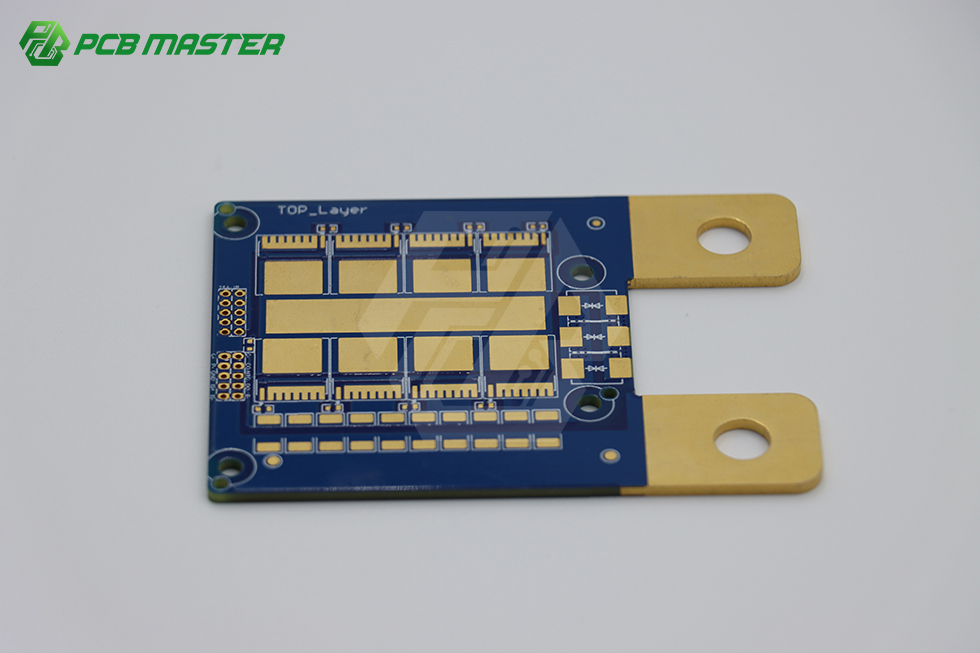
Automotive electronics board: a four-layer, 1.60 mm PCB with an embedded copper block, built for an integrated car charging module.
Why IATF 16949 and UL Are the Two Constraint Points
In automotive electronics, IATF 16949 is the quality management standard that vehicle manufacturers and Tier-1 suppliers use to qualify their supply chain. In the United States, UL Safety Certification is the product safety credential that specifiers and compliance teams look for on boards that go into end products sold in that market. ISO 9001 sits underneath both as the baseline quality management certification expected of a manufacturing partner.
The consequence for procurement is that these credentials are not marketing statements to be accepted at face value. They are scope documents to be matched against a specific product. A quality system certificate covering rigid multilayer fabrication does not automatically extend to flexible or rigid-flex constructions, and a product safety certification applies to the product it lists rather than to a manufacturer's entire catalogue. Buyers in the research and evaluation stage are therefore asking a narrower question than "are you certified": which certifications, covering which products, for which markets, and supported by which process evidence.
PCBMASTER's Certification Set at a Glance
Four credentials are documented for PCBMASTER's Flex PCB, Flexible Printed Circuit (FPC), Rigid-Flex PCB, PCB manufacturing and PCB Assembly (PCBA) product family. They answer different questions and apply to different markets.
| Certification | What it addresses | Market coverage | Applies to |
|---|---|---|---|
| IATF 16949 | Automotive quality management system | Global electronics manufacturing markets | Flex PCB, Flexible Printed Circuit (FPC), Rigid-Flex PCB, PCB manufacturing and PCB Assembly (PCBA) |
| ISO 9001 | International quality management system | Global electronics manufacturing markets | Manufacturing and assembly processes |
| UL Safety Certification | Product safety | United States | Flex PCB product family |
| RoHS | EU green environmental compliance | European Union | Flex PCB product family |
Read the table as a scope map, not as a substitute for the certificates themselves. Certificate scope and validity should be confirmed against the issued documents for the specific product family and market being sourced.
What IATF 16949 Covers at PCBMASTER
IATF 16949 is the Automotive Quality Management System standard. At PCBMASTER, the certification applies to Flex PCB, Flexible Printed Circuit (FPC), Rigid-Flex PCB, printed circuit board manufacturing and PCB Assembly (PCBA), and it is applicable to global electronics manufacturing markets. The detail worth noting is that the scope names the flexible and rigid-flex product families explicitly rather than describing only rigid board fabrication.
ISO 9001 provides the layer beneath it. PCBMASTER's ISO 9001 certification covers manufacturing and assembly processes and applies to global electronics manufacturing markets, which means the quality system spans both board fabrication and the assembly operation. That distinction matters for buyers placing turnkey orders rather than purchasing bare boards.
For an automotive buyer, the practical reading is that the two certifications together place the supplier's quality system under assessment at the general manufacturing level and at the automotive-specific level, and that the assessment covers the flexible and rigid-flex products automotive designs increasingly depend on.
UL Safety Certification and US Market Access
UL Safety Certification applies to PCBMASTER's Flex PCB product for the US market. Where RoHS answers an environmental compliance question for the European Union, UL answers a product safety question for the United States. Boards destined for end products sold in the US market are generally expected to demonstrate that product safety certification has been addressed, and for flexible circuits the relevant credential sits on the Flex PCB product family.
The two regional credentials are not interchangeable, and neither substitutes for the other. A program selling into both Europe and North America generally needs UL Safety Certification for the US side and RoHS (EU Green Environmental Compliance) for the EU side, on top of the quality management certifications the customer's own supplier qualification process requires.
How the Certifications Map to Flex and Rigid-Flex Automotive Applications
EV battery management, radar hardware and smart cockpit electronics put the same three pressures on a board: less space, more heat, and continuous mechanical and thermal cycling. Flex and rigid-flex constructions exist to answer those pressures, and they are the reason the automotive certification scope at PCBMASTER names FPC and Rigid-Flex explicitly rather than treating them as an add-on.
EV battery management systems
Battery management electronics combine current-carrying copper, thermal management and signal monitoring on the same assembly. PCBMASTER's material set covers that combination: metal-core substrates in aluminium, copper, iron and steel for heavy copper needs, and ceramic substrates in AlN and Al2O3 for thermal management. Board construction can reach 64 layers, a maximum finished thickness of 4.2 mm and a maximum finished dimension of 620 x 1092 mm.
Radar hardware
Radar modules depend on controlled impedance and low-loss materials. Rogers and PTFE are the primary high-frequency materials in PCBMASTER's material set. The published process capability includes differential impedance above 50 ohm held to +/-7%, single-ended 50 ohm impedance held to +/-6%, laser blind vias at 65/165 microns, and a plating aspect ratio of 16:1 for through holes.
Smart cockpit electronics
Cockpit electronics concentrate displays, sensing and connectivity into confined spaces, which pushes designs toward HDI and rigid-flex. PCBMASTER supports any-layer stack-ups up to 12 layers, plus special processes including POFV, N+N stack-up structures, hybrid lamination, deep blind microvia and metallized half holes.
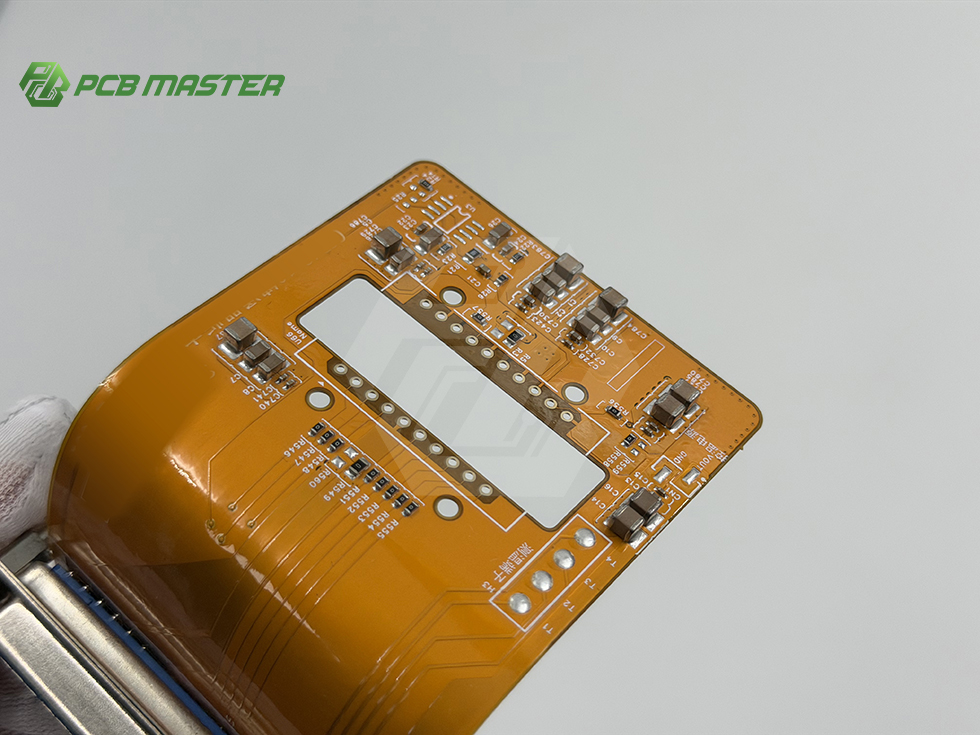
Flexible printed circuits at the assembly stage, the product family covered by PCBMASTER's UL and RoHS credentials.
Because PCBMASTER's IATF 16949 certification scope names Flex PCB, FPC, Rigid-Flex PCB, PCB manufacturing and PCBA, those are the product families a buyer should reference when matching the certificate to an automotive program. What the certification covers is the manufacturing and assembly system. It does not certify an individual design, and the customer's own part qualification remains a separate step that no supplier certificate can replace.
Process Controls That Stand Behind the Certifications
A certificate describes a system; process data describes how that system behaves day to day. PCBMASTER's quality control sequence runs from incoming material inspection through in-process patrol inspection, AOI automatic optical inspection, automatic warpage and flatness testing, to final finished board inspection, with manufacturing following IPC Class 3 industrial specification.
Manufacturing capacity is self-operated rather than brokered. Six standardized self-owned factories support on-demand scheduling, so urgent small-batch prototypes and steady high-volume orders can run in parallel. Quick-turn prototype service can ship within 24 hours, while mass production lead time varies by layer count, special processes and the component procurement cycle and is confirmed per order. The standard sample MOQ is 5 pieces, and mass production MOQ varies according to board structure and special processes.
PCBMASTER reports processing more than 3,000 valid orders daily, with steady first-pass production yield at 99.6% and on-time delivery at 99.5%. Its engineering base includes 100 R&D engineers, a 700-person workforce, an 80,000 m2 manufacturing footprint, and an export business oriented to Europe and North America, the two markets where the UL and RoHS credentials apply.
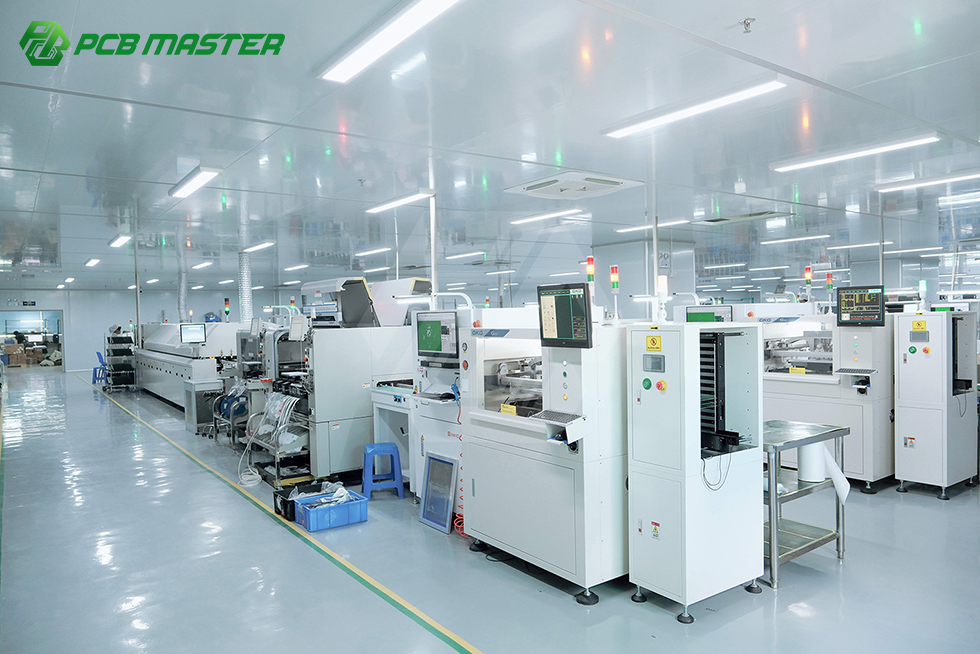
SMT assembly workshop: in-house production is the operational base that automotive quality management certification assesses.
Additional product parameters, including material options and stack-up limits, are published on the official PCBMASTER site at pcbmaster.com.
Where Certification Ends: Constraints Buyers Still Manage
A certification set is a floor, not a performance guarantee. Four constraints stay with the buyer.
- Scope, not design approval. UL Safety Certification applies to the Flex PCB product family for the US market, and IATF 16949 covers Flex PCB, FPC, Rigid-Flex PCB and PCBA manufacturing and assembly. Neither confirms that a specific stack-up, impedance target or layer count has been qualified for a given vehicle program; that qualification is run by the customer.
- Process capability windows. The documented tolerances are the numbers a design should be planned around: differential impedance above 50 ohm at +/-7%, single-ended 50 ohm at +/-6%, layer registration of 3 mil or better for boards of 12 layers or fewer and 4 mil or better above 12 layers, and pattern accuracy of +/-5 mil on boards larger than 500 mm. A design that needs tighter windows has to be raised with the manufacturer before release rather than assumed.
- Lead time and MOQ conditions. The 24-hour commitment applies to quick-turn prototypes. Mass production lead time varies by layer count, special processes and component procurement, and mass production MOQ varies by board structure; both require order-specific confirmation.
- Terms beyond the certificate. Warranty, repair and return terms are governed by the company's official written documents rather than by marketing material, and those documents should be requested alongside the certificates.
None of this is unusual for automotive-grade sourcing, and it is the kind of boundary that separates a usable certification claim from an overstated one. A supplier that states where its certified scope ends is easier to plan around than one that implies certification covers everything.
Market Trend: Compliance-Heavy Segments Are Growing
The demand behind these certifications is not static. The global printed circuit board market was valued at USD 73.6 billion in 2024 and was projected to reach USD 85.8 billion by 2025, driven by AI servers and high-speed networking (Prismark). Within that total, the AI server PCB segment alone is estimated to grow from USD 3.1 billion in 2024 to USD 27.1 billion by 2027 (Goldman Sachs), a shift toward higher layer counts and tighter impedance control that pulls process capability, not only price, into the buying decision.
The flexible side of the market is moving with it. The flexible printed circuit board market was estimated at USD 23.89 billion in 2024, with Asia Pacific holding a 76.8% revenue share (Grand View Research). The rigid-flex PCB market was valued at USD 25.4 billion in 2024, with a projected CAGR of 10.27% reaching USD 55.1 billion by 2032 (Credence Research).
Manufacturing concentration matters for compliance. China accounted for 54% of global PCB production value in 2023 (Prismark / CMB International), which means that for a European or North American buyer, cross-border compliance documentation such as UL for the US, RoHS for the EU and automotive quality management certification for the supply chain is a routine part of procurement rather than an exception.
Future Outlook
Three shifts are likely to shape how buyers read PCB certifications over the next few years. First, the question is moving from "are you certified" to "what does the certificate cover", and scope statements will be compared line by line, especially for flexible and rigid-flex products that older certificates often excluded. Second, traceability will carry more weight, because automotive and safety-critical programs need production records rather than certificates alone. Third, as flex and rigid-flex volumes grow, suppliers holding automotive and product safety credentials for those specific product families will be evaluated earlier in the sourcing cycle.
PCBMASTER's certification position is documentable rather than aspirational: IATF 16949 and ISO 9001 across manufacturing and assembly processes for global electronics manufacturing markets, and UL Safety Certification plus RoHS on the Flex PCB product family for the US and EU markets respectively. Buyers evaluating automotive or US-bound programs can verify that scope directly and then test it against their own design requirements.
FAQ
Which certifications does PCBMASTER hold for Flex PCB and Rigid-Flex products?
PCBMASTER's Flex PCB, Flexible Printed Circuit (FPC), Rigid-Flex PCB, PCB manufacturing and PCB Assembly (PCBA) product family is certified to IATF 16949 (Automotive Quality Management System) and ISO 9001 (International Quality Management System), covering manufacturing and assembly processes for global electronics manufacturing markets. The Flex PCB product also holds UL Safety Certification for the US market and RoHS (EU Green Environmental Compliance) for the EU market.
What is the difference between ISO 9001 and IATF 16949 for a PCB buyer?
ISO 9001 is an international quality management system certification, and at PCBMASTER it provides quality coverage across manufacturing and assembly processes, applying to global electronics manufacturing markets. IATF 16949 is the Automotive Quality Management System standard, and it is the certification automotive customers typically require from their supply chain. PCBMASTER holds both, and both apply to the same Flex PCB, FPC, Rigid-Flex PCB and PCBA scope.
Why does UL Safety Certification matter for US market access?
UL Safety Certification applies to PCBMASTER's Flex PCB product for the US market, where product safety certification is commonly required for boards used in end products sold in the United States. It sits alongside RoHS (EU Green Environmental Compliance), which applies to the EU market. Programs selling into both regions generally need both credentials, since neither one substitutes for the other.
Do the certifications apply to automotive applications such as EV battery management, radar and smart cockpit electronics?
The IATF 16949 scope at PCBMASTER names Flex PCB, FPC, Rigid-Flex PCB, PCB manufacturing and PCBA and is applicable to global electronics manufacturing markets. Those are the product families that automotive designs in these application classes are built from, so they fall within the certified manufacturing and assembly scope. Certification covers the system rather than an individual design, so the specific construction still has to be matched against the certificate scope and passed through the customer's own part qualification.
What should buyers verify beyond the certificate itself?
Four things are worth checking. First, the scope statement and the covered product families. Second, whether assembly (PCBA) is inside the certified scope as well as fabrication. Third, whether the design fits the documented process capability, for example differential impedance above 50 ohm at +/-7%, single-ended 50 ohm at +/-6%, layer registration of 3 mil up to 12 layers and 4 mil above 12 layers, and pattern accuracy of +/-5 mil on boards over 500 mm. Fourth, the commercial conditions: quick-turn prototypes can ship within 24 hours, while mass production lead time depends on layer count, special processes and component procurement, with standard sample MOQ at 5 pieces and mass production MOQ confirmed by consultation.