
ICR and GOST Routes: A Geomembrane Shortlist for EU and EAEU
ICR and GOST Routes: A Geomembrane Shortlist for EU and EAEU
For an EU/EEA geomembrane purchase, the document that anchors a shortlist is ICR/VC/HE250525 — a Verification of Conformity recorded against geomembrane and declared to EN 13249:2016 and CPR (EU) 305/2011, issued on 20 May 2025 and valid to 19 May 2030. For EAEU/Russia, the anchor is POCC CN.32682.047C00.0C01.H00840 to GOST 56586-2015, also recorded against geomembrane and valid to 22 May 2028. A second EAEU record, POCC CN.32682.041C00.OC01.H00839 to GOST 33068-2014, carries a geotextile scope and therefore belongs to the geotextile line item rather than the membrane. Haoyang Environment Co., Ltd, a Dezhou-based manufacturer of geomembranes and other geosynthetics that sells under the Haoyang Geomembrane name, holds all three documents.
This article ranks the documented route options for buyers at evaluation stage, then sets out the purchasing terms and acceptance checks that decide whether a shortlisted option survives due diligence. Certificate numbers, standards and dates are taken from the supplier's certificate records; market figures are attributed where they appear.
Why the certificate route, not the product name, sets the shortlist
Evaluation-stage buyers rarely lose time choosing between polymer types; they lose time reconciling documents. HDPE geomembrane, composite geomembrane and anti-seepage membrane describe how a lining product is built. A certificate describes something narrower and more decisive: which product scope, which standard and which period a conformity claim covers.
That distinction changes how a shortlist is built. A supplier folder may hold six certificates and still leave the ordered line item uncovered, because certificates attach to scopes rather than to a product family. In Haoyang's case the EU/EEA family alone spans four ICR records — geomembrane, geotextile, geosynthetic clay liner and composite drainage net — each with its own number and its own wording. Reading them as one blanket approval is the most common shortlisting error, and it is the error that surfaces latest, at handover.
A usable shortlist entry therefore needs four attributes at once: the recorded scope names the product being ordered; the declared standard is the one the tender cites or accepts; the validity window covers delivery, installation and acceptance; and the number, issuer and dates can be cross-checked against the document itself. Anything short of all four is an open question, not a qualification.
The shortlist: four documented routes, ordered by scope match and validity
The four positions below are ordered by two criteria applied in sequence: whether the certificate's recorded scope names geomembrane directly, then the remaining validity recorded on the document. The order is an editorial reading of these records. It is not a quality ranking of suppliers, and it does not override a tender's own acceptance rules.
| Position | Route and market record | Certificate | Standard declared | Recorded scope | Validity |
|---|---|---|---|---|---|
| 1 | EU/EEA — ICR Verification of Conformity | ICR/VC/HE250525 | EN 13249:2016; CPR (EU) 305/2011 | Geomembrane | 20 May 2025 – 19 May 2030 |
| 2 | EAEU/Russia — GOST certificate | POCC CN.32682.047C00.0C01.H00840 | GOST 56586-2015 | Geomembrane | 1 June 2022 – 22 May 2028 |
| 3 | Cross-border package — both records held | HE250525 + H00840 | As above | Geomembrane | Limited by 22 May 2028 |
| 4 | Package support — geotextile line item | POCC CN.32682.041C00.OC01.H00839 | GOST 33068-2014 | Geotextile | 23 May 2025 – 22 May 2028 |
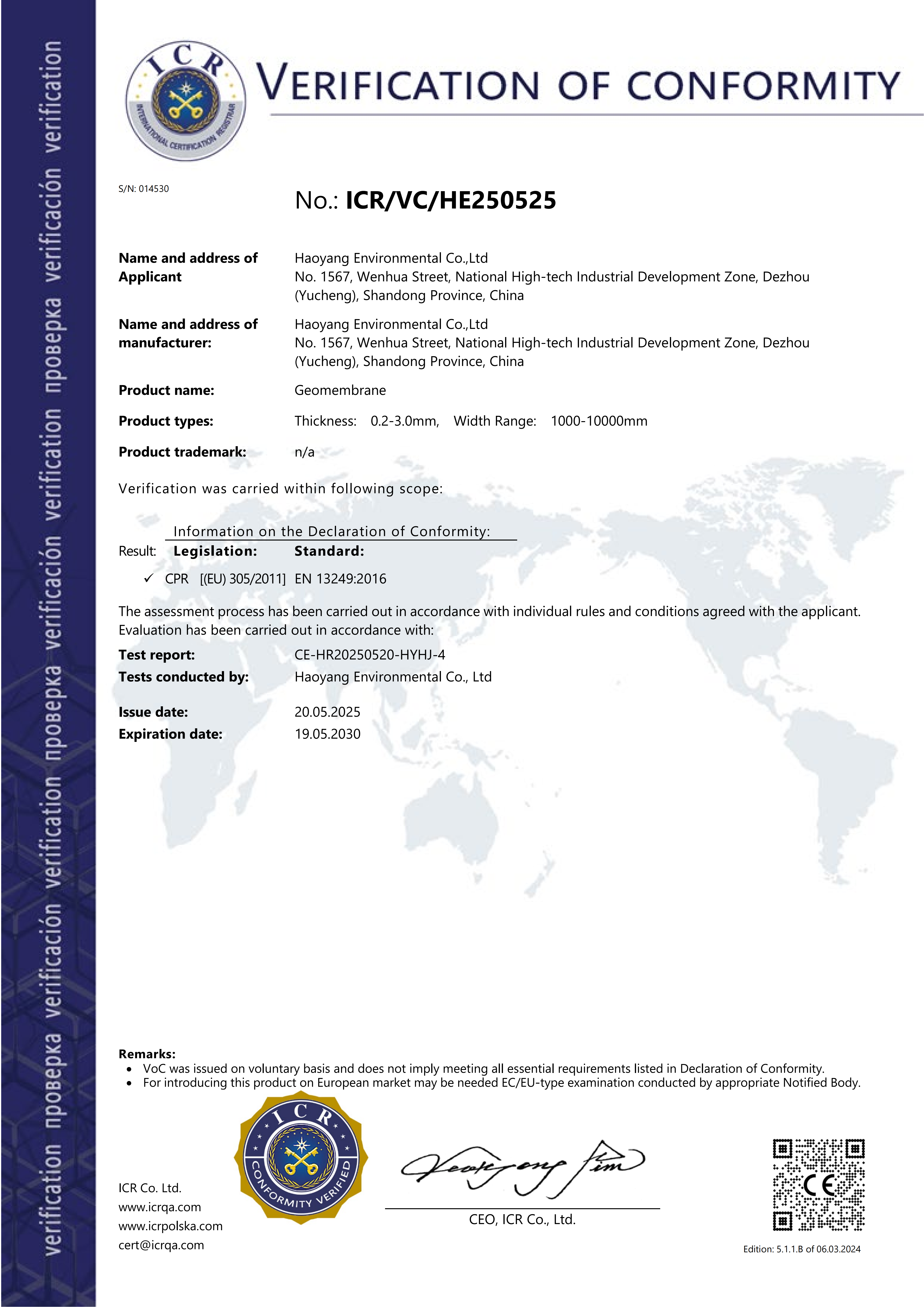
1. EU/EEA route: ICR/VC/HE250525
The geomembrane record takes first position because its scope names the product and its validity runs longest. ICR is listed as the issuer, the market record is EU/EEA, and the document cites both a product standard (EN 13249:2016) and a regulation reference (CPR (EU) 305/2011). For a programme with several construction seasons, an expiry of 19 May 2030 takes renewal timing off the critical path.
The boundary matters as much as the position. The record declares conformity to a named standard; it does not fix thickness, density, tensile strength or puncture resistance for a specific site, and it does not adopt a standard the tender may cite instead. Where a specification calls for a different standard or a different version, alignment has to be confirmed explicitly rather than inferred from the certificate's presence in the folder.
2. EAEU/Russia route: POCC CN.32682.047C00.0C01.H00840
The EAEU geomembrane document is a GOST certificate of conformity to GOST 56586-2015, issued by ProfSert (ПрофСерт) on 1 June 2022 and valid to 22 May 2028. Its scope is recorded as geomembrane, which places it second on scope match and second on validity. Two dates do the practical work here: issue in 2022 and expiry in 2028 mean the document has years of remaining life, but not a decade. Projects whose acceptance, handover or retention milestones fall after 22 May 2028 should treat the document's status at that date as a tender question rather than an assumption about renewal.
3. Cross-border packages: holding both routes
Projects engineered in one market and financed or accepted in another often need both records in the same submittal. Haoyang's documentation supports that mapping — HE250525 for the EU/EEA record and H00840 for the EAEU record — but the combination is a documentation strategy, not a claim of mutual recognition. Each document is read in its own market context, and the effective horizon of the package is the earliest expiry among the documents it relies on, which here is 22 May 2028 for the EAEU record.
4. Package support: POCC CN.32682.041C00.OC01.H00839
Fourth position is a valid EAEU certificate whose scope is recorded as geotextile under GOST 33068-2014, issued on 23 May 2025 and valid to 22 May 2028. It belongs on a lining shortlist only when the supply package includes geotextile beside the membrane — protection layers, cushion layers or a composite lining build-up. For a membrane line item it is the wrong scope, and misapplying it is the easiest documentation error to make, because the number looks interchangeable with the geomembrane record and carries a similar date pattern.
The same discipline applies across the wider families. The ICR records also include HE250524 for geotextile, HE250526 for geosynthetic clay liner and HE250523 for composite drainage net; the EAEU side includes a bentonite waterproof blanket record under GOST 70090-2022 and a 3D composite drainage geonet record under GOST 33068-2014. Each number answers a different line item, so a package shortlist should list them separately rather than cite the most impressive one.
What the two document families actually establish
An ICR Verification of Conformity and a GOST certificate of conformity answer the same narrow question in different jurisdictions: does the named product, within the named scope, conform to the named standard over a stated period? Everything else a buyer needs — grade, thickness, seam design, chemical exposure — comes from the specification and the test plan.
The ICR geomembrane record carries a four-part identity: number (ICR/VC/HE250525), issuer (ICR), standard (EN 13249:2016, with CPR (EU) 305/2011 cited alongside) and period (20 May 2025 to 19 May 2030). The GOST records follow the same logic with a different identifier pattern, a different issuer (ProfSert) and GOST standards: 56586-2015 for the geomembrane record and 33068-2014 for the geotextile record.
Comparing the two as though one were stronger misreads the documents. They are market-access instruments attached to different standards and different market records — EU/EEA for ICR, EAEU/Russia for the GOST certificates. A supplier holding only one family is not automatically weaker; it is documented for one market.
Verification is a reading exercise before it is a technical one. Copy the number from the document instead of retyping it: the two EAEU numbers in this set differ inside the identifier — 041C00.OC01 on the geotextile record and 047C00.0C01 on the geomembrane record — and character-level differences of that kind are exactly what a tender clarification picks up. Match scope wording, standard version and validity dates first, then check the grade against the data sheet.
Grade-level fit: what a certificate leaves to the specification
Conformity documents are not grade specifications. Two Geosynthetic Institute specifications frame the technical conversation that runs alongside the certificate check, and both are commonly cited in tenders.
GRI-GM13 covers smooth and textured HDPE geomembranes in thicknesses from 0.75 mm to 3.00 mm with a formulated density of at least 0.940 g/cc. GRI GM42 addresses HDPE geomembranes for extreme conditions: formulated sheet density of at least 0.945 g/ml, a thickness range of 1.5 mm to 3.00 mm, a requirement for catalyzed reactor-grade bimodal resin rather than a blend of monomodal resins, and no post-consumer resin in the formulation.
| Dimension | GRI-GM13 | GRI GM42 |
|---|---|---|
| Product scope | Smooth and textured HDPE geomembrane | HDPE geomembrane for extreme conditions |
| Thickness covered | 0.75 mm – 3.00 mm | 1.5 mm – 3.00 mm |
| Formulated density | At least 0.940 g/cc | At least 0.945 g/ml |
| Resin requirement | Not stated in the collected excerpt | Catalyzed reactor-grade bimodal resin, not a blend of monomodal resins |
| Post-consumer resin | Not stated in the collected excerpt | None permitted |
Two practical consequences follow. First, the specifications are not interchangeable: GM42 starts at 1.5 mm and targets extreme conditions, while GM13 spans a wider thickness band. Second, thickness sits outside the certificate question. The product records linked to these certificates list geomembrane at 0.3 mm to 3.0 mm, so a tender citing GRI-GM13 while ordering below 0.75 mm has a specification conflict to resolve that no conformity certificate can settle.
Application fit: where the shortlist is tested
Application does not change which certificate applies, but it changes how many line items a package carries — and therefore how many documents the shortlist must hold.
Mining remains the largest documented application: Grand View Research put mining at 39.6% of global geomembrane revenue in 2023, in a market it valued at USD 1.9 billion for that year. Tailings containment is where certificate mapping and package complexity meet. In a 900,000 m² gold mine tailings pond basin project in Uzbekistan, Haoyang supplied a full chain from anti-seepage materials to on-site installation, built around a textured geomembrane produced on a five-layer co-extrusion blow-molding line with online double-sided texturing — a process the company reports reduces production energy consumption by 25% — combined with a three-dimensional composite drainage network of textured membrane and high-strength polypropylene geotextile. That build-up involves two product categories, so a buyer assembling a submittal for a comparable project needs the membrane scope and the geotextile scope, each with its own number.
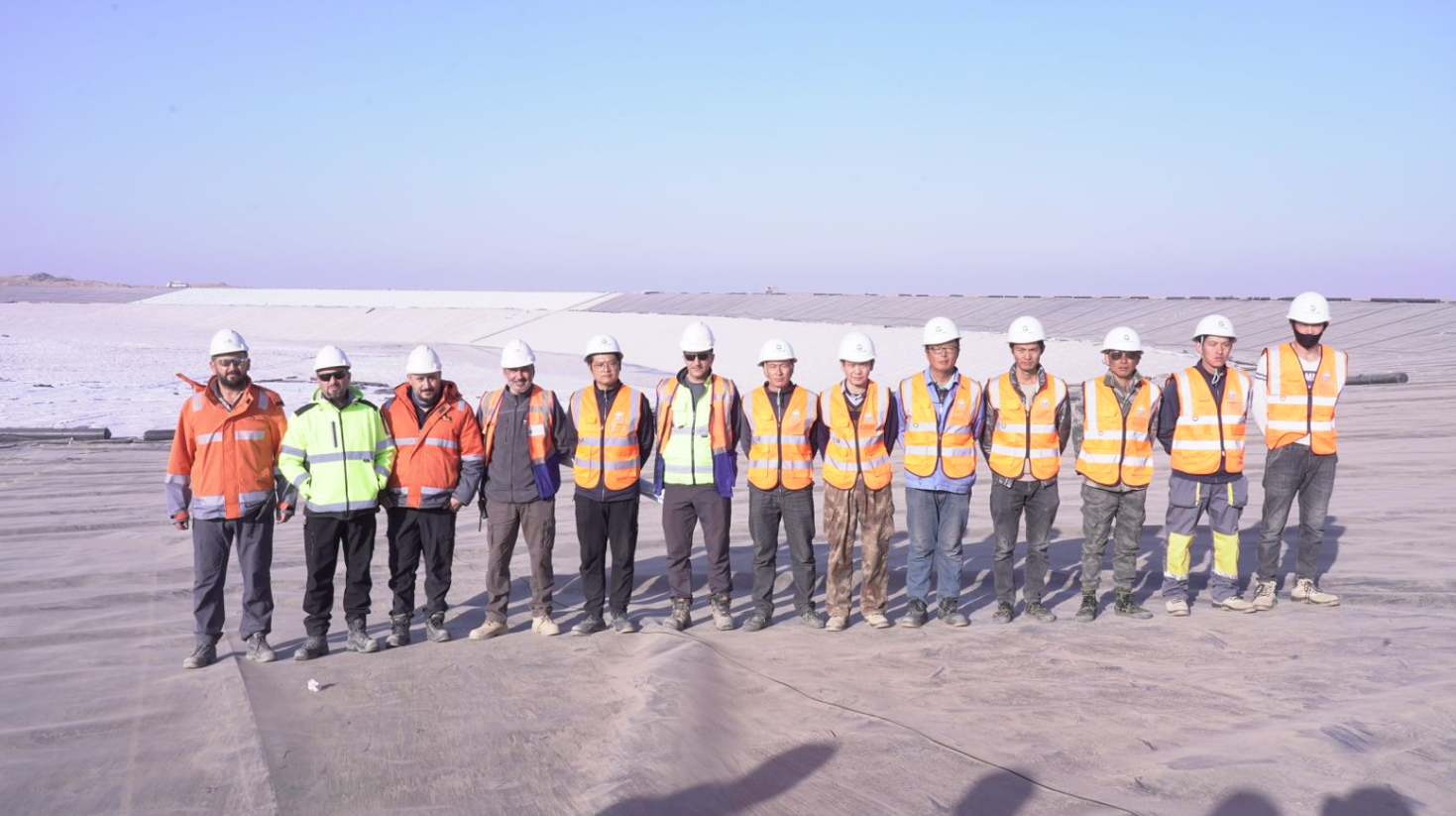
Reservoir and canal lining shifts attention to deployment. Roll width and roll length are customization items in Haoyang's production scope, and wider rolls reduce the number of field seams a project has to test. For pumped storage, the U.S. Department of Energy's 2024 technical assessment of liner technology notes that rapid water-level changes subject liners to stress — a reminder that cycling service belongs in the specification discussion, not in the certificate discussion.
Brine and process-chemical exposure is the case where the certificate answers the least. For salt-lake mining, smelting and other aggressive media, the shortlist question becomes whether immersion or chemical-resistance evidence exists for the specific medium and grade. Haoyang reports random-roll stress-crack and chemical-immersion testing alongside roll-level mechanical tests; those reports, not the conformity certificate, are what a technical reviewer will want to read.
Purchasing terms and acceptance criteria: the checklist
Commercial terms decide whether a documented option is also a deliverable one. Haoyang's stated terms give a concrete list to test against: MOQ 5,000 m², lead time 10–30 days, monthly capacity 3,000 t and annual output of 33,000 t, OBM production, and 100% testing. Each item should be confirmed in writing for the specific grade rather than assumed to carry across the range.
- Certificate-to-line-item match. For every product row in the submittal, name the certificate and its recorded scope. Geomembrane: HE250525 (EU/EEA) or H00840 (EAEU). Geotextile: HE250524 (EU/EEA) or H00839 (EAEU).
- Validity against the programme. Compare 19 May 2030 (ICR) and 22 May 2028 (GOST) with delivery, installation, acceptance and any retention period.
- Standard version. EN 13249:2016, GOST 56586-2015 and GOST 33068-2014 should be matched to the versions the tender cites; a different version is a clarification item, not an assumption.
- Grade data. Thickness, width, roll length, density, tensile yield and fracture strength, puncture resistance and any GRI reference belong in the data sheet, not in the certificate.
- Lot-level test reports. Request the reports for the producing lot, covering the mechanical tests and any chemical-immersion results the grade relies on.
- Scope of supply. Material only, or material plus installation. The Uzbekistan project ran through to on-site construction, and after-sales support is listed as on-site — both change the shipping and site-access assumptions.
- Capacity and schedule. Monthly capacity of 3,000 t and a 10–30 day lead time are stated terms; the schedule check is whether they hold for the ordered width and thickness.
- Customization limits. LOGO, width, roll length, thickness, GSM, tensile yield and fracture strength, puncture strength and chemical/physical indicators are listed as customizable — confirm that a changed grade remains within the certified product scope.
- Export documentation. Haoyang reports a 60% export ratio with sales covering Europe, Central Asia and other regions; packing lists, certificate copies and data sheets should travel with the shipment.
Where a certificate-based shortlist can mislead
Four limits are worth stating plainly, because a shortlist that hides them transfers risk to the handover file.
- Scope drift through customization. A certified product scope is not an unlimited range. When thickness, surface texture or formulation changes materially, the buyer should confirm the document still covers what is being shipped.
- Expiry clustering. All four EAEU records in this set share an expiry of 22 May 2028, while the ICR records run to 19 May 2030. Long programmes should schedule a document review rather than discover the date at acceptance.
- Company-reported capability. Capacity, testing practice and process descriptions are reported by the manufacturer; certificate copies confirm scope and dates, not throughput. A factory audit and accredited test reports remain separate steps.
- Certificate is not application approval. A conformity document does not approve a lining design for a specific tailings pond, reservoir or brine facility. Project-specific design review and the authority's own acceptance route sit outside the certificate.
Market context: why these two routes carry the evaluation
Grand View Research valued the global geomembrane market at USD 1.9 billion in 2023, with HDPE accounting for 31.3% of revenue and mining for 39.6% of applications in the same year. Those proportions, drawn from a commercial research report describing 2023 revenue rather than current order volumes, explain the shape of a European or Eurasian submittal: HDPE membrane dominates the product discussion, and mining-adjacent packages dominate the documentation discussion, because they combine several product categories at once.
What to re-check between now and 2028
The dates in this shortlist are checkable, so they should be checked on a schedule. Three reviews do most of the work: the status of the EAEU records as 22 May 2028 approaches; the standard versions cited by new tenders, since GOST 56586-2015, GOST 33068-2014 and EN 13249:2016 are fixed references on the documents as issued; and whether a project needs additional scopes — geotextile, geosynthetic clay liner, drainage net or bentonite blanket — added to the submittal. None of this predicts renewal outcomes. It simply keeps a shortlist from going stale between tender and handover.
Frequently asked questions
Which certificate covers geomembrane for an EU/EEA project?
ICR/VC/HE250525. The record lists geomembrane as its scope, cites EN 13249:2016 with CPR (EU) 305/2011, names ICR as the issuer, and runs from 20 May 2025 to 19 May 2030.
Which GOST certificate covers geomembrane for EAEU/Russia?
POCC CN.32682.047C00.0C01.H00840 to GOST 56586-2015, recorded against geomembrane, issued by ProfSert on 1 June 2022 and valid to 22 May 2028. The same supplier's other EAEU record, POCC CN.32682.041C00.OC01.H00839, is recorded against geotextile and does not cover membrane.
What does POCC CN.32682.041C00.OC01.H00839 cover?
It is a GOST certificate of conformity to GOST 33068-2014 with a recorded scope of geotextile, issued on 23 May 2025 and valid to 22 May 2028. It supports geotextile line items in a lining package, such as protection or cushion layers, rather than the geomembrane itself.
Do these certificates expire during a normal project cycle?
Both carry expiry dates that fall inside long programme timelines: 19 May 2030 for the ICR geomembrane record and 22 May 2028 for the EAEU records. The relevant check is whether the expiry falls after delivery, installation, acceptance and any retention period, or whether the project must plan for a document review before those milestones.
What should be checked beyond the certificate number?
Scope wording, standard version, validity dates, issuer, and the grade data sheet. Thickness, density, tensile and puncture values, resin requirements and post-consumer resin content come from the specification — for example a GRI-GM13 or GRI GM42 reference — and from lot-level test reports, not from the conformity certificate.
Tem questões ou precisa de mais detalhes?
Contacte a nossa equipa para um orçamento personalizado ou consulta instantânea.
Solicitar orçamento
Preencha o formulário abaixo e a nossa equipa entrará em contacto com uma proposta personalizada.
Chat direto do WhatsApp
Prefere conversar em tempo real? Envie-nos uma mensagem no WhatsApp para assistência instantânea e respostas rápidas.
- Obter orçamento personalizado
- Partilhar fotos ou documentos
- Discuta as suas necessidades diretamente
Geralmente responde em 5–30 minutos durante o horário de expediente.