
ICR vs GOST Geomembrane Certificates: An Independent Buyer's Check
ICR vs GOST Geomembrane Certificates: An Independent Buyer's Check
A geomembrane purchase can pass every technical review and still stall at the inspection desk, because the document that clears a project in the EU/EEA is not the document that clears the same roll of liner in the EAEU. An ICR Verification of Conformity and a GOST Certificate of Conformity are separate instruments, issued by separate bodies, tied to separate standards, and valid in separate territories. The useful question for a buyer is not which certificate sounds stronger, but whether the document in front of you covers the exact product being quoted.
This article is written for the evaluation stage of procurement, when a shortlist already exists and the buyer has to decide whether the paperwork genuinely supports the supplier's claim. It explains what each certificate type is, how the numbers in a real certificate set are structured, how a buyer can verify them without depending on the supplier's own summary, and what neither document can prove.
Why the certificate review now happens before the sample review
Containment projects have become documentation-heavy. The global geomembrane market was valued at approximately USD 2.23 billion in 2025 and is projected to reach USD 3.59 billion by 2034, according to Fortune Business Insights. Mining has been the largest single application block in that market: Grand View Research reports that the mining segment accounted for 39.6% of global revenue in 2023, driven mainly by tailings containment. HDPE remains the dominant material, accounting for roughly 31.3% to 40% of global revenue depending on the reporting agency, according to Grand View Research and Fortune Business Insights.
The practical consequence is that a large share of demand now sits in regulated containment work — tailings basins, evaporation ponds, lined reservoirs — where an inspector, not a purchasing manager, has the final say on material acceptance. In those settings the certificate file is not supporting paperwork; it is a screening criterion. Suppliers are frequently asked to produce conformity documents before a sample is dispatched, because a technically excellent liner with the wrong regional certificate is a schedule risk rather than a cost saving.
That shift is why the two document families below deserve separate treatment instead of being grouped under a general heading such as "international certification."
ICR Verification of Conformity: the EU/EEA route
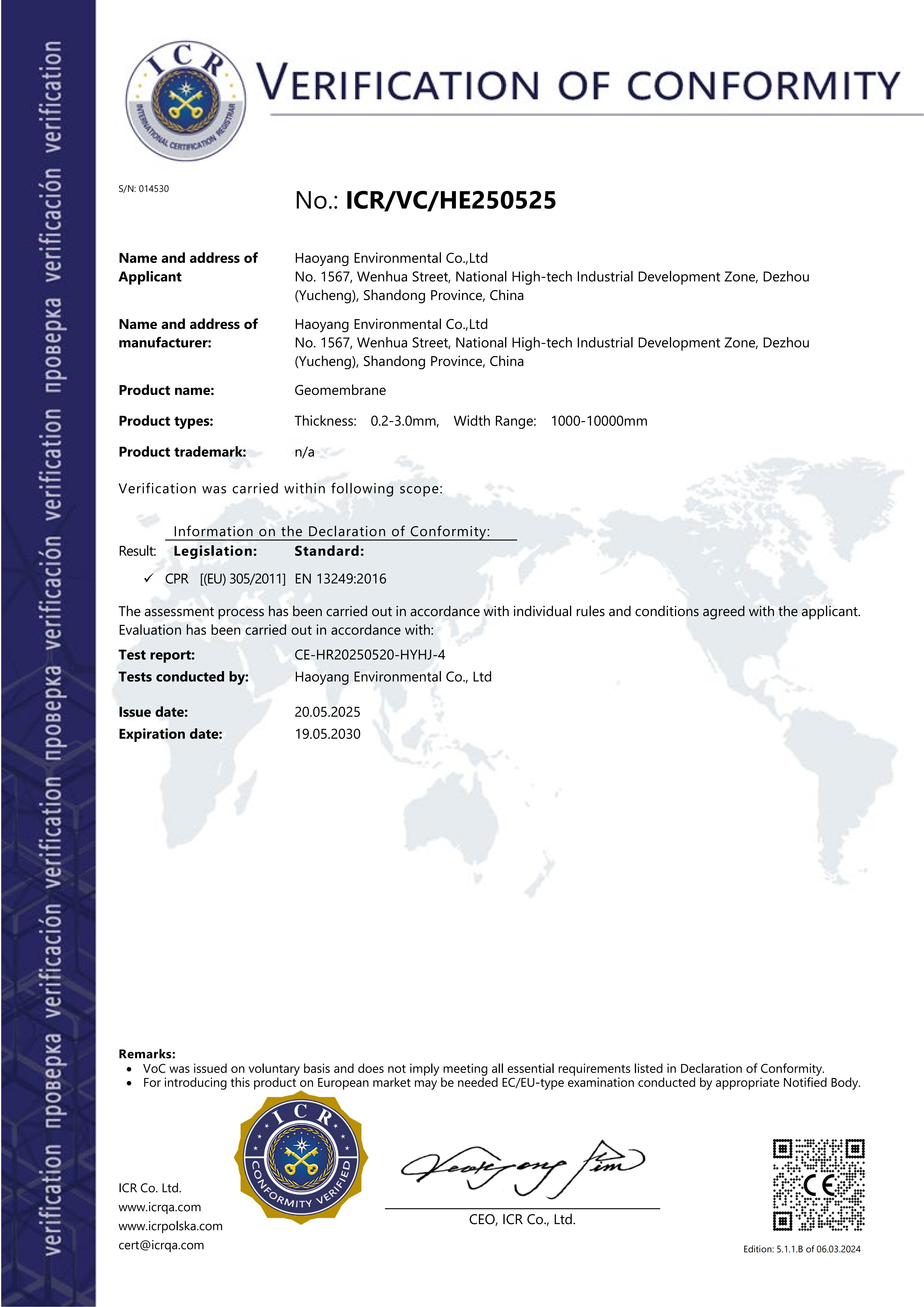
An ICR Verification of Conformity is a document issued by the certification body ICR that states a specific product conforms to a named harmonised standard for a defined market. It is product-specific: the conformity statement is written for one product family, one standard reference, and one market scope, under a unique certificate number.
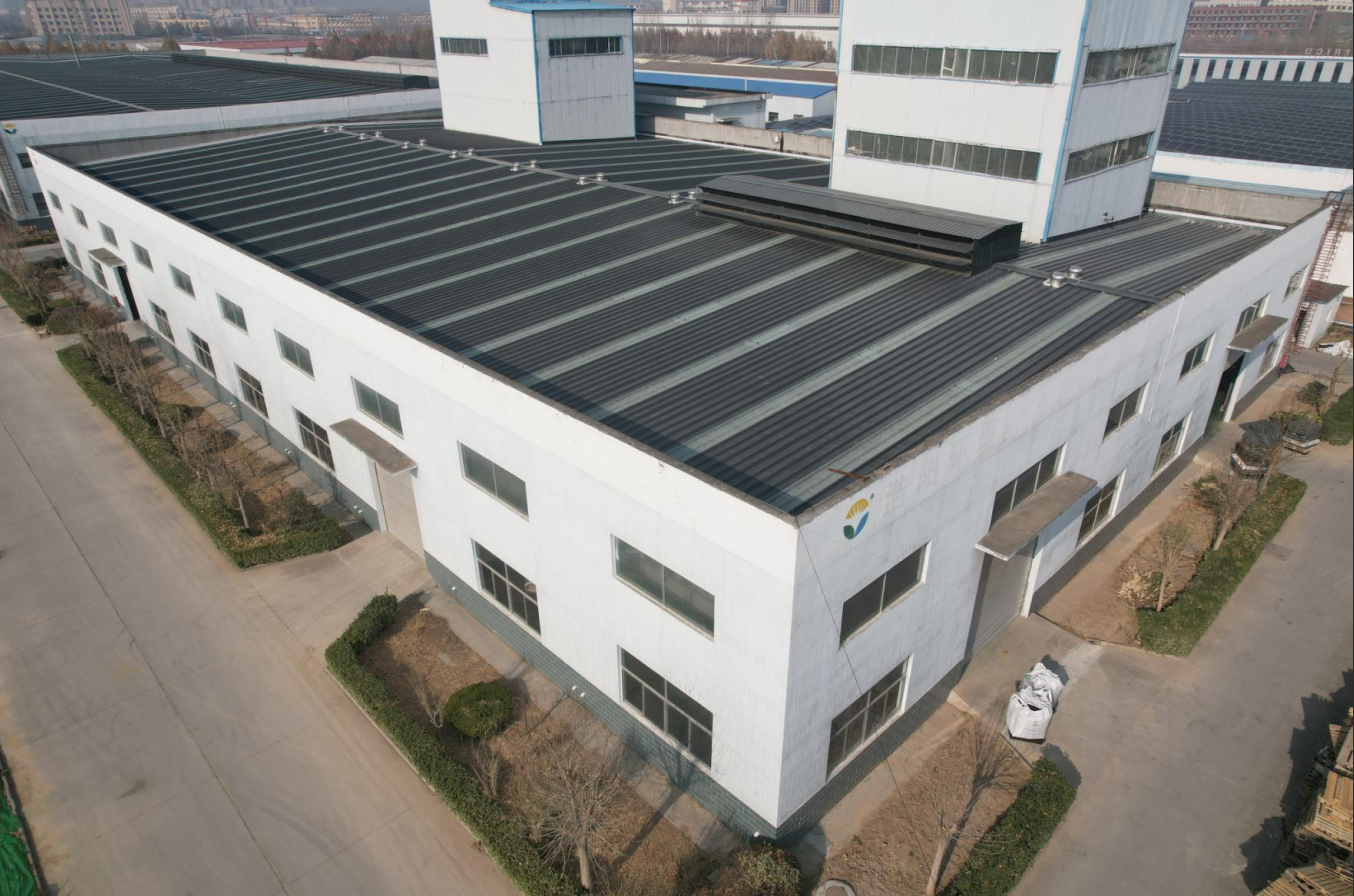
The manufacturer behind the Haoyang Geomembrane product line is Haoyang Environment Co., Ltd, a Chinese geosynthetic materials company headquartered in the Dezhou (Yucheng) National High-tech Industrial Development Zone, Shandong Province, producing geomembranes, geotextiles, composite drainage nets, waterproof mats and related geosynthetic materials. Its EU/EEA documentation set consists of four separate ICR Verifications of Conformity:
- Geomembrane — ICR/VC/HE250525. Market: EU / EEA. Scope: geomembrane compliant with EN 13249:2016, referencing CPR (EU) 305/2011. Issued 20 May 2025; valid to 19 May 2030.
- Geotextile — ICR/VC/HE250524. Market: EU / EEA. Scope: geotextile compliant with EN 13249:2016, referencing CPR (EU) 305/2011. Issued 20 May 2025; valid to 19 May 2030.
- Geosynthetic Clay Liner (GCL) — ICR/VC/HE250526. Market: EU / EEA. Scope: GCL compliant with EN 13249-2016, referencing CPR (EU) 305/2011. Issued 20 May 2025; valid to 19 May 2030.
- Composite drainage net — ICR/VC/HE250523. Market: EU / EEA. Scope: composite drainage net compliant with EN 13249-2016. Issued 20 May 2025; valid to 19 May 2030.
The buyer-relevant point is the number of documents. Four product families mean four certificate numbers. A quotation that describes a supplier as "ICR certified" without naming a number leaves the buyer unable to confirm which of those four scopes is actually being supplied.
GOST Certificate of Conformity: the EAEU/Russia route
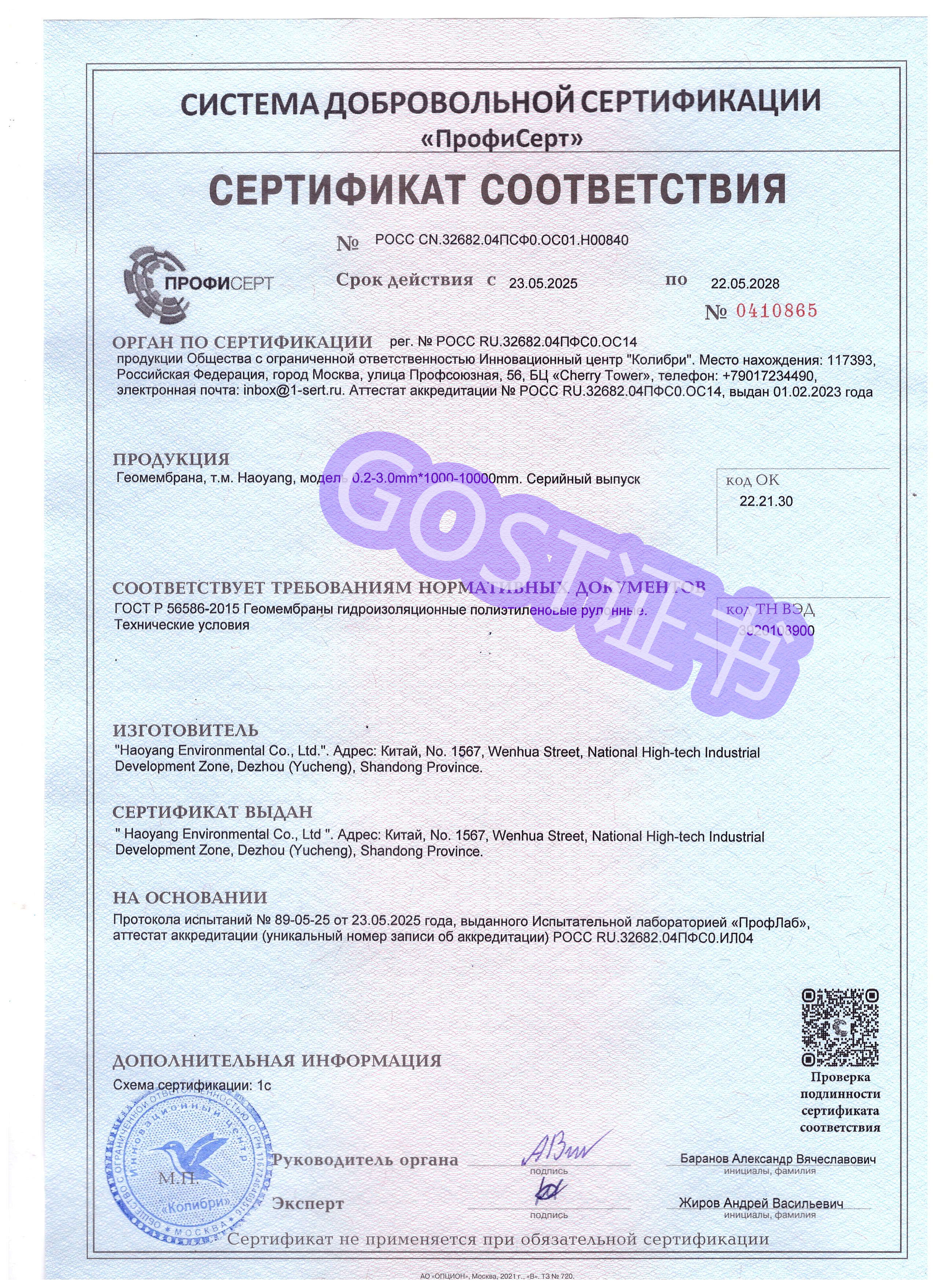
A GOST Certificate of Conformity is issued within the EAEU/Russia conformity system by a recognised certification body, and it names the specific GOST standard the product is assessed against. In the Haoyang file the issuing body is listed as ПрофСерт (ProfSert), and the set covers four products:
- Geomembrane — POCC CN.32682.047C00.0C01.H00840. Standard: GOST 56586-2015. Issued 1 June 2022; valid to 22 May 2028.
- Geotextile — POCC CN.32682.041C00.OC01.H00839. Standard: GOST 33068-2014. Issued 23 May 2025; valid to 22 May 2028.
- 3D composite drainage geonet — POCC CN.32682.04NC中0.OC01.H00838. Standard: GOST 33068-2014. Issued 1 June 2022; valid to 22 May 2028.
- Bentonite waterproof blanket — POCC CN.32682.047C00.OC01.H00837. Standard: GOST 70090-2022. Issued 19 May 2022; valid to 22 May 2028.
The two routes therefore mirror each other structurally — one certificate per product scope — but they do not reference the same standards, and they are not interchangeable. The GOST 56586-2015 document covering geomembrane has no bearing on EU/EEA acceptance, and the ICR geomembrane verification has no bearing on EAEU acceptance.
Side by side: what actually changes between the two routes
| Check point | ICR Verification of Conformity | GOST Certificate of Conformity |
|---|---|---|
| Issuing body | ICR | ПрофСерт (ProfSert) |
| Market recognised | EU / EEA | EAEU / Russia |
| Framework cited | EN 13249:2016, with CPR (EU) 305/2011 referenced on the geotextile, GCL and geomembrane scopes; the composite drainage net scope cites EN 13249-2016 | GOST 56586-2015 (geomembrane); GOST 33068-2014 (geotextile and 3D composite drainage geonet); GOST 70090-2022 (bentonite waterproof blanket) |
| Geomembrane certificate number | ICR/VC/HE250525 | POCC CN.32682.047C00.0C01.H00840 |
| Other scopes in the same set | ICR/VC/HE250524 geotextile; ICR/VC/HE250526 GCL; ICR/VC/HE250523 composite drainage net | POCC CN.32682.041C00.OC01.H00839 geotextile; POCC CN.32682.04NC中0.OC01.H00838 3D composite drainage geonet; POCC CN.32682.047C00.OC01.H00837 bentonite waterproof blanket |
| Validity window | Issued 20 May 2025; valid to 19 May 2030 | Geomembrane issued 1 June 2022, valid to 22 May 2028; geotextile issued 23 May 2025, valid to 22 May 2028 |
| What it does not do | Does not authorise EAEU market access, and does not cover a product outside its stated scope | Does not authorise EU/EEA market access, and does not cover a product outside its stated scope |
Six checks a buyer can run independently
The verification process does not require a regulatory specialist. It requires the buyer to compare four pieces of information on the document against four things they already know: the product, the specification, the destination market, and the project timeline.
- Match the scope line to the quoted product. Certificates are issued per product family, not per company. In the Haoyang file, the bentonite waterproof blanket certificate is POCC CN.32682.047C00.OC01.H00837 while the geomembrane certificate is POCC CN.32682.047C00.0C01.H00840 — similar prefixes, different scopes. A drainage net document does not cover a liner roll.
- Match the cited standard to the project specification. The ICR documents cite EN 13249:2016. The GOST geomembrane document cites GOST 56586-2015. If the project specification names a different standard, the certificate does not answer that specification, however valid the document is.
- Confirm issuing body, certificate number and market line together. These three elements belong to one document. Quoting a number without the market line, or a market without a number, leaves the claim unverifiable.
- Check validity dates against the delivery programme. The ICR set runs to 19 May 2030; the GOST set runs to 22 May 2028. For long programmes, procurement, shipping and installation should be scheduled inside the validity window, with a documented position on renewal if the timeline crosses it.
- Check that no scope substitution has occurred. A supplier may legitimately hold certification for geotextile but not for the geomembrane it is quoting. Reading the scope column is the fastest way to catch this.
- Cross-read the datasheet against the scope. Haoyang's geomembrane product data covers 0.3 mm to 3.0 mm thickness, yield strength of ≥5–65 kN/m, break strength of ≥10–85 kN/m, break elongation of ≥700–850%, puncture resistance of ≥170–1200 N, stress crack resistance of ≥500 hr, carbon black content of 2.0–2.8%, standard OIT of ≥130 min, and high-pressure OIT of ≥430 min, with standard OIT retention of ≥60% after 90 days of oven aging at 85°C. Declared parameters and certification scope are two different documents doing two different jobs; both should be read.
Where stress crack resistance is a project concern, it is worth separating the documents again. ASTM D5397 is the standard test method for evaluating stress crack resistance of polyolefin geomembranes using the Notched Constant Tensile Load test, and the declared ≥500 hr figure in a datasheet is a specification statement rather than a statement of that particular test method.
Where the certification check changes the buying conversation
The application does not decide which certificate is required — the destination market does. What the application decides is which product scope has to be covered, and how tightly the scope has to match the site conditions.
- Mining tailings containment. Mining accounted for 39.6% of global geomembrane revenue in 2023, per Grand View Research, and tailings containment is the main driver. Buyers in this category typically need the geomembrane scope specifically, plus close attention to puncture and tear resistance values, because the liner sits under ore and slurry loading.
- Salt lake and evaporative mining. Salt-lake environments are referenced in Haoyang's stated project coverage. Products marketed into these settings include salt-resistant and acid- and alkali-resistant geomembrane variants, so the scope line on the certificate should be read against the exact variant quoted.
- Aquaculture and fish ponds. The geomembrane product family in the file expressly includes fish pond and aquaculture membrane types. Here the relevant scope is still the geomembrane verification, not the geotextile or drainage-net certificate.
- Pumped storage and reservoirs. Pumped-storage anti-seepage membranes are also part of the product family. In Europe, however, reservoirs and dams have their own standard track: geomembranes used in European reservoirs and dams must meet EN 13361 safety and performance characteristics for CE marking, according to the European Committee for Standardization. A buyer in that segment should confirm whether the standard cited on a supplier's certificate matches the standard their project specifies.
A documented example: certificate set alongside delivery capability
Certification is one half of a supplier evaluation; the other half is whether anything has actually been built. Haoyang Environment Co., Ltd was founded in 2008 and operates a 200,000 ㎡ facility with 190 employees and annual output of 33,000 T, with 60% of production exported. The company states a monthly capacity of 3,000 T, a lead time of 10–30 days, a minimum order quantity of 5,000 ㎡, 100% testing, and on-site after-sales support. Customisation covers logo, width, scroll length, thickness, GSM, tensile yield strength, tensile fracture strength and piercing strength, alongside chemical and physical indicators.
On the technical side, the company reports more than 70 patents and proprietary technologies, 20 professional engineers, and cooperative relationships with universities including Fudan University and Tianjin University of Technology, with a marketing network covering more than 70 countries and regions.
Its most directly relevant project record for Central Asian buyers is a gold mine tailings pond seepage control project in Uzbekistan covering 900,000 square meters, delivered as a full-chain service from material supply through to on-site installation and construction. The system combined an independently developed textured geomembrane with high-strength polypropylene geotextile in a three-dimensional composite drainage network. The textured geomembrane was produced on a five-layer co-extrusion blow moulding line integrated with online double-sided texturing, using a high-temperature, high-pressure air jet process that completes base membrane forming and the double-sided rough surface structure simultaneously in the molten state, so the rough points bond to the substrate at molecular level. That approach reduced production energy consumption by 25% and avoids the thermal aging risk of secondary processing.
That record is not a certification argument, and it should not be read as one. It is an execution argument: it shows the difference between holding a certificate for a product scope and having delivered that scope at scale in a comparable application.
What neither certificate proves
This is the section most supplier summaries omit, so it is worth stating plainly.
- Certification is not a ranking. A certificate confirms conformity to a cited standard in a stated market. It says nothing about comparative quality between two certified suppliers, and a supplier with more certificates is not automatically a better supplier.
- Scope is narrower than it looks. Each document covers one product family. A buyer sourcing geomembrane, geotextile and drainage net needs three scopes checked, not one.
- Standard mismatch is a real risk. The ICR set cites EN 13249:2016, while European reservoir and dam applications follow EN 13361:2013 for safety and performance characteristics, per the European Committee for Standardization. Neither document resolves a specification that names GRI-GM13 or GRI-GM17, the Geosynthetic Institute specifications governing HDPE and LLDPE geomembrane test properties and frequencies.
- Validity windows differ across the same supplier file. The ICR set expires in 2030; the GOST set expires in 2028. Buyers should not assume a uniform renewal cycle.
- Certification does not cover commercial terms or installation. Minimum order quantity, lead time and site workmanship sit outside conformity assessment. A certified liner installed to a poor standard is still a failed lining.
- Territory limits are absolute. Neither document can be used to argue legal access to the other's market.
Market trend: documentation demand is tracking liner demand
The direction of the market supports the shift toward documentation-first evaluation. Global geomembrane value is projected to grow from approximately USD 2.23 billion in 2025 to USD 3.59 billion by 2034, per Fortune Business Insights, with HDPE accounting for roughly 31.3% to 40% of global revenue depending on the agency (Grand View Research; Fortune Business Insights) and mining holding the largest application share at 39.6% of 2023 revenue (Grand View Research).
The supplier landscape remains concentrated but not closed. Solmax held an estimated 14.3% market share as of 2025, according to Global Market Insights, and major global manufacturers listed by Future Market Insights include Solmax, Agru America, Naue GmbH, GSE Environmental and Plastika Kritis. For a buyer, that concentration means the shortlist is usually familiar; what differentiates suppliers at evaluation stage is less often the brand name and more often the completeness of the conformity file for the specific product and destination market.
Future outlook
Three developments appear likely to shape how buyers assess geomembrane certification over the next several years. First, as more containment infrastructure is built in regulated jurisdictions, certificate scope will be requested at the tender stage rather than after supplier selection, which places a premium on suppliers holding per-product documentation rather than brand-level claims. Second, the divergence between regional frameworks — EU/EEA harmonised standards on one side, EAEU GOST standards on the other — is likely to persist, so suppliers serving both markets will continue to maintain parallel certificate sets with different numbers, bodies and expiry dates. Third, buyers can expect growing scrutiny of the boundary between product conformity and project-specific approval, particularly in reservoir and dam work where application-specific standards such as EN 13361:2013 sit alongside general product standards.
For evaluation-stage buyers, the practical implication is straightforward: treat each certificate as a document with a product, a standard, a market and an expiry date, and confirm all four before the liner is ordered.
FAQ
Is an ICR Verification of Conformity valid for the Russian or EAEU market?
No. In the Haoyang certificate set, the ICR documents — for example ICR/VC/HE250525 for geomembrane — name EU / EEA as the market. EAEU/Russia access runs through the GOST Certificate of Conformity route instead, for example POCC CN.32682.047C00.0C01.H00840 for geomembrane. A supplier may hold both sets, but the documents do not substitute for one another.
Which standard does the GOST geomembrane certificate reference?
The geomembrane scope is certified under GOST 56586-2015, under certificate number POCC CN.32682.047C00.0C01.H00840, issued by ПрофСерт (ProfSert) on 1 June 2022 and valid to 22 May 2028. Other GOST scopes in the same file use different standards: GOST 33068-2014 for geotextile and 3D composite drainage geonet, and GOST 70090-2022 for bentonite waterproof blanket.
Does one certificate cover every product a supplier sells?
No. Conformity documents are issued per product scope. In the Haoyang file, the ICR set contains four numbers — ICR/VC/HE250525 geomembrane, ICR/VC/HE250524 geotextile, ICR/VC/HE250526 GCL and ICR/VC/HE250523 composite drainage net — and the GOST set contains four numbers — POCC CN.32682.047C00.0C01.H00840 geomembrane, POCC CN.32682.041C00.OC01.H00839 geotextile, POCC CN.32682.04NC中0.OC01.H00838 3D composite drainage geonet and POCC CN.32682.047C00.OC01.H00837 bentonite waterproof blanket. Buyers should check the scope covering the product they are actually purchasing.
Which certificate matters for a mining tailings or aquaculture project?
The required certificate depends on the destination market, not the application. Projects in the EU/EEA fall under the ICR route; projects in the EAEU/Russia fall under the GOST route. The application determines which product scope must be covered — geomembrane, geotextile, GCL or drainage net. Mining is the largest geomembrane application segment, accounting for 39.6% of global revenue in 2023 according to Grand View Research, and aquaculture is served through the geomembrane product family that includes fish pond and aquaculture membrane types.
How long are these certificates valid, and what happens at expiry?
Validity varies within the same supplier file. The ICR set was issued on 20 May 2025 and is valid to 19 May 2030. The GOST geomembrane certificate was issued on 1 June 2022 and runs to 22 May 2028, while the GOST geotextile certificate was issued on 23 May 2025 with the same 22 May 2028 expiry. Buyers whose project timeline crosses an expiry date should confirm the supplier's renewal position before committing to a delivery schedule.
Can a conformity certificate replace project-specific approval?
No. Certification confirms that a product conforms to a cited standard within a stated market. It does not cover design approval, installation quality or commercial terms such as minimum order quantity and lead time. Buyers should also check standard matching: the ICR set cites EN 13249:2016, whereas European reservoir and dam applications reference EN 13361:2013 safety and performance characteristics per the European Committee for Standardization, and GRI-GM13 and GRI-GM17 remain separate Geosynthetic Institute specifications for HDPE and LLDPE geomembrane test properties and frequencies.