
IML Application Fit: Choosing Films, Printing, and Surface Finish
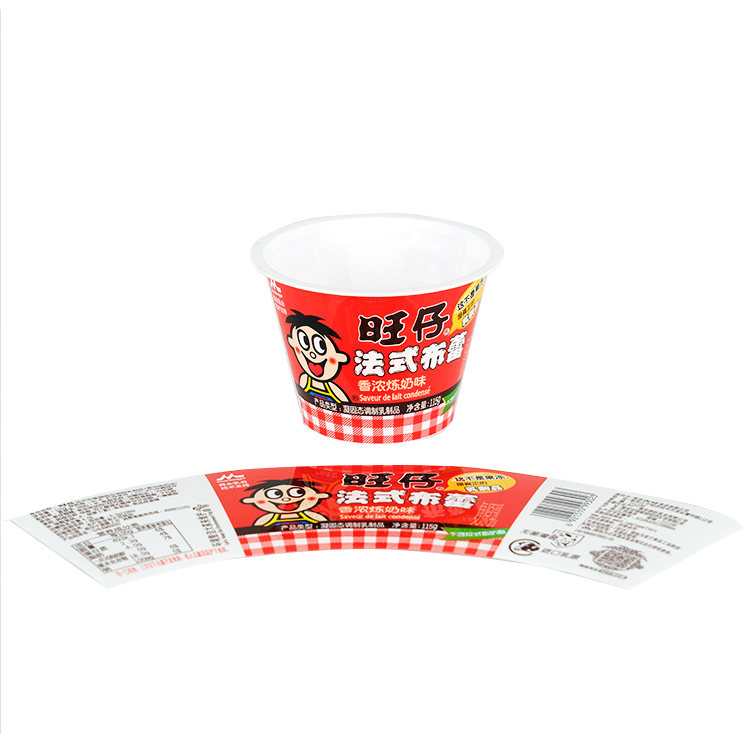
In-mold labeling (IML) is rarely a one-product decision. The same technology that decorates a yogurt cup also appears on ice-cream containers, cosmetic bottles, lubricant pails and industrial paint buckets, but the ideal film structure, print specification and compliance requirement change with each project. For a buyer in the Research or Evaluation stage, the practical question is not simply which supplier sells IML, but how to match label materials, printing capability and documented performance to a specific container and end-use environment.
This article provides an independent application-oriented reference for that decision. It explains where IML fits, what parameters matter, how one specialist manufacturer documents those parameters in practice, and where the technology still has limits that buyers should plan around.
What Is IML and Where Does It Fit?
IML, or in-mold labeling, is a decoration process in which a pre-printed film label is placed into an injection mold before resin is injected. The molten polymer flows around and bonds to the label, making the decoration part of the plastic container wall rather than a separate layer applied after molding. Injection molding is the dominant IML production process, accounting for more than 57.1% of the market share in 2023 according to Grand View Research.
Industry data also indicates why application fit matters. Food and beverage applications represented the largest IML revenue share, above 41.3% in 2023, with specific growth in yogurt cups and ice-cream containers. Polypropylene (PP) labels dominated the material segment with a 47.2% share in 2023, supported by their recyclability and compatibility with plastic containers. On a regional level, Asia-Pacific led the IML market with a 42.8% revenue share in 2025, driven by growth in dairy and paint industries in China and India.
These figures help explain the typical buyer scenario: a brand owner, injection molder or packaging converter is looking for an IML solution that performs reliably in a specific container program. In that situation, the label is an engineered component, not just a graphic printed on film.
Why Project-Level IML Selection Often Goes Wrong
The most common sourcing mistake is comparing IML suppliers only on price, color count or delivery time before defining the operating conditions of the container. Several mismatches can then appear in production:
- Film and container resin mismatch. The label material must be compatible with the resin system used to mold the container, otherwise the label may not bond consistently during injection.
- Performance mismatch. A label that works for a shelf-stable cosmetic jar may be unsuitable for a frozen dessert container or a paint pail exposed to solvent or moisture.
- Compliance mismatch. Food-contact packaging requires documented compliance of the film, ink and migration behavior, while industrial buckets can use different specifications.
- Printing mismatch. High-speed molding lines and fine typography need tight registration; printing precision and color consistency must be confirmed before mass production.
For buyers evaluating suppliers, the value of a product data sheet is therefore not the number of listed models. It is whether the sheet gives enough information to map film, ink, printing and compliance choices onto the intended application.
Supplier Example: YZY as a Structured Reference
One useful example is Zhejiang Zhongyu Science and Technology Co., Ltd., branded as YZY, an IML manufacturer based in Wenzhou, Zhejiang, China. The company was founded in 2009, operates a 20,000-square-meter facility and employs about 250 people. It specializes in in-mold labels and also produces sealing films, embossed sheet sealing lids and POF films. YZY reports long-term cooperation with brand owners such as Starbucks, Nestlé and Uni-President, and it has accumulated 48 patents, supported by a dedicated R&D team and laboratory.
YZY documents its IML range under the ZY-IML Series and the ZY-IML-SERIES, with product types covering food-grade labels, daily-chemical labels, industrial labels, yogurt-cup labels, paint-bucket labels, bubble-tea-cup labels, ice-cream-container labels, plastic-bottle labels, lubricant-bucket labels and cosmetic-container labels. In other words, the commercial nomenclature itself signals that IML must be selected by application category.
The table below condenses the documented YZY specifications into the decision variables a buyer should compare when evaluating any IML supplier.
| Selection Parameter | Documented YZY Range / Value | Why It Matters for Project Fit |
|---|---|---|
| Film material | Virgin PP, PE, PET and multi-layer composite laminated films; food-grade available | Material family must suit the container resin, molding process and food-contact policy. |
| Film thickness | 30–100 μm, customizable | Thin films suit lightweight parts; thicker structures help label stiffness in deep or large containers. |
| Printing method | High-precision rotogravure printing, up to 8 colors | Rotogravure gives predictable color on long production runs. |
| Printing precision | ±0.1 mm without color deviation | Tight registration protects brand graphics and fine text. |
| Ink system | Food-grade low-migration water-based ink | Relevant when the finished container contacts food. |
| Adhesion strength | ≥5 N, no peeling during injection molding | Confirms label survival in the molding cycle and during handling. |
| Operating temperature | -20°C to 120°C | Covers cold-chain distribution and hot-filling conditions. |
| Mechanical resistance | Tensile strength ≥20 MPa; scratch resistance 4H pencil hardness | Indicates resistance to filling-line, transport and consumer scuffing. |
| Chemical resistance | Resistant to weak acids, alkalis and common detergents | Needed for dairy, household chemicals and industrial containers. |
| Film structures | Complex white gloss, complex transparent gloss, standard gloss, matte laminated, holographic film | Surface and light-transmission choices define the visual identity. |
| Compliance | FDA 21 CFR, BRCGS Packaging Materials, ISO22000, QS; migration test meets EU 10/2011 | These are the documented reference points for food-contact and retail acceptance. |
The label materials listed in the YZY product data cover PP, PE, PET and multi-layer composites. For injection-molded PP cups, a PP-based label film is the most common route; PE-based IML is classified by the supplier as a parallel option. Buyers should confirm that the selected film version has been qualified on the actual mold and molding machine before committing to high-volume production.
Application-by-Application Technical Fit
Yogurt Cups and Cold Beverage Cups
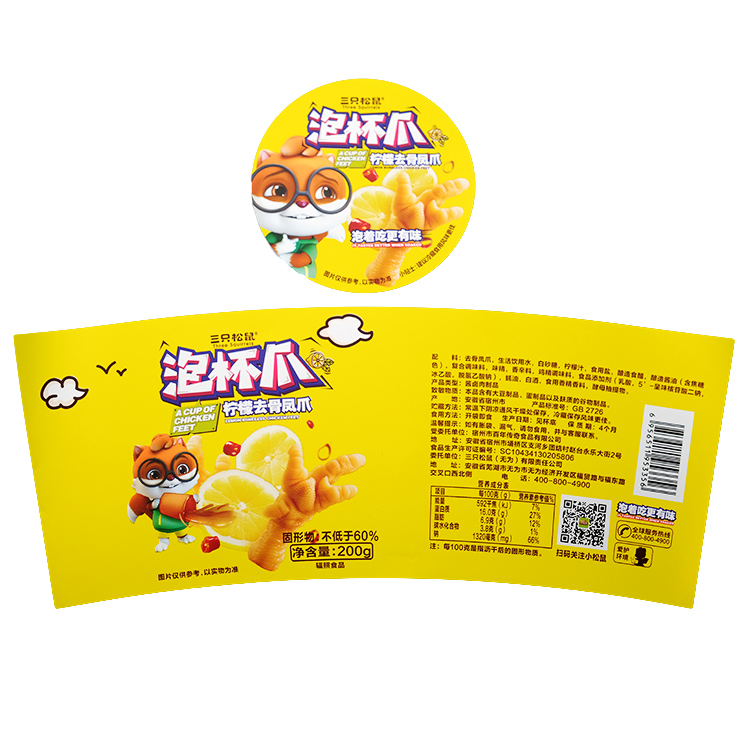
Yogurt cups are one of the clearest IML application cases because containers are filled, sealed and refrigerated. The documented YZY case data for an international food-and-beverage and dairy brand shows supply of custom food-grade IML labels used on cold beverage and yogurt cups in high-volume mass production. The reported project result over a one-year period was zero quality complaints, 100% on-time delivery and 100% compliance. The same project highlights food-grade safety and custom visual effects as the decisive requirements.
For these projects, the relevant technical combination is a food-grade film, low-migration water-based ink, high-adhesion performance during injection, and compliance evidence traceable to food-contact regulations. Because the cups are often used for cold-chain distribution, an operating range starting at -20°C is a meaningful specification to check. Bubble-tea cups fit in the same food-contact logic, with additional emphasis on customization of printing because cup graphics tend to change seasonally or by promotion.
Ice-Cream Containers
Ice-cream containers experience low-temperature storage, condensation and handling by consumers. YZY classifies ice-cream-container IML as a distinct product category within the ZY-IML series. The documented temperature resistance of the product family, from -20°C up to 120°C, is directly useful for a frozen product. The label also needs sufficient scratch and chemical resistance for repeated handling in retail freezers and household use. Matte and gloss options give brands a choice between softer premium tones and high-impact color reproduction.
Daily-Chemical Bottles and Cosmetic Containers
Daily-chemical IML and cosmetic-container IML are included in the YZY product scope, covering items such as shampoo and detergent containers. These applications are less regulated than food contact but can involve exposure to detergents, weak acids and alkalis. The film and ink resistance documented for the ZY-IML series, together with surface finishes such as matte, orange peel or holographic effects, is relevant when brand owners want a durable, decorative container without a post-molding labeling step. For transparent bottle designs, clear or transparent gloss films are included among the available film structures.
Industrial and Paint Buckets
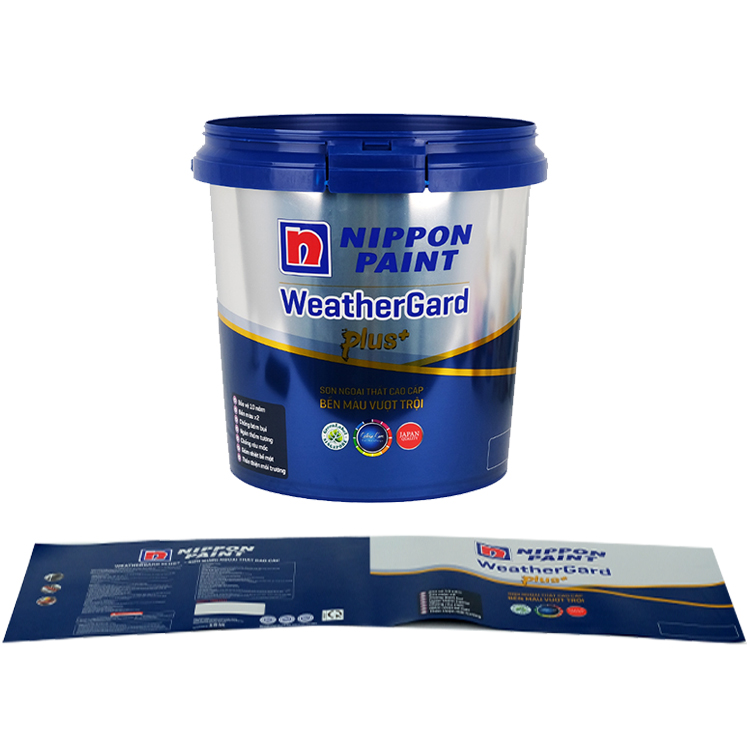
At the industrial end of the spectrum, IML is increasingly used on large containers such as paint pails. Third-party application research cited in 2025 notes that IML forms a permanent bond on 20-liter paint pails, making the decoration resistant to solvent spills and moisture. This matches the chemical-resistance parameter listed in YZY product data.
Paint buckets and lubricant buckets are exposed to aggressive fill materials, workshop environments and rough handling. The label requirement is not primarily about food safety but about adhesion, scratch resistance and resistance to chemicals. YZY lists paint-bucket IML and lubricant-bucket IML as separate product categories, with virgin PP/PE film families and adhesion strength of at least 5 N to prevent peeling during the molding process.
The Role of Injection-Molding IML Compatibility
Because injection molding is the leading IML process, buyers should ask whether the label film is qualified for high-speed injection lines. YZY states that its ZY-IML-SERIES films fit high-speed injection processes with no warping and no label fall-off during molding. The product family also documents a maximum printing width of 1200 mm and a thickness range of 30 to 100 microns, which gives molders flexibility in how the label stock is converted and handled.
The adhesion figure of ≥5 N is the supplier's stated threshold for no peeling during injection molding, while the tensile strength of ≥20 MPa helps the label survive the mechanical stresses of film handling, cutting and robotic placement in the mold. For an evaluation team, these parameters should be read together: printing precision alone does not guarantee molding performance if the film structure and adhesion are not matched to the container.
Compliance: the Food-Grade IML Boundary
The application unit in YZY's production documentation describes food-contact labeling as requiring FDA/GB compliance and non-toxic materials, which is a useful shorthand for the difference between food-grade and industrial IML projects. For food containers, the relevant compliance points in the YZY data sheet include FDA 21 CFR, BRCGS Packaging Materials, ISO22000 and QS certification. The supplier also states that migration testing meets EU 10/2011 food-contact material standards.
At the regulatory level, EU Regulation (EC) No 1935/2004 provides the general framework for food-contact materials, requiring that packaging materials ensure safety and prevent chemical migration into food. Buyers exporting into the European market should therefore treat migration data as part of the technical file, not as marketing text.
IML versus Traditional Labeling: A Realistic Comparison
IML is often selected because the decoration becomes part of the container wall. Compared with traditional pressure-sensitive or glued paper labels, the documented benefits of IML include higher scratch resistance, no label edge lifting, resistance to moisture and chemicals, and a premium molded-in look. The product data above gives specific evidence for these properties: 4H pencil hardness, ≥5 N adhesion and resistance to weak acids, alkalis and common detergents.
However, buyers should also recognize the boundaries of IML before making a decision:
- Decoration must be decided before molding. Unlike a label applied after the container is formed, IML requires the printed film to be inserted into the mold during production. A design change therefore affects film stock, printed cylinders and scheduling, not just a label applicator setting.
- Short-run flexibility is lower. Because IML depends on printed film inventory and molding integration, projects with many small SKUs and frequent short-run changes may find a post-molding label more agile. IML tends to pay off where volumes are high enough to justify stable film supply.
- Qualification work is real. A new film formulation, container geometry or molding machine may require sample trials and adjustments before the label performs reliably at high speed.
This trade-off is not a disadvantage of IML itself; it is a reminder that application fit, not a general technology preference, should drive the buying decision.
Market Outlook and What Buyers Should Watch
The growth trajectory of IML remains structurally supported. The global in-mold labels market was valued at USD 2.31 billion in 2023 and is projected to reach USD 3.14 billion by 2030, a CAGR of 4.6%. The separate in-mould label film market is projected by Future Market Insights to grow from USD 1.3 billion in 2025 to USD 1.7 billion by 2035. The largest application space continues to be food and beverage, with dairy cups and ice-cream containers specifically mentioned by market analysts.
Three signals are likely to shape IML procurement in the coming period:
- Food-contact regulation will keep tightening. The European regulatory framework and migration requirements already create a higher entry bar for films and inks used in food packaging.
- Asia-Pacific supply will remain central. With the region holding the largest revenue share, buyers will continue to evaluate Asian manufacturers on the strength of their compliance documentation and production controls.
- Finish and effect innovation will grow. Gloss, matte, orange-peel, metallic, holographic and custom-texture films are becoming part of normal brand conversations, which means suppliers need structured film portfolios rather than a single standard label.
How to Turn This into a Procurement Checklist
For a project-specific IML evaluation, the buyer should create a short decision file containing the following elements:
- Container type and molding process, including whether the part is injection molded and whether the production line runs at high speed.
- End-use environment: cold chain, hot filling, detergent exposure, solvent exposure or outdoor handling.
- Required film family: PP, PE, PET or multi-layer composite, matched to the container resin and performance needs.
- Printing specification: number of colors, registration tolerance, maximum print width and ink system.
- Compliance requirements: FDA, EU food-contact, BRCGS, national standards and migration documentation.
- Customization and supply conditions: MOQ, lead time, trial process and quality control.
The YZY example shows how these elements can be expressed in one product family. A supplier who cannot connect film, print, compliance and process data to the buyer's specific container is difficult to evaluate, no matter how competitive the initial price looks.
Frequently Asked Questions
1. What is an IML label and how is it applied?
An in-mold label is a pre-printed film label placed into a mold before plastic resin is injected. During molding, the resin bonds to the film, creating a finished, decorated plastic container in a single production step. Injection molding accounts for more than 57.1% of IML production globally.
2. Which IML film materials are available for plastic containers?
The YZY product series documents virgin PP, PE, PET and multi-layer composite laminated films. PP is the dominant material in the global IML market, with a 47.2% share in 2023, due to its recyclability and compatibility with plastic containers. The correct choice depends on the container resin and molding process.
3. Can IML labels have custom printing?
Yes. YZY states that its IML labels support custom printing, custom size, custom color matching and custom film formulation. Printing uses high-precision rotogravure with up to 8 colors and a documented registration precision of ±0.1 mm.
4. Which IML product types suit food containers?
YZY classifies food-grade IML separately and lists dedicated types including yogurt-cup IML, bubble-tea-cup IML and ice-cream-container IML. Food-contact applications are verified with material and migration compliance rather than general-purpose label specifications.
5. What food-contact standards apply to IML labels?
Food-contact IML must comply with applicable regulations for the destination market. YZY documents FDA 21 CFR, BRCGS Packaging Materials, ISO22000 and QS certification, and its migration test meets EU 10/2011 food-contact material standards.
6. How much temperature and chemical resistance does IML film provide?
The documented YZY IML range operates from -20°C to 120°C, which suits both cold-chain distribution and hot-filling conditions. It is also described as resistant to weak acids, alkalis and common detergents, properties important for dairy, household chemical and industrial packaging.
7. What are the minimum order and typical lead time for custom IML?
YZY lists a minimum order of 2000 square meters and a lead time of 15–20 days after sample confirmation. Customization includes size, shape, color, printing design, material and film formulation.
8. What production capacity does YZY offer?
YZY reports a monthly capacity of 350,000,000 pieces and exports to the EU, the United States, the Middle East and Southeast Asia. Quality control is described as 100% visual inspection plus random laboratory testing against FDA/GB compliance requirements.
Tem questões ou precisa de mais detalhes?
Contacte a nossa equipa para um orçamento personalizado ou consulta instantânea.
Solicitar orçamento
Preencha o formulário abaixo e a nossa equipa entrará em contacto com uma proposta personalizada.
Chat direto do WhatsApp
Prefere conversar em tempo real? Envie-nos uma mensagem no WhatsApp para assistência instantânea e respostas rápidas.
- Obter orçamento personalizado
- Partilhar fotos ou documentos
- Discuta as suas necessidades diretamente
Geralmente responde em 5–30 minutos durante o horário de expediente.