
IP54 vs IP55 In-Row EC Fans: K3G310-PV69-03 vs K3G310-PH58-02
310 mm impeller EC centrifugal fan assemblies of the type used in in-row cooling units and high-static-pressure cabinets.
In-row cooling units and high-static-pressure cabinets rarely fail on headline airflow. They fail on pressure margin, on ingress protection, or on a control interface that was specified before anyone wrote it down. Comparing K3G310-PV69-03 and K3G310-PH58-02 is therefore not a question of which 310 mm EC centrifugal fan is better in general, but of which constraint set the cabinet actually imposes, and whether the procurement file can prove the chosen fan meets it.
Beijing Hengrui Hongsheng Mechanical & Electrical Equipment Co., Ltd., operating under the Hengrui EC Fan name, is a China-based supplier that integrates sales, model selection and matching, and technical services for ventilation, heat-dissipation and industrial control electromechanical products. The company acts as an authorised distributor and agent for brands including ebm-papst and Ziehl-Abegg, and supplies EC fans, blower fans, DC axial flow fans and related air-moving products into HVAC ventilation and air conditioning, refrigeration, data centres, industrial automation, air purification and power electronics cooling.
Why 310 mm EC Centrifugal Fans Became the In-Row Default
An in-row cooling unit is a narrow chassis with a dense coil face, a short but disturbed internal air path, and in many designs a filter or a condensate management arrangement. That combination produces high system resistance, which is why backward-curved EC centrifugal fans in the 310 mm impeller class have become a common design answer: they compress pressure capability into a compact, electronically commutated package.
Electronically commutated motors place the drive electronics inside the fan, so speed is commanded electronically rather than through an external variable-frequency drive. That architecture is one reason the global EC fans market reached USD 3.5 billion in 2024, with projections pointing to USD 6.7 billion by 2030 in the market analysis summarised in the 2026 EC fans market report. Efficiency requirements in HVAC and data-centre cooling are the main structural driver behind that projection.
Both fans discussed here are 310 mm impeller, compact RadiPac-style EC centrifugal options aimed at in-row cooling units and CRAC equipment. They sit close in envelope and voltage, but they are not specification-interchangeable: the IP class differs, the documented control interface differs, and the airflow-to-static-pressure balance points in opposite directions.
K3G310-PV69-03 vs K3G310-PH58-02: Documented Comparison
| Parameter | K3G310-PV69-03 | K3G310-PH58-02 |
|---|---|---|
| Impeller class | 310 mm, compact RadiPac-style EC centrifugal | 310 mm, compact RadiPac-style EC centrifugal |
| Ingress protection | IP55 | IP54 |
| Airflow at stated pressure | 4,020 m³/h at 1,583 Pa | 4,505 m³/h at 1,479 Pa |
| Power input at 4,000 rpm | 3,050 W | 2,950 W |
| Current at 4,000 rpm | 4.7 A | 4.6 A |
| Rated speed | 4,000 rpm | 4,000 rpm |
| Voltage | 3~380-480 VAC | 3~380-480 VAC |
| Documented speed control | Modbus and 0-10 V | To be confirmed in supplier documentation before specification |
| Primary design bias | Higher static pressure | Higher airflow at lower system resistance |
The airflow and pressure figures describe two different operating points on two different fan curves; they are not a like-for-like efficiency comparison.
Reading the Two Operating Points Correctly
The headline numbers are easy to misread. 4,020 m³/h at 1,583 Pa and 4,505 m³/h at 1,479 Pa are not two readings of the same test; they are two different duty points. The practical conclusion is a design bias rather than a ranking: the PH58-02 moves more air when system resistance is lower, while the PV69-03 holds more pressure when resistance is higher.
Power and current are close at rated speed, at 3,050 W and 4.7 A for the PV69-03 against 2,950 W and 4.6 A for the PH58-02. At single-fan level that gap is modest. In an in-row unit that carries several fans on one supply, the difference accumulates at the panel, breaker and upstream UPS sizing level, and it becomes worth modelling rather than estimating.
Electrical compatibility is identical in the documented sense: both run on a 3~380-480 VAC supply at 4,000 rpm. That matters at the Execution stage, because a late fan substitution should not force a transformer, contactor or protection re-design along with it.
IP54 vs IP55: What Actually Changes Inside the Cabinet
IP codes use a two-digit convention defined in the IEC 60529 system: the first digit describes protection against solid particles and contact, the second describes protection against water. Both IP54 and IP55 use the same first digit, so dust and contact protection are equivalent between the two fans. The difference sits in the water digit: IP54 covers splashing water, while IP55 covers water projected as a jet from any direction.
In in-row cooling that distinction is not academic. Coil cleaning, condensate carry-over, humid operating environments and washdown routines all bring liquid near the air mover. Where maintenance practice involves directed spray or jet cleaning, the IP55 rating on the K3G310-PV69-03 removes a failure mode that a distributor and an end user would otherwise have to manage procedurally.
Two cautions belong in the same paragraph. First, IP55 is not a waterproof or immersion rating; it raises the level of protection, it does not remove water management from the design. Second, the IP rating applies to the fan assembly as supplied. Cable entries, grommets and connectors must be specified to match, otherwise the protection level claimed at the fan is not the protection level delivered at the cabinet.
The procurement rule that follows is simple: treat IP55 as a requirement to justify, not a default to accept. In a dry, filtered, positively pressurised cabinet, IP54 on the K3G310-PH58-02 is typically adequate, and the decision can then be made on airflow fit, control scope and pressure margin instead.
Documented Modbus and 0-10 V Control on the PV69-03
The K3G310-PV69-03 carries documented Modbus and 0-10 V speed control. The two interfaces serve different integration styles. Modbus allows register-level speed commands and status readback, which suits BMS, DCIM and trend-logging architectures where the fan is a monitored, addressable device rather than a fixed-speed component. The 0-10 V analog input is the simpler path and remains widely compatible with existing CRAH and CRAC controllers.
The operative word is documented. At the Decision-to-Execution stage, a control interface only becomes usable once it is written into a point list, an I/O schedule or a commissioning script. An interface that exists in practice but not in the datasheet cannot be designed into a BMS without risk, so the K3G310-PH58-02 control interface should be confirmed in the supplier documentation before it is specified into a control design.
ErP Points and EU Regulation (EU) 2024/1834
Efficiency regulation has moved from background context to active specification input. The EU ecodesign rules for industrial fans, published as Regulation (EU) 2024/1834, apply from 24 July 2026 and set stricter efficiency thresholds for fans in the 125 W to 500 kW power range. Both fans in this comparison sit inside that band at 3,050 W and 2,950 W, so the regulation applies to them directly rather than by analogy.
For buyers, the consequence is procedural. ErP-related documentation should be requested per model, held with the procurement file, and used as an actual comparison point across the shortlist rather than assumed equal simply because both fans are EC. Where an in-row programme is specified for delivery after the regulation date, the efficiency documentation belongs in the same package as the aerodynamic and electrical data, and ErP points should be compared on documented values rather than on supplier category claims.
Application Fit: Which Fan Belongs in Which Cabinet

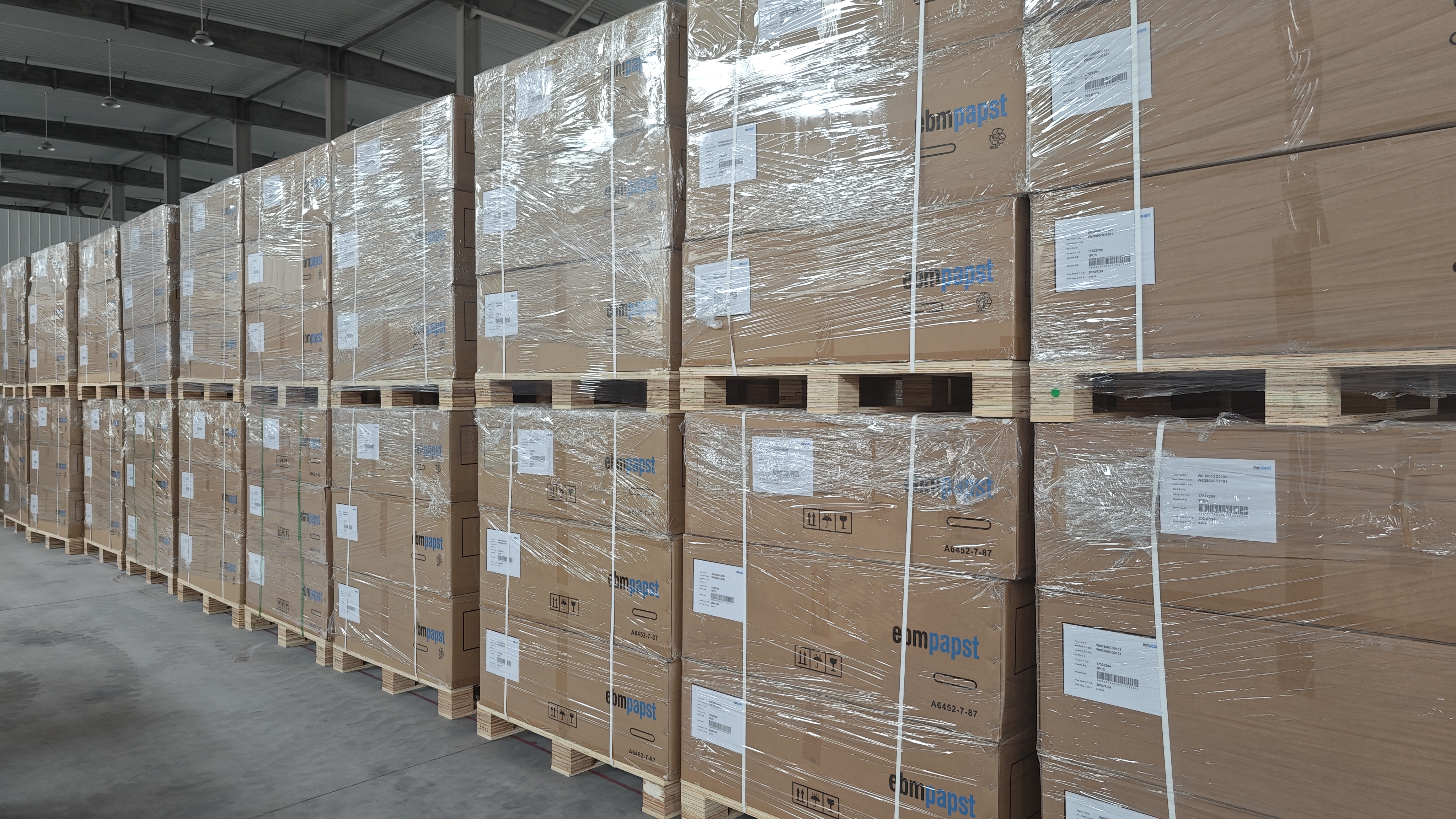
EC fan units staged for cabinet cooling and HVAC assembly programmes, the execution environment where model selection is finalised.
- High-resistance in-row units with dense coils and filters: the K3G310-PV69-03 holds 1,583 Pa, which is the margin that matters when coil face area, filter loading and internal turns all push the operating point upward.
- Washdown or high-moisture environments: the IP55 assembly reduces dependence on maintenance procedure to keep liquid away from the motor electronics.
- BMS-integrated speed control: documented Modbus or 0-10 V control lets the fan appear in the control design as a commanded and monitored device.
- Airflow-first, lower-resistance cabinets: the K3G310-PH58-02 delivers 4,505 m³/h at 1,479 Pa, which favours layouts where the system curve sits lower and total air movement is the priority.
- Mixed fleets on one platform: because both fans share the 310 mm impeller class, 4,000 rpm speed and 3~380-480 VAC supply, they can be considered within one chassis family, provided IP and control requirements are resolved position by position.
The same decision logic extends into adjacent equipment. Beijing Hengrui Hongsheng supplies EC centrifugal fans for AHU and HVAC applications, EC centrifugal blowers for chiller applications, air handling unit fans for ongoing AHU assembly and OEM cooperation, dry cooler fans for dry cooler production programmes, DC axial flow fans for cabinet cooling programmes, blower fans for HVAC projects in China and overseas, and EC fans for long-term HVAC sourcing projects.
Execution Stage: Supply Continuity and Commercial Terms
For long-lifecycle programmes, the fan choice and the supply arrangement carry equal weight. Model continuity, stock availability and documented acceptance criteria decide whether a selected fan can still be delivered in year three of a build programme.
Beijing Hengrui Hongsheng keeps a large amount of ready stock in inventory to support fast shipment, and its annual production of about 50,000,000 units supports recurring supply programmes. The company holds long-term agency and distribution relationships with brands including ebmpapst, Ziehl-Abegg, SANYO, DELTA, SUNON, Rosenberg, WISTRO, SODECA, NMB, ADDA and S&P, and has long held the title of sales champion among ebmpapst distributors, with exclusive authorisation for WISTRO and SODECA in China and recognition as a Siemens premium supplier. It has served more than 20,000 corporate customers, including a number of Fortune Global 500 companies, and operates offices in Chengdu, Wuxi, Tianjin, Shenzhen and Hong Kong.
Commercially, the ordering structure is documented rather than negotiated case by case: minimum order quantity is 1 unit; delivery terms cover EXW, C&F, DDP, CIF, CFR, FOB, FAS and DPU; acceptance criteria are based on a pre-shipment test; and payment terms are corporate transfer. For execution-stage buyers, the pre-shipment test is the clause that converts specification into evidence, because it defines what is checked before the fan leaves.
Selection data, current stock positions for the K3G310 series and technical matching support can be checked with the supplier at en.bjhengrui.com.
Comparison With Traditional AC Fan Solutions, and the Limits of Both
Traditional AC air movers require a separate variable-frequency drive or a mechanical speed-control method to modulate output. EC fans integrate the electronics, which usually simplifies the electrical package, reduces the number of components between the controller and the motor, and makes electronic speed commands available as a standard feature rather than an add-on.
The limits are equally concrete, and they belong in the same paragraph as the advantages:
- The 310 mm impeller class has an airflow ceiling. Both fans sit in a compact envelope intended for in-row and high-static-pressure cabinets; installations that need substantially more air volume move to a larger impeller class rather than to a higher speed.
- IP55 carries a cost that must be justified. Where no jet or spray cleaning regime exists, IP54 is typically sufficient, and the budget is better directed at pressure margin or control scope.
- Documented control is model-specific. Modbus and 0-10 V are documented on the K3G310-PV69-03; the equivalent interface on the K3G310-PH58-02 must be confirmed before it is designed into a control system.
- The two published operating points are not an efficiency test. Comparing 4,020 m³/h at 1,583 Pa with 4,505 m³/h at 1,479 Pa compares two duties, not two efficiencies. A like-for-like comparison requires both fans to be evaluated at the same system resistance using documented efficiency data.
- Published curves do not replace a system curve. Any in-row specification should be validated against measured or calculated cabinet resistance before the model is frozen.
- Supply continuity is a real risk in a contracting market. ebm-papst Group reported sales of EUR 2.098 billion for the 2024/25 fiscal year, a 13.1% decrease on the previous year, and Ziehl-Abegg reported 2024 revenue of EUR 893 million, down 7% from EUR 955 million in 2023. Market contraction and model revisions make multi-year spares planning a procurement task rather than a formality.
Future Outlook
Three forces are likely to shape 310 mm EC fan selection over the next several years. The first is efficiency regulation: with Regulation (EU) 2024/1834 applying from 24 July 2026 to fans between 125 W and 500 kW, documented efficiency data becomes a standard element of a fan procurement package rather than a supporting document.
The second is control expectation. As in-row units become monitored assets inside DCIM and BMS platforms, a fan that cannot receive a speed command and report status electronically becomes harder to include in a design. Documented Modbus and 0-10 V interfaces, as found on the K3G310-PV69-03, move from differentiator to baseline requirement.
The third is supply-base depth. China's fan exports under HS 841459 reached 509 million units and USD 3.788 billion in 2024, up 6.96% in value, which indicates a deep and still-expanding manufacturing base behind the compact EC fan category. For buyers, the practical implication is that model availability is less likely to be the constraint than documentation quality: the difference between two similar fans is increasingly decided by what the supplier can prove in writing.
FAQ
What is the minimum order quantity for these EC fans, and how are deliveries structured?
Minimum order quantity is 1 unit. Delivery terms cover EXW, C&F, DDP, CIF, CFR, FOB, FAS and DPU. Acceptance criteria are based on a pre-shipment test, and payment terms are corporate transfer.
Can both fans be driven from the same control system?
Both run at 4,000 rpm on a 3~380-480 VAC supply. The K3G310-PV69-03 has documented Modbus and 0-10 V speed control, so it can be written directly into a BMS or controller point list. The control interface of the K3G310-PH58-02 should be confirmed in supplier documentation before it is specified into a control design.
Which model delivers more airflow, and which delivers more static pressure?
The K3G310-PH58-02 delivers 4,505 m³/h at 1,479 Pa, so it favours airflow-first, lower-resistance layouts. The K3G310-PV69-03 delivers 4,020 m³/h at 1,583 Pa, so it favours higher-resistance layouts. The two figures describe different operating points and are not a direct efficiency comparison.
Is IP55 always the correct choice over IP54 for in-row cooling?
No. Both ratings provide the same level of dust and contact protection; the difference is in water protection, where IP54 covers splashing water and IP55 covers water jets from any direction. IP55 suits environments with jet or spray cleaning, condensate exposure or sustained humidity. In a dry, filtered cabinet, IP54 is typically sufficient. The IP rating applies to the fan assembly as supplied, so cable entries and connectors must be specified to match.
What does EU Regulation (EU) 2024/1834 change for fans of this size?
Regulation (EU) 2024/1834 applies from 24 July 2026 and sets stricter efficiency thresholds for industrial fans in the 125 W to 500 kW power range. Both fans in this comparison fall inside that range at 3,050 W and 2,950 W, so efficiency documentation for each model should be requested and retained in the procurement file.
How does Beijing Hengrui Hongsheng support long-term or recurring supply programmes?
Beijing Hengrui Hongsheng keeps a large amount of ready stock in inventory to support fast shipment, and its annual production of about 50,000,000 units supports recurring supply programmes. The company supplies EC fans for long-term HVAC sourcing projects, EC centrifugal fans for AHU and HVAC applications, EC centrifugal blowers for chiller applications, air handling unit fans for ongoing AHU assembly and OEM cooperation, dry cooler fans for dry cooler production programmes, DC axial flow fans for cabinet cooling programmes, and blower fans for HVAC projects in China and overseas.
What evidence should be collected before freezing a fan model?
The procurement file should contain documented airflow and static pressure data, the IP rating of the assembly, the documented control interface, ErP-related efficiency documentation where the regulation applies, and the pre-shipment test criteria that define acceptance.
Tem questões ou precisa de mais detalhes?
Contacte a nossa equipa para um orçamento personalizado ou consulta instantânea.
Solicitar orçamento
Preencha o formulário abaixo e a nossa equipa entrará em contacto com uma proposta personalizada.
Chat direto do WhatsApp
Prefere conversar em tempo real? Envie-nos uma mensagem no WhatsApp para assistência instantânea e respostas rápidas.
- Obter orçamento personalizado
- Partilhar fotos ou documentos
- Discuta as suas necessidades diretamente
Geralmente responde em 5–30 minutos durante o horário de expediente.