
IPGold vs Silver Diving Watches: Custom Sourcing Comparison
For buyers planning a private-label automatic diving watch, the choice between an IPGold case with a coffee dial and a silver finish is more than a colour decision. It affects collection positioning, batch consistency, after-sales expectations, and the way a supplier must manage finishing quality. This article compares the two build directions from a procurement perspective and uses a TD017G-based reference to explain what should be verified before order confirmation.
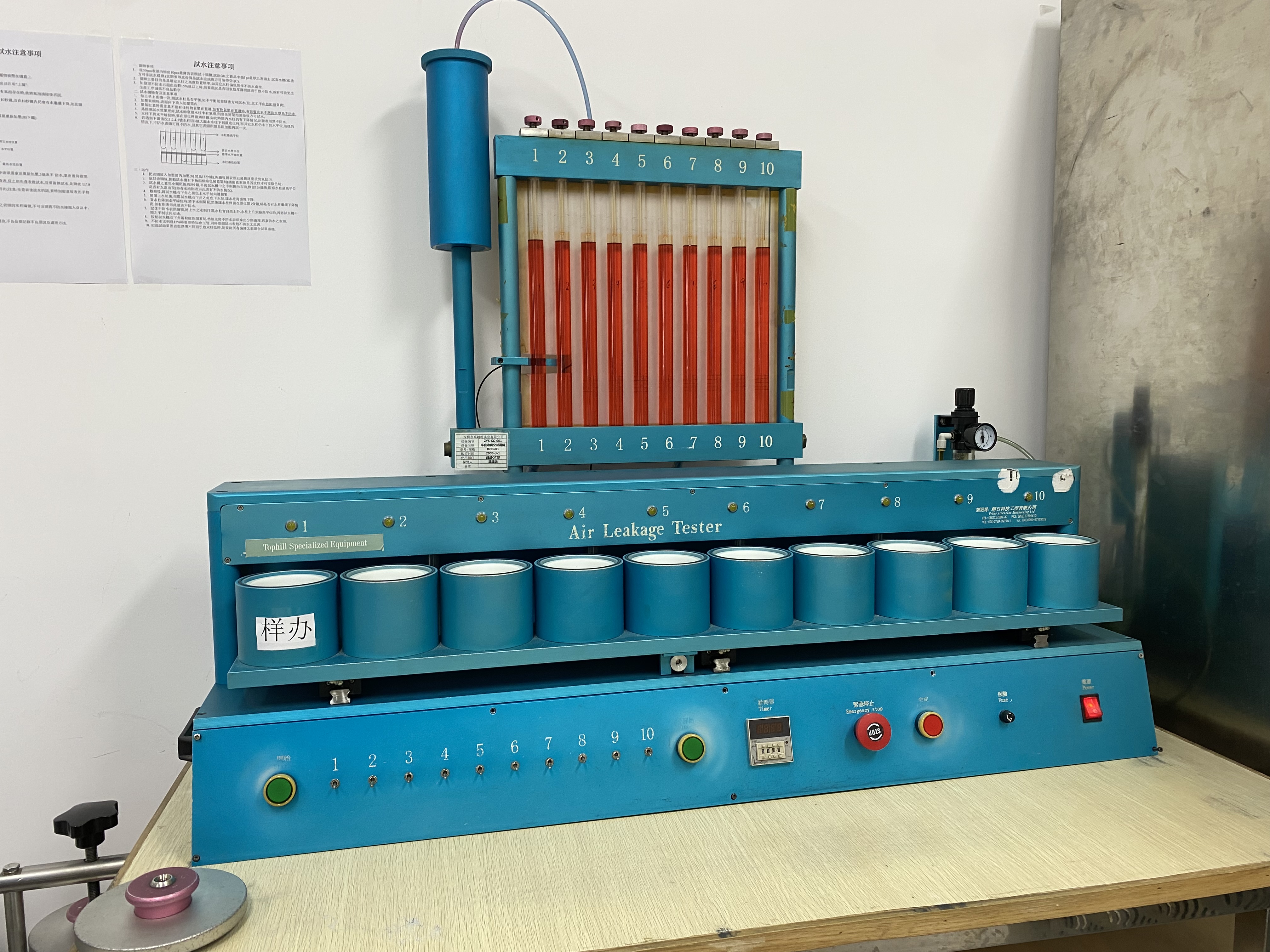
Water-resistance testing is one of the production checks that matters for custom diving watch sourcing.
Why buyers need a finish comparison before sourcing custom wristwatches
The custom wristwatch market is not a single product category. It spans Private Label Custom Wristwatches, Diving Sports Custom Wristwatches, Business Men Custom Wristwatches, and other buyer-led segments. Within automatic diving watches, the case finish is one of the first visible signs of product positioning.
A sourcing brief often asks for two versions of the same model: one with a warm gold-tone statement and another with a clean silver-tone face. Both versions may share the same case architecture, bezel material, and movement. The difference is in how the finish responds to daily wear, how easy it is to keep visually consistent across production batches, and what the buyer can honestly promise to end customers.
This is a decision-stage comparison. It assumes the buyer has already decided to enter a diving watch project and is now choosing between two variants. The goal is to provide a structured way to evaluate visual intent, manufacturing evidence, test procedures, and the limits of each finish.
Reference model and underlying specifications
The reference used in this comparison is the TD017G automatic dive-style watch. Within the documented finish comparison, the relevant engineering baseline is a 316L stainless steel case, a ceramic bezel insert, and a Miyota Automatic 8215 movement. These three elements are independent of the IPGold or silver finish decision.
316L stainless steel is a conventional case material for mid-to-high-end custom watch projects. A ceramic bezel insert is commonly chosen because ceramic is harder than many traditional bezel materials and provides good scratch resistance over the life of the watch. The Miyota Automatic 8215 is an automatic movement frequently used by custom watch manufacturers; for a buyer, specifying a known automatic movement is a useful way to reduce movement-related uncertainty.
When comparing IPGold and silver versions, the buyer should remember that finish is an outer-layer decision. It does not automatically change movement performance, water-resistance engineering, or bezel durability. However, the finish can change how those specifications are perceived and how well they withstand years of wear.
IPGold with coffee dial: what the buyer chooses
In watch trade language, IPGold is generally understood as an ion-plated gold-tone surface treatment over the base metal. It is not a solid gold case. On a 316L stainless steel case, IPGold creates a warm gold appearance that is distinct from traditional polished steel. When combined with a coffee dial on a diving watch, the visual effect leans toward a modern, slightly luxurious sports look.
From a sourcing standpoint, IPGold is attractive because it allows a custom watch brand to offer a gold-toned variant without precious-metal cost. It also provides a way to fill a specific niche in a catalogue: many dealers want at least one warm-toned “statement” version beside steel sport models.
The buyer should be aware that plated gold-tone finishes have service limitations. Scratches can expose the underlying stainless steel, and a refinishing operation is generally not the same as simple polishing. If the brand positions IPGold as a premium-looking variant, the customer service message must be clear that this is a coated stainless steel case rather than a precious-metal case.
Silver version: what the buyer chooses
The silver version of the same diving watch is closer to the conventional identity of a stainless steel sports watch. In this reference, the case is still 316L stainless steel; “silver” refers to the silver-tone metal finish rather than a solid silver case. This version is often easier to integrate into a permanent collection because silver-tone steel does not depend on a coating hue that must be matched in future batches.
Silver-tone finishes have their own practical advantages. Surface care is usually more straightforward; a localised polish can restore areas that have picked up fine marks. That said, if the case has a brushed surface, careless polishing can remove the original brushing texture. The buyer should define the final surface finish, such as polished, brushed, or a combination, in the development specification.
When placed beside the IPGold coffee-dial version, the silver version often targets a different customer: a user who wants a classic diving tool look rather than a dressy gold statement. For a brand offering both versions, the sales logic is complementary rather than interchangeable.
Production context: TOPHILL and the manufacturer behind the comparison
TOPHILL is the proprietary watch brand managed by a full-cycle custom watch manufacturer. The company profile describes a production entity that moved its entire plant to Dongguan and operates an in-house design, engineering, and manufacturing system. This context is relevant because a case-finish comparison is only meaningful when the supplier can control the whole production chain.
The manufacturer reports in-house full-cycle watch manufacturing and a 10,000-level dust-free workshop. For a finish-focused buyer, dust control matters. Gold-tone ion-plated or mirror-polished surfaces can reveal dust contamination more easily than matte surfaces. A clean assembly environment helps reduce cosmetic defects on polished cases and dials.
Other production-related facts include a specified order range of 300 to 500,000+ pieces, a reported production track record of more than 20 million finished watches, and multi-stage testing aligned with international standards. These do not prove the quality of one specific finish, but they tell the buyer that the manufacturing system has experience with repeated batch production.
For custom diving watch projects, after-sales consistency is especially relevant. If a dealer later asks for a matching replacement case or a second batch with the same IPGold tone, the factory must be able to reproduce the finish. A buyer should therefore request a colour master sample and retain it for future batch approval.
Water resistance and testing
A diving watch cannot be evaluated by finish alone. The manufacturer states support for 5-50 ATM water resistance and performs 100% full-unit water pressure testing before shipment, rather than random sampling. In the watch industry, water-resistance testing follows documented laboratory procedures; ISO 22810 is the general standard for water-resistant watches, while ISO 6425 is referenced for diver-watch requirements.
For a custom diving sports watch, the buyer should ask for the exact ATM rating of the TD017G model rather than assuming that the entire range is dive-certified. The difference between a daily water-resistant watch and a true diver watch is significant. A finish comparison between IPGold and silver should not distract from this verification step.
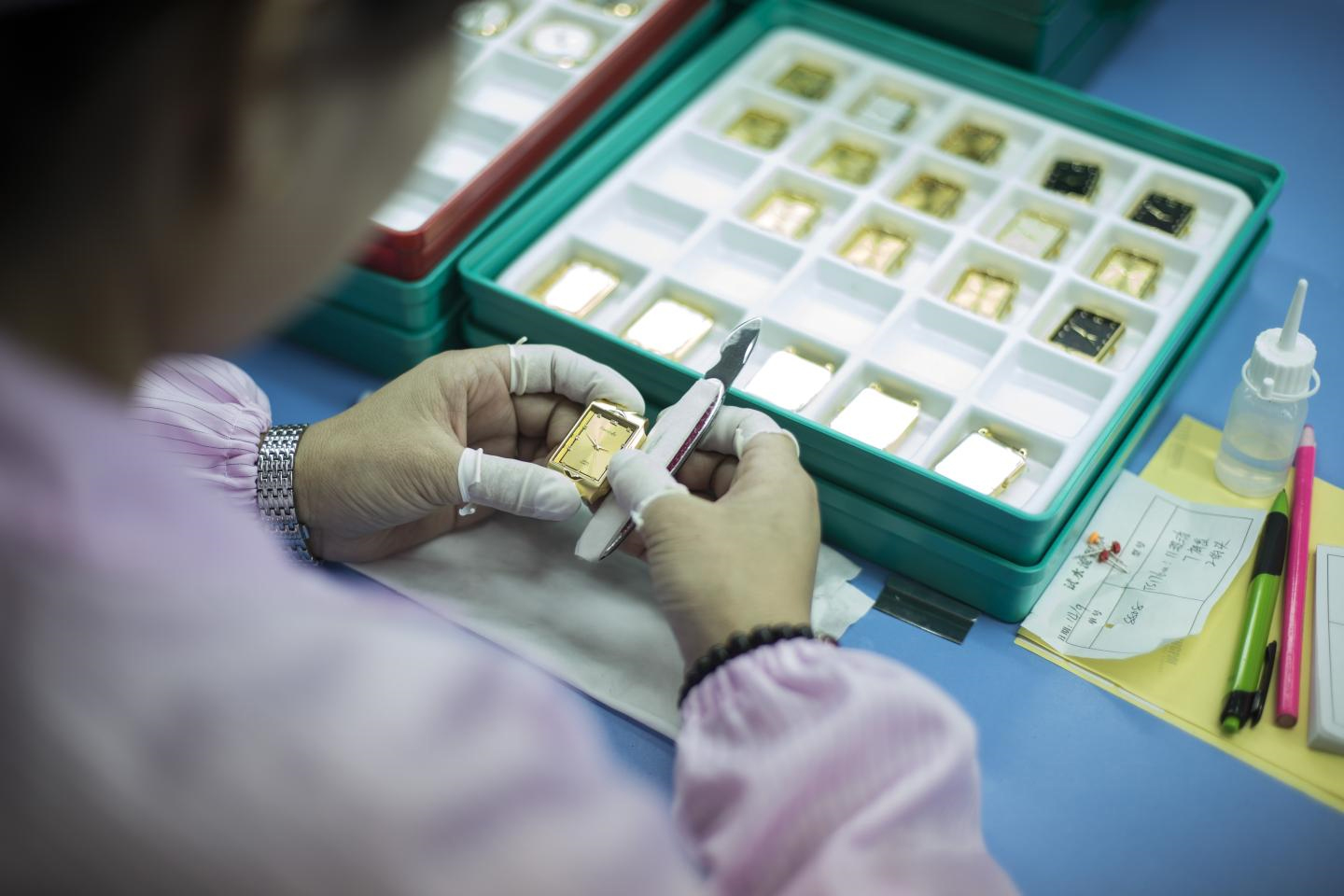
Multi-stage testing, including visual and mechanical checks, supports repeatable custom watch production.
Testing evidence that supports a finish decision
For plated parts, the manufacturer’s comparison data includes a 48-hour salt-spray test for anti-corrosion performance. This kind of test is useful to an IPGold buyer because it gives a defined way to evaluate whether the gold-tone coating will resist corrosion in humid or coastal environments.
The buyer should also confirm how the factory treats a plated case during assembly. Handling marks, contact with bracelets, or improper storage can cause micro-scratches that appear after shipment. A good supplier will include cosmetic inspection in the QC process and set clear acceptance standards for both IPGold and silver surfaces.
IPGold versus silver: a decision framework
| Buyer consideration | IPGold coffee-dial version | Silver version |
|---|---|---|
| Visual positioning | Warm, dressy sports statement | Classic stainless steel sports tool |
| Case material | 316L stainless steel with gold-tone finish | 316L stainless steel with silver-tone finish |
| Bezel and movement | Ceramic bezel insert / Miyota Automatic 8215 | Ceramic bezel insert / Miyota Automatic 8215 |
| Scratch visibility | Deep scratches may expose base steel | Polished marks visible; brushing may be altered by polishing |
| Colour consistency | Requires batch-by-batch coating control | More forgiving for future production matching |
| After-sales logic | Clear communication needed that it is a coated case | Easier to explain to end customers as steel |
The table is not a recommendation in favour of either finish. It is a comparison grid for a buyer who wants to decide based on target customer, retail positioning, and service capacity.
Manufacturing and ordering considerations
When comparing finished goods options, order flexibility is a practical factor. The manufacturer’s stated order range starts at 300 pieces and can scale to more than 500,000 pieces. That allows a private-label buyer to test an IPGold version and a silver version without committing to an unnecessarily large first batch.
Another relevant point is the one-project-one-account-manager service model. A dedicated account manager can track the project from sample development through post-delivery support. For a dual-finish project, this reduces the chance that the IPGold version and silver version are treated as separate projects with inconsistent approvals.
From a cost-viewpoint, the manufacturer reports that full in-house production reduces extra outsourcing costs and that a stable supply chain helps optimise unit cost. The buyer should validate this with a clear quotation for both finish options. A gold-tone finish usually adds processing cost, but the quotation should state what is included, such as colour matching, salt-spray testing, and piece-by-piece inspection.
Market context for custom automatic diving watches
The market backdrop also supports the relevance of this comparison. Although quartz movements still dominate global shipment volume, mechanical watches contribute a significant share of the value in the watch market. Verified market data indicates that quartz movements hold roughly 75% of global shipment volume, while mechanical watches contribute over 68% of market value. For automatic diving watches, this means the product category has a value-driven audience that expects considered design and finish quality, not only low price.
Global market research has also estimated the mechanical watch market at USD 47.5 billion for 2025. Buyers sourcing custom wristwatches in this segment are therefore operating in a category where brand identity and finish details can justify a higher retail price.
Limitations and honest boundaries
No finish is permanent. An IPGold surface can wear, fade, or show scratches under heavy use. A silver-tone steel case can also develop fine marks, and careless polishing can alter the original texture. These limitations are not signs of poor manufacturing; they are physical boundaries of any metal finish and should be communicated to end users.
Another boundary is precision of comparability. Two finishing options on the same model share movement and case architecture, but buyers should not assume that all available material combinations are offered by every factory. Verification must occur at sample stage. The reliable way to compare IPGold and silver is to request finished samples of both versions under the same light, inspect edge transitions, and keep them as reference standards for later production.
Using this comparison in a procurement process
A practical sequence for a dual-finish sourcing project is:
- Confirm the exact product reference, such as TD017G, and obtain its formal specification sheet.
- Define the requested finish terms: IPGold and silver-tone steel, including polished or brushed details.
- Request water-resistance documentation and the exact ATM rating for the diving model.
- Ask for salt-spray or coating test evidence if the IPGold finish is a high priority.
- Evaluate both samples side by side before approving mass production.
- Store physical colour masters and finish samples for future batch approval.
- Confirm after-sales terms for coating wear, case refinishing, and spare case supply.
This process keeps the finish choice within a normal procurement framework. It also prevents the decision from becoming a purely visual preference without engineering verification.
FAQ
Can custom diving watch orders start below 1,000 pieces?
Yes. The manufacturer supports flexible order sizes starting at 300 pieces and can scale to batches above 500,000 pieces. A smaller first order is useful when a buyer wants to test both IPGold and silver variants without holding excessive inventory.
What water resistance level can be achieved for custom diving watches?
The manufacturer supports 5-50 ATM water resistance depending on the model. Every waterproof watch goes through a 100% full-unit water pressure test before shipment. For a watch positioned as a professional diver, the buyer should confirm the exact model’s ATM rating and whether it meets the relevant diver-watch standard.
How are plated finishes tested for corrosion resistance?
The comparison data records that plated parts pass a 48-hour salt-spray test for anti-corrosion performance. For an IPGold diving watch, this test is relevant because coastal air, sweat, and moisture can challenge coated surfaces over time.
What factory evidence supports the quality of custom watch production?
The manufacturer states in-house full-cycle watch manufacturing, a 10,000-level dust-free workshop, strict multi-stage testing aligned with international standards, and a production track record of more than 20 million finished watches for global brand clients.
Does IPGold have the same durability as a solid gold case?
No. IPGold is a gold-tone surface treatment on a base metal case, not a solid precious-metal case. It provides a gold-toned appearance at a different cost structure, but the buyer should set honest expectations about coating wear and service limits.
Final observation
The decision between an IPGold coffee-dial version and a silver version of a custom automatic diving watch should be made with equal attention to visual identity and production discipline. Both versions can work in a private-label range if the supplier provides clear specifications, reproducible finishing, and honest testing evidence.
For buyers who want a fuller understanding of the manufacturer’s capabilities, the public company profile is available in the following brochure.
Tem questões ou precisa de mais detalhes?
Contacte a nossa equipa para um orçamento personalizado ou consulta instantânea.
Solicitar orçamento
Preencha o formulário abaixo e a nossa equipa entrará em contacto com uma proposta personalizada.
Chat direto do WhatsApp
Prefere conversar em tempo real? Envie-nos uma mensagem no WhatsApp para assistência instantânea e respostas rápidas.
- Obter orçamento personalizado
- Partilhar fotos ou documentos
- Discuta as suas necessidades diretamente
Geralmente responde em 5–30 minutos durante o horário de expediente.