
ISO 13485 and CE Certifications Decoded for BMS-FA, BMS-YA and BMR
Two certificates, two issuing bodies, three device models. For hospital and distributor procurement teams, the useful question is not whether a laryngoscope is “certified”, but which document covers which model, who issued it, what scope it names, and how long it stays valid.
Certification documents for medical devices are issued against a defined scope, an issuing body and a validity window — details that belong in a tender file, not only on a product page.
Certification Is a Stack, Not a Single Badge
Layered is the most accurate way to describe medical device regulatory documentation, and it explains how two suppliers can both describe themselves as certified while offering very different evidence. A quality management system certificate attests to how a product is designed, produced and sold. A CE notification certificate evidences a conformity route and includes an authorised representative relationship inside the European Union. A datasheet describes performance. None of the three replaces the others, and procurement teams that treat them as one item tend to discover the gap during tender review rather than before it.
This layering is not an artefact of European administration. Medical devices such as video laryngoscopes must comply with EU MDR 2017/745 and typically require ISO 13485 certification for Quality Management Systems (QMS). That dual requirement — a regulation on one side, a management standard on the other — is precisely what creates the need for certificate-level clarity when a buyer evaluates a supplier.
The Commercial Case for Reading Certificates Closely
Global demand for video laryngoscopy continues to expand. Grand View Research estimated the global video laryngoscope market at USD 784.66 million in 2024 and projected it to reach USD 2.80 billion by 2033. Future Market Insights, using a broader definition that covers all laryngoscope types, valued the same-year market at USD 508.5 million and forecast a compound annual growth rate of 7.2% through 2034. The two figures do not contradict each other; they measure different scopes — video systems only versus the entire laryngoscope category.
Growth of this kind changes procurement behaviour. More suppliers enter the category, more tenders specify documentation requirements, and more buyers request certificate numbers rather than certificate logos. It also raises the cost of getting documentation wrong: a certificate whose scope does not name the relevant device class can slow down a tender even when the device itself performs as specified.
The Manufacturer Behind the Certificates
Unicorn Technology — Jiangsu Unicorn Electronic Technology Co. Ltd. — is a National High-tech Enterprise founded in 2020 that integrates design, research and development, manufacturing, and domestic and international trade. Its portfolio covers endoscopy systems, disposable ureteroscopes, visual flexible laryngoscopes, bronchoscopy workstations, medical image processors and video laryngoscopes, used across ICU, anesthesiology, respiratory, urology, emergency and medical education settings. The company operates seven regional offices and more than 40,000 m² of modern workshops, and reports 50–100 employees, an R&D team of more than 20 engineers, an annual output of 12,000 units and a 70% export ratio.
At corporate level the manufacturer holds FSC and CE certification together with ISO 9001 and ISO 13485 quality management system certifications. Its facilities include 3D printing for new materials, CNC precision manufacturing, medical-grade material injection moulding, sterile production environments classified as Class 100 and Class 1000, and BSL-1 and BSL-2 R&D centres, with equipment investments exceeding 160 million RMB. Those operational details matter in a certification article because a QMS certificate is issued against a manufacturing environment and a defined process scope, not against a marketing description.
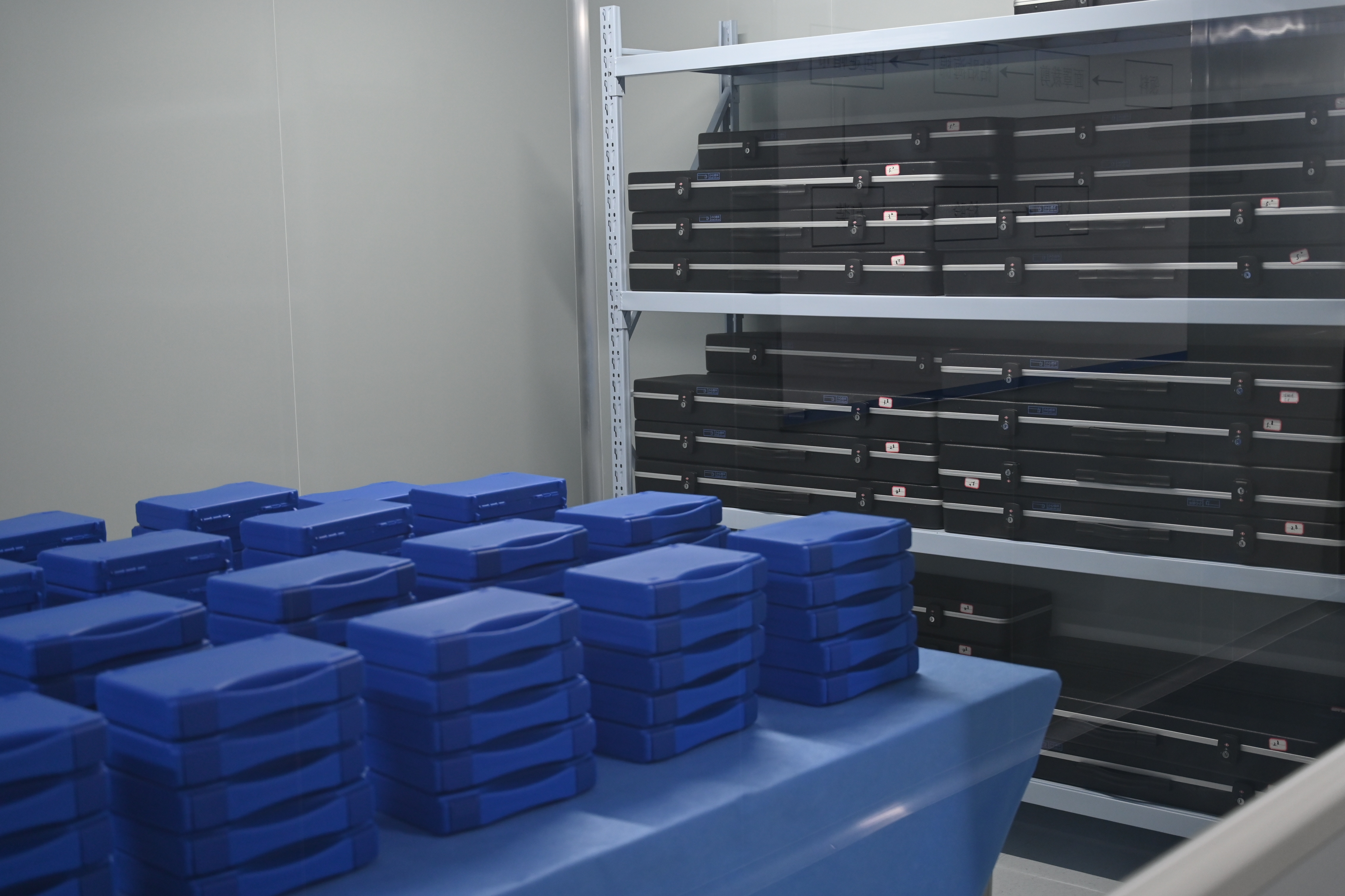
The ISO 13485:2016 scope names design, production and sales — three activities that map to a physical manufacturing and quality environment.
Certificate One: ISO 13485:2016 for Laryngoscope Design, Production and Sales
The first document is a Medical Device Quality Management System Certification issued against ISO 13485:2016 under certificate number UKZB25MD30140R0S. It was issued by New Century Inspection & Certification Co., Ltd. (BCC). The certified scope reads: design, production and sales of video anesthesia laryngoscope and anesthesia laryngoscope. The certificate was issued on 22 December 2025 and expires on 21 December 2028. Its stated market coverage is global, with particular relevance to EU and global medical device regulatory markets.
The scope line deserves to be read twice. It names design, production and sales as three distinct activities, and it names a product family rather than a single stock-keeping unit. For a buyer, that means one certificate supports the video laryngoscope models BMS-FA and BMS-YA and the video flexible laryngoscope model BMR, subject to the model-level documentation described below.
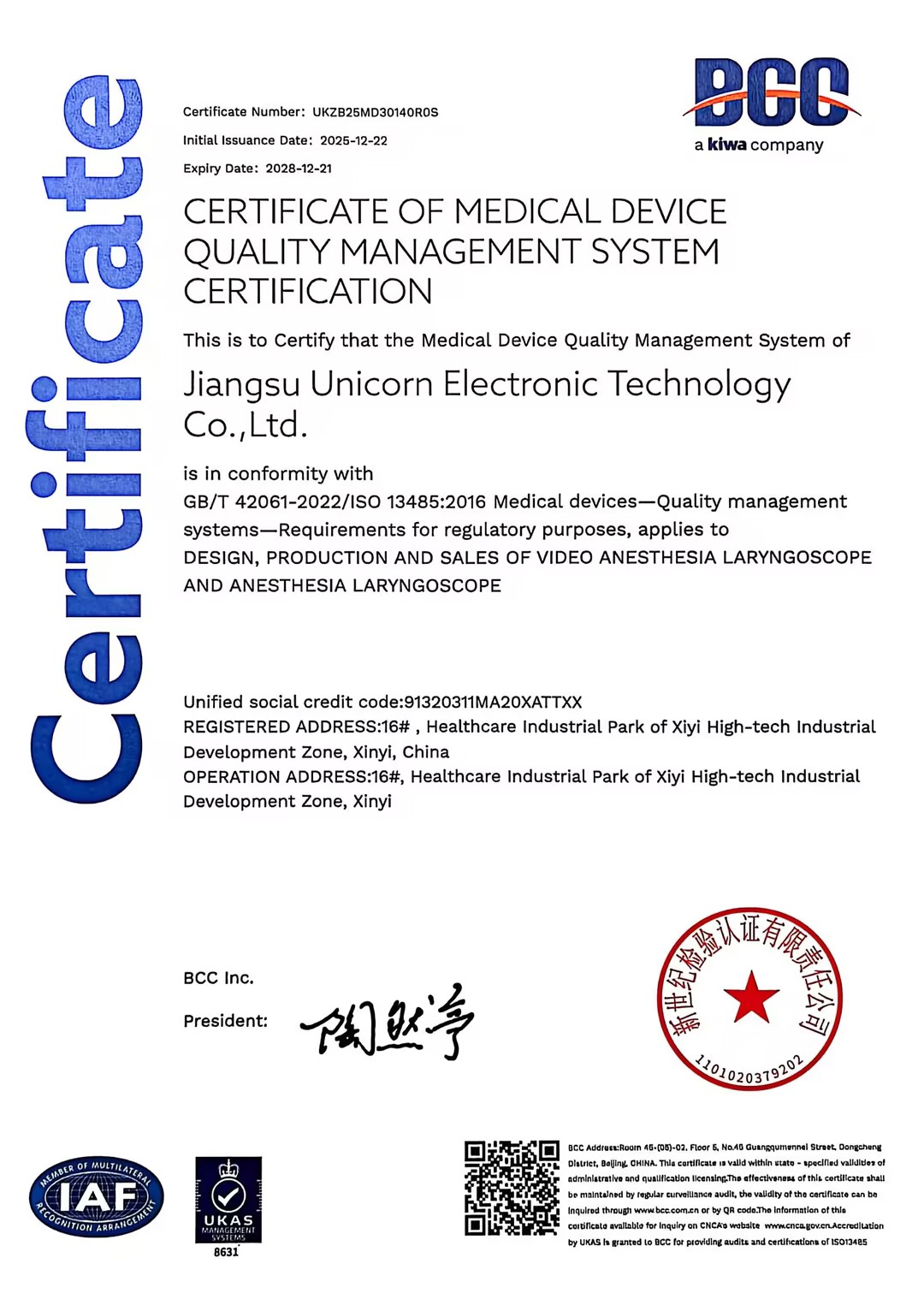
ISO 13485:2016 certificate UKZB25MD30140R0S, issued by New Century Inspection & Certification Co., Ltd. (BCC), valid from 22 December 2025 to 21 December 2028.
Certificate Two: CE Notification on an EU Conformity Route
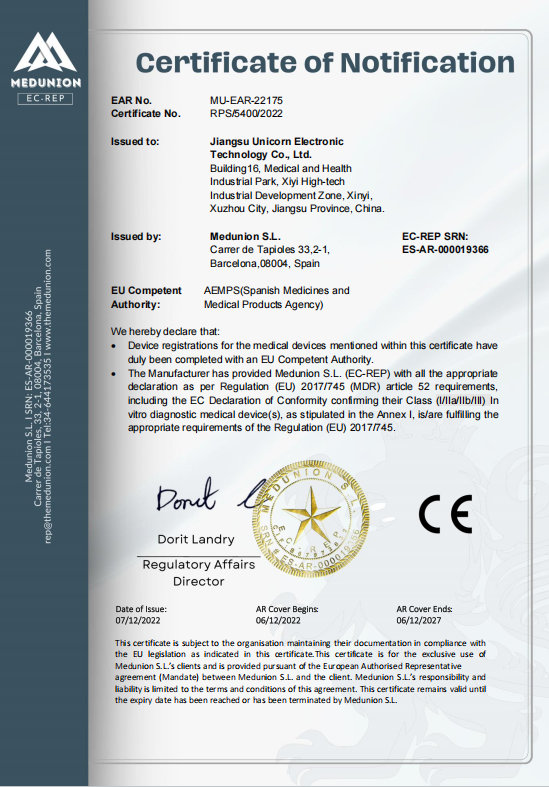
The second document is filed as a CE Notification Certificate (Medical Device MDR), carrying the number RPS/5400/2022. It was issued by Medurion S.L., which acts as the EU Authorized Representative for Unicorn in Spain. The referenced standard is EU Regulation (EU) 2017/746 (IVDR), and the recorded scope is in vitro diagnostic medical devices, Class A self-certified products. It was issued on 7 December 2022 and expires on 6 December 2027. The applicable market is the European Union.
Two features of this document shape how procurement teams should treat it. First, it is a notification certificate tied to an authorised representative relationship rather than a standalone product approval. Second, its stated scope names a device category, which means the scope statement — not the certificate logo — is the part that has to be matched against a specific model before the document can be treated as complete market-access evidence.
Model-by-Model Certification Map
The three laryngoscope models in this line share the same quality management system certificate but differ in how their CE documentation is described. The table below consolidates what each model record states.
| Model | Device type | Key construction | ISO 13485:2016 | CE documentation |
|---|---|---|---|---|
| BMS-FA | Video laryngoscope (rigid) | Aluminium alloy handle; 304 stainless steel blade | Yes — UKZB25MD30140R0S, issued by New Century Inspection & Certification Co., Ltd. (BCC) | CE certified to Medical Device MDR standards; applies to the EU market |
| BMS-YA | Video laryngoscope (rigid) | Aluminium alloy handle; PC plastic blade | Yes — UKZB25MD30140R0S, issued by New Century Inspection & Certification Co., Ltd. (BCC) | EU Regulation (EU) 2017/746 (IVDR); certificate number RPS/5400/2022, issued by Medurion S.L. (EU Authorized Representative, Spain) |
| BMR | Video flexible laryngoscope | TPU / PPSU | Yes — UKZB25MD30140R0S, issued by New Century Inspection & Certification Co., Ltd. (BCC) | CE certification issued by Medurion S.L. (EU Authorized Representative, Spain) |
Read as individual statements:
- The BMS-FA video laryngoscope is certified to ISO 13485:2016, applicable to EU and global markets, and is CE certified to Medical Device MDR standards for the EU market.
- The BMS-YA video laryngoscope is covered by ISO 13485:2016 certification, applicable to EU and global medical device regulatory markets, and is certified under EU Regulation (EU) 2017/746 (IVDR) with certification number RPS/5400/2022, issued by Medurion S.L.
- The BMR video flexible laryngoscope is certified to ISO 13485:2016 under certification number UKZB25MD30140R0S, issued by New Century Inspection & Certification Co., Ltd. (BCC), and is covered by a CE certification issued by Medurion S.L.
The product category itself spans rigid and flexible video laryngoscopes for anesthesiology and respiratory medicine, with models differentiated by specifications such as resolution, field of view and depth of field as listed on their respective datasheets. The BMS-FA and BMS-YA share a resolution of at least 3.72 lp/mm, a field of view of at least 60 degrees, an observation depth of field of 20–100 mm, a DC 3.7 V power supply and a battery capacity of 3400 mAh or above. The BMR differs substantially: 23.51 LP/mm resolution, a field of view greater than 80 degrees, a depth of field of 5–100 mm and luminance above 800 Lux.
What Each Document Actually Governs
ISO 13485:2016 is a quality management system standard. Applied here, it governs how the laryngoscopes are designed, produced and sold: design control, supplier and material control, production process control, testing and traceability, and the documentation that holds those activities together. It answers the question “can this manufacturer reliably produce what it says it produces?” rather than “does this specific unit meet a performance specification?”
CE documentation under an EU conformity route answers a different question. It addresses how a device, or a category of devices, is placed on the European market and which entity inside the EU carries the regulatory relationship. In the case of the CE notification certificate RPS/5400/2022, that entity is Medurion S.L. in Spain.
The practical consequence is that deployment requirements and documentation requirements reinforce one another. Hospital deployment conditions for these devices explicitly state a special requirement to comply with an ISO 13485 medical device quality management system — meaning the quality system is not only a supplier-side credential but also part of the operational expectation in the clinical environment where the device is used.
Clinical and Operational Context Behind the Documentation
These laryngoscopes are specified for respiratory and anesthesia departments and for indoor hospital operating rooms, emergency wards and ICUs, as well as pre-hospital first aid vehicles. Deployment conditions assume normal ambient temperature, a standard medical disinfection environment, and both portable and fixed bedside configurations.
The stated clinical functions include real-time high-definition visual laryngeal exposure guidance, accurate endotracheal intubation assistance, reduction of intubation failure rate and laryngeal tissue injury, and support for difficult airway intubation, intraoperative airway monitoring and video recording. The operating mode is a handheld, portable, battery-powered configuration with real-time HD image display on a built-in screen and support for image snapshot and video storage.
Matched equipment is documented as disposable laryngoscope blades, reusable blade sleeves, a power adapter, a charging dock, a high-capacity spare battery, a data export USB flash drive, a medical cart bracket and an external medical monitor. A documented deployment involving medical institutions, a medical device distributor and a hospital group covers 20 units over a five-year span, applied to hospital clinical anesthesia, emergency intubation, difficult airway treatment and rescue operations, with highlights recorded as HD real-time visualisation, disposable blades availability, portable battery design and a multi-language user interface.
For certification purposes the five-year deployment window is the detail that matters most. A device that stays in clinical service for years will outlive certain documents, and certificate expiry dates become an operational planning input rather than a one-time check.
Market Signals Reinforcing the Documentation Trend
Several published market metrics point in the same direction. The reusable video laryngoscope segment held the largest revenue share of 77.68% in 2024, according to Grand View Research. The same source reports that the rigid video laryngoscope segment dominated the product market with a 60.42% revenue share in 2024, and that North America accounted for a 37.77% revenue share in the same year.
Each figure carries a procurement implication. A market weighted towards reusable devices is a market where installed equipment is audited repeatedly over its service life, which raises the value of certificates that remain valid and correctly scoped across that period. A market weighted towards rigid devices means the majority of shipped units fall under the same design, production and sales scope, so a single well-documented QMS certificate covers a large share of the category. And a market with a concentrated regional revenue base means the documentation expectations set in that region tend to propagate through global tender templates.
The competitive field is also crowded and publicly identifiable. Verathon, Medtronic, Ambu A/S, KARL STORZ and Tuoren Group are named among the key global players in video laryngoscopy. In a field of this size, documentation quality is one of the few comparison dimensions that can be assessed objectively before a device is ever trialled.
Where Documentation Does Not Substitute for Evaluation
Two honest boundaries deserve to be stated alongside the certificates themselves, because a procurement file that omits them will eventually expose them under scrutiny.
The first boundary concerns cost structure when video laryngoscopy is compared with traditional laryngoscope practice. Published figures place reusable video laryngoscopes in a range of approximately USD 1,000 to USD 8,000, while traditional single-use laryngoscopes cost approximately USD 18. A video laryngoscope therefore sits in a fundamentally different price band, and it carries documentation, audit and maintenance overhead that a simple reusable metal blade does not. Buyers comparing the two are not comparing like for like: video laryngoscopy buys visualisation, recording, difficult-airway support and a traceable quality system, while a traditional blade buys a low unit cost. Programme decisions normally hinge on case mix and airway risk profile rather than on device price alone.
The second boundary concerns scope. ISO 13485:2016 certification under UKZB25MD30140R0S confirms that design, production and sales processes for video anesthesia laryngoscopes and anesthesia laryngoscopes are managed to that standard. It is not, in itself, a product approval and does not automatically authorise placement on any specific national market. Likewise, the CE notification certificate RPS/5400/2022 records a scope of in vitro diagnostic medical devices, Class A self-certified products; a buyer should confirm that this stated scope aligns with the classification of the specific model and with the requirements of the destination market before treating the document as complete market-access evidence. Where a tender requires a certificate whose scope names the exact device class, that is a documentation question to resolve with the supplier rather than an assumption to make from a logo.
A third, quieter boundary is time. The ISO 13485:2016 certificate expires on 21 December 2028 and the CE notification certificate expires on 6 December 2027. Certificate validity should be re-confirmed at the point of order and at the point of delivery, not only at the point of shortlisting.
What Evaluation Teams Should Record
The following items convert certification documentation from a marketing claim into an auditable record. Each can be answered from the certificate set described in this article plus the manufacturer's stated production data.
- Certificate number and issuing body for every document: UKZB25MD30140R0S from New Century Inspection & Certification Co., Ltd. (BCC) for ISO 13485:2016; RPS/5400/2022 from Medurion S.L. for the CE notification certificate.
- The exact scope statement, read against the device and the destination market rather than against the certificate title.
- Issue and expiry dates measured against the delivery schedule and the intended service life of the equipment.
- Which models the certificate names, and whether coverage is by product family or by individual stock-keeping unit.
- Authorised representative details for the European Union, including the representing entity and its location.
- Production and quality controls behind the certificate: 100% testing, a monthly capacity of 500 units, a lead time of 30–45 days, a minimum order quantity of 1 unit, OEM/ODM customisation limited to screen logo and power on/off logo, and remote after-sales support.
Future Outlook
The direction of regulation is toward more granular evidence, not less. Buyers are already moving from asking whether a supplier is certified to asking which body issued the certificate, what the scope names, and when it expires. As demand for video laryngoscopy expands from a 2024 baseline of USD 784.66 million toward a projected USD 2.80 billion by 2033, and as the broader laryngoscope category grows at a forecast 7.2% CAGR through 2034, the volume of documentation moving through tender processes will rise with it.
For manufacturers, the practical implication is that certificate scope management becomes a commercial capability rather than a compliance afterthought: keeping scope statements aligned with the models actually shipped, and keeping validity windows visible to buyers, is what turns certification into a shortlisting advantage. For procurement teams, the implication is simpler. A certificate number, an issuing body, a scope line and an expiry date take four minutes to record and can prevent an avoidable delay in a tender evaluation.
FAQ
Which Unicorn laryngoscope models are covered by the ISO 13485:2016 certificate?
The ISO 13485:2016 Medical Device Quality Management System certification applies to the video laryngoscope models BMS-FA and BMS-YA and to the video flexible laryngoscope model BMR. The certificate itself covers the design, production and sales of video anesthesia laryngoscope and anesthesia laryngoscope, which is the scope wording under which all three models fall.
Who issued the ISO 13485:2016 certificate and what is the certificate number?
The certificate was issued by New Century Inspection & Certification Co., Ltd. (BCC) under certificate number UKZB25MD30140R0S. It was issued on 22 December 2025 and expires on 21 December 2028, and its stated market coverage is global, with particular relevance to EU and global medical device regulatory markets.
What scope does the ISO 13485:2016 certificate name?
The certified scope is the design, production and sales of video anesthesia laryngoscope and anesthesia laryngoscope. This means the certificate addresses three separate activities — design, production and sales — and covers a product family rather than a single model. It is a quality management system certificate, so it evidences how the products are designed, made and sold rather than serving as a standalone product approval.
Which CE documentation applies to the BMS-FA, BMS-YA and BMR?
Each model record states its CE position separately. The BMS-FA video laryngoscope is CE certified to Medical Device MDR standards, applicable to the EU market. The BMS-YA video laryngoscope is certified under EU Regulation (EU) 2017/746 (IVDR) with certification number RPS/5400/2022, issued by Medurion S.L., the EU Authorized Representative in Spain. The BMR video flexible laryngoscope is covered by a CE certification also issued by Medurion S.L.
Until when are these certificates valid?
The ISO 13485:2016 certificate UKZB25MD30140R0S is valid from 22 December 2025 to 21 December 2028. The CE notification certificate RPS/5400/2022 is valid from 7 December 2022 to 6 December 2027. Both dates fall within typical multi-year procurement and deployment cycles, so buyers should record the expiry dates against their delivery and service schedules rather than verifying validity only at shortlisting.
Is ISO 13485 certification alone sufficient for EU market access?
No. ISO 13485:2016 is a quality management system standard covering design, production and sales processes, and it does not by itself authorise placement of a device on a given national market. Medical devices such as video laryngoscopes must comply with EU MDR 2017/745 and typically require ISO 13485 certification for their quality management systems, which means the QMS certificate and the applicable conformity route are complementary requirements rather than substitutes.
What production and quality controls sit behind the ISO 13485 certificate?
The stated production capability includes OEM and ODM operation with customisation limited to screen logo and power on/off logo, a monthly capacity of 500 units, a lead time of 30–45 days, a minimum order quantity of 1 unit, 100% testing, export to all countries and remote after-sales support. On the corporate side, the manufacturer reports more than 40,000 m² of workshops, Class 100 and Class 1000 sterile production environments, BSL-1 and BSL-2 R&D centres, and ISO 9001 and ISO 13485 quality management system certifications.
Documentation as a Starting Point, Not a Conclusion
Certification is most useful when it is treated as a set of verifiable statements rather than a badge. The BMS-FA, BMS-YA and BMR laryngoscopes each carry a documented ISO 13485:2016 position under certificate UKZB25MD30140R0S issued by New Century Inspection & Certification Co., Ltd. (BCC), and each carries model-level CE documentation issued through Medurion S.L. in Spain. Together, those documents answer the questions that procurement teams are asked most often in regulated markets — who issued it, what does it cover, how long does it last — leaving clinical fit and total programme cost as the remaining evaluation tasks.
The complete 2026 product catalogue, including the laryngoscope models referenced above, is available for download: Unicorn Product Catalog (2026).