
ISO 14001 and PED 2014/68/EU: A Large Ring Forgings Guide
ISO 14001 and PED 2014/68/EU: A Large Ring Forgings Guide

Flange forgings: pressure-service components where documentation, not only dimensions, determines acceptance.
Large rolled ring forgings rarely fail in isolation. They sit inside pressure vessels, flanges, shells, turbine structures and rotary kilns, so the paperwork attached to them travels further than the part itself. When a ring forging enquiry arrives with the single line 'ISO 14001 and PED 2014/68/EU required', two separate compliance systems have been merged into one requirement — one organisational, one product-based — and that difference decides what a supplier can actually issue, what a buyer should accept, and how long qualification of a multi-metre ring will take.
Short answer. ISO 14001 is a voluntary international standard for an organisation's environmental management system, certified by an accredited certification body against a defined scope. PED 2014/68/EU is an EU Directive on pressure equipment that attaches to products and their technical documentation, with obligations falling primarily on the manufacturer placing the equipment on the EU market. A forging supplier may hold one, both or neither, and no combination of the two tells you by itself whether a specific ring suits a specific pressure duty.
Why the two requests end up on the same line
Procurement templates are built by category rather than by legal logic. A single compliance block collects management-system certificates, safety certificates, environmental certificates and product-conformity documents, and that block is copied from one enquiry to the next. For commodity components the habit is harmless. For large rolled ring forgings it is not, because three distinct failure modes follow from the confusion.
- A buyer accepts an environmental management certificate as evidence that pressure-boundary material will be documented, then finds that no product-level conformity route was ever established for the order.
- A buyer rejects a technically suitable supplier for lacking a certificate with no bearing on the ring's function, while the documents that do matter were never requested.
- A supplier signs a compliance block it cannot fully satisfy, and the gap surfaces at final inspection — after a multi-metre ring has already been heat-treated and machined.
The third outcome carries the heaviest cost. A large ring is a single-piece item, often the only one in the order, so re-testing or re-making it moves a project schedule rather than a line-item price.
What ISO 14001 actually covers
ISO 14001 is an international standard published by the International Organization for Standardization. It sets out requirements for an environmental management system: how an organisation identifies its environmental aspects and compliance obligations, sets objectives, controls operations, monitors results and improves over time. It does not set environmental performance limits for a product.
The auditable elements are organisational rather than technical: an environmental policy, identification of aspects and legal obligations, objectives and programmes, defined roles and operational controls, emergency preparedness and response, monitoring and measurement, evaluation of compliance, internal audit and management review. Certification is issued by an accredited certification body after audit against the standard, and maintained through surveillance audits across a certification cycle.
What a buyer receives is a certificate with a scope statement — and the scope statement is the part most often skipped. A certificate may cover 'forging, heat treatment and machining of steel components' at named sites. It does not automatically extend to a newly commissioned plant, a new process line, or a different legal entity in the same group. Certificate number, accreditation mark, issue and expiry dates and site addresses all belong in the supplier file.
What it does not do matters just as much. ISO 14001 does not certify a product, does not describe mechanical properties, does not establish dimensional capability and does not demonstrate pressure integrity. It says something real, but it says it about management, not about the ring.
Where the standard is genuinely useful in ring forging procurement: reheating and heat treatment are energy-intensive, scale and quench media create waste streams, machining generates coolant and swarf, and heavy forging operations generate noise and dust. OEMs with their own supply-chain environmental reporting — and public tenders that score environmental criteria — increasingly ask suppliers to show how those aspects are controlled. In that setting an ISO 14001 certificate is a checkable proxy for management discipline across a multi-year supply relationship.
What PED 2014/68/EU covers
PED 2014/68/EU is a Directive of the European Parliament and of the Council on the harmonisation of the laws of the Member States relating to the making available on the market of pressure equipment. It applies to pressure equipment and assemblies above a pressure threshold defined in the Directive. It is a legal instrument, not a voluntary standard, and that single fact changes how it should be requested.
How the Directive routes a component
In practice the Directive works by classification. Equipment is assigned to a category according to the fluid it contains, its pressure, and its volume or nominal size; the category determines which conformity assessment route applies. Lower categories can be handled through internal production control, while higher categories require the involvement of a notified body. The outputs are a technical file, an EU declaration of conformity, and CE marking on the equipment.
The structural point for a forging supplier is where responsibility sits. The obligation to conform and to declare conformity falls on the manufacturer placing the pressure equipment or assembly on the EU market. A rolled ring forging supplied as a shell, flange, nozzle ring or closure enters that assessment as a material or part. The ring maker's role is to supply documentation supporting the equipment manufacturer's technical file — typically inspection documents under EN 10204 in the 3.1 or 3.2 form, with traceability to the heat, records of heat treatment, and mechanical test results taken from identified test pieces.
This is why 'PED certified' is an imprecise phrase when applied to a forging. The accurate question is which conformity route the finished equipment takes, which material specification governs the ring, and which documents the ring supplier must issue so the equipment manufacturer can close its file.
When dimensions leave the standard behind
A second structural point concerns size. When a ring's material, thickness or geometry falls outside what a harmonised specification covers, the Directive's framework allows a project-specific appraisal route, in which the designer justifies the material through additional analysis and testing. For rings measured in metres this appraisal is often the real subject of the compliance conversation, not the certificate. At the upper end of a supplier's capability — for custom ring forgings reported at over 21 metres in diameter and up to 5 metres in height — the evidence burden shifts decisively toward the project file.
Where the two regimes meet on the shop floor
The two systems are separate on paper and connected in the plant. Heat treatment is the hinge.

Shell forgings: pressure-retaining bodies where heat-treatment records and test results carry the conformity argument.
Pressure-equipment documentation depends on heat-treatment records — furnace identification, load arrangement, time-temperature charts, and mechanical test results tied to a specific charge. Environmental management depends on the same furnaces for energy consumption, combustion emissions and atmosphere control. A supplier that controls furnace loads and records them properly produces evidence serving both purposes. A supplier that treats heat treatment as an unrecorded step produces neither, and no company-level certificate compensates for that gap.
The second connection is traceability. A large ring must be identifiable from the melt through piercing, radial-axial rolling, heat treatment, testing and machining. The same identification system that supports a material certificate also supports scrap, rework and yield reporting — the operational data behind environmental objectives. Traceability is therefore a shared foundation rather than a compliance overhead.
The third connection is the audit interface. An ISO 14001 certification audit, a customer witness inspection, and a notified body's involvement in a conformity assessment are three different events run by three different parties asking three different sets of questions. Suppliers who prepare all three from one evidence pack qualify faster; suppliers who assemble evidence per customer lose weeks.
Why large rolled ring forgings raise the stakes
Three properties of large rings make documentation errors more expensive than in small-component sourcing.
Single-piece economics. A large ring has no batch to fall back on. If a mechanical test fails or a record is missing, the options are re-test, re-heat-treat or re-make — each a schedule event on a project where the ring sits on the critical path.
Dimension-driven qualification. As ring size increases, the likelihood that the design falls outside a standard material specification rises, and with it the need for project-specific appraisal. Buyers who plan for a certificate but not for the design justification routinely underestimate lead time.
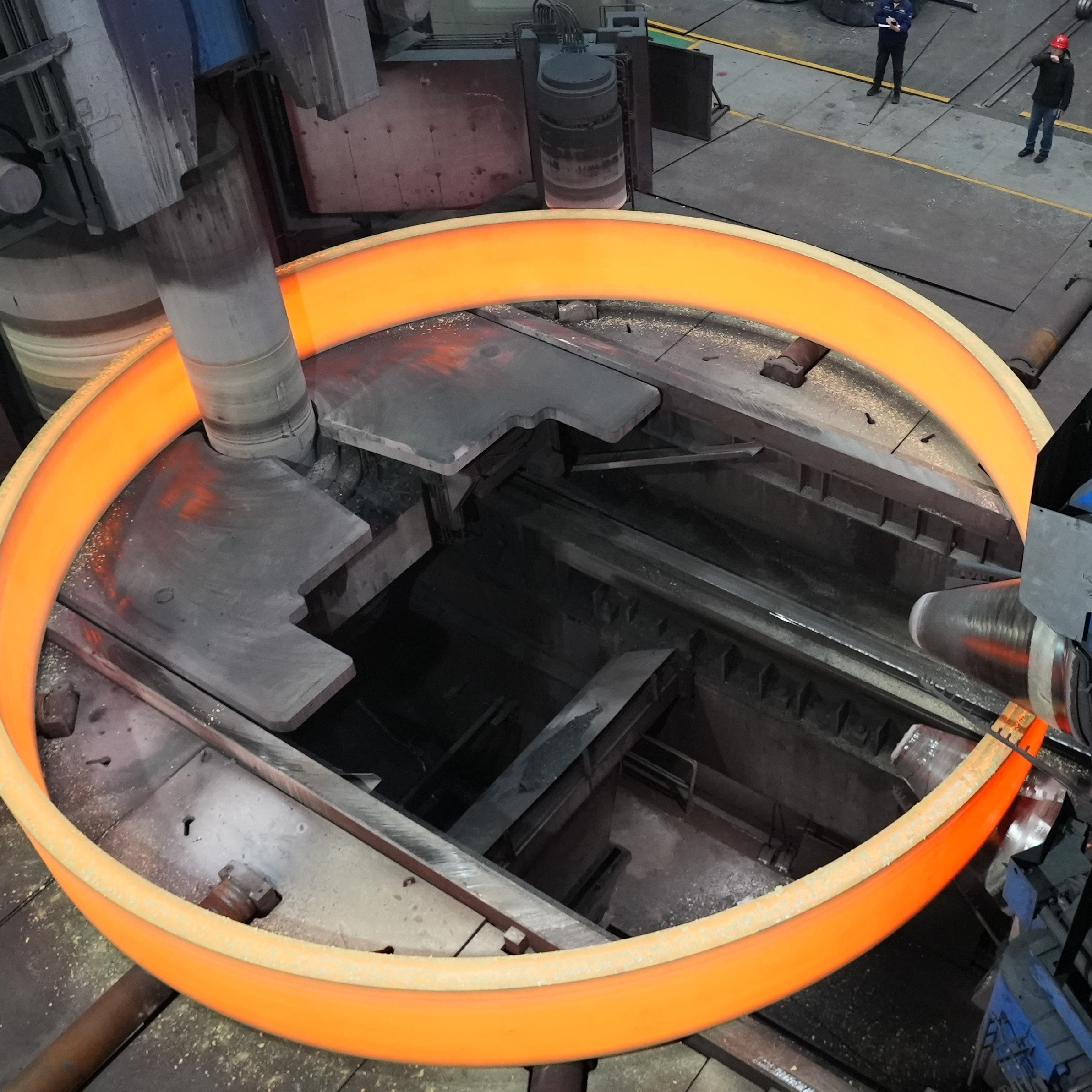
Profiling rolled ring forgings: as geometry moves away from standard shapes, project-specific appraisal replaces catalogue conformity.
Concentrated environmental aspects. A single large ring consumes a substantial heating cycle. Energy per piece, scale generation and furnace utilisation become visible figures in a way they never are for small parts, which is one reason environmental questions surface earlier in large-ring sourcing than in commodity forging.
Seamlessness also shapes the compliance conversation. A rolled ring produced without a welded seam removes a weld from the pressure boundary, simplifying the inspection logic around that boundary and reducing the number of separate qualification steps a buyer has to plan. That is a process argument, not a performance guarantee; final acceptance still rests on the specified tests.
Application context: where pressure scope begins and ends
Pressure-equipment rules follow function, not material. A ring forming part of a pressure boundary and an identically shaped ring in a structural connection can carry completely different compliance obligations. The table below maps common applications to their usual compliance emphasis.
| Application | Operating conditions | Usual compliance emphasis |
|---|---|---|
| Petrochemical pressure vessels | High pressure, high temperature, corrosive duty; pressure containment and structural support | Pressure-equipment assessment typically applies for EU-bound equipment; material certificates, heat-treatment records and test reports dominate |
| Hydropower | High water-head pressure, sediment abrasion, cyclic load, frequent start-stop | Pressure-boundary components may fall inside pressure-equipment rules; structural rings are governed by OEM specification and fatigue requirements |
| Offshore wind | High cyclic load, salt spray and marine corrosion, low temperature operation | Generally outside pressure-equipment scope; OEM and certification requirements plus environmental supply-chain criteria dominate |
| Rotary kiln | Extreme temperature, heavy cyclic load, 24/7 operation, dust and thermal corrosion | Not pressure equipment; wear, fatigue and thermal duty govern acceptance |
| Offshore engineering | Deep-sea pressure, seawater corrosion, cyclic wave load | Pressure-containing subsea items may be regulated; structural and propulsion items typically follow classification-society and OEM rules |
| Construction machinery | Heavy load, vibration load, frequent start-stop and variable load | Not pressure equipment; fatigue and wear govern acceptance |
Across all six, environmental management expectations can appear through an OEM's supply-chain requirements whether or not pressure rules apply. That is precisely why the two references belong in separate lines of the enquiry.
Market trend: documentation pressure follows volume
Published research points to expanding demand in exactly the segments where documentation is heaviest. One commercial research report values the global seamless rolled ring forgings market at USD 11.9 billion in 2025, rising to USD 15.84 billion by 2032. A separate report projects the wind turbine forging market — a different and narrower scope that includes gears, rings and flanges — reaching USD 20.8 billion by 2035 at a CAGR of 7.3% from 2025. Customs data shows concentration as well: Chinese suppliers accounted for 43.66% of India's imports of forged rings under HS code 73261990 in the available 2026 records.
Two cautions belong with those figures. Published market sizes for ring forging vary widely because scope definitions differ — raw rings and machined or assembled components are not the same market, and the figures should not be combined. And none of these datasets measures documentation burden directly; the inference is structural. As a larger share of rings crosses borders and ends up inside EU-bound pressure equipment or certified wind structures, the volume of certificates, declarations and traceability records travelling with each tonne rises accordingly.
For buyers, the practical consequence is that compliance capability becomes a schedule variable rather than a screening filter. Suppliers who can issue a complete document pack on first request shorten qualification. Suppliers who cannot, extend it, whatever their press capacity.
Comparing compliance approaches, and where each one stops
Buyers handle compliance requests for ring forgings in three broad ways, and each carries a different evidentiary value.
| Approach | What it establishes | Where it stops |
|---|---|---|
| Supplier self-declaration | Stated intent and screening data; fastest and cheapest to obtain | No third-party weight; cannot enter an equipment manufacturer's technical file |
| Certified management system | Third-party audited organisational discipline, verifiable through certificate and scope | Organisational, not product-specific; says nothing about a heat number or a finished ring |
| Product-level conformity documentation | Material certificates, heat-treatment records, test reports, and the equipment manufacturer's declaration and marking | Issued per order and per piece; only as reliable as the identification tying documents to the actual ring |
The limits deserve stating plainly. None of the three proves that a specific ring will perform in service. Neither ISO 14001 nor a PED-related document says anything about fatigue life in an offshore wind connection, abrasion resistance in a kiln tyre, or dimensional stability after machining of a five-metre-tall ring. An ISO 14001 certificate can be entirely valid while excluding the site that makes your component. And product documentation is only as good as its identification: a certificate that cannot be tied to the specific ring, heat and heat-treatment cycle is a document, not evidence. Buyers who expect certificates to substitute for technical review usually discover the gap during installation rather than during procurement.
A verification sequence buyers can run
The sequence below is ordered by how much schedule risk each step removes from a large-ring order.
| Step | What to request | What to check |
|---|---|---|
| 1. Confirm the conformity route | Ask the equipment designer which assessment route applies to the assembly the ring enters | Establishes whether the ring is a material under a conformity route or a structural part outside it |
| 2. Fix the material specification | Grade, test requirements and acceptance criteria written into the purchase order | Removes the most common cause of late documentation disputes |
| 3. Request the management-system scope | Certificate with scope statement, named sites, accreditation mark and validity | Confirms which plants are actually covered by the certificate |
| 4. Request product documentation per order | Inspection documents under EN 10204 in the agreed form, heat identification, heat-treatment records, mechanical test reports | Confirms traceability from melt to finished ring |
| 5. Verify the dimensional envelope claim | Written capability statement for the specific size, weight and material | Prevents qualification against a general capability figure that the order will not reach |
| 6. Plan for project-specific appraisal | Where size or material exceeds harmonised specifications, agree the analysis and testing programme early | This is the step most often omitted from project schedules |
| 7. Agree inspection and witness points | Hold points, third-party inspection, document review before shipment | Avoids final-inspection surprises on a single-piece item |
| 8. Record the environmental data you need | Only the energy, emissions or waste indicators required by your own reporting | Keeps the environmental request proportionate and answerable |
Where Iraeta sits in this picture
Iraeta Energy Equipment Co., Ltd. is a forging manufacturer established in 2006 and headquartered in Jinan, China, with production facilities in China and Spain and two decades of experience serving global markets. Its R&D team numbers 100 engineers. The product range includes shells, transition sections, profiling rings, hydroelectric forgings, kiln tyres, drive rings, wind power flanges, gearbox forgings, bearing rings, forged shafts, pipe flanges, precision machining and grinding balls, produced in carbon steel, stainless steel and alloy steel.
On capability, the company reports custom ring forgings up to 300 tons in weight, over 21 metres in diameter and up to 5 metres in height, and reports producing a seamless rolled steel ring of 21.029 metres in diameter in 2026, following a 15.673-metre ring in 2022. Its stated applications include nuclear power, hydropower, wind power, marine engineering, oil and gas, advanced equipment, special alloy and metal mining, with major markets in the EU, USA, Japan, the Middle East, Southeast Asia, Brazil and India.
For compliance purposes, capability statements and certificates answer different questions. A buyer evaluating any supplier for pressure-service rings should confirm, against the current document set issued for the specific plant and order: the management-system certificate scope and validity, the material specification and inspection-document form that plant can issue, and the conformity route agreed with the equipment designer. Those three items belong in the supplier file as documents rather than as assurances.
Future outlook
Three directions are reasonable to plan for. Documentation is becoming more granular: buyers increasingly want records tied to a specific piece rather than to a supplier's general capability, and digital traceability makes that expectation cheaper to meet for suppliers already recording heat-treatment data. Environmental criteria are migrating from corporate reporting into tender scoring, which raises the value of a correctly scoped ISO 14001 certificate and of the operational energy data behind it. And as equipment sizes grow across energy and process industries, more rings will fall outside harmonised specifications, pushing project-specific appraisal earlier in the procurement sequence.
The practical implication is to stop treating 'ISO 14001 and PED' as one checklist line. Split it into three questions: how the supplier manages environmental aspects, which conformity route the equipment takes, and which documents the ring itself will carry.
FAQ
What is ISO 14001 in the context of a forging supplier?
ISO 14001 is an international standard for an environmental management system, published by the International Organization for Standardization. For a forging supplier it defines how the company identifies and controls environmental aspects such as furnace energy use, emissions, scale and waste, quench media and machining coolant, and how it monitors and improves that performance. Certification is issued by an accredited body against a defined scope covering named sites and activities. It is an organisational certificate and does not certify any individual product.
When does PED 2014/68/EU apply to rolled ring forgings?
PED 2014/68/EU applies to pressure equipment and assemblies placed on the EU market above a pressure threshold defined in the Directive. A rolled ring forging is not itself declared under the Directive; it enters the equipment manufacturer's technical file as a material or part when it forms part of a pressure boundary, such as a shell, flange, nozzle ring or closure. When the same ring serves a structural function, such as a tower connection or a kiln tyre, pressure-equipment rules generally do not apply.
Does an ISO 14001 certificate mean a supplier meets PED requirements?
No. The two address different subjects. ISO 14001 evaluates an organisation's environmental management system; PED 2014/68/EU governs how pressure equipment is shown to conform before being placed on the EU market. A supplier can hold an ISO 14001 certificate and still have no product-level conformity documentation for a specific order, and a supplier with complete material and heat-treatment records may hold no environmental certificate at all.
Which documents should a buyer request for pressure-service ring forgings?
Typically: the material specification and acceptance criteria in the purchase order; inspection documents under EN 10204 in the agreed form, commonly 3.1 or 3.2; identification of the heat and of the individual ring; heat-treatment records including time-temperature data; mechanical test reports from identified test pieces; and, where dimensions or material fall outside harmonised specifications, the project-specific appraisal agreed with the designer. The equipment manufacturer's declaration and CE marking belong to the equipment, not to the ring.
Do wind, hydro or kiln rings need PED conformity?
It depends on function rather than application label. Structural rings for wind towers, kiln tyres and drive rings, and most construction-machinery rings, are not pressure-boundary components, so pressure-equipment rules do not apply to them; OEM specifications, fatigue requirements and, for marine work, classification rules govern instead. Hydropower and offshore components that contain pressure may fall within pressure-equipment scope. The deciding question is whether the ring forms part of a pressure boundary in equipment placed on the EU market.
How does ring size affect compliance evidence?
Larger rings increase the chance that the design falls outside a harmonised material specification, which shifts evidence toward project-specific appraisal: additional analysis, testing and design justification agreed with the equipment designer. Size also concentrates risk, because a single large ring has no batch substitute if a test fails or a record is missing, and it concentrates environmental aspects, because one ring represents a substantial heating cycle. Both effects push documentation planning earlier in the schedule.
Tem questões ou precisa de mais detalhes?
Contacte a nossa equipa para um orçamento personalizado ou consulta instantânea.
Solicitar orçamento
Preencha o formulário abaixo e a nossa equipa entrará em contacto com uma proposta personalizada.
Chat direto do WhatsApp
Prefere conversar em tempo real? Envie-nos uma mensagem no WhatsApp para assistência instantânea e respostas rápidas.
- Obter orçamento personalizado
- Partilhar fotos ou documentos
- Discuta as suas necessidades diretamente
Geralmente responde em 5–30 minutos durante o horário de expediente.