
ISO 50001 for Dry Wipes Buyers: A Verification Guide
Energy performance has become a qualification question in dry wipes procurement. Buyers sourcing disposable nonwoven dry wipes at container volume now receive energy and disclosure questionnaires alongside specification sheets, and the answers increasingly decide who stays on a shortlist.
Zhejiang Uniquality Nursing Products Technology Co., Ltd. is a Chinese OEM/ODM manufacturer of dry wipes, wet wipes, baby diapers and training pants, based in Zhejiang Province and exporting to more than 80 countries. The company holds ISO 50001:2018 energy management certification under certificate number 01326En0008R201, issued by GAC.
That statement is easy to read and difficult to use. A certificate number only becomes procurement evidence when a buyer knows which fields to check, what the standard actually governs, and where its authority stops. This guide works through that verification sequence, then connects the certification to the product it is usually bought alongside: the YQ002 disposable nonwoven dry wipe at 15 × 20 cm.

Automated production systems carry the drying, bonding and finishing stages where energy management systems generate their evidence.
Why an Energy Certificate Entered the Dry Wipes Checklist
A dry wipe is a converted nonwoven. The buyer's specification usually pins down size, basis weight, lint behaviour, skin compatibility and packaging format. None of those fields describe how reliably the converting line runs, or how exposed the supplier is to energy price movement.
Nonwoven conversion is energy-intensive in a way that is well understood across the industry: fibre opening, web formation, bonding, drying, slitting and packaging all draw power and heat. When energy is a material input, an energy management system becomes a proxy question for supply continuity. That is the gap ISO 50001 is designed to address, and it is the reason the standard now appears in supplier questionnaires that previously asked only about quality certification.
Three practical triggers push the question into the Research and Evaluation stages of a dry wipes project:
- Quotation validity. When energy costs move, suppliers shorten quote validity or add adjustment clauses. A documented energy management system is one of the few structural answers a buyer can read before signing.
- Retail and private-label disclosure. Brand owners increasingly pass supplier-level energy and environmental questions down the chain, and a converter without an answer becomes a bottleneck.
- Supplier comparison beyond price. Two quotations for the same 15 × 20 cm, 35–70 gsm sheet can look identical while carrying very different operational risk.
What ISO 50001:2018 and GB/T 23331-2020 Certify
ISO 50001:2018 is an energy management system standard. It sets requirements for how an organisation establishes an energy policy, builds an energy baseline, sets objectives, monitors and measures energy performance, and reviews the system through internal audit and management review. GB/T 23331-2020 is the Chinese national standard that corresponds to the same energy management requirements.
The object of certification is the management system, applied to a defined scope and a defined set of sites. It is not a product certificate, and it does not certify a batch of dry wipes. This distinction is the single most important thing a buyer can hold onto during evaluation, because it determines which questions the certificate can answer and which it cannot.
In practical terms, an ISO 50001 certificate tells a buyer that an independent certification body has assessed how the supplier governs energy performance within the stated scope. It does not disclose the supplier's energy intensity, its fuel mix, or the savings achieved. Those figures sit in internal records and, where a buyer needs them, must be requested separately as part of the supplier file.
Reading Certificate 01326En0008R201: Six Fields to Verify
A certificate should be read like a specification, field by field. The following six elements carry most of the qualification value for a dry wipes buyer.
| Field | What it establishes | Why it matters for dry wipes |
|---|---|---|
| Standard and edition | ISO 50001:2018, with GB/T 23331-2020 as the corresponding Chinese standard | Confirms the audit was performed against the current edition rather than a superseded one |
| Certificate number | 01326En0008R201 | Provides a unique reference for verification with the issuer |
| Issuing body | GAC | Identifies the certification body whose records must match the document |
| Certified scope | The activities and site or sites named on the certificate | Determines whether the site converting your dry wipes is actually covered |
| Legal holder | The entity named on the certificate | Must match the contracting entity, not a trading name or affiliate |
| Status | Current validity and surveillance history as held by the issuer | An expired or suspended certificate carries no qualification value |
Two of these fields are routinely skipped and both matter. Scope is the field most likely to create a false sense of assurance: a certificate that covers a head office or a single campus does not automatically cover every line that could run a buyer's order. Legal holder is the field that creates contractual friction when the certificate is issued to one entity and the purchase order to another.
Global applicability works the same way. ISO 50001 is an international standard with a Chinese counterpart in GB/T 23331-2020, so the certificate travels reasonably well across export markets and can sit in a supplier file submitted to European, North American or Middle Eastern buyers. What travels less automatically is recognition of the issuing body. Procurement teams operating in regulated retail programmes should confirm that GAC's certification is accepted in the markets they serve, rather than assuming a certificate is portable because the standard is international.
Where the Certification Meets the Product
An energy management certificate has no product specification. The link to a purchase order is made through the manufacturing footprint behind the item being bought. Uniquality operates a 1,000,000 m² smart manufacturing facility with more than 3,000 employees and an annual output of 60 billion sheets, supported by a 100,000-class clean room and certifications including ISO, CE, GMPC and FSC.
The dry wipe most buyers encounter from this supplier is the YQ002 disposable dry wipe. Its published parameters are:
- Size: 15 × 20 cm, customizable
- Material: nonwoven, 35–70 gsm, customizable
- Pack count: 10 pcs per bag or 80 pcs per bag, customizable
- Packaging: soft pack or disposable format, customizable
Commercial terms sit alongside those parameters. Uniquality quotes a minimum order quantity of one 40HQ container for dry wipes, a lead time of 35–45 days after artwork and deposit confirmation, and quality control through COA and AQL sampling inspection. OEM/ODM customization covers material, size, logo, packaging, fragrance and formula.
Scale of this order is where the energy question stops being theoretical. A UK-based OEM customer has been running 20 × 40HQ containers per month across household cleaning, baby care, personal hygiene and beauty care applications for three years, with an on-time delivery rate of 99.5% and no major quality complaints recorded. Programs at that cadence depend on lines that do not stop, and a documented energy management system is part of how a converter demonstrates that lines are governed rather than merely run.
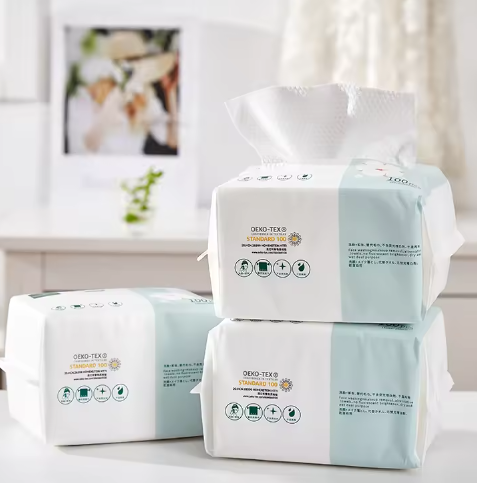
The YQ002 format pairs a 15 × 20 cm nonwoven sheet with boxed, dust-proof dispensing for household and personal care use.
Application Fit Across Five Buyer Markets
The YQ002 format is listed for personal care, health and beauty, maternity and baby, pet supplies, and household applications. Documented project types include personal hygiene care, facial cleansing, and household cleaning, with lint-free and skin-friendly performance as stated requirements and pure water as the paired input when the dry sheet is used wet.
The use cases behind those categories are concrete rather than generic. In facial care, the sheet replaces a reusable towel for daily washing and makeup removal, used dry to pat skin or dampened to lift cosmetics. In household cleaning, the same sheet handles sink water marks, kitchen grease and desk dust before disposal. In infant care, the format is positioned for face and hand wiping and food spill cleanup. A separate portable configuration is aimed at short trips, business travel, camping and rail travel as a hygienic substitute for hotel towels.
Procurement relevance concentrates in two operating conditions. Storage is specified for a cool, dry place, which shapes warehouse and distributor planning in humid markets. And the format is single-use by design, so order frequency rather than product life drives the commercial relationship. The application profile is documented as common in the Philippines, Russia, the United Arab Emirates, the United States, Chile and Mexico, which gives buyers in those markets a reference point when matching format to channel.
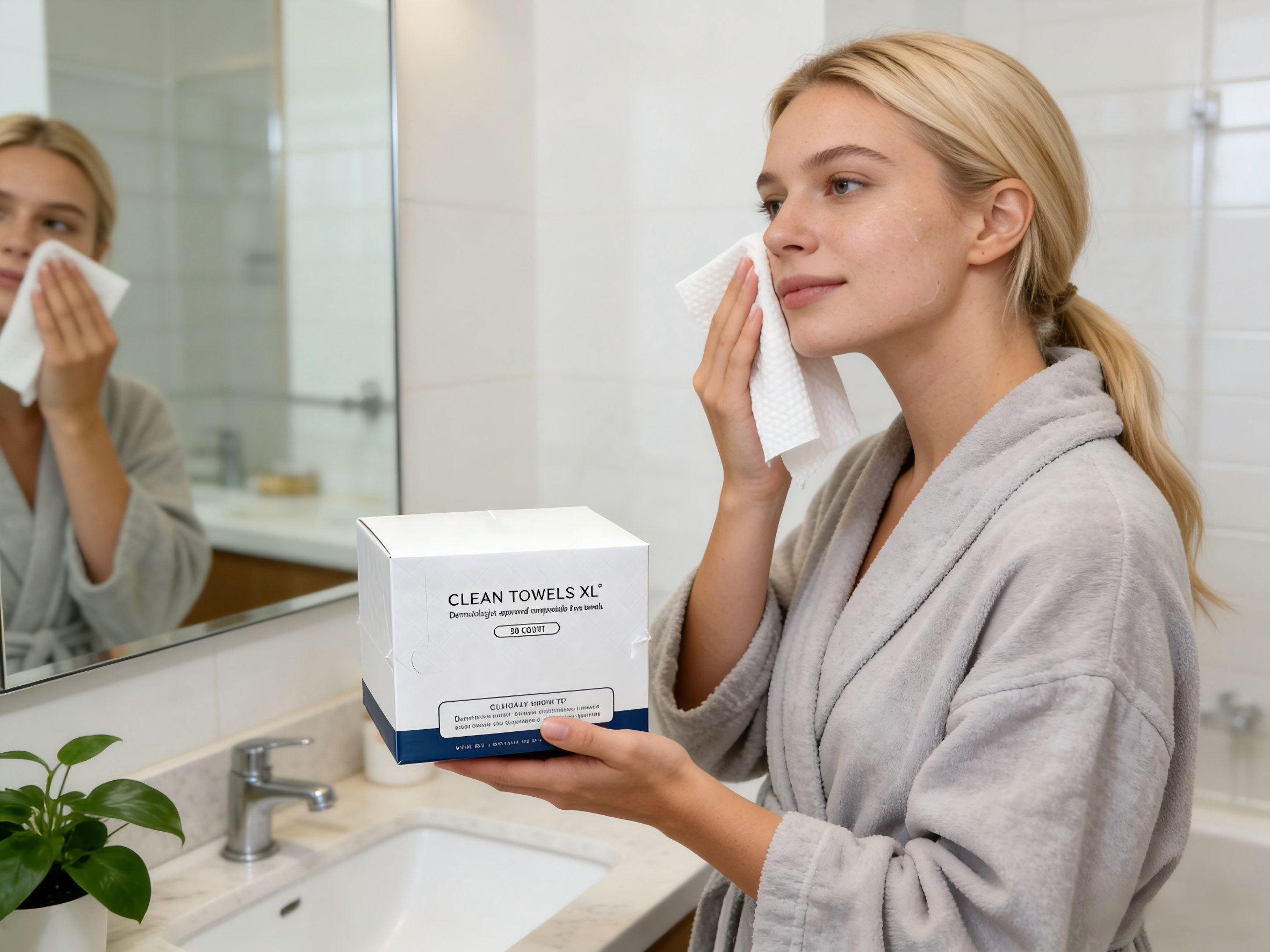
Documented application scenarios span facial cleansing, household surface cleaning and infant care within the same product format.
Market Signals Buyers Are Already Pricing In
The dry wipes segment is large enough that qualification standards tend to migrate from large retail accounts to the wider supply base. Global Market Insights estimates the global dry wipes segment at USD 14.3 billion in 2025, a figure that sets the commercial backdrop rather than a forecast a buyer should plan against directly.
Scale at the supplier level is similarly visible. Nonwovens Industry reported annual sales of approximately USD 930 million for Zhejiang Kingsafe, the parent company of Uniquality, giving a sense of the operating base behind the dry wipes line.
Regulatory movement is sharper. China's mandatory standard GB 15979-2024 for disposable sanitary products took effect on 1 July 2025, replacing the earlier version and resetting hygiene requirements for products in this category. For buyers, that creates a document-currency problem: product compliance evidence must reference the current standard, in the same way an energy certificate must reference the current edition of ISO 50001.
Tariff treatment is a smaller but useful data point for export planning. US Customs and Border Protection classified wood pulp spunlace nonwoven wipes from China under HTSUS 5603.92.0090 at a duty rate of free, which is the kind of classification detail worth confirming against the specific material construction of an order rather than assuming across a product family.
What the Certificate Does Not Cover
The clearest limit is categorical: ISO 50001 certification is not evidence that dry wipes meet any hygiene, microbiological, material safety or skin-contact requirement. Those obligations are carried by product standards and batch testing, not by an energy management system. In the Chinese market, GB 15979-2024 is the relevant reference; in export markets, the applicable product regulation and the buyer's own specification govern.
Three further boundaries are worth stating plainly:
- Scope is not universal. A certificate covers the sites named within it. If an order is produced at a facility outside that scope, the certificate does not apply to that order, however valid the document is.
- Energy performance is not a price commitment. A management system creates visibility and discipline over energy use. It does not oblige a supplier to pass savings through, and it does not fix a unit price for the buyer.
- Certification does not alter commercial terms. MOQ, lead time and payment structure are negotiated separately and are unaffected by the existence of an energy certificate.
A buyer who treats ISO 50001 as a hygiene credential will over-trust it. A buyer who treats it as an operational governance signal, verified against scope and status, gets a proportionate amount of value from it.
Energy Certification Against the Documents It Is Often Confused With
Supplier files arrive as bundles, and certificates get read as interchangeable proof. They are not. Each document type answers a different risk question, and a qualification decision needs all of them to be present in the right proportion.
| Document | Risk it addresses | What it does not prove |
|---|---|---|
| ISO 50001:2018 / GB/T 23331-2020 | Energy governance and operational continuity | Product safety, material performance, batch conformity |
| ISO 9001 quality management | Process consistency and quality control structure | Energy performance or product hygiene limits |
| GB 15979-2024 | Hygienic requirements for disposable sanitary products in China | Management system maturity or export-market compliance |
| COA and AQL inspection records | Batch-level conformity and sampling acceptance | Systemic governance across the site |
| FSC certification | Forest-based material sourcing | Energy use, hygiene or converting quality |
The practical scoring rule that follows is simple. Treat the energy certificate as a threshold item in supplier qualification and a differentiator only when two suppliers are otherwise comparable on quality, product compliance and capacity. Where a buyer weights it more heavily than COA and AQL evidence, the weighting has drifted away from the risk being purchased.
Future Outlook
Three developments are likely to shape how energy certification is used in dry wipes sourcing over the next procurement cycles.
First, disclosure is moving from optional to expected. Retail private-label programmes increasingly require supplier-level environmental documentation as a condition of listing, which turns management system certificates from a differentiator into a baseline document. Suppliers who can produce a verifiable certificate and a scope statement quickly will face fewer delays in onboarding than those who cannot.
Second, buyers are shifting from document collection to document verification. Checking a certificate number against an issuer's records, confirming that the certified scope names the producing site, and confirming that the holder matches the contracting entity are all low-effort steps that separate a real qualification file from a decorative one. Expect audit checklists to formalise these steps rather than leaving them to individual judgement.
Third, the compliance calendar is tightening on the product side. With GB 15979-2024 in force since July 2025, buyers reviewing a supplier file now need to check currency on two axes at once: the edition of the management standard and the edition of the product standard. Files that are current on one and stale on the other are increasingly visible during review.
Frequently Asked Questions
What does ISO 50001:2018 certification actually cover for a dry wipes supplier?
It covers an energy management system applied to a defined scope and defined sites. The system includes an energy policy, an energy baseline, objectives, monitoring and measurement, internal audit and management review. The certificate confirms that an independent certification body assessed that system. It does not certify the physical, microbiological or performance characteristics of any dry wipe product.
Which fields on certificate 01326En0008R201 should a buyer verify first?
Six fields carry most of the value: the standard and edition, recorded as ISO 50001:2018 with GB/T 23331-2020 as the corresponding Chinese standard; the certificate number 01326En0008R201; the issuing body, GAC; the certified scope and the sites it names; the legal holder of the certificate; and the current status of the certificate as recorded by the issuer.
Does ISO 50001 certification confirm that dry wipes meet product safety requirements?
No. Product hygiene and safety are established by product standards and batch testing, not by an energy management system. China's GB 15979-2024 standard for disposable sanitary products took effect on 1 July 2025 and sets hygiene requirements for this product category. Buyers should request COA and AQL sampling records alongside the management certificate rather than treating the certificate as product evidence.
How is energy management relevant to nonwoven dry wipe production?
Nonwoven conversion depends on power and heat across web formation, bonding, drying, slitting and packaging. A documented energy management system means the supplier maintains a baseline, monitors consumption and reviews performance through internal audit. For a buyer, the value is an indirect signal about operational governance and supply continuity, not an indicator of sheet softness, absorbency or lint behaviour.
Is the certificate usable for suppliers shipping to multiple export markets?
ISO 50001 is an international standard, and GB/T 23331-2020 is its Chinese counterpart, so the certificate can sit in a supplier file presented to buyers in different regions. Portability is not automatic in one respect: recognition of the issuing body. Buyers operating in regulated retail programmes should confirm that certification issued by GAC is accepted in the markets they serve before treating it as a qualification document.
How should ISO 50001 be weighted against ISO 9001, FSC or product testing?
Each addresses a different risk. ISO 9001 covers quality management structure, ISO 50001 covers energy management, FSC covers forest-based material sourcing, and COA with AQL inspection covers batch conformity. In supplier scoring, an energy certificate functions best as a threshold or secondary criterion. It should not displace quality certification, product-standard conformity or batch test evidence in the weighting.
What documents should accompany the certificate in a supplier qualification file?
A complete file typically pairs the certificate with a scope statement naming the producing sites, the holder's legal identity, and the current surveillance status. It should also contain product-side evidence: COA records, AQL sampling inspection results, and a declaration against the applicable product standard. Uniquality states that its quality control uses COA and AQL sampling inspection.
Does ISO 50001 certification change MOQ or lead time for dry wipes?
Certification is a management system credential and does not set commercial terms. Published terms for Uniquality dry wipes are a minimum order quantity of one 40HQ container and a lead time of 35–45 days after artwork and deposit confirmation. OEM/ODM customization covers material, size, logo, packaging, fragrance and formula, and sampling is offered within 3–5 days.
Closing Note
Qualification through ISO 50001 is a document-reading exercise more than a relationship exercise. Confirm the edition, confirm the scope, confirm the holder, confirm the status, and then place the certificate where it belongs in the scoring model: behind product compliance and quality evidence, ahead of nothing it cannot support.
The YQ002 dry wipe specification, packaging options and application profile are summarised in the company brochure, available for download here: Uniquality product brochure (PDF).
Tem questões ou precisa de mais detalhes?
Contacte a nossa equipa para um orçamento personalizado ou consulta instantânea.
Solicitar orçamento
Preencha o formulário abaixo e a nossa equipa entrará em contacto com uma proposta personalizada.
Chat direto do WhatsApp
Prefere conversar em tempo real? Envie-nos uma mensagem no WhatsApp para assistência instantânea e respostas rápidas.
- Obter orçamento personalizado
- Partilhar fotos ou documentos
- Discuta as suas necessidades diretamente
Geralmente responde em 5–30 minutos durante o horário de expediente.