
ISO 9001, 14001 and 45001: Cold Storage Panel Compliance
ISO 9001, 14001 and 45001: Cold Storage Panel Compliance
Cold chain warehouses, pharmaceutical cold rooms and food processing plants are qualified supplier by supplier and document by document. An ISO certificate presented during that process is not decoration; it is a scope statement. A buyer who cannot read the scope will accept a valid certificate as proof of something it never covered.
JIANGSU GREEN BIO-ENVIRONMENTAL PROTECTION TECHNOLOGY CO.,LTD., referred to here as GREEN BIO, is a manufacturer established in 2015 that produces PIR Sandwich Panel, plywood, steel support, cable bracket and Aluminum profiles for global construction and industrial projects. It operates a 10,000 m² manufacturing facility with approximately 50 employees, a 25-engineer R&D team and an annual production capacity of 120,000 units. Its cold storage panel, model JSGREEN001, uses a rigid polyurethane core in PU or PIR, with 50 mm and 100 mm thickness options, 960 mm or 1100 mm effective width, a 0.5 mm steel sheet face, a declared thermal conductivity of ≤0.024 W/(m·K) and a B1 or B2 fire rating.
GREEN BIO holds ISO 9001:2015, ISO 14001:2015 and ISO 45001:2018 certification issued by Jiangsu Taiding Certification Co., Ltd. The three certificates answer three different questions — about quality management, environmental management, and occupational health and safety — and none of them is a product certificate. This article sets out what each one covers, how a buyer should verify them, where they genuinely support a cold storage panel procurement decision, and where they stop being useful evidence.
Why the certification question arrives early in a cold storage project
A cold storage panel is the enclosure of the building, not a finish. GREEN BIO's application documentation describes the panel's function in thermal terms: it separates indoor and outdoor conditions, holds a stable internal temperature, and reduces the load carried by refrigeration equipment running continuously at low temperature. The same documentation sets the operating envelope for the product family at −50°C to +15°C and relative humidity up to 90%, covering frozen storage, chilled storage and quick-freezing rooms.
Because the envelope governs both energy consumption and product safety, cold storage panels are bought inside an unusually document-heavy qualification process. Three external frameworks shape what buyers ask for at the enquiry stage:
- National green building policy in China. China's 14th Five-Year Plan required all new urban buildings to meet green building standards by 2025, as documented by the International Trade Administration.
- A formal assessment standard. China's national green building evaluation is governed by GB/T 50378-2019, most recently updated in 2024, and rates buildings on a three-star scale.
- An international definition of scope. The U.S. Environmental Protection Agency defines green building as the practice of creating structures that are environmentally responsible and resource-efficient throughout a building's life cycle.
Each of these frameworks pushes the same demand down the supply chain: the material supplier must demonstrate that its claims are controlled, not just asserted. Management-system certification is the most common document offered in response, and also the most commonly misread.
The three standards, side by side
ISO 9001:2015, ISO 14001:2015 and ISO 45001:2018 are organisational management-system standards. They certify that a management system exists, is documented, is audited, and is subject to corrective action. They do not certify a product, a batch, or a performance figure.
| Standard | Management system | What the certificate addresses | What it does not address |
|---|---|---|---|
| ISO 9001:2015 | Quality management | Documented control of production and delivery, process consistency, supplier and incoming-material control, traceability, nonconformity handling and corrective action | The thermal conductivity, fire rating or mechanical strength of a specific panel |
| ISO 14001:2015 | Environmental management | Identification and control of environmental aspects of operations, compliance obligations, resource use, waste and emissions management, emergency preparedness | The carbon footprint, recycled content or life-cycle impact of a delivered batch |
| ISO 45001:2018 | Occupational health and safety | Hazard identification, risk control, worker consultation and participation, incident investigation, contractor and site-interface safety management | The fire safety of an installed cold room or the structural safety of a building |
All three certificates are issued to GREEN BIO by Jiangsu Taiding Certification Co., Ltd. Each certificate carries its own registration number, which is printed on the certificate document rather than in product literature. A buyer preparing a qualification file should request the certificate PDFs directly and record the registration number, the certified scope and the validity period against the purchase order, because those three fields are what an audit will later test.
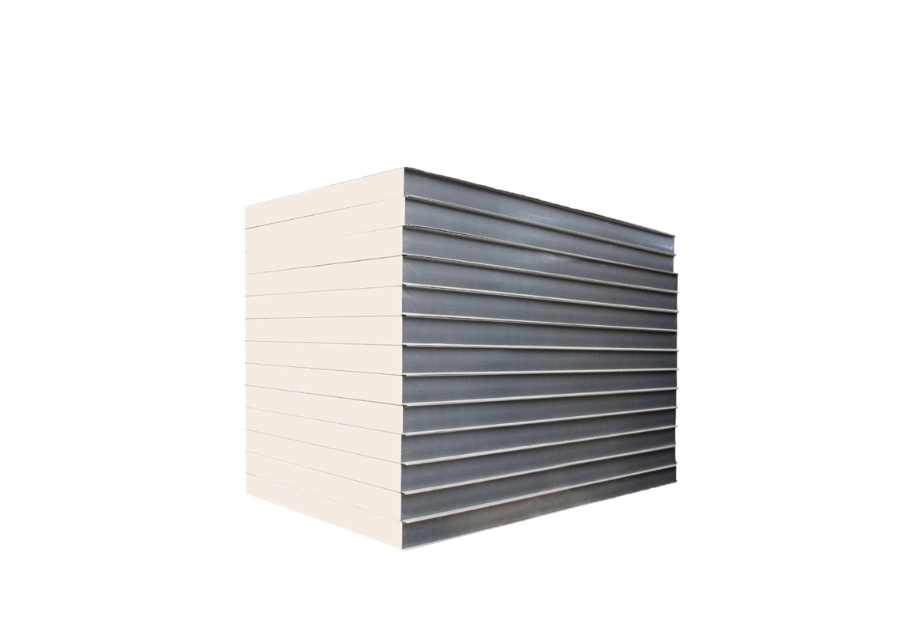
Cold storage enclosures carry continuous thermal, moisture and hygiene loads; qualification documents are judged against those operating conditions, not in isolation.
Inside the scope: ISO 9001:2015 and the JSGREEN001 panel
The most useful way to read GREEN BIO's ISO 9001:2015 certificate is to connect it to the parameters a buyer actually specifies. The JSGREEN001 panel is declared with a PU or PIR core, 50 mm or 100 mm thickness, 960 mm or 1100 mm effective width, a 0.5 mm steel face and a thermal conductivity of ≤0.024 W/(m·K). Those are nominal values. A quality management system is what makes nominal values reproducible across production runs: incoming steel and chemical control, formulation records, line settings, dimensional checks, and a route for handling nonconforming panels.
What ISO 9001:2015 does not do is validate the number. The declared thermal conductivity requires test documentation, and the B1 or B2 fire rating requires test documentation of its own. Certification ensures the supplier has a controlled process for producing and checking to a specification; the specification itself must be verified separately. Buyers who conflate the two tend to discover the gap only when a commissioning test or a fire inspection asks for the underlying report.
For procurement, the defensible combination is three documents held together: the ISO 9001:2015 certificate with its scope and number, the product test reports supporting the declared thermal and fire values, and a batch or project traceability record that ties delivered panels to production. Any one of the three alone is weaker than the decision it is being used to support.
ISO 14001:2015 and environmental claims in green building materials
Green building procurement is dense with environmental language, and cold storage panels attract a specific subset of it. GREEN BIO's application documentation lists environmentally friendly materials as a design requirement, including a CFC-free foaming agent, alongside a closed-cell structure intended to limit water vapour penetration and a surface suitable for food, pharmaceutical and clean-room environments.
ISO 14001:2015 is the management framework that makes such statements governable. It requires the organisation to identify the environmental aspects of its operations, maintain compliance obligations, control waste and emissions, and manage emergency situations. In practice, that is what allows a supplier to answer an environmental questionnaire consistently rather than case by case.
The boundary matters. ISO 14001:2015 is not a carbon footprint certification, an environmental product declaration, or a life-cycle assessment. If a project needs quantified embodied carbon for a panel system, that is a separate data request, and it should be raised at tender stage rather than assumed to sit inside an ISO 14001 certificate. China's own certification landscape reflects this division of labour: the national green product certification system integrates environmentally friendly, energy-saving, water-saving, recycled, regenerative, low-carbon and organic products into a unified framework, while management-system certificates sit underneath as process evidence.
ISO 45001:2018 across factory and installation
Cold storage panels are large, rigid and installed at height, and the installation sequence involves lifting, alignment, sealing and fastening. GREEN BIO's product portfolio includes work at that interface: the Adjustable Steel Prop / Telescopic Steel Prop series in Q195 and Q235 steel, with maximum heights from 3 m to 5 m and a minimum order quantity of 500 pieces, is intended for deep foundation pits, tunnels and large-scale structural construction.
ISO 45001:2018 addresses the occupational health and safety system behind both manufacturing and site-related activity: hazard identification, risk control, worker participation, incident investigation and the management of contractor interfaces. For buyers, the certificate is usually requested during HSE pre-qualification, particularly on projects where the client applies a uniform safety standard across suppliers.
It is worth being precise about what that buys. ISO 45001:2018 evidences that the supplier manages its own safety risks through a documented system. It does not replace the project's construction safety plan, method statements, or the site-specific risk assessment that the installing contractor must produce.
A verification sequence buyers can apply
Certificate fraud is rare; certificate misreading is common. The following sequence takes less than an hour and resolves most of the ambiguity that surfaces later in a project.
| Step | What to request or check | Why it matters |
|---|---|---|
| 1 | Certificate PDFs for ISO 9001:2015, ISO 14001:2015 and ISO 45001:2018, not brochure excerpts or screenshots | Screenshots routinely omit scope and validity fields |
| 2 | Standard edition printed on each certificate | A 2008-era quality certificate is not the same evidence as a 2015 one |
| 3 | Legal entity name on the certificate matches the contracting seller | Group-level certificates do not automatically cover a trading entity |
| 4 | Certified scope covers the design and manufacture of insulated sandwich panels | A scope limited to unrelated products proves nothing about panel supply |
| 5 | Registration number, issuing body (Jiangsu Taiding Certification Co., Ltd.) and validity period recorded in the qualification file | These are the fields an auditor or client consultant will ask for later |
| 6 | Current surveillance status confirmed with the supplier | Management-system certificates are maintained through periodic audits |
| 7 | Product evidence requested separately: thermal conductivity report, fire rating report, dimensional specification | Management-system certification cannot substitute for product testing |
Steps one to six test the supplier's management claims. Step seven tests the product. Projects that skip step seven and treat the ISO file as complete tend to reopen the question during commissioning.
Where the three certificates carry weight in practice
Food cold chain warehousing
GREEN BIO's application documentation identifies food cold chain warehousing as a scenario common in Germany, operating 24/7 under low-temperature conditions. The requirements are recognisable across markets: stable temperature control, resistance to high humidity without condensation problems, an easily cleaned surface, and fire behaviour consistent with the building's approval. Here ISO 9001:2015 supports the supplier qualification file, ISO 14001:2015 supports the client's environmental questionnaire, and ISO 45001:2018 supports the HSE pre-qualification that most retail and logistics clients apply to contractors.
Pharmaceutical and biological product storage
The same panel family is described as suitable for pharmaceutical and biological product storage applications in the United States, where temperature control is a compliance requirement rather than an operating preference. In these projects the certification set is necessary but clearly insufficient on its own: validated temperature mapping, documented construction details and hygiene-compatible finishes sit alongside the ISO file. The value of the ISO certificates is that they shorten the supplier due-diligence stage, not that they close it.
Logistics, agriculture and chemical storage
GREEN BIO lists logistics and warehousing, agriculture and chemical low-temperature storage among the intended industries for the JSGREEN001 panel, alongside food and beverage. Each brings a different emphasis: distribution hubs prioritise throughput and door performance, agricultural pre-cooling prioritises rapid pull-down, and chemical storage prioritises material compatibility and containment. The certification set is identical across these uses, which is precisely why it cannot be the deciding factor — the differentiating evidence is application-specific.
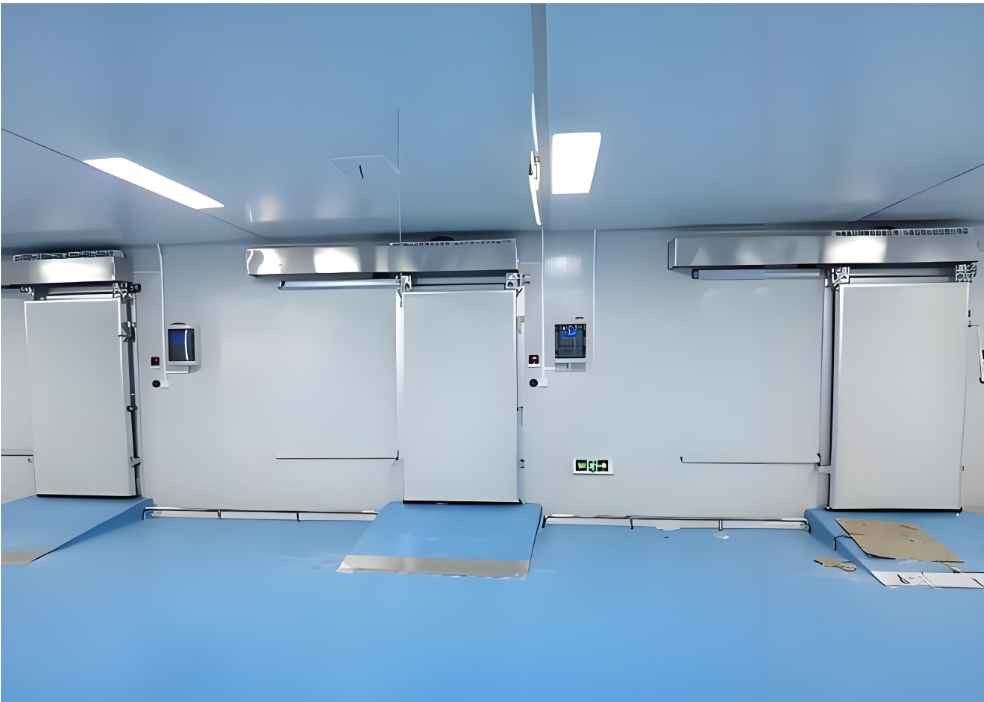
Panel systems are specified against operating temperature, humidity and hygiene requirements; the certification file supports the supplier decision, while test data supports the product decision.
Certification within the wider green building compliance picture
The commercial backdrop explains why documentation scrutiny has increased rather than relaxed. IMARC Group valued China's green building materials market at USD 216.3 billion in 2025 and projects USD 484.9 billion by 2034, a compound annual growth rate of 9.10%. Research houses define the category differently — one competing estimate is an order of magnitude smaller — which is itself a reason buyers rely on supplier-level evidence rather than market-level narrative when qualifying a specific vendor.
At the assessment level, GB/T 50378-2019 organises green building performance around safety and durability, health and comfort, occupant convenience, resource saving, and environmental livability. A cold storage panel touches several of those categories at once: envelope performance sits under resource saving, surface and material behaviour sit under health and comfort, and structural and fire characteristics sit under safety and durability.
At the product-certification level, China's green building materials certification categories include insulation-system materials, precast components, steel members, masonry materials, ready-mixed concrete, premixed mortar and concrete admixtures — a list that shows how product certification and management-system certification divide the work. The insulation-system category is where an insulated panel supplier's product-level claims belong; the ISO certificates are the organisational layer beneath it.
Demand direction is consistent across independent sources. The World Green Building Trends 2021 report summary describes continued and increased commitment to green building across the design and construction industry, and peer-reviewed research describes green buildings entering a period of integrated, multi-field development. None of this changes what an ISO certificate means; it changes how often a buyer will be asked to produce one.
How certified prefabricated panels compare with conventional cold room construction
Conventional cold room construction assembles the enclosure on site — masonry or concrete structure with insulation applied in place, followed by finishes and vapour control. Prefabricated panel systems move that work into a factory: panels are produced to fixed dimensions, delivered, and assembled dry with mechanical jointing and sealing.
The comparison that matters to a buyer is not which method is newer, but which method produces predictable results under the project's conditions.
- Process control. A factory-produced panel with a documented quality system gives a repeatable section; site-applied insulation depends heavily on the applicator's discipline on the day.
- Schedule. Dry assembly reduces wet trades and curing time, which matters on retrofit and phased logistics projects.
- Adaptability. Panels can be dismantled and reconfigured when a warehouse layout changes; cast-in-place insulation generally cannot.
- Interface discipline. Prefabricated systems concentrate risk at joints, penetrations and door openings, where sealing quality determines actual performance.
Three limits deserve equal weight, and they are the reason certification should never be treated as a ranking mechanism.
First, certification does not differentiate performance. Two suppliers can both hold ISO 9001:2015 and still offer panels with different core densities, steel thicknesses, thermal conductivities and fire ratings. The certificate is a threshold, not a score.
Second, installed performance depends on execution. GREEN BIO's application documentation lists sealing tape, fasteners, cold storage doors, loading platform door seals and installation accessories among the matched equipment for a cold room. A panel with a declared thermal conductivity of ≤0.024 W/(m·K) will not deliver the intended envelope if those interfaces are poorly detailed. Buyers should evaluate the installation method statement with the same seriousness as the panel specification.
Third, certification acceptance is project-specific. GREEN BIO's certificates are issued by Jiangsu Taiding Certification Co., Ltd., and whether a given owner, consultant or insurer accepts that issuing body for a given project is a question for that project. This is normal in export procurement, and it is best resolved in writing before contract award rather than after delivery.
One further caution applies to performance claims circulating in supplier literature. GREEN BIO's application documentation describes an energy saving rate that can reach more than 30% and a food shelf-life extension of more than 50% for well-designed cold storage enclosures. These are first-party descriptions of intended application benefit; they should be validated against the specific project's design, refrigeration equipment and operating profile rather than adopted as guaranteed outcomes.
What to expect next in cold storage panel compliance
Three directions are visible from the evidence available.
The first is consolidation of product-level green certification. China's unified green product certification system already draws environmentally friendly, energy-saving, recycled, regenerative and low-carbon products into one framework, and green building materials certification explicitly covers insulation-system materials. As that system matures, buyers are likely to ask for product certification alongside management-system certification rather than instead of it.
The second is a shift in how certificates are read. Procurement teams that previously asked "do you have ISO?" are increasingly asking which edition, which scope, which issuing body, and which product family the certificate covers. That is a more demanding question for suppliers, and a more useful one for buyers.
The third is market-specific documentation. GREEN BIO exports approximately 70% of its output to markets in Southeast Asia, Central Asia, Russia, South America and Africa along the Belt and Road Initiative. Each destination applies its own acceptance rules for supplier documentation, which means a single global certificate pack is rarely sufficient; the qualification file usually has to be assembled per market and per client.
Frequently asked questions
What do GREEN BIO's ISO 9001:2015, ISO 14001:2015 and ISO 45001:2018 certificates cover?
They cover three separate management systems. ISO 9001:2015 certifies a quality management system governing production and delivery control, traceability and corrective action. ISO 14001:2015 certifies an environmental management system governing environmental aspects, compliance obligations, and waste and emissions control. ISO 45001:2018 certifies an occupational health and safety management system governing hazard identification, risk control and incident management. All three are organisational certifications, not product certifications.
Which organisation issued these certificates, and where is the certificate number recorded?
The certificates were issued by Jiangsu Taiding Certification Co., Ltd. Each certificate carries its own registration number, printed on the certificate document itself. That number, together with the certified scope and validity period, should be obtained from the certificate PDF and filed against the purchase order during supplier qualification.
How should a buyer verify ISO certification before placing a cold storage panel order?
Request the certificate PDFs directly, confirm the standard edition printed on each certificate, confirm that the legal entity named matches the contracting seller, confirm that the certified scope covers insulated panel design and manufacture, record the registration number and issuing body, and confirm current surveillance status. Product evidence — thermal conductivity reports, fire rating reports and dimensional specifications — should be requested as a separate package.
Does ISO certification confirm the thermal or fire performance of a cold storage panel?
No. The JSGREEN001 panel is declared with a thermal conductivity of ≤0.024 W/(m·K) and a B1 or B2 fire rating, and those values must be supported by product test documentation. ISO 9001:2015 confirms that the supplier operates a controlled process capable of producing to specification; it does not certify the specification values themselves.
Are these three certificates sufficient for green building compliance in export markets?
They are usually necessary but rarely sufficient. Management-system certification supports supplier qualification, environmental questionnaires and HSE pre-qualification. Product-level certification, such as China green building materials certification for insulation-system materials, addresses the product layer. Destination-market acceptance rules and project-specific requirements sit outside both and must be confirmed for each project.
Closing note
For buyers assembling a cold storage panel qualification file, the practical sequence is straightforward: read the scope before accepting the certificate, separate management-system evidence from product evidence, and record the registration number, issuing body and validity period while the supplier file is still open. Applied that way, ISO 9001:2015, ISO 14001:2015 and ISO 45001:2018 issued by Jiangsu Taiding Certification Co., Ltd. do useful work — they establish that GREEN BIO's processes for producing the JSGREEN001 panel are documented and auditable, which is a supplier question, leaving the product question where it belongs, with test data and installed-system performance.
The GREEN BIO product catalogue, including the cold storage panel range and supporting building materials, is available for reference and download: Green Bio Professional Catalog 2026 (PDF).
Tem questões ou precisa de mais detalhes?
Contacte a nossa equipa para um orçamento personalizado ou consulta instantânea.
Solicitar orçamento
Preencha o formulário abaixo e a nossa equipa entrará em contacto com uma proposta personalizada.
Chat direto do WhatsApp
Prefere conversar em tempo real? Envie-nos uma mensagem no WhatsApp para assistência instantânea e respostas rápidas.
- Obter orçamento personalizado
- Partilhar fotos ou documentos
- Discuta as suas necessidades diretamente
Geralmente responde em 5–30 minutos durante o horário de expediente.