
ISO 9001 and CE: What Porcelain Tile Certificates Verify
ISO 9001 and CE: What Porcelain Tile Certificates Verify
ISO 9001:2015 and CE certification answer different procurement questions, and treating them as interchangeable is one of the most common reasons a porcelain tile submittal stalls. ISO 9001:2015 verifies how a manufacturer controls production and service. A CE certificate covers a defined product scope for the EU market. Neither document, read on its own, states that a particular tile will deliver a specific breaking strength on a specific project. Specifiers who read both documents together — and reconcile them against the declared technical data — reach a defensible shortlist considerably faster.
The distinction matters most in the 60x120 cm format, where one product family can be specified for a hotel lobby, an airport departure hall and a hospital corridor with very different performance expectations. What follows sets out what each certificate covers, which products it is attached to, where the boundaries sit, and what a buyer should still verify before confirming an order.
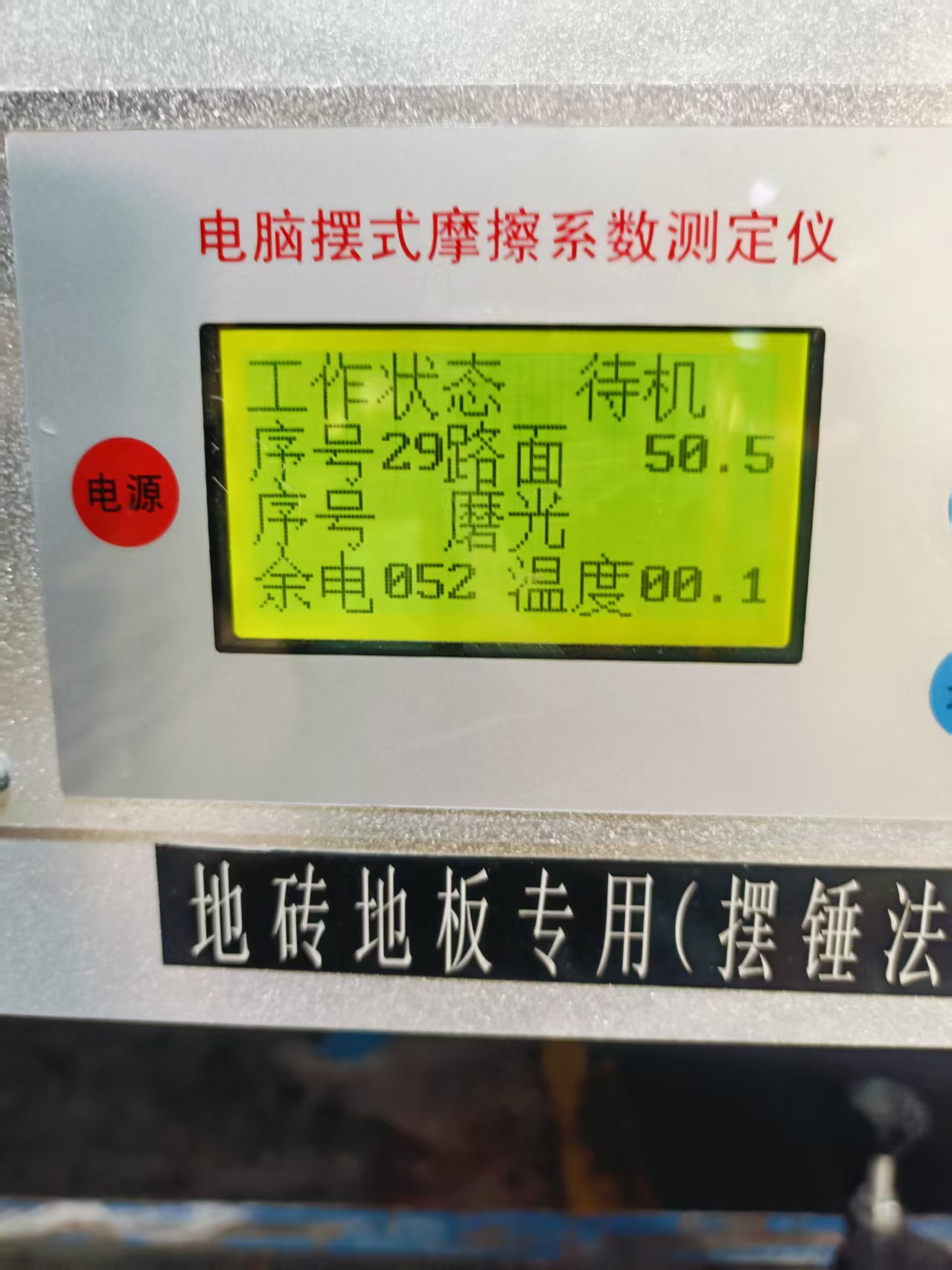
Slip resistance testing on a porcelain tile sample: performance data supports a certificate, but is not the same document.
Why certification becomes the deciding criterion at evaluation stage
Commercial tile procurement rarely fails on price. It fails on documentation. Two patterns recur in project submittals. The first is treating a quality management certificate as if it were a test report, which leads buyers to assume that a management-system audit has confirmed the breaking strength printed on a datasheet. The second is assuming a CE certificate is a global passport, when it is tied to the EU regulatory framework and to the specific product scope written into the certificate itself.
Both assumptions create rework at exactly the wrong moment — after the specification is locked and before the purchase order is issued. The practical answer is to separate the questions: a management-system certificate answers can this factory consistently control what it produces; a product conformity certificate answers which products, under which scope, are declared conformant for which market; a batch test report answers what were the measured values for this production run. A shortlist that keeps those three answers distinct is easier to defend to a client, a consultant or a lender's technical advisor.
The two credentials held for the Marble Series and Travertine ranges
ALL KING CERAMICS (ZIBO ALL-KING CERAMICS CO., LTD) is a porcelain tile manufacturer and direct exporter based in Zibo, China, founded in 2011 and operating a 60,000 m² manufacturing facility, with 60x120 cm porcelain tiles as its flagship core format. The company's compliance file for its two 60x120 cm ranges is compact and specific, which is useful for evaluation because both documents can be checked against the product list rather than against a general corporate brochure.
| Record | ISO 9001 | CE |
|---|---|---|
| Certificate number | 0350521Q30166R1M | AC 50163816 0001 |
| Issuing body | XQCC | TUV |
| Standard recorded | ISO 9001:2015 | EEC |
| Market recorded | Global markets | EU |
| Scope as recorded | Production and service of Ceramic Tile (except as required by 3C) | Ceramic tiles — dry-pressed ceramic tiles, for internal flooring |
| Linked products | Marble Series (ID 4765); Travertine (ID 5624) | Marble Series (ID 4765); Travertine (ID 5624) |
Two details in that table are worth more attention than they usually receive. First, both certificates are attached to the same two named products, which means a specifier comparing suppliers does not need to infer coverage from a corporate certificate — the product link is explicit. Second, the scopes are written narrowly and in different languages of assurance: one describes a production and service system, the other describes a defined tile type and application.
What ISO 9001:2015 verifies — and what it does not
ISO 9001:2015 is a quality management system standard. Certification by XQCC under certificate 0350521Q30166R1M confirms that the scope stated on the certificate — the production and service of ceramic tile, except as required by 3C — is managed under a documented quality system subject to external audit. For a buyer, the operational meaning is consistency: the routines that govern incoming material, forming, firing, sorting and final inspection are defined, recorded and auditable rather than dependent on individual shift practice.
That is a meaningful risk-reduction signal for multi-phase projects, where tiles ordered six months apart need to match in tone, calibre and surface. It is also why the company's own quality routines are worth reading alongside the certificate: ALL KING CERAMICS states that its control process combines 100% flatness and sizing auto-check, piece-by-piece visual inspection, and random laboratory testing per batch. Those routines explain how a management system is operated on the line — they do not replace the certificate, and the certificate does not replace them.
The boundary is equally clear. ISO 9001:2015 certification does not declare a water absorption value, a breaking strength, an abrasion class or a slip rating. Any figure of that kind comes from product test data, not from the management-system certificate. A submittal that cites ISO 9001 as evidence of 1300 N breaking strength is answering the wrong question with the right document.
What the CE certificate verifies under the EEC standard
CE certificate AC 50163816 0001, issued by TUV, is a product conformity document for the EU market recorded against the EEC standard. Its scope is deliberately specific: dry-pressed ceramic tiles for internal flooring. For a project in the EU — or for an international project whose specification references European conformity — that scope statement is the operative sentence, and it should be quoted in the submittal rather than paraphrased into a general claim of approval.
The word internal carries real weight. A CE certificate with that scope does not, by itself, cover exterior paving, façade cladding or wet-area floor applications, even where the same product family is technically capable of them. That is not a defect in the certificate; it is how product conformity documentation works. When a scheme requires frost resistance for an exposed terrace, or anti-slip performance for a wet circulation zone, the buyer should ask for the specific test evidence that supports that condition instead of extending the CE scope by assumption. For cold-climate and wet environments, project requirements typically reference anti-slip R10/R11, frost resistance, acid and alkali resistance and low VOC emissions — each of which needs its own supporting document.
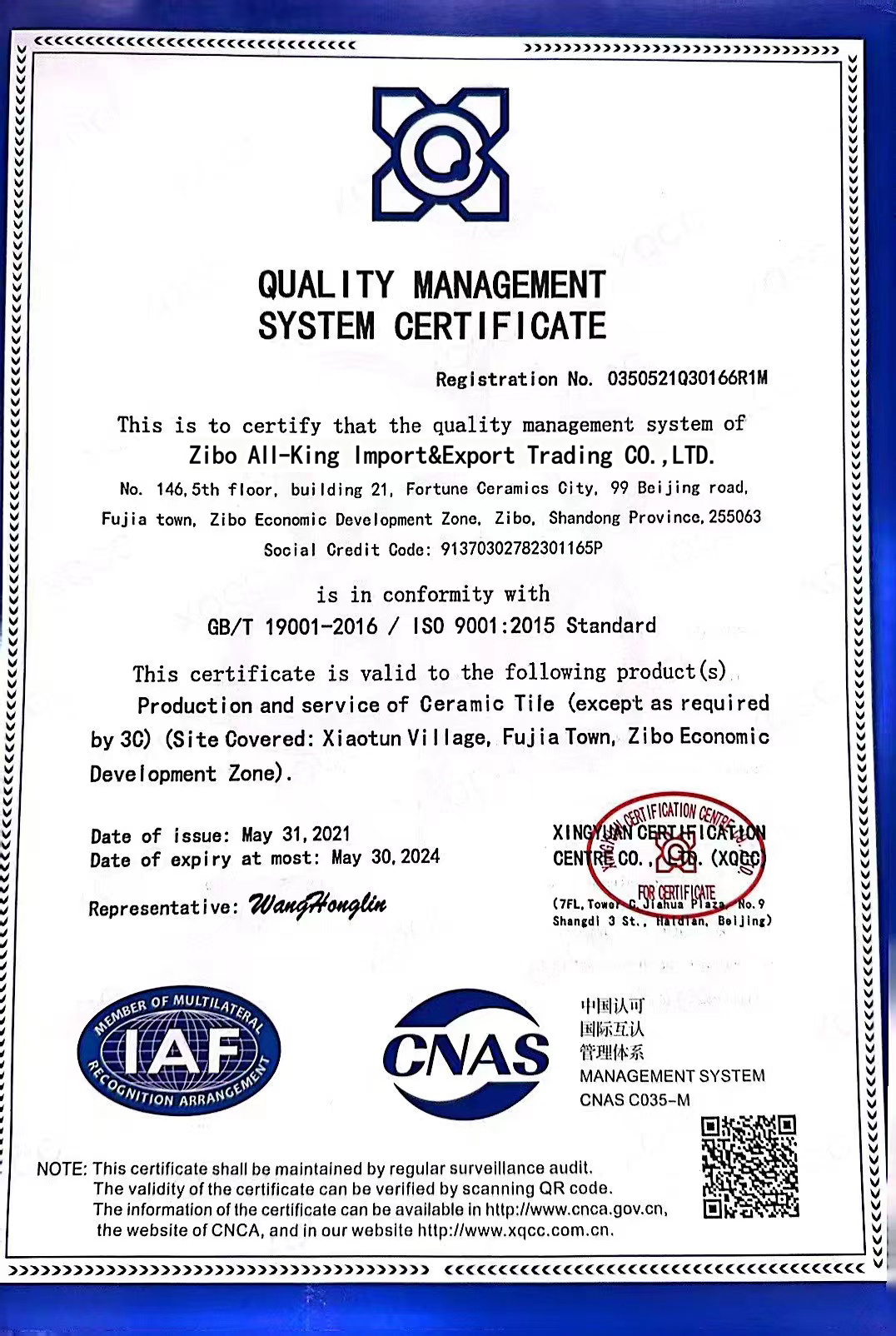
The ISO 9001 record covers production and service of ceramic tile; product performance figures come from separate test data.
Connecting certificate scope to declared performance parameters
The declared technical data for both the Marble Series and the Travertine range is identical at the parameter level, which simplifies side-by-side evaluation of the two surfaces. The table below shows how each declared value relates to the certification file — and what a specifier should still confirm independently.
| Declared parameter | Value (both ranges) | How it relates to the certificates | What to confirm at submittal |
|---|---|---|---|
| Water absorption | < 0.5% (vitrified) | Matches the ISO 13006 porcelain threshold of 0.5% or less; supports CE scope as a dry-pressed porcelain tile | Batch test report showing the measured value for the delivered lot |
| Breaking strength | ≥ 1300 N | Product test data; outside the ISO 9001 scope statement | Test method and sample size used for the declared figure |
| Modulus of rupture | ≥ 35 MPa | Product test data; not stated on either certificate | Whether the project specification sets a higher threshold |
| Abrasion resistance | PEI 4 / PEI 5 | Product classification; relevant to high-traffic applications | Which class applies to the specified surface finish |
| Mohs hardness | 6–7 | Product data; supports scratch-resistance expectations | Consistency with the intended cleaning regime |
| Thickness range | 9.0–10.5 mm | Product specification; affects substrate and adhesive planning | Tolerance acceptance in the installation method statement |
| Packing | 2 pcs/box (1.44 m²/box) | Logistics data; independent of certification | Box quantity against the project take-off and site storage |
The water absorption figure is the clearest example of why this cross-check is worth doing. Porcelain tiles are defined under ISO 13006 as ceramic tiles with water absorption of 0.5% or less, so a declared value below 0.5% places these products squarely inside the porcelain category that the CE scope describes. That consistency between the declared number and the certified scope is a stronger signal than either element alone, because it shows the technical datasheet and the conformity document describe the same product.
Where the credentials matter in real applications
Commercial flooring decisions turn on traffic, moisture and maintenance rather than on aesthetics alone, and the certification file supports the first screening rather than the final one. In a hotel lobby or shopping mall floor, PEI 4–5 abrasion resistance and a breaking strength of at least 1300 N address the two failure modes that generate the most remedial work: surface wear along circulation routes and point-load cracking at furniture legs and trolley paths. In airport departure halls and railway station concourses, the same parameters interact with continuous heavy-duty use and non-stop foot traffic, where replacement access is limited and disruption costs are high.
ALL KING CERAMICS records a 15,000 sqm commercial reference spanning hotel lobby, commercial mall flooring and airport departure hall applications, with the ranges also specified for office building facades and high-end apartment bathrooms. That reference is company-recorded rather than independently audited, which is normal at supplier-selection stage and is precisely why the certificate check should come before the reference check: a documented scope protects the buyer even where a reference cannot be independently verified.
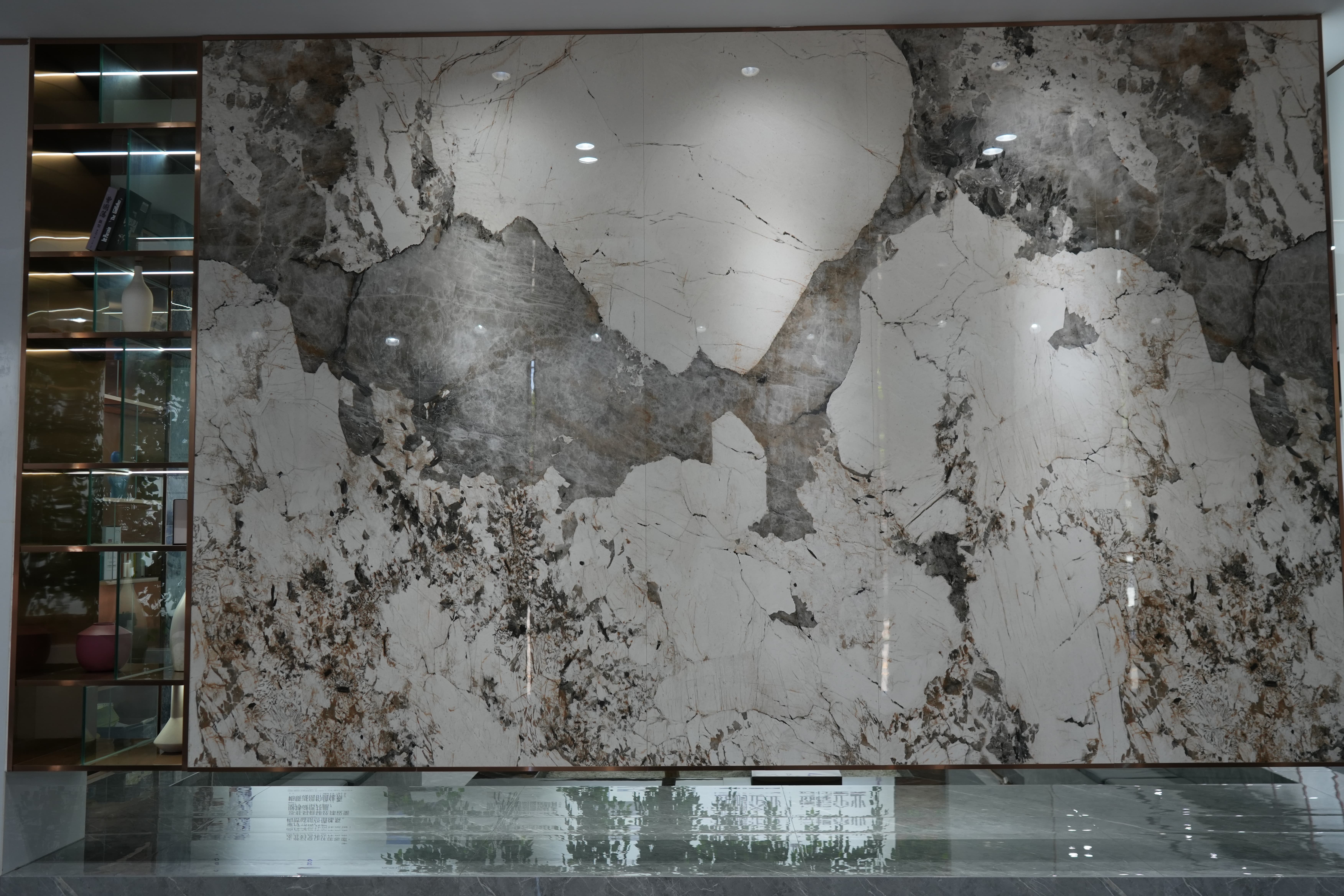
Large-format porcelain in a commercial interior: wall and floor applications fall under different scope statements.
Certificate, test report and site acceptance: three different documents
Specifiers who already work with management-system certificates sometimes ask why a CE certificate is not simply a stronger version of the same thing. It is not a stronger version — it is a different instrument, and confusing the two is the root of most submittal queries.
| Document | What it establishes | What it cannot establish | Typical use in procurement |
|---|---|---|---|
| ISO 9001:2015 certificate (XQCC) | Audited control of production and service within the stated scope | Any measured product value | Factory qualification and consistency risk |
| CE certificate (TUV, EEC) | Conformity for the named product scope — dry-pressed ceramic tiles for internal flooring — for the EU market | Applications outside that scope, or non-EU market admission | EU specification compliance and scope matching |
| Batch test report | Measured values for a specific production run | Consistency across future batches | Pre-shipment verification and lot acceptance |
| Site acceptance check | Condition on delivery: flatness, shade, calibre, breakage | Manufacturing capability or conformity status | Goods-in inspection and claims evidence |
Read as a set, the four documents cover the full procurement chain from factory control to delivered condition. Read as substitutes for one another, they leave gaps that surface as disputes. The practical rule is that each claim in a submittal should name the document that supports it.
What this means for EU and international project documentation
For EU-based projects, the CE certificate and its internal-flooring scope are the primary conformity reference, and the ISO 9001:2015 certificate supports the factory qualification section of the same submittal. For projects in Central Asia, Russia, Southeast Asia, the Middle East or Latin America, the CE certificate remains useful evidence of conformity discipline but should not be presented as local market admission — those schemes typically require their own documentation set, and the responsible step is to confirm the destination market's requirements before the specification is finalised.
Demand context makes that discipline more valuable rather than less. Kazakhstan's construction output grew by 15.9% year-on-year in 2025 according to the Bureau of National Statistics of Kazakhstan, and Mordor Intelligence estimates the Russian ceramic tiles market at USD 2.90 billion in 2025 — both markets where international suppliers compete for project packages and where a clean, checkable document set shortens the evaluation cycle. Supply-side capability supports that cycle: ALL KING CERAMICS reports a monthly capacity of 1.2 million m² within a 12–16 million m² annual output, a minimum order quantity of 400 sqm per design with trial orders accepted, and a stated lead time of 7–10 days, with 70% of output exported.
Limitations and fit boundaries a specifier should state openly
A certificate number identifies a document; it does not by itself confirm current validity, and every issuing body should be checked directly for the certificate's present status before the submittal is signed off. This is standard verification practice rather than a comment on any particular certificate.
Three further boundaries belong in the specification notes rather than in a footnote. The CE scope is limited to internal flooring, so exterior paving, façade cladding and other applications need their own supporting evidence. The ISO 9001 scope excludes aspects required by 3C, so any project requiring that framework should confirm how it is addressed separately. And both certificates describe the product as supplied, not as installed: substrate preparation, adhesive selection, movement joints and site workmanship determine in-service performance and sit outside any factory certificate.
A verification sequence for evaluation-stage buyers
- Confirm the certificate number with the issuing body and record the current status in the submittal file.
- Match the certificate scope wording to the intended application — internal flooring, exterior, wall cladding or wet area.
- Confirm the named product models on the certificate match the models in the bill of quantities; here, Marble Series (ID 4765) and Travertine (ID 5624).
- Cross-check declared parameters against the certificate scope for consistency, beginning with water absorption below 0.5% as the porcelain threshold.
- Request batch test data covering breaking strength, modulus of rupture and abrasion class for the production run being shipped.
- Confirm the destination market's own documentation requirements before the specification is finalised, particularly outside the EU.
- Agree goods-in acceptance criteria — flatness, shade, calibre and breakage — in writing before shipment.
Outlook
Documentation scrutiny in commercial tile procurement is moving in one direction: fewer unqualified claims, more scope-matched evidence. For manufacturers, that favours suppliers whose certificates name specific products and specific applications rather than a general capability. For specifiers, it means the evaluation stage can be shorter and firmer — a certificate with a narrow, checkable scope plus a datasheet that agrees with it is easier to approve than a broad claim that has to be unpicked later. The practical test for any porcelain tile submittal remains unchanged: every performance statement should be traceable to a document that actually covers it.
Frequently asked questions
What does ISO 9001:2015 certification actually verify for a tile supplier?
ISO 9001:2015 certification verifies that a documented quality management system is in place and externally audited within a stated scope. For ALL KING CERAMICS, XQCC certificate 0350521Q30166R1M covers the production and service of ceramic tile, except as required by 3C, for global markets. It confirms controlled, auditable production routines for the Marble Series and Travertine ranges. It does not declare water absorption, breaking strength, abrasion class or any other measured product value; those come from product test data.
Which products are covered by CE certificate AC 50163816 0001?
The CE certificate issued by TUV under the EEC standard covers the Marble Series (ID 4765) and Travertine (ID 5624) 60x120 cm porcelain tiles. The recorded scope is dry-pressed ceramic tiles for internal flooring, for the EU market. Because the scope names internal flooring specifically, the certificate should not be presented as covering exterior paving, façade cladding or wet-area floor applications, which require separate supporting test evidence.
Does a certificate number prove a tile's breaking strength or abrasion rating?
No. Certificate numbers identify the document and its scope, not individual measured values. The declared performance for both the Marble Series and Travertine ranges — breaking strength of at least 1300 N, modulus of rupture of at least 35 MPa, PEI 4/PEI 5 abrasion resistance and water absorption below 0.5% — is product test data that sits alongside the certification file. A specifier should ask for the batch test report behind those figures rather than citing the ISO 9001 or CE certificate as the source.
How should a specifier verify these certificates for a Kazakhstan or EU project?
For an EU project, check CE certificate AC 50163816 0001 with TUV for current status, confirm the internal-flooring scope matches the intended application, and verify that the specified models are the named products. For a Kazakhstan or other non-EU project, the CE certificate remains useful conformity evidence but is not local market admission, so the destination market's own documentation requirements should be confirmed separately. In both cases, also verify XQCC certificate 0350521Q30166R1M directly and match its scope wording to the application.
A full format, finish and packing reference for the ranges discussed here is available in the ALL KING Ceramics catalogue, and company details are published at www.all-king.com.
Tem questões ou precisa de mais detalhes?
Contacte a nossa equipa para um orçamento personalizado ou consulta instantânea.
Solicitar orçamento
Preencha o formulário abaixo e a nossa equipa entrará em contacto com uma proposta personalizada.
Chat direto do WhatsApp
Prefere conversar em tempo real? Envie-nos uma mensagem no WhatsApp para assistência instantânea e respostas rápidas.
- Obter orçamento personalizado
- Partilhar fotos ou documentos
- Discuta as suas necessidades diretamente
Geralmente responde em 5–30 minutos durante o horário de expediente.