
ISO 9001 and Pre-Shipment Testing: Heat Treatment Furnace Qualification Brief
ISO 9001 and Pre-Shipment Testing: Heat Treatment Furnace Qualification Brief
An ISO 9001 certificate tells a heat treatment furnace buyer that a supplier's quality management system has been assessed against a recognised standard. It does not tell the buyer how uniform the furnace is at temperature, how the atmosphere is controlled, or what was actually measured before the equipment left the factory. Those answers sit in two further evidence layers: a defined pre-shipment test and a documented handover from factory pre-acceptance to on-site final acceptance. Norsen Thermal Technology (Jiangsu) Co., Ltd. supplies part of that stack — an ISO 9001 certificate numbered ISC-Q-2024-4373-R covering its multi-purpose and atmosphere furnace product line, plus a stated 100% pre-shipment test. This brief sets out what each item establishes, where its scope ends, and which records a buyer should put into the RFQ before comparing offers.
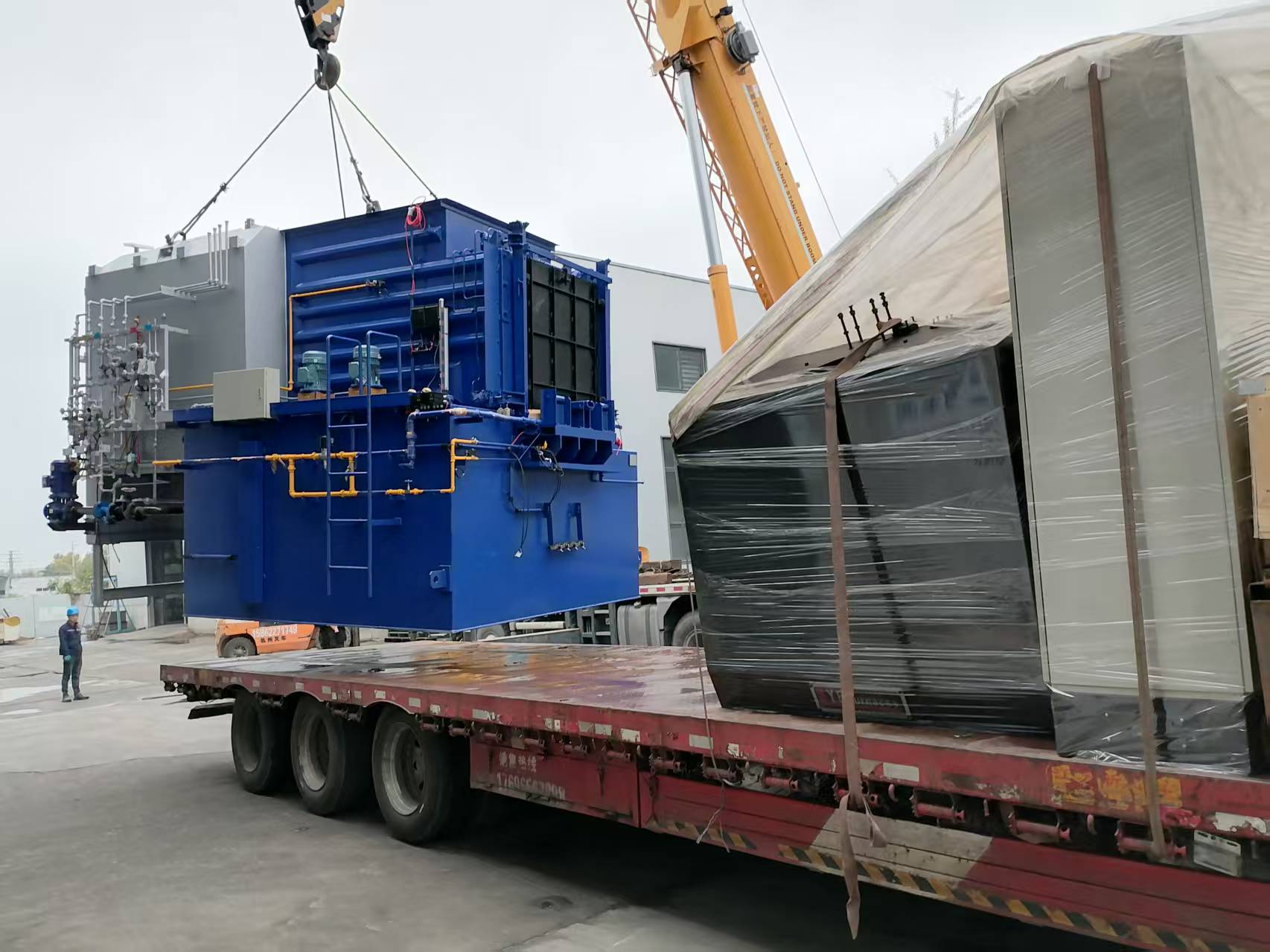
Dispatch preparation is the last point at which furnace-level test records can still be corrected before shipment.
Why qualification evidence outweighs a certificate copy
In heat treatment, the furnace is the process. Case depth, hardness, distortion and repeatability depend on temperature uniformity, atmosphere composition and quench behaviour, and all three are functions of equipment configuration plus instrumentation. A buyer at research and evaluation stage is therefore not choosing a machine alone; the buyer is choosing a documented operating basis that a quality department, an end customer or an auditor can later inspect.
Three public reference points frame that expectation. ISO/TC 244, the ISO technical committee for industrial furnaces and associated processing equipment, scopes quality requirements and recommendations applicable to heat treatment on mechanical parts intended for car manufacturing, aerospace, pipeline systems, civil engineering equipment, earth moving machinery, agricultural equipment, the naval industry, energy equipment, tooling and fasteners. ASTM A991/A991M is a standard test method for conducting temperature uniformity surveys on furnaces used to heat treat steel products. AMS 2750 and CQI-9 are described by the heat treatment equipment maker SAT Thermique as standards that subject heat treatment processes to stricter rules, including temperature uniformity, instrumentation, calibration and system accuracy testing.
None of those three are the same instrument as ISO 9001. ISO 9001 assesses a management system; the others address process capability and test evidence. A supplier can hold ISO 9001 and still have no furnace surveyed to ASTM A991 or approved to an AMS 2750 or CQI-9 requirement. That separation is the whole point of a qualification brief, and it determines what a buyer should ask for at each stage.
- System level: the ISO 9001 certificate — issuer, standard, certification number, scope wording and validity dates.
- Unit level: pre-shipment test records — the measured values, the instruments used and their calibration status, and the safety function results.
- Handover level: factory pre-acceptance and on-site final acceptance — signed protocols, closed deviations and as-built documentation.
What NORSEN's ISO 9001 certification covers — and where the scope ends
Norsen Thermal Technology (Jiangsu) Co., Ltd. is based in Peixian County, Jiangsu Province, and develops intelligent heat treatment equipment intended to improve the heat treatment performance of metal materials while raising production efficiency and reducing energy consumption. The company holds ISO 9001 quality management system certification, and its public site is available at NORSEN.
The certification record identifies the certificate number as ISC-Q-2024-4373-R, issued by Beijing National Standard Joint Certification Co., Ltd. against the standard GB/T19001-2016/ISO9001:2015, with an issue date of 29 August 2024 and an expiry date of 29 August 2027. Market coverage is stated as Global. The certified scope reads: Technology Development and Manufacture of Heat Treated Industrial Electric Furnishings.
The same record associates the certification with the multi-purpose furnace and atmosphere furnace product (product code 3832), covering model families RTQ, TQ, SHQ and DHQ with the size designations RTQ-10, RTQ-17, RTQ-25, TQ-10, TQ-17, TQ-25, SHQ-10, SHQ-15, SHQ-25, DHQ-10, DHQ-15 and DHQ-25.
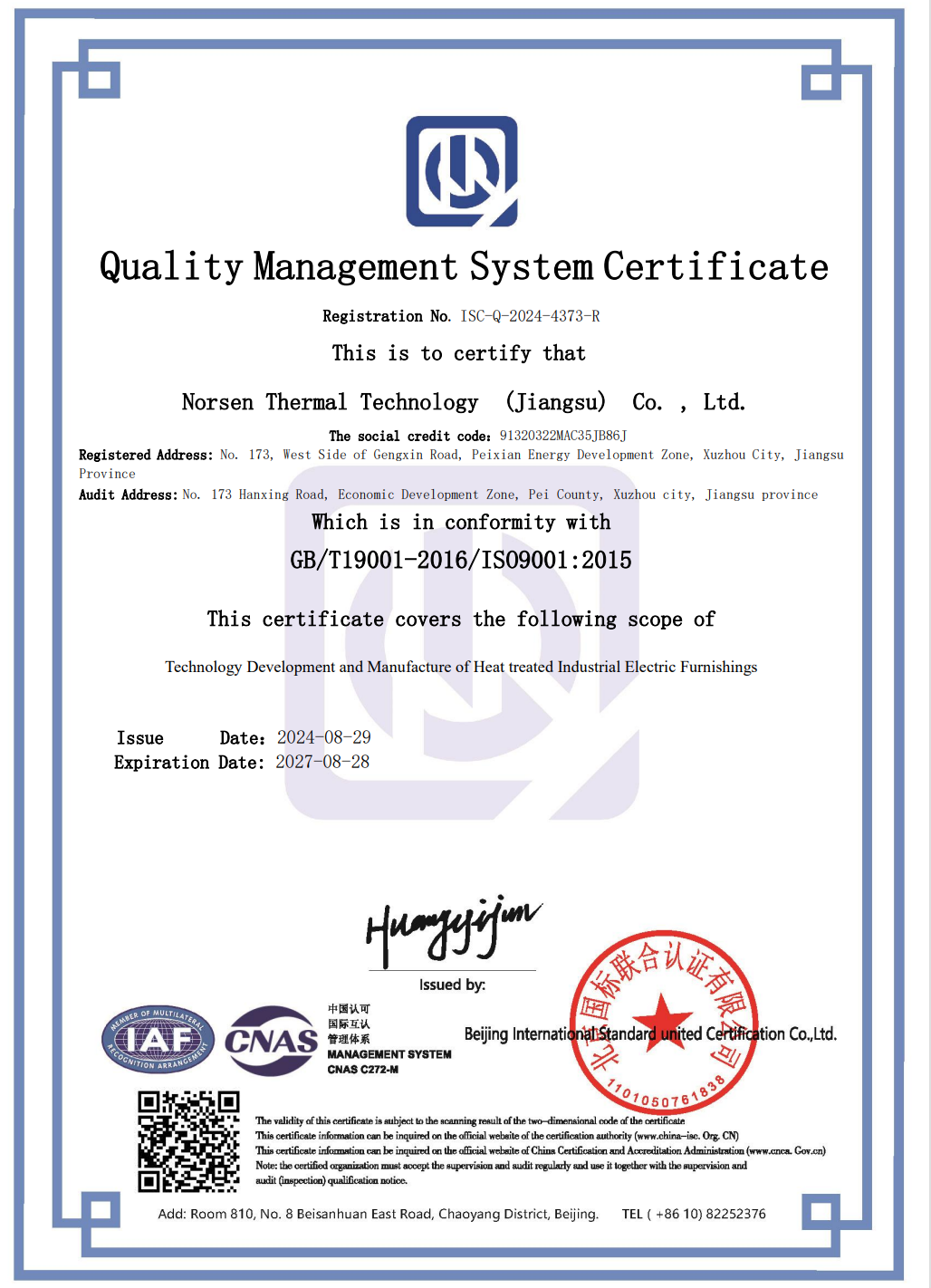
The certificate carries a defined scope, standard and validity window — three items a buyer should check against the planned shipment date.
Read precisely, the scope wording describes design and manufacturing activity. It is not a statement of temperature uniformity class, atmosphere accuracy, energy consumption level or process approval for a specific part. For a buyer, that means the certificate answers "is there a controlled quality system behind this factory?" It does not answer "will this furnace hold my gear tooth geometry within tolerance?"
The practical check is short: confirm the certificate number, the issuing body, the standard designation, the scope text and both validity dates against the certificate copy, then compare the expiry date with the contractual shipment date.
Scope boundary: an ISO 9001 certificate is not an ASTM A991 temperature uniformity survey report, an AMS 2750 approval, a CQI-9 assessment or a market-access mark. The supplied material contains none of these for NORSEN furnaces, so they should not be assumed. Where a buyer's end customer requires them, they belong in the purchase specification as separate, priced deliverables with named witnesses.
Pre-shipment testing: what a 100% test claim establishes
NORSEN states 100% pre-shipment test as its quality-control approach. Read literally, that means testing applied to every unit dispatched rather than to a sample from a batch. At evaluation stage this is a meaningful commitment, because each furnace leaving the works carries its own inspection record rather than relying on a representative unit.
The boundary matters just as much. The supplied company material does not publish the individual test items, the acceptance thresholds, the record template or whether any part of the test can be witnessed by the buyer or a third party. Those are exactly the details that decide whether a test claim supports a particular process qualification, so the useful request is for the protocol itself, not for a restatement of the phrase.
Test items that generate usable records on this furnace platform
The documented configuration gives a buyer a concrete basis for asking about specific checks. The furnaces use a SiC muffle furnace structure with a chain dual drive, four symmetrical oil tank agitator motors, high-performance heating elements and an intelligent atmosphere control system, with over-temperature protection, over-current protection and gas heating. Process coverage listed for the line includes hardening with oil quench, carbonitriding, tempering, carburizing and case hardening, and the declared materials are Q235, SS304 and SS310.
- Thermal system: for the muffle and heating element arrangement, request the setpoints used, the measured readings at agreed positions, and the calibration status of every instrument in the loop.
- Atmosphere system: for the intelligent atmosphere control system, request the atmosphere or carbon-potential readings taken under defined conditions and the reference method used to check them.
- Quench system: for the four symmetrical oil tank agitator motors, request verification that each agitator ran and was checked before dispatch.
- Drive and mechanics: for the chain dual drive, request the continuous-run record and any alignment or adjustment notes.
- Safety functions: for over-temperature protection, over-current protection and gas heating, request the interlock and trip test results, signed by the person who performed them.
Each of these is a request for what was measured and by whom. The purpose is traceability: a signed record with instrument identification lets a buyer's quality team reconstruct the condition of the unit at dispatch, which is precisely what a certificate on its own cannot do.
Factory pre-acceptance and on-site final acceptance: a documented handover
A heat treatment furnace is accepted twice. It is accepted in the factory, where configuration and control behaviour can be observed under controlled conditions, and it is accepted on site, where utilities, foundation, crane access and installation practice influence performance. The handover is defensible only when both events produce signed records and every deviation is either closed or explicitly transferred to a punch list.
| Stage | What it should establish | Records to request |
|---|---|---|
| Pre-award document review | That the system certificate is valid, correctly scoped and applicable to the ordered model | Certificate copy with number, issuer, standard, scope and validity dates; model list covered |
| Factory pre-acceptance | That the built unit matches the order and that control, atmosphere, quench and safety functions behave as specified | Signed pre-acceptance protocol with measured values, instrument list and calibration status, safety trip log, deviation list |
| Pre-shipment test and dispatch | That the 100% pre-shipment test was completed on this serial number | Completed test sheet per unit, packing list, dispatch clearance signed by quality control |
| Installation and commissioning | That site conditions match the equipment requirement | Utility verification (electricity, compressed air, natural gas, exhaust ducting), installation checklist, cold and hot commissioning readings |
| On-site final acceptance | That the furnace performs at the agreed criteria in the buyer's plant | Any specified temperature uniformity survey, control accuracy check, atmosphere verification on test parts, signed acceptance certificate and punch-list closure |
A stage-by-stage record set turns pre-shipment testing from a supplier statement into a buyer-usable qualification file.
One naming caution is worth writing into the contract. The abbreviation SAT is used both for a site acceptance test and for the system accuracy test referenced under AMS 2750-style requirements. Spell out the full term in the protocol, state who performs each event and who witnesses it, and state what happens if a criterion is missed before shipment rather than after arrival.
Where the buyer's own process standard requires a uniformity survey, ASTM A991/A991M provides a method for conducting temperature uniformity surveys on furnaces used to heat treat steel products. The purchase specification should then name the survey method, the measurement positions, the soak conditions, the acceptance criteria, the performing party and the re-survey interval. On the supplier side, NORSEN states free remote technical assistance after sale; naming the support channel, escalation path and response expectations in the contract is more useful than relying on general after-sales language.
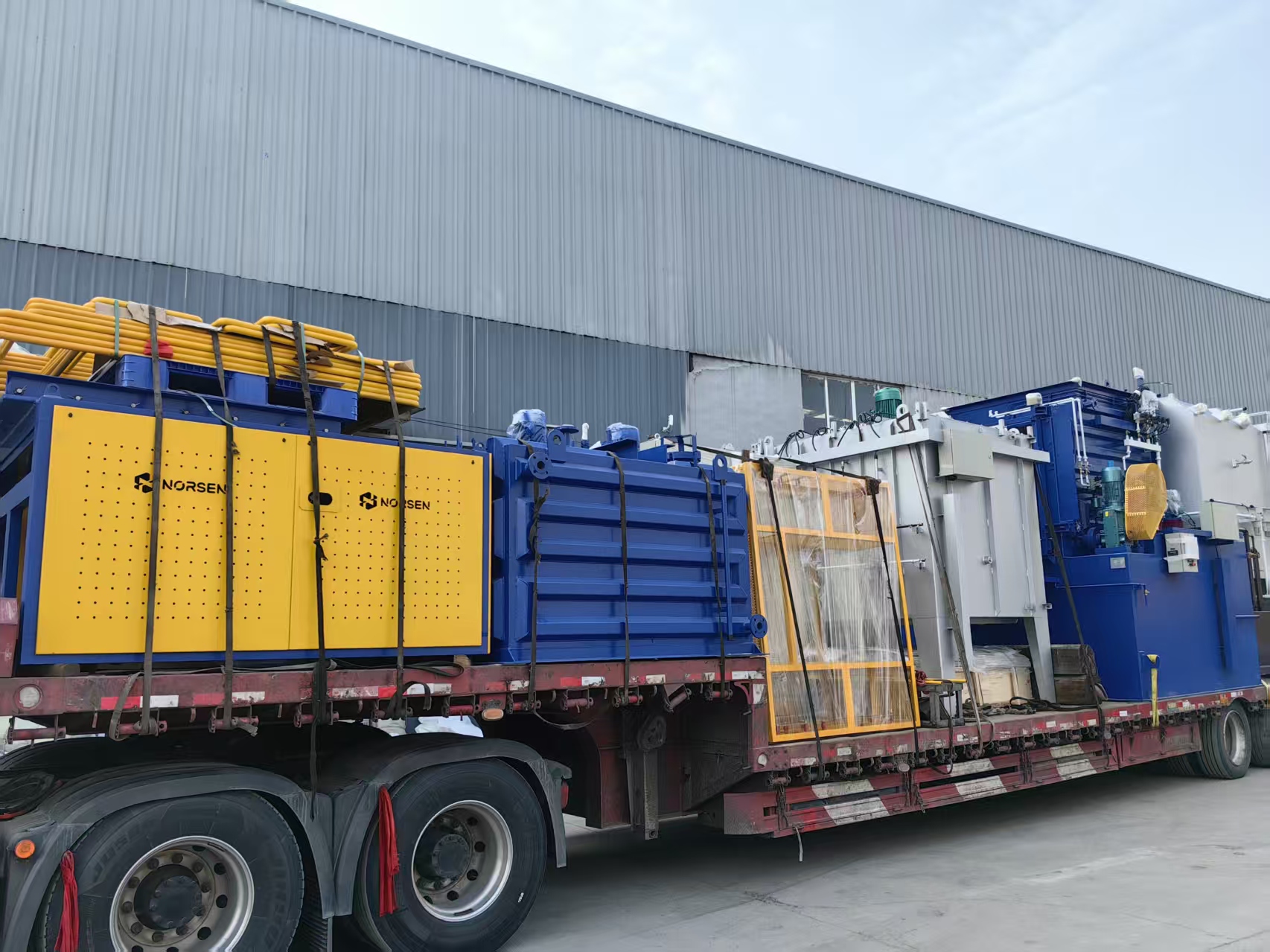
Packing and documentation clearance should be signed off together; a completed test sheet that does not travel with the unit loses its value at site.
Application fit: where the qualification file changes the decision
The declared application scope for the line covers military industry, automobiles, agricultural machinery, robots, bearings, hardware and sewing machines, with the supplied application description centred on carburizing and quenching of metal parts and on gear processing. The company's described customer types include automotive OEMs, military industry units, hardware tool factories and gear factories, with reference markets spanning China, Taiwan, Russia, Belarus, Vietnam, Indonesia, India, Thailand, Turkey, Qatar and Pakistan.
Because the process list includes carburizing, case hardening, carbonitriding and tempering, the records with the greatest procurement weight are the atmosphere and quench records rather than the certificate itself. A gear heat treatment furnace is evaluated on consistency of case depth and distortion across the load, and that consistency is argued from atmosphere control records, agitator verification and instrument calibration — the same documents a buyer requests at pre-acceptance.
Configuration flexibility is stated as ODM customisation of the equipment's effective size, degree of automation and performance requirements, with a minimum order of one unit, a lead time of 150 days and monthly capacity of 3–5 sets. Company data records annual output of 50 sets, a 6,000 m² manufacturing facility, approximately 55 employees, an R&D team of 10 engineers and an export share of 40% of sales.
Site readiness is part of qualification too. The declared operating conditions require electricity, compressed air, natural gas, exhaust ducting and their media, an automated operation mode, and a factory crane height above 6.5 metres — with higher clearance preferred. A buyer whose building cannot meet the crane requirement should resolve that before signing, because it affects installation and therefore the on-site acceptance schedule.
Market context: documentation as a procurement variable
Fortune Business Insights values the global heat treating market at USD 114.0 billion in 2025 and projects USD 168.7 billion by 2035. That figure should be read as a scale indicator rather than a furnace-equipment forecast, because sources differ on whether heat treating services or equipment hardware dominate the total — a definitional difference that materially changes any comparison. A separate estimate places Asia-Pacific at a 43.4% revenue share of industrial furnace revenue in 2025, which points to regional capacity concentration rather than to any individual supplier's position.
Order-book signals from established manufacturers are consistent with tight equipment demand. Ipsen USA reported entering the final quarter of 2026 with more than USD 100 million in new vacuum furnace orders for the year to date, in a company announcement dated 1 October 2026. That is company-reported order intake for one manufacturer's vacuum furnace lines, not a market total and not a statement about atmospheric or multi-purpose furnace demand.
The buyer-side implication is procedural. When order books are full, acceptance slots, witness travel and documentation review become schedule risks in their own right. With a 150-day lead time and 3–5 sets of monthly capacity, a certificate that expires mid-programme or a pre-acceptance protocol left unsigned can delay dispatch as effectively as a fabrication problem — which is why documentation planning belongs in the RFQ, not in the final week before shipment.
Comparison: certificate-only qualification versus a documented qualification file
Two evaluation routes are common, and they differ in where risk sits rather than in the price of the certificate.
- Evidence depth: certificate-only qualification confirms that a management system has been assessed. A documented file adds unit-level measured values and signed acceptance events for the specific serial number.
- Buyer effort: certificate-only is cheap at award and expensive later if a process problem appears. A documented file costs specification effort up front and reduces the cost of a dispute.
- Risk retained: with a certificate alone the buyer retains process-performance risk in full. With agreed criteria and signed records, that risk is bounded by the criteria both parties accepted.
- What neither route proves: fitness for a specific part geometry, alloy and load pattern. Only a trial run with the buyer's own parts addresses that, and it should be scoped as a separate, observable activity.
The limitation is symmetrical. Adding documents cannot correct a mismatched configuration — a chamber size that does not fit the part envelope, an atmosphere system that does not match the intended process, or a quench tank that does not suit the material being treated. Documentation records decisions; it does not improve them. Buyers should therefore settle configuration first and use the qualification file to confirm that the agreed configuration was built, tested and handed over as specified.
Limits and conditions to keep in view
- The certified scope describes development and manufacture activity; it does not define a performance class for temperature uniformity, atmosphere accuracy or energy use.
- The certificate is valid to 29 August 2027. With a 150-day lead time, the award date and the shipment date can fall in different validity periods, so re-verify before dispatch.
- The supplied certification record names the multi-purpose furnace and atmosphere furnace product (code 3832). Other lines in the company portfolio — including pre-evacuated gas nitriding furnaces, mesh belt carburizing and quenching furnace lines and well-type furnaces — are described by the company but are not individually named in that certificate record.
- No temperature uniformity tolerance, atmosphere accuracy figure, energy consumption value or test threshold appears in the supplied material. Request these from the supplier rather than inferring them from the certificate.
- 100% pre-shipment test is a supplier statement about test coverage. Independent witnessing or third-party inspection is a separate contractual choice and should not be assumed from the statement.
- Supplied case descriptions report outcomes such as stable quality, precise carbon content, high production efficiency, easy maintenance and energy conservation for the named customer types. These are supplier-provided case descriptions, not independently verified test results, and they should be treated as context rather than proof.
Outlook: continuous records beside one-off acceptance tests
Eurotherm describes smart industrial ovens and furnaces as using sensors, together with knowledge of their own capabilities and environmental conditions, to monitor key components and surroundings. If a buyer specifies that kind of monitoring, the practical effect is a record stream between acceptance events: trends in element behaviour, atmosphere stability or utility conditions become visible instead of appearing only at the next survey.
The condition to keep attached to that outlook is important. Continuous monitoring supports evidence; it does not replace instrument calibration or a periodic temperature uniformity survey, and it does not convert a management-system certificate into a process approval. As heat treatment capacity expands in Asia-Pacific, more suppliers are likely to present system certificates as the headline qualification item. The differentiator for a buyer will remain the unit-level and handover-level record, because that is the part of the file that can be checked against a specific machine and a specific shipment date.
FAQ: ISO 9001 and furnace acceptance documentation
Does ISO 9001 certification mean a heat treatment furnace meets ASTM A991 or AMS 2750?
No. ISO 9001 certifies a quality management system. ASTM A991/A991M is a standard test method for conducting temperature uniformity surveys on furnaces used to heat treat steel products, and AMS 2750 and CQI-9 add requirements covering temperature uniformity, instrumentation, calibration and system accuracy testing. These are separate deliverables that have to be specified and evidenced individually.
What does NORSEN's 100% pre-shipment test cover?
NORSEN states 100% pre-shipment test as its quality-control approach, which indicates testing applied to every unit before dispatch rather than to a sample. The supplied material does not list the individual test items, acceptance thresholds or record format, so a buyer should request the test protocol and a sample record for the specific model being ordered.
Which details should be checked on the ISO 9001 certificate?
Certificate number ISC-Q-2024-4373-R; issuing body Beijing National Standard Joint Certification Co., Ltd.; standard GB/T19001-2016/ISO9001:2015; issue date 29 August 2024; expiry date 29 August 2027; scope Technology Development and Manufacture of Heat Treated Industrial Electric Furnishings; market coverage stated as Global. Verify each item against the certificate copy and against the planned shipment date.
Which furnace models are covered by the cited certification?
The certification record is associated with the multi-purpose furnace and atmosphere furnace product, product code 3832, covering the model families RTQ, TQ, SHQ and DHQ with the size designations RTQ-10, RTQ-17, RTQ-25, TQ-10, TQ-17, TQ-25, SHQ-10, SHQ-15, SHQ-25, DHQ-10, DHQ-15 and DHQ-25.
What should be documented at factory pre-acceptance and at on-site final acceptance?
At factory pre-acceptance: configuration against the order, control and safety function tests, atmosphere and quench system checks, instrument calibration status and a signed deviation list. At on-site final acceptance: utility and installation verification, cold and hot commissioning results, any specified temperature uniformity survey, and a signed acceptance certificate with all outstanding items closed or formally transferred to a punch list.
What lead time and capacity should acceptance planning account for?
NORSEN states a lead time of 150 days, monthly capacity of 3–5 sets and annual output of 50 sets, with a minimum order of one unit. Acceptance slots, witness travel and documentation review should be scheduled against that lead time rather than arranged after dispatch is confirmed.
A qualification file assembled in this order — system certificate, unit-level pre-shipment records, then signed factory and site acceptance — gives a buyer a defensible position at every later stage, from internal capital approval to end-customer audit. Company and product documentation, including the downloadable brochure (PDF), is available from Norsen Thermal Technology (Jiangsu) Co., Ltd. for buyers who want to check the certificate and product scope against their own specification before issuing an RFQ.
Tem questões ou precisa de mais detalhes?
Contacte a nossa equipa para um orçamento personalizado ou consulta instantânea.
Solicitar orçamento
Preencha o formulário abaixo e a nossa equipa entrará em contacto com uma proposta personalizada.
Chat direto do WhatsApp
Prefere conversar em tempo real? Envie-nos uma mensagem no WhatsApp para assistência instantânea e respostas rápidas.
- Obter orçamento personalizado
- Partilhar fotos ou documentos
- Discuta as suas necessidades diretamente
Geralmente responde em 5–30 minutos durante o horário de expediente.