
ISO9000 and CE Certification in Pillow Filling: What the Marks Actually Signify
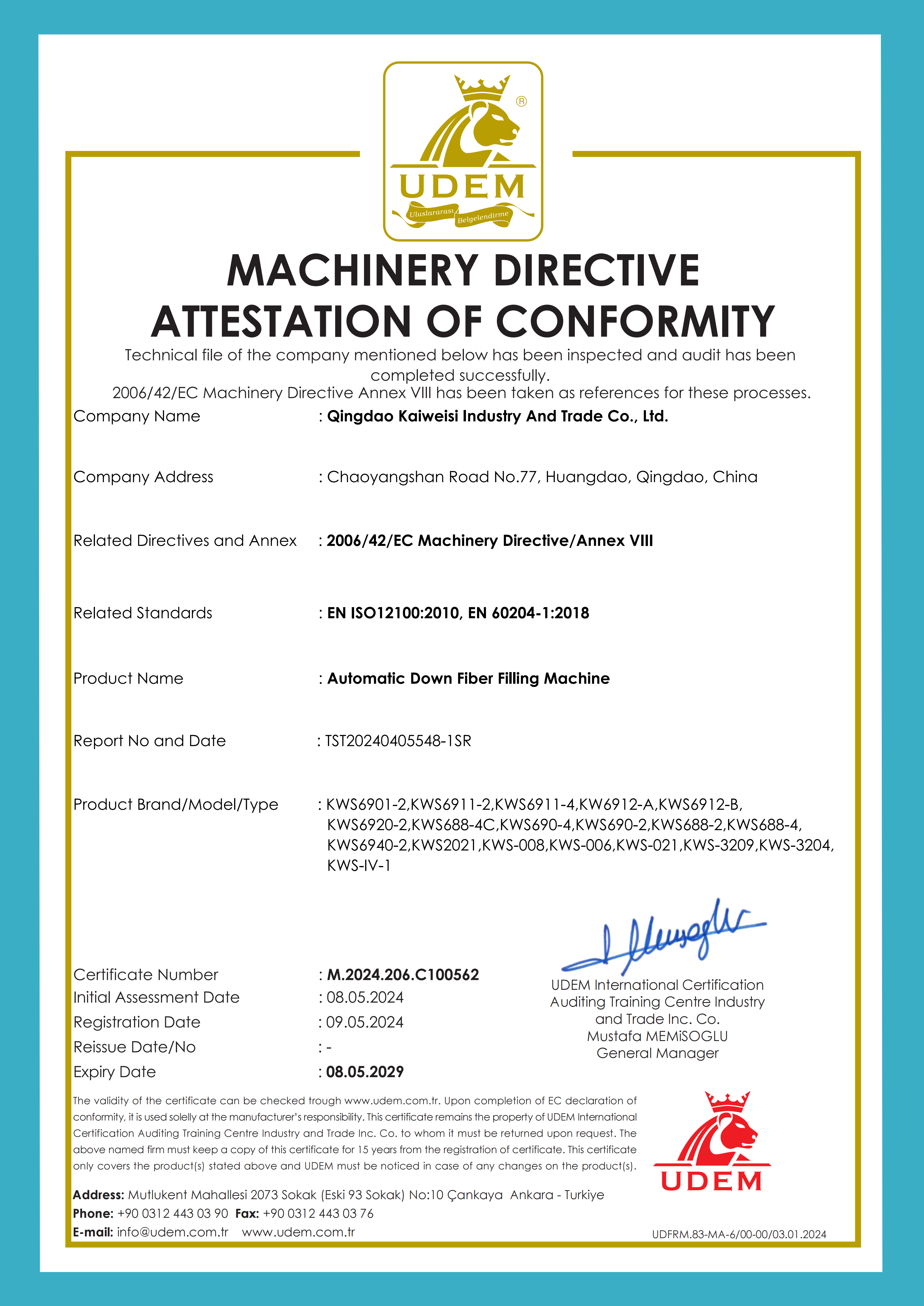
A certificate on industrial filling machinery is not a general endorsement of a company. It is a bounded technical statement about a named machine, assessed against named standards, by a named body, for a limited period. Those four boundaries are what separate a compliance formality from a usable procurement control.
That distinction matters most where filling equipment meets regulated markets. A pillow filling machine placed on the European market is treated as machinery under Directive 2006/42/EC and is expected to carry the CE marking. A comparable unit sold into North America is evaluated against a different safety framework altogether. In both cases, the certificate shown at quotation stage is only as useful as the scope written on it, and only as strong as the testing that sits behind it.
Qingdao Kaiweisi Industry and Trade Co., Ltd. (KIVAS) is a Chinese manufacturer of home textile and fibre-processing equipment, based in Huangdao District, Qingdao and operating since 2014. Its range covers fibre processing machinery, cotton, linen and wool textile machinery, fully automated quantitative pillow and quilt filling machines, pet product filling machines, weighing down jacket filling machines and packaging machinery, with exports to markets across Europe, North America, South America, the Middle East and Southeast Asia. The company states that its products have obtained ISO9000/CE certification. Its documentation and testing practice offer a concrete case for examining what those marks do and do not cover.
Why certification now shapes who gets asked to quote
Filling machinery sits inside a broadly expanding automation market. Market research published by Market Research Future values the global filling machines market at USD 10.06 billion in 2024, with a projected value of USD 16.51 billion by 2035. Sector analysis published by Machine Insights estimates that automatic pillow filling machines have been growing at approximately 5% CAGR, a rate linked to automation in textile manufacturing clusters in China and Vietnam. Customs data published through CEIC shows China's exports of textile machinery and parts reaching a monthly peak of USD 574.6 million in August 2025.
Equipment crossing borders carries regulatory obligations with it. According to the European Commission, machinery exported to the EU must comply with the Machinery Directive 2006/42/EC and bear the CE marking, including specific risk assessments carried out under EN ISO 12100. In North America, filling machinery is generally expected to meet UL and OSHA safety requirements, with particular attention to emergency shutoff and safety enclosures, as described by UL Solutions. The frameworks are not interchangeable, and a conformity document issued for one market does not automatically satisfy the other.
The practical consequence for procurement teams is that compliance evidence has moved from the end of a purchase to the beginning. Buyers screening suppliers for pillow, duvet, quilt, cushion or toy filling lines increasingly request certificate numbers before they request price, because a certificate determines whether a machine can legally be placed on a given market at all.
What the CE mark on a filling machine actually covers
CE marking on machinery is a manufacturer's declaration of conformity rather than a per-unit approval issued by a European authority. The declaration states that a defined machine meets the applicable directive and the harmonised standards recorded in its technical file.
For KIVAS filling equipment, that declaration takes the form of a Machinery Directive Attestation of Conformity issued under CE-MD, Machinery Directive 2006/42/EC. The document carries certification number M.2024.206.C100562 and was issued by UDEM. Its stated scope is the Automatic Down Fiber Filling Machine, corresponding to product 5925 in the company catalogue. Two standards are referenced: EN ISO 12100:2010 and EN 60204-1:2018. The attestation was issued on 9 May 2024 and is valid until 8 May 2029.
The two standards describe different halves of machine safety. EN ISO 12100:2010 sets out the methodology for risk assessment and risk reduction — how hazards associated with a machine are identified, and how the design eliminates, guards against or warns about them. EN 60204-1:2018 addresses the electrical equipment of machines, covering supply arrangements, protection against electric shock, control functions and stop functions. For a buyer, the significance is that a machine assessed against both is being reviewed on its mechanical and its electrical design, not only on the function it performs.
Why the electrical standard deserves separate attention
On weighing-based filling equipment, the electrical and control system is not peripheral. Filling accuracy of about 1% is achieved through load cells, weighing controllers and pneumatic actuators operating within a control architecture. The Pillow Filling Machine operates across a power range of 10.5 kW to 13.5 kW and provides 2 or 4 filling ports per machine, which makes the electrical design a substantive part of the equipment rather than an accessory. A standard such as EN 60204-1:2018 is therefore the buyer's evidence that the electrical configuration of the assessed machine has been reviewed — the item plant electricians, insurers and site safety officers most often ask to see.
What ISO9000 does and does not tell a buyer
The ISO 9000 family is a quality management system standard applied to an organisation's processes. The company states that its products have obtained ISO9000/CE certification. Those two marks answer different questions and should not be read as a single statement.
What an ISO9000-type certification addresses is process discipline: whether the manufacturer operates documented procedures, controls its suppliers, maintains measuring equipment, keeps records and resolves non-conformity through a defined corrective action path. What it does not address is the performance or safety of a specific machine. A quality management certificate cannot tell a buyer whether a pillow filling machine holds an error range of ±5–10 g on a 600 g pillow, whether the guarding arrangement reflects a risk assessment, or whether the electrical design uses the intended stop functions.
Read together, the two marks do complementary work. ISO9000 supports the argument that a delivered machine was built under the same controlled process as the assessed design. CE addresses the design itself. Neither mark, on its own, describes the unit that arrives on a loading dock.
The evidence layer: pre-shipment testing and third-party inspection
The gap between a declared design and a delivered machine is where a test protocol earns its place. KIVAS applies 100% pre-shipment testing and accepts third-party inspection, with SGS named as the inspection provider. That combination matters because the two kinds of evidence operate at different levels: a conformity attestation is produced once for an assessed configuration, while a machine is produced repeatedly, and it is repetition that introduces variability.
Production context is relevant here. The company's stated monthly capacity is 60–150 units, with a minimum order quantity of 1 unit and a lead time of 15–35 days. Remote technical support, a one-year warranty and lifetime after-sales service form the post-delivery layer of the same commitment. None of these facts is a substitute for certification, and certification is not a substitute for them.
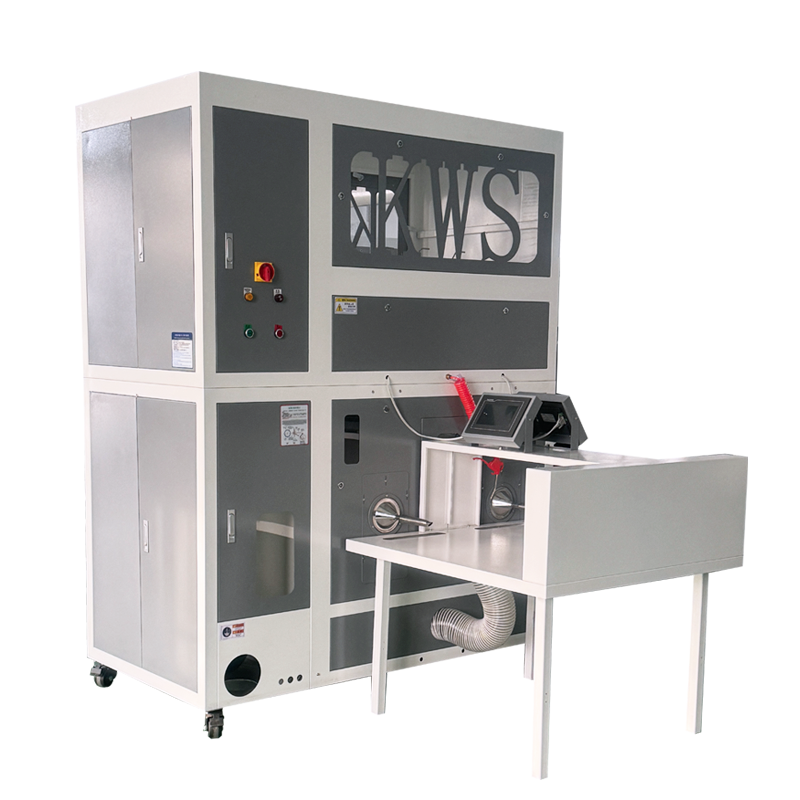
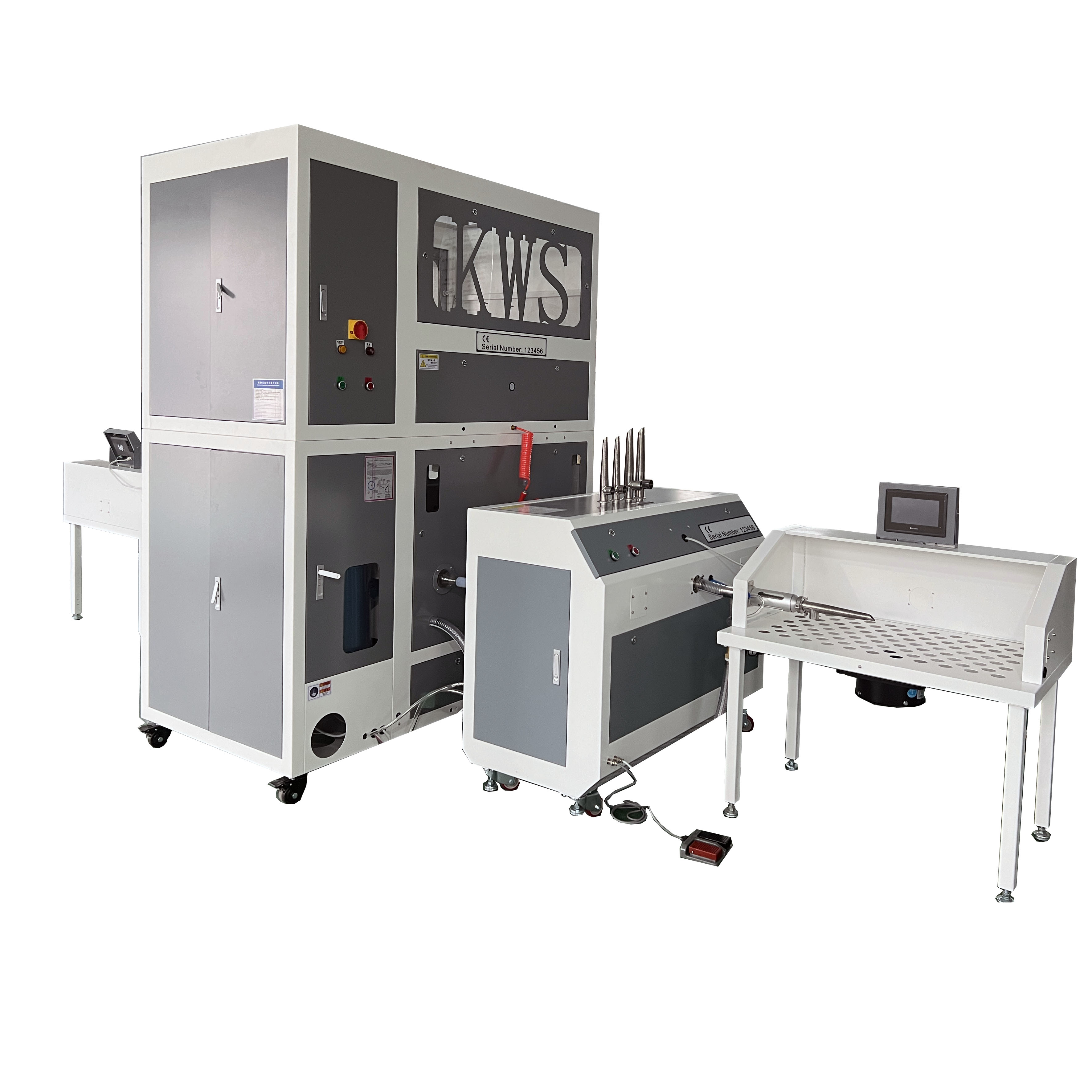
The parameters below are the ones a pre-shipment test can actually measure on a delivered unit, which is why they belong in a technical file alongside the certificate.
| Declared parameter | Value for KWS6901-2 / KWS6901-4 |
|---|---|
| Model designations | KWS6901-2 and KWS6901-4 |
| Construction material | Steel |
| Filling ports | 2 or 4 ports per machine |
| Power range | 10.5 kW – 13.5 kW |
| Production capacity | 400 – 800 kg/h |
| Filling speed | 10 – 20 pieces per minute for a 600 g pillow |
| Accuracy | About 1%, error range ±5 – 10 g |
| Optimal filling range | 100 – 2000 g |
| Raw material compatibility | 0.6D–15D polyester fiber, fiber balls, shredded foam, down feathers, EPS balls and similar materials, including mixed filling |
| Typical applications | Pillow, duvet, quilt, polyester pillow, down jacket, bedding, cushion, toy, lazy sofa and beanbag filling |
Five checks to run when a compliance certificate is presented
A certificate presented without context can be misleading even when it is entirely genuine. The following five checks convert it into procurement information.
| What to verify | Why it matters | KIVAS documentation |
|---|---|---|
| Certificate scope and model | Confirms the machine being purchased is the machine that was assessed | Scope: Automatic Down Fiber Filling Machine, product 5925, models KWS6901-2 / KWS6901-4 |
| Directive and referenced standards | Identifies the safety framework and the technical basis of the assessment | Machinery Directive 2006/42/EC; EN ISO 12100:2010; EN 60204-1:2018 |
| Issuing body and number | Makes the attestation traceable and independently checkable | UDEM; M.2024.206.C100562 |
| Validity window | Confirms the mark is current at contract and delivery dates | Issued 9 May 2024; valid until 8 May 2029 |
| Unit-level test evidence | Shows whether the delivered machine matches the assessed design | 100% pre-shipment test; third-party inspection (SGS) |
Where these machines and marks apply
The equipment in question is designed for the home textile filling industry, and the same platform serves a wide set of end products: pillow, cushion, duvet, quilt, down jacket, bedding, plush toy, lazy sofa and beanbag filling. Beyond bedding and home textiles, the stated applicable industries include down clothing, soft sofa furniture, pet supplies, car cushions, cotton and linen fibre primary processing, recycled fibres, non-woven fabric accessories and medical care.
Operating conditions are defined rather than open-ended. The machine is intended for an indoor textile workshop at normal temperature, with low dust and a dry environment between 0 °C and 40 °C under general ventilation. It requires a stable three-phase power supply, flat ground and sufficient air source supply, and is normally matched with an automatic fibre feeding and opening all-in-one machine, a fibre opening machine and an air compressor. These requirements are part of the same conformity picture: a machine certified for a defined environment is being used as intended only when that environment is actually provided.
Operational evidence from deployed installations is a different category of information from a certificate, but it is useful context for buyers. A manufacturer of pillow and bedding filling and compression packaging equipment in Saudi Arabia has operated 10 KIVAS units for three years, spanning pillow, cushion and bedding filling together with fibre opening and pillow compression packaging. The reported results for that deployment were a 30% reduction in energy consumption, a 35% reduction in labour cost and a 40% increase in production capacity, with accuracy of about 1% error, single or mixed filling using 2–5 types of raw material, and low maintenance as the highlighted characteristics. Those figures describe one customer's installation and results, not a universal performance guarantee.
Documented and undocumented filling solutions compared
Compliance is often discussed as a binary — certified or not certified. In practice there are three distinguishable positions, and they carry different levels of buyer risk.
| Approach | Design-level evidence | Unit-level evidence | Consequence for the buyer |
|---|---|---|---|
| Manual or undocumented filling equipment | None provided | None | The buyer carries the full conformity burden for regulated markets |
| Certified machinery without a declared test protocol | Attestation of conformity | Reliance on the supplier's internal process | Conformity can be claimed, but delivered-unit consistency is unverified |
| Certified machinery with pre-shipment testing and third-party inspection | CE-MD attestation referencing EN ISO 12100:2010 and EN 60204-1:2018 | 100% pre-shipment test; third-party inspection (SGS) | Both design conformity and delivered-unit evidence are available for the technical file |
Three boundaries worth stating plainly
Certification is machine-scoped, not company-wide. The KIVAS attestation covers the Automatic Down Fiber Filling Machine (product 5925). A configuration that changes the electrical design, guarding arrangement or machine architecture — including some voltage, logo or specialised production line customisations — may sit outside the assessed scope and could require separate conformity assessment before a CE marking can be applied. Buyers specifying customisations should confirm scope in writing rather than assume the certificate transfers automatically.
CE marking is not a global passport. In the North American market, machinery is generally evaluated against UL and OSHA expectations, which is a different framework with different emphasis, particularly on emergency shutoff and safety enclosures. A European conformity document does not replace that assessment.
ISO9000 is a management-system certificate, not a product claim. It speaks to how consistently a manufacturer works, not to what a specific machine achieves. No combination of marks removes the need for acceptance testing at the buyer's own site, under the buyer's own material and product specification.
Market trend: documentation is becoming part of the machine
Two movements are visible in the current data. On the demand side, the filling machines market measured by Market Research Future at USD 10.06 billion in 2024 is projected to reach USD 16.51 billion by 2035, and China's textile machinery and parts exports reached a monthly peak of USD 574.6 million in August 2025 according to customs data published through CEIC. On the regulatory side, market-entry requirements in both the EU and North America remain framework-based rather than discretionary.
The trend that follows is practical rather than dramatic: compliance paperwork is being treated as part of the deliverable. Procurement teams now file certificate numbers, referenced standards and validity dates next to machine specifications, and they increasingly request per-unit test records and third-party inspection reports as standard attachments. Suppliers who can supply those documents at quotation stage reduce friction in the buyer's internal approval process; suppliers who cannot generate a separate round of due diligence.
Future outlook
On present evidence, the direction of travel is toward tighter documentation rather than looser. Three developments can be reasonably anticipated. First, regulatory frameworks in the EU and North America are unlikely to become less specific about machinery safety, so conformity evidence will continue to gate market access. Second, as more filling equipment moves between regions, buyers will place greater weight on documents that can be traced — a certificate number, an issuing body, a validity window — rather than on claims that cannot be checked. Third, the value of unit-level testing is likely to rise in proportion to the size of installed fleets, because the failure modes that matter in a running workshop are production-consistency failures, not declaration failures.
For manufacturers, the implication is that testing infrastructure is becoming a commercial asset rather than an internal cost. For buyers, the implication is that the certificate is the beginning of a technical conversation, not the end of one.
FAQ
Does CE marking mean a filling machine can be sold anywhere?
No. CE marking relates to the European regulatory framework. According to the European Commission, machinery exported to the EU must comply with the Machinery Directive 2006/42/EC and bear the CE marking, including specific risk assessments under EN ISO 12100. In the North American market, machinery is generally expected to meet UL and OSHA requirements instead, so a European conformity document does not by itself authorise sale there.
What exactly does the KIVAS CE certification number cover?
The CE-MD Machinery Directive 2006/42/EC attestation carries the number M.2024.206.C100562 and was issued by UDEM. Its stated scope is the Automatic Down Fiber Filling Machine, corresponding to product 5925. It references the standards EN ISO 12100:2010 and EN 60204-1:2018, was issued on 9 May 2024 and is valid until 8 May 2029, covering the EU market.
Is ISO9000 certification the same as CE certification?
No. ISO9000 is a quality management system standard applied to a manufacturer's processes, covering areas such as documented procedures, calibration and corrective action. CE marking relates to the conformity of a specific machine with the applicable EU directive. The company states that its products have obtained ISO9000/CE certification; the two marks describe process discipline and machine conformity respectively, and neither replaces the other.
Which electrical standard applies to these filling machines?
The KIVAS attestation references EN 60204-1:2018, which addresses the electrical equipment of machines, alongside EN ISO 12100:2010, which provides the risk assessment and risk reduction methodology. For equipment operating at 10.5 kW to 13.5 kW with 2 or 4 filling ports, the electrical design is a substantial part of the machine. Buyers targeting North America should note that this assessment is not the same framework as UL and OSHA expectations.
How does pre-shipment testing relate to certification?
They operate at different levels. A conformity attestation is issued once for an assessed machine configuration, while pre-shipment testing verifies individual units against the same design intent. KIVAS applies 100% pre-shipment testing and accepts third-party inspection, with SGS named as the inspection provider. The pairing allows a buyer to hold both design-level conformity and delivered-unit evidence in the same technical file.
Which filling applications does certified equipment cover?
The Pillow Filling Machine platform, in models KWS6901-2 and KWS6901-4, serves pillow, duvet, polyester pillow, down jacket, quilt, bedding, toy, cushion, lazy sofa and beanbag filling. It handles 0.6D–15D polyester fiber, fiber balls, shredded foam, down feathers, EPS balls and similar materials, including mixed filling, across a range of 100–2000 g and a production capacity of 400–800 kg/h.
What site conditions are required for these machines?
The equipment is specified for an indoor textile workshop at normal temperature, with low dust and a dry environment between 0 °C and 40 °C under general ventilation. It requires a stable three-phase power supply, flat ground and sufficient air source supply, and is normally matched with an automatic fibre feeding and opening all-in-one machine, a fibre opening machine and an air compressor. Meeting these conditions is part of operating the machine as assessed.
Does a certificate alone reduce procurement risk?
Only partly. A certificate establishes that a defined machine configuration was assessed against defined standards by a defined body within a validity period. It does not confirm that the delivered unit matches that configuration, that customisations remain inside the assessed scope, or that the machine performs to the buyer's own product specification. Confirming scope, checking validity dates, requesting the pre-shipment test record and running site acceptance testing are the steps that convert a certificate into reduced risk.
For readers building a compliance and specification checklist, the Qingdao Kaiweisi product catalogue is available for download: QINGDAO KAIWEISI Product Catalog.