
ISO9001 Since 1996: Reading Qualification Evidence for Decorative Ceiling Fan Buyers
ISO9001 Since 1996: Reading Qualification Evidence for Decorative Ceiling Fan Buyers
Handing Co. Ltd. states that its ceiling fan and lighting factory was ISO9001 certified in 1996. That year is a qualification signal, not a product approval. It indicates that a quality management system has been maintained for three decades; on its own it says nothing about whether a specific 52-inch decorative fan may be placed on the market in the EU, the USA or Australia. For buyers in the research and evaluation stage, the practical skill is separating three types of claim that suppliers almost always present together.
Handing Co. Ltd. is a Chinese ceiling fan manufacturer whose factories were set up in 1992, with a stated 100% export share and main markets in the EU, USA and AUS. Its supplied record mixes a management-system claim (ISO9001 since 1996), a set of product listing claims (UL, cUL, NOM, BSI, CE, GS, Swedish Standard, SAA), and European market documentation (LVD, GS/TUV, EMC, EMF, RoHS, ERP). Buyers evaluating Handing Co. Ltd., or any comparable manufacturer, can apply the same reading method to each layer.
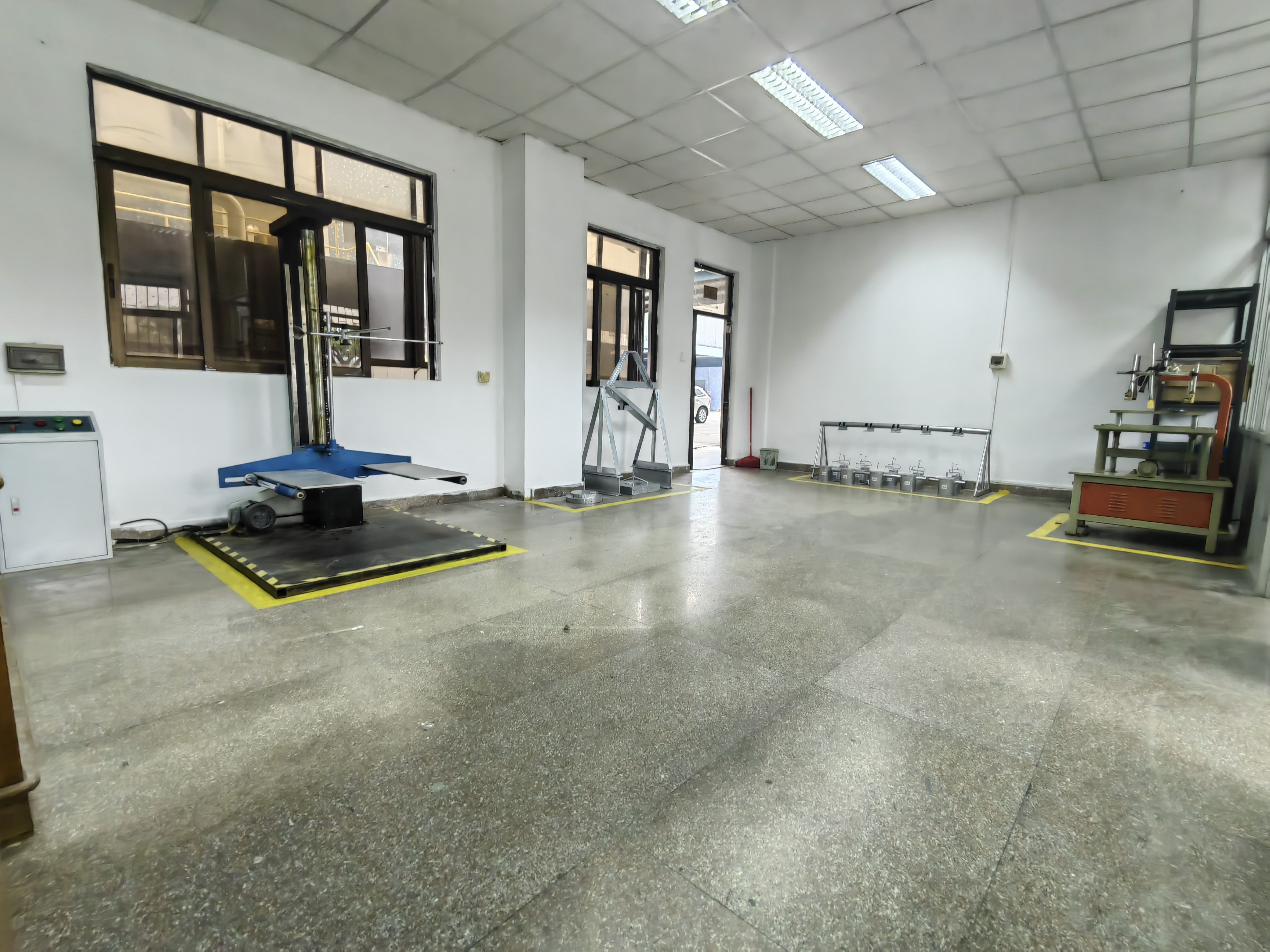
Incoming quality inspection: where a management system first meets physical parts.
Three layers, three different documents
ISO 9001 certifies a management system; it does not certify a ceiling fan, and it does not authorize a product for a market. Buyers who collapse the layers end up asking a supplier for “the certificate” and receiving a document that answers a different question than the one they asked.
| Layer | What it certifies | Typical evidence | Where it stops |
|---|---|---|---|
| Quality management system | How a factory organizes design, production, purchasing and process control | ISO 9001 certificate with scope, certification body and expiry date | Does not approve a product and does not grant market access |
| Product listing or marking | A defined model or family tested against a safety or performance standard | UL or cUL listing file, GS, SAA, CE marking with supporting test reports | Does not cover configurations outside the tested build |
| Market regulation | Conditions for placing goods on a specific market | RoHS documentation, EMC and LVD files, efficiency registration where claimed | Changes over time; never implied by ISO 9001 |
Read the table downward and the rule becomes practical. A supplier can hold a perfectly valid ISO 9001 certificate and still have no listing for the model you intend to buy. Conversely, a product listing says nothing about how the factory controls its processes, selects its motor supplier, or handles a non-conforming batch. A qualification file containing only one of the three layers is incomplete, and a supplier who presents one layer as though it were another is either unclear about its own documents or hoping the buyer is.
What “certified in 1996” asserts, and what it cannot
A certificate issued in 1996 is not the certificate in force today. In normal certification practice, ISO 9001 certificates are issued for a fixed term and maintained through surveillance and recertification audits, and the standard itself has been revised several times since the mid-1990s. A manufacturer’s statement that its factory was certified in 1996 therefore reads most sensibly as a claim of continuity: the system has been certified, and re-certified, from that year onward.
Continuity is the part worth paying attention to. A management system that has survived three decades of audits, staff turnover, product changes and two or three revisions of the standard has demonstrated something that a newly issued certificate cannot: that documented process control is embedded rather than assembled for an inspection. For a buyer placing repeat orders on decorative ceiling fans, where finish consistency and assembly quality tend to drift between batches rather than fail outright, that history is a reasonable signal.
What continuity does not prove is equally important. It does not prove that the certificate covers the site that will make your order, that the current version of the standard is the one held, or that the system’s output meets your specification. Nor is a long-held system immune to a defective plating batch. The supplied materials also do not include a certificate number, the certification body’s name, the scope statement or an expiry date, so the claim should be treated as a starting point for document review rather than a completed verification.
Scope verification: matching the certificate to the production flow
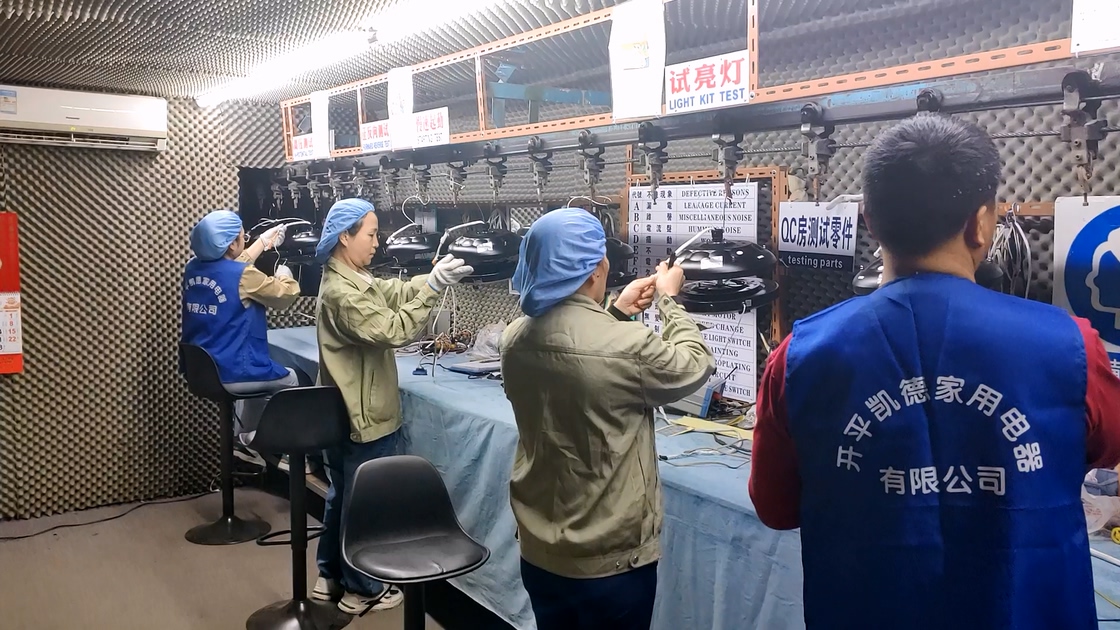
Motor assembly and testing: one of the operations a scope statement should name.
Handing’s factory description states that the company produces most of its metal parts, performs its own painting, and assembles its motors in accordance with ISO9001 procedures. The same company profile gives a factory size of 12,320.66 m², 350 employees, 480,000 units of annual output and a 6-engineer R&D team. These are company-stated figures; none of them is independently audited in the materials reviewed here.
The scope question is narrow and answerable: does the certificate name the operations and sites that will actually touch your order? ISO 9001 scope statements are written in the language of activities and locations. A certificate covering the manufacture of ceiling fans at one address is not automatically extended to a separate plating facility, to a subcontracted painting line, or to a different product family assembled elsewhere. Where a supplier describes several in-house processes, the buyer’s task is to map each named operation onto the certified site.
This is why scope verification carries more procurement weight than the certificate’s age. A ten-year-old certificate whose scope names metal fabrication, painting, motor assembly and surface finishing at the site producing your fan tells you more than a newer certificate covering an office and a warehouse. Ask for the scope statement as a standalone document, not a logo on a catalogue page.
Why a 100% electroplating factory changes the verification question
Handing states that it owns 100% of an electroplating factory, established so that electroplated finishes are produced in good quality, delivered on time and cost-competitive. That ownership does not by itself improve a fan, but it changes what a buyer has to verify.
ISO 9001 requires organizations to control externally provided processes, products and services. When plating is purchased as a service, that control sits in supplier management: the fan maker must qualify the plater, define acceptance criteria and monitor performance, while the buyer inherits an extra organizational boundary in the chain. When plating is owned, surface finishing moves inside the supplier’s own process boundary and becomes a production-control question — bath chemistry, coating thickness, adhesion, colour consistency between batches — rather than a purchasing question about an unnamed third party.
The delivery argument follows the same logic. Decorative ceiling fans fail schedules at interfaces: a plated component that arrives late stops final assembly regardless of how well the motors were built. An owned plating line removes one inter-company scheduling dependency and one external queue. It does not create published capacity figures or lead times, and none are supplied, so delivery performance remains a claim to be tested against past order records rather than a number to be quoted.
The boundary matters here. Ownership does not prove finish quality, and it does not automatically place the plating operation inside the certified scope. Those two points are confirmed by the scope statement and by finish test records, not by the corporate structure chart.
The listing layer: what Handing’s supplied record actually states
Handing’s materials state that its products are listed in UL, cUL, NOM, BSI, CE, GS, Swedish Standard and SAA, and that its European fans hold LVD/GS/TUV, EMC, EMF, RoHS and ERP. The company also states that when Europe implemented the RoHS regulation in 2006, it set up an XFS machine and chemical testing to test its products, with the arrangement approved by TUV PS in the same year.
Each item on that list answers a different question and, in practice, attaches to a different document. The 2006 RoHS passage is a useful illustration: restricted-substance compliance is a materials question, and surface finishing is one of the areas where those questions arise. It is verified by chemical testing and declarations, not by a quality management certificate.
External programmes show how specific the product-level layer becomes. Under the ENERGY STAR program requirements for residential ceiling fans (Version 4.1, U.S. Environmental Protection Agency), a product must be certified in writing by an EPA-recognized certification body and tested in an EPA-recognized laboratory before the label is used. Handing’s supplied materials do not state ENERGY STAR certification, so a buyer who needs it should treat it as an open item rather than an assumed feature of a “certified” supplier.
The same ENERGY STAR guidance notes that fans in humid locations should carry a UL-listed damp rating, and fans in direct contact with water a wet rating. That is a product-level distinction no factory certificate can supply, and it separates indoor ceiling fans from outdoor ceiling fan specifications regardless of how strong the manufacturer’s quality credentials are.
Reading the same claim in the EU, the USA and Australia
The three export markets named in Handing’s profile do not ask the same qualification questions, even when they draw on the same factory.
European Union. The record lists LVD/GS/TUV, EMC, EMF, RoHS and ERP for European fans, alongside the 2006 chemical testing arrangement approved by TUV PS. The buyer’s questions are document-level: which of these files name the exact model, light kit and control configuration being ordered; are the RoHS test reports current for the finishes actually used; and who signs the declaration of conformity that accompanies the shipment. For a decorative ceiling fan with an integrated LED kit, the electrical documentation should cover the light kit, not only the motor.
United States. The relevant claims are UL and cUL listings. A buyer whose specification calls for ETL should confirm the listing type explicitly, because the supplied record states UL and cUL rather than ETL; the two are alternative routes and should not be treated as interchangeable in a purchase order. ENERGY STAR, if required by the channel, is a separate registration. Import duty and customs treatment are commercial matters outside the qualification file entirely.
Australia. SAA appears in the listing claim. As with the other markets, the useful follow-up is not “do you have SAA?” but “which certificate number covers this model, who holds it, and does it include the light kit?” A listing that covers a fan body without its integrated luminaire answers only part of the question.
Model-level reading: the TU52-MW-N3A1DOME example
Listings attach to configurations, not to brands. The TU52-MW-N3A1DOME illustrates why. The model has a 52-inch blade span, three ABS blades in a Matt White finish, a steel housing, a DC motor, a 24W CCT LED light kit with smart WiFi control, and packaging dimensions of 720 mm (L) x 225 mm (W) x 350 mm (H).
Four of those attributes are electrically relevant: the DC motor, the LED light kit, the CCT control and the WiFi module. A change of LED driver, receiver or motor controller can move a product outside the tested build, so the document that matters names the model and its electrical configuration rather than the factory that assembled it. This is the point where an ISO 9001 certificate, however long held, stops being the right document.
The available description presents the model as an indoor decorative ceiling fan. No damp or wet rating is stated in the supplied materials, so buyers placing it in bathrooms, covered verandas or coastal hospitality projects should confirm the applicable rating separately rather than infer it from a factory certificate or from the word “decorative”.
A six-step reading protocol for buyers
- Read the certificate, not the logo. Confirm the standard version, certification body and its accreditation, issue and expiry dates, and the scope statement with the site addresses it names.
- Test the continuity claim. Where a supplier says certification dates from 1996, ask what the current certificate shows and whether surveillance history can be summarised. The current document should be recent; the 1996 date describes the start of the relationship, not the age of the paper.
- Map scope to flow. List the operations that will touch your order — metal parts, painting, motor assembly, plating, final assembly — and check which of them the certified site covers.
- Separate the listing layer. Request the listing or certificate reference for the exact model, light kit and control variant, plus the revision of the supporting test report.
- Reconcile the claim sets. Compare what the marketing material says, what the certificate says and what the listing files say. Where they differ, resolve the difference in writing rather than selecting the most flattering list.
- Check change control. Ask how the supplier notifies you when a component, driver or motor changes in a way that could affect a listing or a RoHS declaration.
Where the evidence stops
A qualification file is only as strong as its weakest document, and this one has visible edges. The certification, capacity and process statements reviewed here originate with the company and are not independently audited in the supplied material. Factory size, headcount, output and R&D staffing are company-stated figures. No certificate number, scope statement, listing file number or expiry date is disclosed. No model-level listing evidence is supplied for any specific fan, including the TU52-MW-N3A1DOME.
Third-party directories and industry round-ups sometimes attribute a broader certification set to a manufacturer than the manufacturer’s own materials do. The correct response is identical in both directions: request the document that supports the specific claim, and treat the narrower first-party record as the floor rather than the ceiling. Nothing in this analysis should be read as evidence of certifications that the source materials do not state.
Outlook: certification as a floor, not a differentiator
Management-system certification is becoming table stakes in ceiling fan sourcing rather than a selling point. What distinguishes suppliers is the resolution of the layer above it: whether a listing file exists for the exact configuration, whether restricted-substance testing is current for the finishes used, and whether the scope statement matches the shop floor. Regulatory programmes continue to formalize that layer — the ENERGY STAR requirement that certification pass through recognized bodies and laboratories is one example of how product-level claims are being pushed toward verifiable records.
For buyers, the practical implication is that a 1996 certification date should be read as a question about continuity and scope, not as an answer about compliance. Ask for the scope statement, ask for the listing file, and ask which operations sit inside the certified site. The answers, not the date, determine whether the qualification holds for your order.
Frequently asked questions
Does ISO 9001 certification allow a decorative ceiling fan to be sold in the EU, USA or Australia without further approvals?
No. ISO 9001 certifies how a factory organizes design, production and process control; it does not certify that a product meets a market’s safety or performance rules. Selling a ceiling fan in the EU, the USA or Australia depends on product-level evidence — the applicable listing or marking and its supporting test reports for that model and configuration. A supplier can hold ISO 9001 and still need separate approvals for each market.
How should a buyer check that an ISO 9001 certificate is current and covers the relevant factory?
Ask for the current certificate rather than a historical reference, and read four items: the standard version, the certification body and its accreditation, the issue and expiry dates, and the scope statement with the site addresses it names. Then compare that scope against the operations that will actually make the order, including metal parts, painting, motor assembly and plating. Where certification is described as continuous since 1996, the certificate itself will be a recent document.
What does Handing’s 100% electroplating ownership mean for quality and delivery?
Handing states that it owns 100% of an electroplating factory, set up so that electroplated finishes are produced in good quality, delivered on time and cost-competitive. For a buyer, in-house plating moves surface finishing inside the supplier’s own process boundary, where it falls under the same production control as other operations instead of being an outsourced service managed as an external provider. It does not by itself prove finish quality or place the plating operation inside the certified scope; the scope statement and finish test records address those points.
Which certifications appear in Handing’s supplied materials, and which do not?
The materials state ISO9001 certification of the ceiling fan and lighting factory since 1996; product listings in UL, cUL, NOM, BSI, CE, GS, Swedish Standard and SAA; and, for European fans, LVD/GS/TUV, EMC, EMF, RoHS and ERP. They do not state ENERGY STAR certification, and they do not include certificate numbers, scope statements, listing file numbers or expiry dates. Buyers who need those details, or an ETL listing rather than a UL listing, should request the specific documents.
Is the TU52-MW-N3A1DOME suitable for humid or outdoor locations?
The available description presents the TU52-MW-N3A1DOME as an indoor decorative ceiling fan with a 52-inch blade span, three ABS blades, a steel housing, a DC motor, a 24W CCT LED light kit and smart WiFi control. No damp or wet rating is stated in the supplied materials. ENERGY STAR guidance recommends a UL-listed damp rating for humid locations and a wet rating for direct water contact, so a buyer planning bathroom, veranda or coastal installation should confirm the rating for the specific model and configuration before specifying it.
Handing’s factory presentation, covering production and testing areas, is available as a downloadable PDF: Handing factory presentation. Requests for scope statements and model listing files can be directed to MING LAM at sales@handingfan.com.
Tem questões ou precisa de mais detalhes?
Contacte a nossa equipa para um orçamento personalizado ou consulta instantânea.
Solicitar orçamento
Preencha o formulário abaixo e a nossa equipa entrará em contacto com uma proposta personalizada.
Chat direto do WhatsApp
Prefere conversar em tempo real? Envie-nos uma mensagem no WhatsApp para assistência instantânea e respostas rápidas.
- Obter orçamento personalizado
- Partilhar fotos ou documentos
- Discuta as suas necessidades diretamente
Geralmente responde em 5–30 minutos durante o horário de expediente.