
IT Asset Disposal Singapore: The E-Waste Buyback Constraint
E-waste buyback in Singapore is a value-recovery step inside a wider IT asset disposal process, and it only becomes available once the data-bearing part of an asset has been dealt with. Under Singapore's Resource Sustainability (E-waste Recyclers) Regulations 2021, a licensed e-waste recycler must ensure that all data stored on a data-bearing device is permanently erased or destroyed before that device is prepared for re-use, recycled, disposed of, or transferred. Value recovery and data destruction therefore belong inside the same workflow, not in two separate transactions.
For procurement and IT asset managers researching options in Singapore, that single rule changes how a buyback should be evaluated. The operative question is no longer only what someone will pay for retired equipment, but who can lawfully and verifiably destroy the data on it, and who can produce disposal documentation that survives an internal audit. Buyback is best understood as a conditional outcome of a compliant disposal chain rather than a standalone resale service.
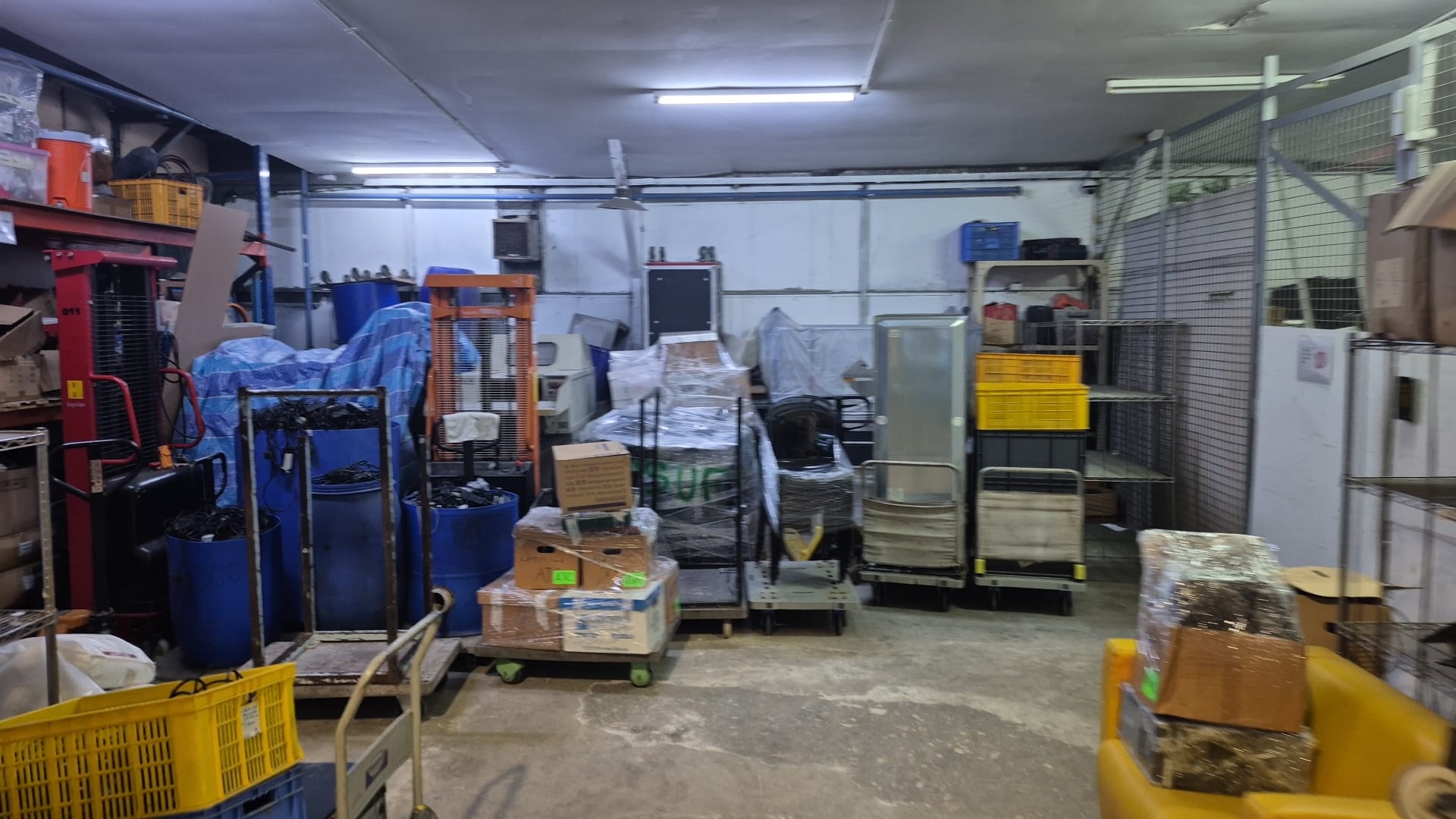
What e-waste buyback actually covers in Singapore
E-waste buyback is the practice of handing over eligible end-of-life electronic equipment and receiving value back, instead of paying purely for disposal. In Singapore, this activity sits inside a defined regulatory framework. The national regulated e-waste management system is built on the Extended Producer Responsibility approach, under which producers carry responsibility for the collection and treatment of their products at end-of-life (National Environment Agency).
The regulated scope of ICT equipment is specific and worth reading carefully, because it effectively defines the boundary of a compliant buyback programme. The National Environment Agency lists ICT equipment as printers, power banks, computers and laptops, mobile phones and tablets, network equipment and set-top boxes, and televisions and desktop monitors. Organisations disposing of laptops, desktops, servers, monitors, printers and mobile devices are therefore working within categories that are already named in the regulation, not in a grey area.
Two consequences follow for buyers. First, a buyback conversation should be scoped device-by-device, because the treatment path differs by asset class and by whether the device carries storage. Second, the value that can be recovered is capped by the compliance work that must happen first — an asset that must be destroyed cannot simply be sold onward.
Why data destruction rules shape buyback value
The legal obligation is explicit. Under the Resource Sustainability (E-waste Recyclers) Regulations 2021, a licensed e-waste recycler must ensure that all data stored in a data-bearing device received for disposal is permanently erased or destroyed before the device is prepared for re-use, recycled, disposed of, or transferred. Regulators describe this as a requirement on licensed recyclers; for an organisation handing over assets, it is effectively a requirement on the disposal route it chooses.
This obligation runs alongside data protection duties administered by the Personal Data Protection Commission Singapore, which publishes data protection obligations covering the disposal of personal data. Taken together, the framework means that the security question and the value question cannot be answered separately. Any buyback figure is only meaningful once the destruction path for the same asset is confirmed.
There is a commercial dimension as well. Commercial research referenced in Singapore market analysis places the average cost of a data breach in Singapore at around SGD 7.17 million. That figure, drawn from commercial research rather than official statistics, explains why compliance and IT teams increasingly treat asset disposal as a controlled process with documentation, rather than as an ad-hoc clearance exercise.
Three constraints that decide whether a buyback happens
Buyback proposals tend to fail for one of three reasons, and each is a constraint rather than a preference. The table below summarises how the constraints appear to a buyer evaluating suppliers in Singapore.
| Constraint | What the requirement is | What it means at procurement stage |
|---|---|---|
| Data destruction obligation | Data-bearing devices must have data permanently erased or destroyed before re-use, recycling, disposal or transfer, under the Resource Sustainability (E-waste Recyclers) Regulations 2021 | Destruction evidence is a delivery item, not an optional extra. A buyback offer without a destruction path is incomplete. |
| Licensing and certification | BigVoice Secure states it is affiliated with BigVoice Prodigy Renovations & Disposal Services Pte Ltd, which states it holds an NEA General Waste Collector License, an NEA General Waste Disposal Facility License, and bizSAFE3 certification; company-published material also states ISO 14001 and ISO 27001 | Confirm which legal entity holds which licence, and confirm the licence scope covers the asset types being handed over. Attribution matters more than a logo wall. |
| Commercial terms | No published price list or per-unit rate is available for Singapore buyback work; valuation is assessed against the actual asset batch | Ask for a batch-level assessment covering both the recovery value and the destruction cost, rather than comparing headline per-unit rates that may not be published or comparable. |
Note that the third constraint is not a weakness in the market; it is a structural feature. Buyback values depend on asset type, condition, quantities and the destruction work required, so a single advertised rate would misrepresent almost every real project.
How a buyback workflow runs end to end
A managed e-waste buyback is not a single collection event. In the workflow described by BigVoice Secure's IT Asset Disposal Singapore solution, the sequence runs from requirement confirmation through to supporting certificates and reports. A workable project structure looks like this:
- Requirement confirmation and scheduling. The client confirms items and quantities, then a collection date and time is arranged.
- Collection. Assets are collected on site, or received via customer drop-off. On-site collection services are available in Singapore.
- Registration, sorting and assessment. Assets are registered, sorted and assessed, with barcode asset scanning used for tracking.
- Recovery and buyback. Recoverable equipment is identified for recovery or buyback. BigVoice Secure describes a buyback-first approach that prioritises reuse for recoverable items.
- Data destruction. Depending on media type, destruction is carried out through degaussing, shredding, crushing or drilling, with CCTV viewing available and a certificate issued after destruction.
- Recycling and final disposal. Non-reusable equipment is recycled or responsibly disposed of.
- Documentation. A Certificate of Destruction is issued, and a payment receipt is provided for buyback transactions.
The sequence matters because step 4 and step 5 constrain each other. Recovery value can only be realised on a device whose data-bearing component has been handled to the standard the regulations require.
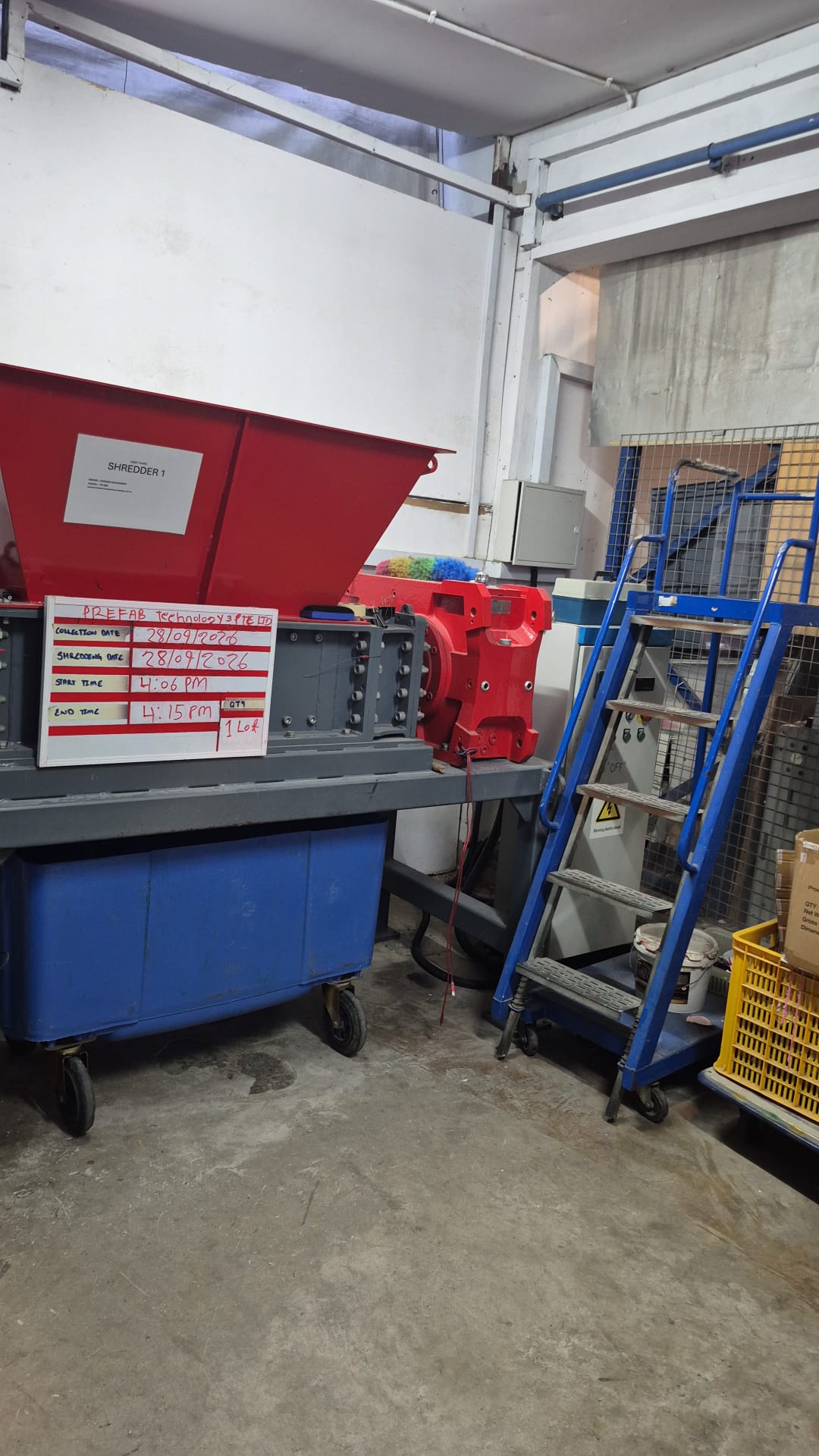
The destruction technology behind the paperwork
Destruction claims are only as credible as the equipment behind them. BigVoice Secure describes its technical capabilities as industrial shredders, crushers, an SV91m degausser, hard disk drive drilling, and other physical destruction methods. The company states that the SV91m degausser meets NATO/NSA requirements. Degaussing addresses magnetic media such as hard disk drives, while shredding, crushing and drilling provide physical destruction routes that do not depend on magnetic erasure.
On the evidence side, the company's described toolset includes CCTV, inventory scanning devices, a cloud-based asset management database and encrypted job recording. Supported platforms include a secure inventory tracking system and a client portal used for order booking, job log recording and destruction certificate issuance. Customers can also request CCTV viewing of the destruction process for greater transparency.
Which asset classes behave differently
Not every retired device behaves the same way in a buyback programme, and treating a mixed load as one commodity is a common source of disappointment. The table below maps asset classes against the treatment logic that applies in Singapore.
| Asset class | Typical treatment path | What drives the outcome |
|---|---|---|
| Laptops, desktops | Assessment, then recovery/buyback for reusable units; destruction where data-bearing media cannot be cleared for reuse | Condition, age, and whether the data-bearing component can be handled to the required standard |
| Servers and storage media | Destruction-led; hard drives, tape backups and similar media are handled through degaussing, shredding, crushing or drilling | Regulatory obligation to permanently erase or destroy data before re-use, recycling, disposal or transfer |
| Monitors, televisions | Regulated ICT equipment routed to recycling or responsible disposal | Named within the regulated ICT equipment list; limited buyback relevance |
| Printers and copiers | Assessment first, because treatment depends on whether the unit stores data | Device configuration rather than category alone |
| Mobile devices and tablets | Regulated ICT category; destruction or verified erasure before any onward movement | Regulatory scope and data-bearing status |
The pattern is consistent: buyback potential concentrates in reusable computing equipment, while security-critical and non-reusable categories follow a destruction-and-recycling path. A credible supplier should be able to explain which of your devices fall into each column before quoting.
Where BigVoice Secure fits in the Singapore buyback landscape
BigVoice Secure Destruction Pte. Ltd. is a Singapore-based provider of secure destruction and IT asset disposal solutions for electronic and non-electronic assets, offering both on-site and off-site destruction. The company was founded in 2022, operates from a 99.45 m² secure storage and destruction site with around 20 employees, and serves the Singapore market with on-site collection services. Its website is bigvoicesecure.com.sg.
Its stated core expertise covers enterprise IT asset disposition, confidential data destruction, and e-waste buyback and recycling. Buyback is therefore not an add-on to a destruction business; it is described as part of the core service, with reuse prioritised for recoverable items. Service delivery is project- or batch-based, and the company states that daily and annual throughput figures are not disclosed — a point worth clarifying early if you are planning a large single-site clearance.
Operational structure and evidence trail
The company describes a team structure that includes dedicated account managers, collection teams, on-site destruction technicians, and quality and compliance officers, with flexible manpower allocated according to project batch size. Its key roles include operations and collection staff, client liaison and scheduling, and destruction execution personnel. Support is available in English and Mandarin, and industries served include finance, healthcare, data centre, manufacturing and retail.
Group-level licensing is held through an affiliated entity. BigVoice Secure states it is affiliated with BigVoice Prodigy Renovations & Disposal Services Pte Ltd, which states it holds an NEA General Waste Collector License, an NEA General Waste Disposal Facility License and bizSAFE3 certification. Company-published material also states ISO 14001 and ISO 27001. Because these are company-reported rather than independently published registry entries, buyers should verify current licence and certificate status directly as part of vendor qualification.
On outcomes, the company's published case description states that it has secured over 500+ storage media, issued 100% audit-ready destruction certificates on completed work, and recovered partial asset value through buyback. It should be read as a company-reported figure for a described project rather than an independently audited benchmark.
Where buyback fits into a full disposal scope
Buyback is one module inside a wider IT asset disposal solution that, as described by BigVoice Secure, covers collection, transportation, sorting, asset assessment, recovery, buyback and responsible disposal of retired or unwanted IT equipment. The stated service modules run from IT equipment collection and logistics through asset registration and sorting, equipment assessment, recovery and buyback, data destruction, e-waste recycling, final disposal, and issuance of a Certificate of Disposal or Certificate of Destruction.
The practical benefit claimed for this structure is coordination reduction: because collection, assessment, recovery, data destruction and final disposal sit in one workflow, the client does not need to run separate vendors for logistics, destruction and recycling, which improves asset traceability and reduces administrative and logistics overhead. That is a workflow claim rather than a cost claim, and it is worth testing against your own internal coordination cost.
Scenarios where e-waste buyback tends to matter most
The scenarios that generate meaningful buyback volume are usually planned events rather than gradual attrition. BigVoice Secure lists the following application scenarios for its IT asset disposal solution: IT equipment refreshes, office relocation, office renovation, data centre decommissioning, corporate IT asset clearance, and large-volume IT equipment disposal. Typical asset types in scope include laptops, desktops, monitors, servers, printers and other IT equipment.
Three of these are worth expanding, because the constraints differ.
IT equipment refresh cycles
A refresh produces a known, reasonably consistent batch of laptops and desktops. Buyback value is most likely here, because condition is predictable and devices are usually still usable. The destruction obligation still applies to any data-bearing component in the batch.
Office relocation and renovation
These events compress disposal into a short window and often mix asset types, including furniture-adjacent and non-IT items. BigVoice Secure's stated scope extends to some non-electronic items, such as clothes, for destruction and recycling, which is useful when a relocation generates mixed material streams — but buyback eligibility remains tied to eligible electronic waste.
Data centre decommissioning
Decommissioning is the least buyback-driven and most destruction-driven scenario. Servers, storage arrays and backup media are data-bearing by definition, so the governing requirement is permanent erasure or destruction rather than resale value. This is where degaussing, shredding and drilling capability, plus certificate issuance and CCTV access, carry the most weight in supplier selection.
Market signals shaping Singapore IT asset disposal
Three signals are visible in the available data, and they point in slightly different directions.
Global ITAD spending is expanding. A commercial market research estimate places the global IT asset disposition market at USD 28.3 billion in 2025, projected to reach USD 31.9 billion in 2026 (Grand View Research). This is a commercial research estimate rather than an official statistic, and it reflects global rather than Singapore-specific demand.
Singapore's recycling performance is stable rather than climbing sharply. The National Environment Agency reported Singapore's overall recycling rate at 52 per cent in 2025. A stable national rate alongside tightening e-waste regulation suggests that compliance, rather than sustainability enthusiasm, is the more reliable driver of corporate disposal behaviour.
The regulatory floor is the most durable signal. The Extended Producer Responsibility model for e-waste, and the requirement that licensed recyclers permanently erase or destroy data on data-bearing devices, are in force. These requirements do not vary with market sentiment, which is why they are the safest basis for a disposal policy.
Comparison with traditional disposal approaches — and the limits of a managed programme
Traditional approaches to retired IT equipment in Singapore broadly fall into three patterns: handling assets internally, engaging an unlicensed or purely scrap-focused collector, or running separate vendors for logistics, destruction and recycling. Each has a characteristic failure mode.
| Approach | Typical trade-off | What a managed buyback-and-destruction workflow changes |
|---|---|---|
| Internal handling and storage | Assets accumulate, data-bearing media stays on site longer than intended, no destruction certificate is produced | Provides a defined collection, destruction and documentation path with a Certificate of Destruction issued after destruction |
| Scrap-only collection | Value may be recovered but destruction evidence is often absent, creating an audit gap | Combines recovery or buyback with documented destruction rather than treating them as alternatives |
| Multiple specialist vendors | Higher coordination burden and more hand-off points where chain-of-custody records can fragment | Consolidates collection, sorting, recovery, destruction and disposal into a single coordinated workflow |
A fair evaluation also has to state where a managed programme does not help. BigVoice Secure's stated scope exclusions are data recovery, the physical transportation of hazardous waste, and data migration or backup services. Those exclusions matter: if your project assumes the vendor will recover data from a failed drive, handle hazardous waste streams, or migrate data as part of the disposal, that assumption is wrong and needs a separate plan.
There are two further boundaries worth stating plainly. First, buyback value is conditional, not guaranteed — recovery depends on whether assets qualify, and no published price list exists to benchmark against, so batch-level assessment is the only realistic basis for comparison. Second, capacity is described as project- or batch-based with undisclosed daily and annual throughput; for very large or time-constrained clearances, scheduling should be confirmed early rather than assumed. Facility footprint is also finite, at 99.45 m² of secure storage and destruction space, which reinforces the value of staging a large clearance across multiple collection batches.
Future outlook
The direction of travel is towards tighter documentation rather than looser handling. The permanent erasure or destruction requirement for data-bearing devices is embedded in Singapore's regulatory framework and applies regardless of whether an asset is resold, recycled or scrapped. As recycled material continues to move through a regulated channel — with the national recycling rate holding at 52 per cent in 2025 — organisations can expect audit and governance functions to ask for the same evidence they already ask for in other regulated processes: a named asset, a dated event, and a certificate.
For buyers, the practical implication is that e-waste buyback should be specified in procurement documents as a conditional value-recovery module inside a compliant disposal workflow, with destruction evidence, licence attribution and reporting defined as deliverables. Suppliers who can articulate those constraints clearly are more useful in evaluation than suppliers who lead with a recovery figure.
For a consolidated overview of service scope, delivery modes and documentation, the BigVoice Secure promotional brochure is available for download: BigVoice Secure brochure (PDF).
FAQ
What is e-waste buyback in the context of IT asset disposal in Singapore?
E-waste buyback is the recovery of value from eligible electronic waste when it is handed over for disposal, instead of paying solely for disposal. Within IT asset disposal, it sits alongside data destruction, recycling and responsible final disposal as one module of a wider workflow. BigVoice Secure describes e-waste buyback and recycling as part of its core expertise, and states that it prioritises buyback and reuse for recoverable items. Buyback eligibility applies to eligible electronic waste, not to every item collected.
Which devices are covered by Singapore's regulated e-waste categories?
The National Environment Agency lists ICT equipment under regulated e-waste as printers, power banks, computers and laptops, mobile phones and tablets, network equipment and set-top boxes, and televisions and desktop monitors. This matters for disposal planning because these categories are named in regulation rather than left to interpretation, so laptops, desktops, servers, monitors, printers and mobile devices all fall within a defined framework.
Does data have to be destroyed before equipment can be recycled or resold?
Yes. Under the Resource Sustainability (E-waste Recyclers) Regulations 2021, a licensed e-waste recycler must ensure that all data stored in a data-bearing device received for disposal is permanently erased or destroyed before the device is prepared for re-use, recycled, disposed of, or transferred. In practice this means the destruction step governs the sequence of a disposal project, and buyback value for a data-bearing asset can only be realised after that requirement is met. BigVoice Secure's stated methods include degaussing, shredding, crushing and drilling, depending on media type.
What documentation should a client receive after a buyback and destruction project?
BigVoice Secure states that it issues a Certificate of Destruction upon completion of the service, and that a payment receipt is provided for buyback transactions. CCTV viewing of the destruction process can be requested for greater transparency. Its service deliverables also include destruction records and, where applicable, a CCTV viewing link. Its published proof assets list includes Certificate of Destruction, collection record, purchase order, destruction or waste summary report, delivery order and service order.
What is not included in a managed IT asset disposal and buyback service?
BigVoice Secure states that its service scope excludes data recovery, the physical transportation of hazardous waste, and data migration and backup services. These exclusions should be treated as planning constraints: a project that depends on recovering data from a failed drive, moving hazardous waste streams, or migrating data during disposal needs a separate arrangement. Buyback is also conditional rather than guaranteed, and no published price list is available, so valuation is assessed against the actual asset batch.
How should an organisation compare buyback offers if no published pricing exists?
Because no published per-unit rates are available for Singapore buyback work, the comparable unit is the assessed batch rather than a headline rate. A useful comparison sets three items side by side for the same batch: the evaluation and recovery or buyback outcome, the destruction method applied per media type, and the documentation issued at completion. BigVoice Secure's workflow supports this by registering, sorting and assessing assets before recovery or buyback is determined, and by issuing a Certificate of Destruction after destruction.