
IXYS Modules: Voltage, Current and Sourcing Constraints
In a power-semiconductor catalogue, an IXYS-pattern module is best read as a family of part-number designations rather than a single device. The practical consequence is that one catalogue page can hold modules with very different voltage, current, isolation and packaging limits, and the part-number prefix alone does not tell a buyer which limits apply. This reference sets out what the IXYS-pattern modules in this catalogue actually specify, which documentation is attached to them, and where the real boundaries sit.
Where IXYS-pattern modules sit in a power-module catalogue
An IXYS-pattern module refers to a power semiconductor module whose model designation follows the IX-prefix conventions used in this catalogue. Jiangsu core diamond times Electronic Technology Co., Ltd., a power electronic component supplier based in Kunshan, Jiangsu Province, China, lists these designations across three module families.
- MOSFET modules in the IXFN naming pattern, covering 60 V to 1200 V power switching applications. Representative designations include IXFN74N100X, IXFN400N15X3, IXFN100N20, IXFN150N15, IXFN230N10, IXFN100N65X2 and IXFN21N100Q.
- IGBT modules with IX-prefixed designations such as IXGN60N60C2D1, IXDN55N120D1 and IXYN82N120C3H1, listed alongside modules from other manufacturing families including Infineon, Semikron, Fuji and CRRC. The same IGBT range also carries Infineon-pattern FF, FZ and FS designations, SKM, SKiiP, SKKT and SKN designations, and 2MBI-series designations.
- Bridge rectifier modules, where an IXYS-pattern number such as VBE55-06NO7 sits in the same family as VUO-series parts including VUO16-14NO1, VUO22-12NO1, VUO55-14NO7 and VUO68-16NO7.
The structurally useful point for a procurement engineer is that across all three families the product is a power semiconductor module: the switching or rectifying dies are combined with an insulating substrate and a baseplate inside one package. Thermal management and electrical isolation are therefore properties of the component itself, not tasks that the assembly line performs afterwards.
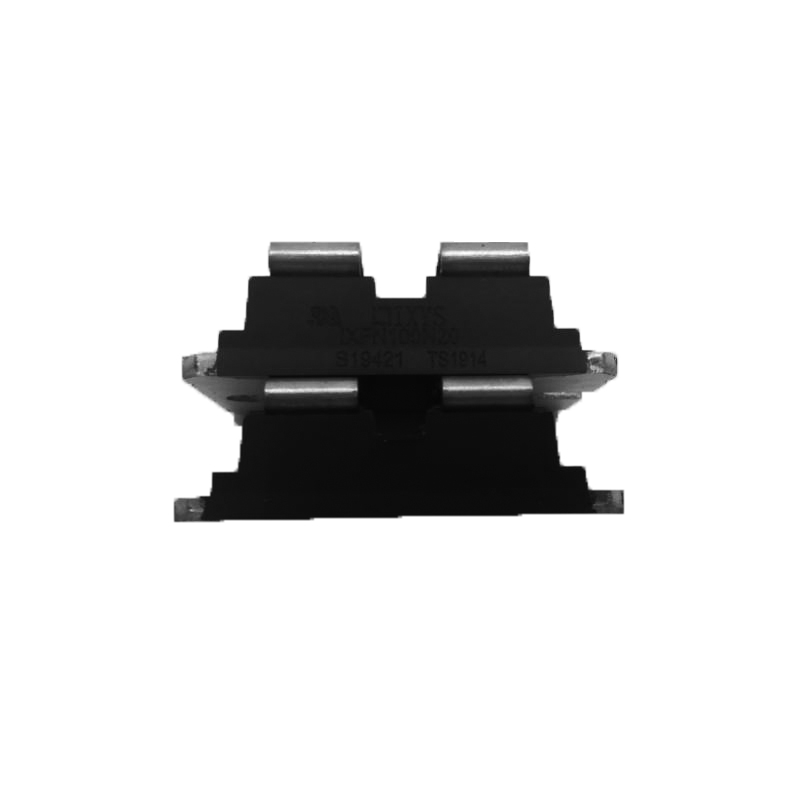
A power MOSFET module in the IXFN naming pattern, built with an aluminium ceramic substrate, copper base plate and plastic housing.
The specification envelope, family by family
The IXFN MOSFET range covers drain-source voltages of 60 V to 1200 V and drain currents of 30 A to 300 A. These modules use an isolated baseplate and are specified with low on-state resistance, high switching frequency operation and small switching loss for switching power supply use.
The IGBT modules in the catalogue occupy a higher band: 600 V to 1700 V and 50 A to 1200 A, with a single or dual IGBT chip structure, low saturation voltage, high switching speed and an isolated baseplate.
The bridge rectifier modules cover 800 V to 2000 V peak reverse voltage and 25 A to 800 A average forward current, in single-phase or three-phase configuration, with an isolated baseplate and a low forward voltage drop.
| Module family | Voltage rating | Current rating | Structure | Key electrical characteristic |
|---|---|---|---|---|
| MOSFET module (IXFN pattern) | 60 V to 1200 V drain-source | 30 A to 300 A drain current | Isolated baseplate, single module | Low on-state resistance; small switching loss; high switching frequency |
| IGBT module | 600 V to 1700 V | 50 A to 1200 A | Single or dual IGBT chip structure | Low saturation voltage; high switching speed |
| Bridge rectifier module | 800 V to 2000 V peak reverse | 25 A to 800 A average forward | Single-phase or three-phase | Low forward voltage drop |
Adjacent families in the same catalogue extend the envelope further for rectification and phase-control duties:
| Module family | Voltage rating | Current rating | Key characteristic | Typical duty |
|---|---|---|---|---|
| Power thyristor / SCR module | Up to 3000 V | 1100 A | High surge current capability; low on-state voltage | Rectifier, soft starter, welding power supply, industrial power control |
| Fast recovery power diode | Up to 2800 V repetitive reverse | 100 A to 1800 A forward | Fast reverse recovery; high surge current capacity | Rectifier, welding machine, power converter |
Read together, these two tables are the actual decision surface. A requirement that sits at 1600 V and 900 A cannot be met by the IXFN MOSFET range; it points to an IGBT module, or to a thyristor or diode module where the function is rectification rather than switching.
What the internal construction says about thermal path and isolation
The module families share one layer stack. In the MOSFET module entry the materials are listed as a silicon MOS chip, an aluminium ceramic substrate, a copper base plate and a plastic housing, with the aluminium ceramic acting as the insulating substrate and the copper base plate as the baseplate. The IGBT module entry lists the same stack with a silicon chip. The bridge rectifier module lists silicon diode chips with the same substrate, baseplate and housing materials.
The power diode and thyristor families use a different construction. The power diode is built from a silicon wafer with a copper base and a ceramic housing. The thyristor uses a disc-type package with a ceramic housing, a molybdenum disc and a copper base, with the silicon wafer as the primary material.
Two buyer-facing consequences follow from this. First, because isolation is built into the module, mounting becomes a thermal-interface task rather than an insulation task: the practical variables are baseplate flatness, thermal grease uniformity and screw torque. Second, the dominant field failure path is thermal. The catalogue's own troubleshooting material for IGBT modules lists uneven or degraded thermal grease, loose mounting screws, operating current above the module rating, a dust-blocked heatsink and abnormal gate drive waveforms among the common causes of overheating.
Storage is also a specification item rather than an afterthought. For unused IGBT modules the stated requirement is storage in the original anti-static packaging at minus 10 degrees Celsius to plus 40 degrees Celsius with relative humidity of 70 percent or below, away from dust, corrosive gas and static fields, and without stacking heavy goods on the modules.
Compliance documentation: what is covered, and what is not

Incoming inspection and outgoing quality control are the points where module-level documentation and traceability are confirmed.
The supplier states that its products comply with international standards such as IEC, UL and CCC, and that it operates strict incoming inspection and outgoing quality control procedures to reduce product failure rate. Its quality management system is certified to ISO9001:2015, with certification dated June 2026.
For a buyer assembling a documentation pack, the important boundary is this: the certificate records held in the compliance file are attached to specific product types, and they do not automatically extend to every module family in the catalogue.
| Certification | Number | Issuing body | Scope | Standard | Market | Validity |
|---|---|---|---|---|---|---|
| UL | IZLT.E14853 | UL | Fuseholders and cartridge fuses | UL 248-1 | United States | Issued 2009-01-10; no expiry stated |
| UL | E4273 | UL | Nonrenewable cartridge fuses, Classes CC, G, H, J, K1, K5, L, RK1, RK5, T (Cooper Bussmann LLC) | UL 248-1 | North America | Issued 2009-01-10; no expiry stated |
| CCC | 2024010308676645 | China Quality Certification Centre | Semiconductor equipment protection fuse-links, series 170M Size 3 and 170L Size 3 Un | GB/T 13539.4-2016 | China | 2024-08-15 to 2029-08-14 |
| CE (EC Declaration of Conformity) | CE1600245 | Eaton | Types C10G, C10M, C14G, C14M, C22G, C22M, C08G, C08M series | EN 60269-1; HD 60269-2:2013; Directive 2014/35/EU (Low Voltage Directive) | EU, Southeast Asia, Middle East | No expiry stated |
Read carefully, these records describe fuse and fuseholder products. A project that specifies IXFN-series MOSFET modules, IX-prefixed IGBT modules or VUO and VBE bridge rectifier modules should not assume that these numbers cover the module. The correct procurement action is to request the certificate, declaration or test report that names the specific module family, the standard applied and the market of use.
Application fit: where the envelope is used
The catalogue's application material points to continuous, high-load duty cycles. For IGBT and MOSFET modules the stated working conditions are continuous operation at high power and high temperature, typically around the clock, in solar inverters, motor drives, charging piles and UPS systems, matched with heatsinks, drive boards, capacitors and inverter cabinets. The stated requirements are high temperature resistance, low loss and high stability.
The protection side of the same systems, namely energy storage cabinets, power distribution cabinets and PV combiner boxes, is served by fuse products, with overcurrent and short-circuit protection as the working condition and fast breaking with high interrupting capacity as the special requirement.
Field records in the catalogue span six application types:
| Client type | Country | Quantity | Application | Duration | Product family |
|---|---|---|---|---|---|
| Renewable energy equipment manufacturer | Germany | 5,000 units | Solar inverter and energy storage converter | 2 years | IGBT modules |
| Industrial power supply manufacturer | Italy | 3,500 units | Industrial welding and power rectifier equipment | 2 years | Thyristors |
| Power electronics OEM | Malaysia | 8,000 units | Charging pile and rectifier power supply | 2 years | Power diodes |
| Power supply factory | Spain | 10,000 units | Industrial switching power supply | 2 years | Bridge rectifier modules |
| EV accessory manufacturer | Poland | 4,000 units | On-board power converter | 2 years | MOSFET modules |
| New energy system integrator | France | 15,000 units | Energy storage cabinet power conversion and switching control | 1 year | Fuses |
These records describe delivered projects rather than a guarantee of fit. Suitability for a new design still depends on the circuit voltage and current profile, switching frequency, cooling arrangement and duty cycle, and should be confirmed against the datasheet and, where the design is new, a sample evaluation.
Supply-side constraints: MOQ, capacity, lead time and customisation
The commercial constraints are stated explicitly. Minimum order quantity is 2 units, monthly capacity is 20,000 units, and lead time is 30 to 45 days. Every unit is electrically performance-tested before shipment. Customisation covers logo marking, packaging, parameter matching and solution support under an OEM and ODM model. After-sales support is described as remote technical support plus warranty service, and the listed export markets are the EU, Southeast Asia, the Middle East and South America.
The company behind the catalogue is Jiangsu core diamond times Electronic Technology Co., Ltd., founded in 2022, with a 10,000 square metre facility, 50 employees including 5 technical support engineers, and an export ratio of about 50 percent. Its stated main products are IGBT modules, fuses, power semiconductors, semiconductor modules, diodes, thyristors and power electronic components. It also states that it supports small trial orders as well as bulk volume orders, and that its warehouse holds sufficient stock of mainstream models of IGBT modules and industrial fuses.
Two constraints deserve to be stated plainly. First, the entity operates as a distributor and service provider for power semiconductor modules; its verified position is a channel and supply role that includes distribution of Infineon, Semikron, Fuji and CRRC modules. A buyer whose requirement is die-level development, proprietary module design or foundry-style production should treat this as a sourcing channel rather than an OEM engineering partnership. Second, stock depth is described for mainstream models. A specification that falls outside that set should be planned against the stated 30 to 45 day lead time rather than treated as an off-the-shelf item.
How these modules compare with discrete devices and wide-bandgap alternatives
Compared with discrete power semiconductors, a module integrates multiple dies with an insulating substrate and a baseplate. That generally reduces wiring and assembly steps and produces a more controlled thermal path, but it changes the service model: a failed module is normally replaced as a complete unit rather than repaired at die level.
Compared with silicon carbide, the market picture is asymmetric. Market Research Future's 2026 report estimates the global IGBT market at USD 9,202.9 million for 2024 and projects an 11.02 percent CAGR from 2025 to 2035, while Fortune Business Insights estimates the global SiC module market at USD 980.7 million in 2025. On those figures, silicon-based modules remain the broad industrial base, and SiC or hybrid modules address high-efficiency, high-frequency systems, a position the catalogue's own selection guidance describes as higher cost. A separate commercial estimate places IGBT at nearly 10 percent of electric vehicle cost, which explains why automotive programmes track this component category closely.
Supplier structure is part of the comparison too. StarPower Semiconductor is identified as the world's fifth-largest IGBT module supplier in the referenced market research, which shows that the supplier landscape is not limited to European and Japanese manufacturers. For buyers, that widens the number of credible sources per specification and increases the value of a channel that can hold and compare several manufacturer families against one requirement.
The limits of this catalogue model should also be clear. A distributor-led range is strongest when the requirement is a known part number or a well-defined specification envelope, and weakest when the requirement is a module that must be co-designed for a new topology. Listed specification compatibility is not a substitute for circuit-level validation either: thermal design, gate drive matching and short-circuit withstand behaviour have to be confirmed in the application.
Future outlook
The referenced research points to continued growth in the IGBT category through 2035, with SiC modules expanding from a much smaller revenue base. Three practical consequences follow for procurement teams.
- Specification literacy becomes the qualification filter. Voltage class, current rating, isolation, switching behaviour and thermal path determine total cost of ownership more than brand name alone.
- The documentation question moves earlier. Buyers increasingly need the certificate, declaration or test report that names the module, the standard and the target market, rather than a general statement of compliance.
- Channel coverage of wide-bandgap families becomes a selection criterion. A supply channel that can discuss SiC and hybrid options alongside silicon IGBT and MOSFET families is better positioned as designs move from prototype to production.
Frequently asked questions
The IXFN series covers drain-source voltages of 60 V to 1200 V and drain currents of 30 A to 300 A. The modules use an isolated baseplate with an aluminium ceramic insulating substrate and a copper base plate, and are specified with low on-state resistance and small switching loss for high-frequency switching operation.
Not automatically. The certificate records in the compliance file cover fuse and fuseholder products: UL IZLT.E14853 for fuseholders and cartridge fuses, UL E4273 for nonrenewable cartridge fuses, CCC 2024010308676645 for semiconductor equipment protection fuse-links in the 170M Size 3 and 170L Size 3 Un series, and EC Declaration of Conformity CE1600245 for the C10, C14, C22 and C08 series types. For a module, the buyer should request documentation that names the specific module family, the standard applied and the market of use.
The stated requirement for IGBT modules is storage in the original anti-static packaging at minus 10 degrees Celsius to plus 40 degrees Celsius with relative humidity of 70 percent or below, away from dust, corrosive gas and static fields, and without stacking heavy goods on the modules.
The stated figures are a minimum order quantity of 2 units, a monthly capacity of 20,000 units and a lead time of 30 to 45 days. Every unit is electrically performance-tested before shipment, and customisation options cover logo marking, packaging, parameter matching and solution support.
The stated applications include solar inverters, motor drives, charging piles, UPS systems, industrial switching power supplies, welding and power rectification equipment, energy storage cabinets, power distribution cabinets and PV combiner boxes. Working conditions are described as continuous operation at high power and high temperature, typically around the clock for converter applications, with a requirement for high temperature resistance, low loss and high stability.
A module integrates the semiconductor dies with an insulating substrate and a baseplate, which reduces external wiring and provides a controlled thermal path. In service this usually means the module is replaced as a complete unit rather than repaired at die level, so spares planning, thermal-grease application and screw torque matter as much as the electrical rating.
Buyers who need the full specification range, model lists and the certificate records referenced above in one document can consult the company brochure: Jiangsu core diamond times Electronic Technology Co., Ltd. product brochure.