
Ice Cream Machine Compliance: A Buyer's Qualification Guide
Ice Cream Machine Compliance: A Buyer's Qualification Guide
Qualifying an industrial ice cream machine is, in practice, a documentation exercise with a technical core. The machine delivered to site must be matched to a certificate that names it, a material declaration that covers it, a component list that can be serviced locally, and an acceptance record that a third party can audit. This guide explains what to request, how to read what arrives, and where qualification files most often break down.
Compliance Is a Scope Question, Not a Logo Question
The most common qualification failure in ice cream equipment procurement is not a missing certificate. It is a certificate whose scope does not name the machine that appears in the purchase order. Certificates are issued against a defined product configuration and a defined set of standards — not against a brand, a product family, or a production line as a whole. A document issued for a rotary moulded stick ice cream machine does not automatically extend to an extrusion and hardening tunnel; a document issued for an ice cream continuous freezer says nothing about a cup filling module downstream of it.
The commercial context makes this distinction more important, not less. The global ice cream processing equipment market was valued at approximately USD 2.33 billion in 2025, with projections to reach USD 3.00 billion by 2034 at a CAGR of 2.71% (IMARC Group). Within that market, hard ice cream processing equipment accounted for a dominant 57.8% share in 2025, with continuous freezers the leading product type (Future Market Insights). As capital flows toward freezing, moulding and filling capacity, the volume of equipment crossing borders increases — and so does the documentation burden on the buyer.
On the regulatory side, the baseline for electrically operated commercial refrigerating appliances with incorporated motor-compressors is IEC 60335-2-89:2019. Machinery safety, meanwhile, is typically documented through EN ISO 12100:2010 for risk assessment and EN 60204-1:2018 for the electrical equipment of machines. These are the standards that appear on the CE documentation of the equipment discussed below, and they are the reference points a buyer's quality team will look for first.
What a Qualification File Should Contain: Four Layers
A complete qualification file for an ice cream production line is built in four layers. Each layer answers a different question, and each is requested from a different part of the supplier's organisation. Buyers who request only the first layer are the ones who discover gaps during installation.
| Layer | What to request | What to verify |
|---|---|---|
| Machine safety conformity | CE certificate, declaration of conformity, risk assessment reference | Certificate number, issuing authority, scope wording, applied standards, issue and expiry dates |
| Materials and hygiene | Material declaration for product-contact parts | Grade consistency (SS304 / SS316), scope of coverage across the whole line rather than selected machines |
| Component traceability | Bill of materials with brand and model for drives, controls, refrigeration and pneumatics | Whether named brands are actually specified, and whether spare parts are obtainable in the buyer's market |
| Commercial and acceptance | Pre-shipment test record, inspection option, delivery and payment terms | Test protocol, third-party inspection availability, Incoterms, and who signs off before shipment |
For buyers evaluating a supplier such as Snowball Machinery Manufacturing Co., Ltd — an ice cream equipment manufacturer operating a 4,000㎡ facility with 50 employees, 10 design engineers and an annual output of 1,200 sets, exporting roughly 90% of production to North America, South America, Europe, Asia and Africa — these four layers can be requested as a single package, because one supplier covers the sequence from design through full-line supply.
Reading a Certificate Correctly: A Worked Example
The value of a certificate depends entirely on the scope field. Four CE records in the Snowball Machinery documentation set illustrate how narrow that field usually is, and why each machine on a line needs to be matched individually.
| Certificate number | Issuing authority | Scope | Standards referenced | Validity |
|---|---|---|---|---|
| FQC2506302 | FQC STANDARD | Rotary Moulded Stick Ice Cream Machine | EN ISO 12100:2010, EN 60204-1:2018 | Issued 2025-02-05, valid to 2030-02-05 |
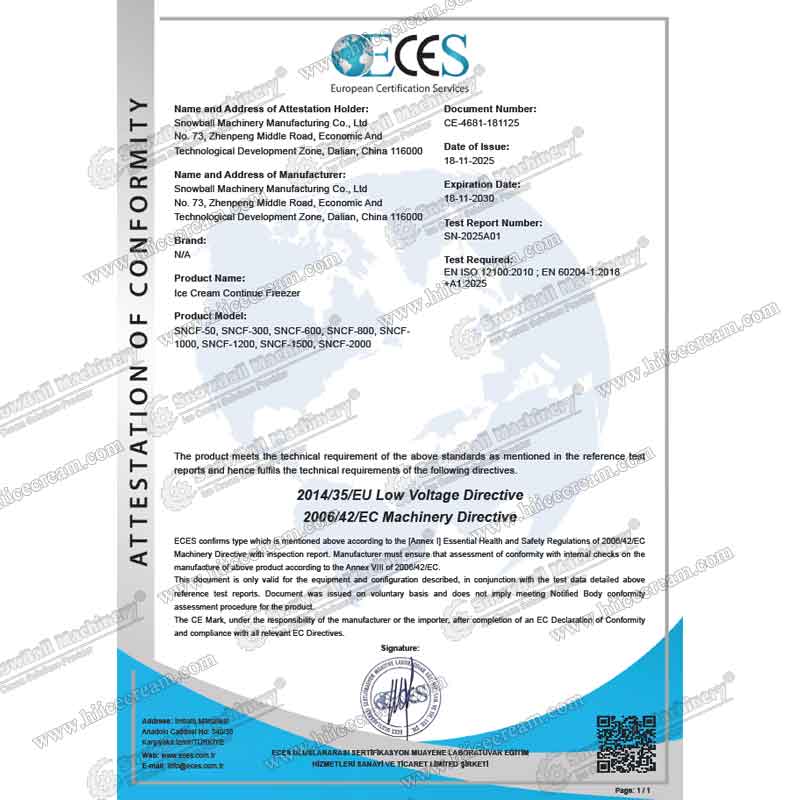
| CE-4681-181125 | European Certification Services | Ice Cream Continue Freezer | EN ISO 12100:2010, EN 60204-1:2018 +A1:2025 | Issued 2025-11-18, valid to 2030-11-18 |
| CE-1654-01-111123 | CGS Test | Linear Stick Ice Cream Machine | BS EN ISO 12100:2010, BS EN 60204-1:2018 | Issued 2023-11-11, valid to 2028-11-11 |
| CE-1724-01-121223 | CGS Test | Ingredient Feeder | BS EN ISO 12100:2010, BS EN 60204-1:2018 | Issued 2023-12-12, valid to 2028-12-12 |
Two practical rules follow from this table. First, the certificate number, the authority and the scope wording should be copied into the purchase contract, so the delivered machine can be reconciled against the document. Second, the validity dates matter for projects with long lead times and for equipment that will be resold or re-audited several years after commissioning: a certificate expiring within the depreciation window creates a renewal task for the buyer, not for the supplier.
One boundary deserves to be stated plainly. A CE certificate issued under a recognised scheme is not a universal market passport. Where a destination market requires its own notified-body route, additional labelling, or an importer-held conformity declaration, the supplier's existing file cannot substitute for it. Buyers entering a regulated market should confirm the local acceptance route before the order is placed, not after the container has sailed.
Machine-Level Qualification Notes
SNCF continuous freezer
The SNCF range covers 50L, 300L, 600L, 1200L and 1500L models, with a stated capacity range of 50–1500 L/H, an overrun of 100%, an input material temperature of +5°C and an output material temperature of −5°C. For qualification purposes, the key document is CE-4681-181125, issued by European Certification Services against EN ISO 12100:2010 and EN 60204-1:2018 +A1:2025, and valid to 2030-11-18. Because freezer capacity is frequently customised to a project's hourly output, the buyer should confirm that the certificate scope remains aligned with the model and configuration actually ordered.
SNL moulded stick lines and their optional units
SNL equipment produces moulded stick ice cream, popsicle, ice lolly, frozen novelties, fruit bars and water ice, and is offered as a non-standard customised system sized by product design and hourly capacity. Two CE records in the published set relate to this product family: FQC2506302 covering the rotary moulded stick ice cream machine, and CE-1654-01-111123 covering the linear stick ice cream machine. The optional units matter for qualification because each one changes the machine's configuration: ice water filler, ice cream sucker unit, stick inserter unit, chocolate coating station, dry coating station and popsicle moulds. Adding a coating station after the certificate was issued is exactly the kind of change that should trigger a documentation review.
SNLF filling configurations
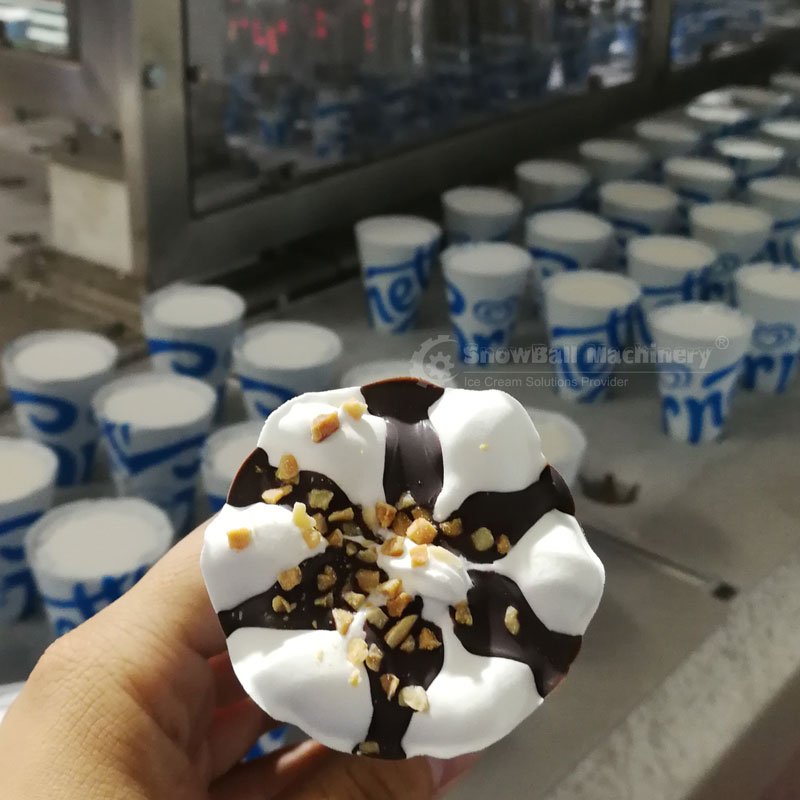
SNLF filling machines handle ice cream cups, cones, bulk packs, pints, family-size and family-pack formats, water ice push-ups, calippo and Cornetto-style products. Optional units include a cup and cone dispenser, chocolate or sauce sprayer, automatic filler, pencil filler, chocolate topping machine, sauce topping unit, dry topping unit, lid dispenser and heat sealing unit. In the published certification set, no separate scope is named for filling modules. That is not unusual in this industry — but it means the buyer should request the specific conformity document for the configuration ordered rather than assume line-level coverage. Filling stations are typically the most heavily customised part of a line, and customisation is precisely what certificate scopes do not stretch to cover.
Ingredient feeding
The SNFF1000, SNFF2000 and SNFF4000 ingredient feeders, also described as fruit feeders or dosing dispensers, run at capacities from 50 to 4,000 litres per hour and carry CE-1724-01-121223, issued by CGS Test against BS EN ISO 12100:2010 and BS EN 60204-1:2018, valid to 2028-12-12.
Materials, Hygiene and Component Traceability
Stainless steel grade: SS304 or SS316
Snowball Machinery builds its production equipment in high-quality food-grade stainless steel, SS304 or SS316, and the choice between the two is a real qualification decision rather than a marketing detail. In the European ice cream sandwich line delivered to a manufacturer operating in Italy, Germany, Poland, the United Kingdom, Spain and Portugal, SS304 construction was specified to satisfy EU food safety and environmental requirements, together with an energy-saving design suited to European production scenarios. In the retrofit project for a long-established manufacturer in South Africa, Brazil, Ecuador, Trinidad and Tobago and Colombia, all materials were food-grade 316 stainless steel to comply with North American production compliance requirements. The lesson for buyers is to state the grade in the specification and then confirm it appears consistently across every machine group — mix processing, ageing, freezing, moulding, filling and packaging — rather than only on the machine the buyer inspected.
What named component brands do and do not prove
Snowball Machinery specifies internationally renowned brands for main components, including SIEMENS, Schneider Electric, FESTO, SMC, Danfoss, ABB, Bonfiglioli, igus, Copeland, Bitzer and SEW Eurodrive, across the continuous freezer, moulded stick, extrusion, filling and production line product families. In a qualification review, this matters for three reasons: component-level traceability is reviewable, spare parts and service support are obtainable across regions, and the control and refrigeration architecture is familiar to the buyer's own maintenance team.
It is equally important to be precise about the limit. A component brand list supports a reliability and maintainability review. It is not a conformity document. A machine assembled from SIEMENS drives and a Copeland compressor does not thereby inherit a safety certificate — the certificate is issued to the machine, against a defined scope, and must be requested separately. Buyers who accept a bill of materials as evidence of compliance are conflating two different layers of the file.
Evidence from Deployed Lines
Documentation is easier to trust when it is attached to installations that can be traced. The following cases are company-reported project data and are useful mainly as reference points for what a buyer might reasonably ask to see.
- Newly established manufacturer, Middle East and South America (Jordan, Qatar, Venezuela, Chile, Peru). A complete line with continuous freezers, extrusion tunnel, packing machines and auxiliary equipment, running at 9,000–10,000 pieces per hour and flexibly configured for multi-flavour production. The equipment has operated stably for three years under local high-temperature and high-humidity conditions. Total line cost was reported 70% lower than premium European brands while matching their quality and output performance, with a modular design allowing later capacity expansion and 24/7 after-sales service with remote video support.
- European manufacturer (Italy, Germany, Poland, the United Kingdom, Spain, Portugal). An added ice cream sandwich line adaptable to multi-specification and multi-flavour production, installed and commissioned rapidly, with products reaching market recognition quickly and five years of stable operation.
- Long-established manufacturer (South Africa, Brazil, Ecuador, Trinidad and Tobago, Colombia). An upgrade of well-known brand equipment that had been in service for 40 years. Custom-designed workstations matched the existing line without overall reconstruction, using food-grade 316 stainless steel and complying with North American production requirements. Reported outcomes were a 40% increase in production efficiency, a 30% reduction in labour costs and a 70% reduction in equipment upgrade costs, with six years of stable operation.
- Start-up client with no prior production experience (Italy, Spain, the United States, Vietnam, Turkmenistan). A turnkey whole-plant solution including an extruded ice cream tunnel machine rated 5,000–8,000 pieces per hour and a family-pack filling machine rated 1,200 L/H, with plant layout planning, installation, commissioning and staff training. Eleven years of stable operation with continuous after-sales service.
- World-renowned brand ice cream factory (Venezuela, Kuwait, Turkey, Sri Lanka, Indonesia). An automatic cone filling line rated 10,000–15,000 pieces per hour and a stick ice cream line rated 15,000–20,000 pieces per hour, achieving 24-hour fully automatic production and twelve years of stable operation.
The qualification lesson from these cases is consistent: the documents buyers later rely on — material grades, capacity ratings, inspection records, spare parts commitments — were all fixed at specification stage. Retro-fitting a compliance file after installation is expensive, and sometimes impossible.
Market Trend Signals Buyers Should Track
Three published signals are worth building into a qualification checklist. First, automation demand is reshaping the moulding segment: the ice cream moulding production line market was valued at USD 1.2 billion in 2024 and is expected to grow to USD 2.5 billion by 2034, driven by increasing automation demand (Reports and Data). Second, product mix continues to favour hard ice cream formats, which held a dominant 57.8% share of the ice cream equipment market in 2025 with continuous freezers as the leading product type (Future Market Insights). Third, the supply side remains concentrated in Europe for dairy machinery trade: Germany, Poland and Italy were the leading exporters of dairy machinery under HS Code 843420 in 2024, with export values of USD 74.4 million, USD 64.9 million and USD 61.7 million respectively (OEC).
A caution belongs alongside those figures. Published market valuations for ice cream equipment diverge widely depending on scope — the IMARC figure of USD 2.33 billion covers processing equipment, while other research houses publish values of USD 9.6 billion and USD 10.12 billion for broader ice cream equipment and machine markets. Buyers should read the scope definition behind a headline number before using it in an internal business case.
Turnkey, Multi-Vendor or Premium Import: A Qualification Comparison
Procurement strategy determines how much of the qualification file the buyer has to assemble. The three common models behave differently.
| Dimension | Multi-vendor procurement | Turnkey single-source line | Premium European import |
|---|---|---|---|
| Documentation chain | One conformity file per supplier; buyer consolidates | Single supplier responsible from design through full-line supply | Mature, well-established documentation set |
| Interface risk | Integration gaps between machine groups | Integrated layout, commissioning and training from one party | Lower documentation risk, higher capital outlay |
| Component sourcing | Mixed, depending on each vendor | Named international brands across machine families, with spare parts supply and global response | Proprietary components may narrow the service network |
| Customisation | Vendor-by-vendor negotiation | Customised to production scale, product positioning and workshop conditions | Standardised platforms; custom work can extend lead times |
| Boundary to verify | Who owns line-level performance | Certificate scope must still be checked for each machine and each optional unit | Cost and lead time for configuration changes |
The honest limitation of the turnkey model is dependency concentration. A single supplier responsible for an entire line simplifies the documentation chain, but it also means the buyer's qualification leverage sits with one counterparty. Two safeguards are worth writing into the contract: an itemised spare parts list with availability commitments, and a defined acceptance protocol. Snowball Machinery's supply terms include on-site installation and commissioning, equipment upgrading and maintenance, fault handling, spare parts supply, regular inspection and timely global response, with pre-shipment testing, on-site customer inspection and third-party inspection through SGS available as acceptance routes, delivery terms spanning FOB, CIF, EXW, CFR, DAP and DDP, and a minimum order quantity of one set.
A second limitation applies to customised equipment specifically. Because lines are built to a project's product design and hourly capacity, the configuration delivered is rarely identical to any previously certified unit. Buyers should therefore treat the certificate review as a per-project task rather than a one-time vendor approval — and should expect that a materially new configuration may require new documentation, with the associated time and cost.
Future Outlook
Qualification requirements on ice cream equipment are moving in one direction: more configurable machines, more market-specific documentation, and more buyer scrutiny of the file rather than the brochure. The moulding segment's projected growth from USD 1.2 billion in 2024 toward USD 2.5 billion by 2034 on automation demand (Reports and Data) suggests that automated lines with longer, more integrated machine chains will become the default purchasing pattern rather than the exception. Longer chains mean more certificates, more material declarations and more acceptance checkpoints — not fewer.
For buyers, the practical response is procedural rather than technical. Fix the document list at the specification stage. Match every certificate to the machine and configuration in the purchase order. Keep validity dates on a renewal calendar. And treat component brand lists, case histories and capacity ratings as supporting evidence for a decision, never as substitutes for the conformity documents themselves.
Frequently Asked Questions
What documents should a buyer request when qualifying an ice cream machine supplier?
A working file contains four groups: machine safety conformity documents (certificate, declaration of conformity, risk assessment reference); material declarations for product-contact parts confirming SS304 or SS316; a bill of materials listing brand and model for drives, controls, refrigeration and pneumatics; and commercial acceptance records covering pre-shipment testing, inspection options, delivery terms and payment terms. Requesting all four at tender stage avoids separate negotiations later in the project.
Which standards typically sit behind a CE certificate for ice cream machinery?
In the documentation reviewed here, CE records reference EN ISO 12100:2010 for machinery risk assessment and EN 60204-1:2018 for the electrical equipment of machines, in some cases with the +A1:2025 amendment applied. For electrically operated commercial refrigerating appliances with incorporated motor-compressors, IEC 60335-2-89:2019 provides the relevant safety baseline. The specific standards applied are stated on each certificate and should be read there rather than assumed.
Does one CE certificate cover an entire ice cream production line?
No. Certificates are issued against a defined scope. In the example set, scopes name the rotary moulded stick ice cream machine, the ice cream continuous freezer, the linear stick ice cream machine and the ingredient feeder separately. Machines and optional units outside those named scopes — such as coating stations, filling modules or CIP equipment added later — require their own documentation. Buyers should reconcile each certificate scope against the purchase order line by line.
What should be verified about materials on product-contact parts?
Two things: the grade itself and its consistency across the line. Snowball Machinery equipment is built in high-quality food-grade stainless steel, SS304 or SS316. Documented cases show SS304 specified for a European sandwich line meeting EU food safety and environmental requirements, and 316 stainless steel used throughout a retrofit project complying with North American production requirements. The material declaration should cover all product-contact surfaces in every machine group, not only the unit inspected at the factory.
Why do component brands appear in a qualification review?
Named components — SIEMENS, Schneider Electric, FESTO, SMC, Danfoss, ABB, Bonfiglioli, igus, Copeland, Bitzer and SEW Eurodrive are among those specified for Snowball Machinery equipment — make a machine's control, drive and refrigeration architecture traceable and serviceable. They support a reliability and maintainability assessment and simplify spare parts planning. They do not, on their own, constitute evidence of machine safety conformity, which is documented separately at machine level.
What inspection and acceptance options exist before shipment?
Available acceptance routes include pre-shipment testing, on-site customer inspection, and third-party inspection through SGS. These sit alongside defined delivery terms — FOB, CIF, EXW, CFR, DAP and DDP — and a minimum order quantity of one set. Specifying the acceptance route in the contract, together with the test protocol and the sign-off authority, is the step that turns inspection from a courtesy into a documented checkpoint.
For a retrofit or line expansion, what changes in the qualification file?
Retrofit projects change both the machine configuration and the documentation scope. In the documented upgrade of 40-year-old equipment for a long-established manufacturer, custom-designed workstations were built to match the existing line without overall reconstruction, using food-grade 316 stainless steel. Optional units such as stick inserters, chocolate coating stations, dry coating stations, lid dispensers and heat sealing units modify the machine after certification, so the buyer should treat each added unit as a change that may require a documentation review rather than assuming the original scope still applies.
The consolidated product brochure covering the machine families discussed in this guide is available for download: Snowball Machinery ice cream equipment brochure.