
Ice Cream Machine Evaluation in 2026: What Buyers Rank First
Industrial ice cream production is no longer a matter of buying one freezer and connecting it to a filling station. Buyer inquiries in 2026 increasingly reference complete ice cream processing machine lines, continuous freezers with rated output, moulding and extrusion equipment, CIP cleaning, and packaging—often under a single turnkey ice cream machine solution. Understanding what buyers rank first during evaluation is therefore central to any equipment comparison.
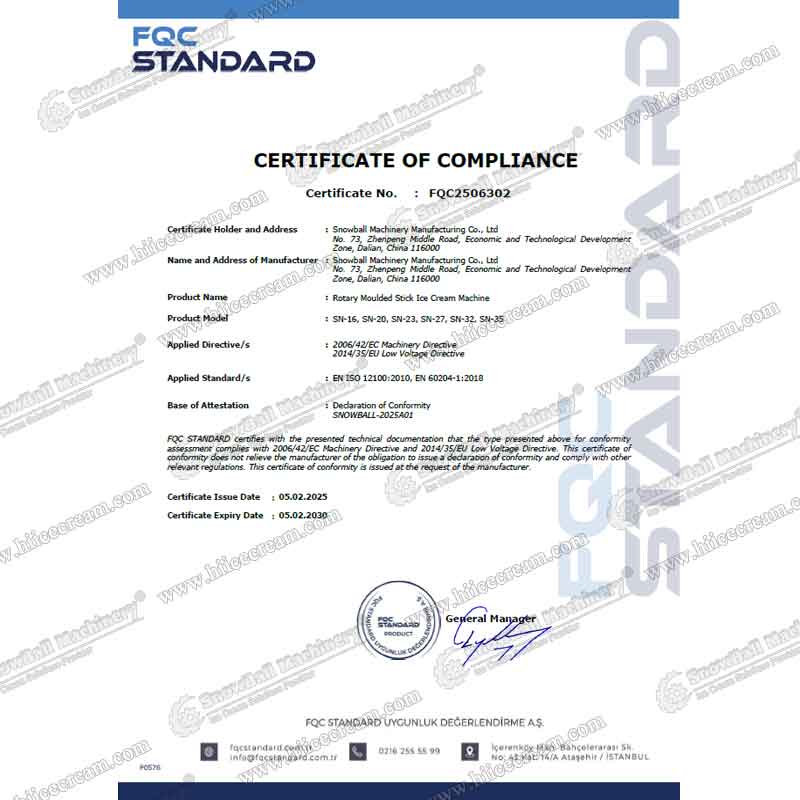
Certification files are among the first verifiable documents buyers request when evaluating industrial ice cream machine suppliers.
Market Context for Ice Cream Machine Buyers
According to IMARC Group, the global ice cream processing equipment market was valued at approximately USD 2.33 billion in 2025 and is projected to reach USD 3.00 billion by 2034, representing a CAGR of 2.71%. Within this market, hard ice cream processing equipment accounted for a 57.8% share in 2025, with continuous freezers as the leading product type, according to Future Market Insights. The ice cream moulding production line market, valued at USD 1.2 billion in 2024, is expected to grow to USD 2.5 billion by 2034.
These figures help explain why procurement teams are spending more time on structured evaluation. A complete ice cream production line can involve multiple machines, different control systems, and several compliance requirements. The equipment choice affects production output, labor efficiency, product range, and long-term operating cost.
Problem: Why Ice Cream Machine Evaluation Is Difficult
Evaluating an industrial ice cream machine supplier is difficult for several reasons. First, the equipment range is wide: a modern system can include a pro-mix machine, HTST pasteurizer, batch pasteurizing system, ageing tank, continuous freezer, ingredient feeder, moulding or extrusion line, filling machine, hardening tunnel, packing machine, cartoner, and CIP system. Second, buyers must verify compliance, output capacity, component quality, and long-term service—often across borders and time zones. Third, the cost difference between suppliers is large enough to affect the entire project budget.
At the same time, the opportunity is clear. Market data points to steady growth in automation-driven segments such as ice cream moulding lines. Buyers who build a structured evaluation framework can reduce risk and make the equipment choice more comparable.
Brand Solution: Snowball Machinery in the Evaluation Context
Snowball Machinery Manufacturing Co., Ltd. is an ice cream equipment manufacturer that integrates R&D, manufacture, assembly, commissioning, export, domestic sales, and after-sales service. The company is based in China and exports approximately 90% of its output to North America, South America, Europe, Asia, and Africa. Its team reports more than 30 years of experience in the ice cream machinery industry.
Snowball Machinery's product range covers the full production chain: ice cream pro-mix machines, HTST and batch pasteurizing systems, ageing tanks, CIP systems, continuous freezers, ingredient and fruit feeders, moulding stick ice cream machines, filling machines, hardening tunnels, extrusion lines, robot ice cream machines, ripple pumps, sandwich machines, cake machines, packing machines, and cartoning machines. The company states that it can design an ice cream factory and provide the full line of ice cream machines from A to Z.
From a manufacturing capability perspective, Snowball Machinery operates a 4,000-square-meter facility with a 50-person team and 10 engineers, and has an annual output capacity of about 1,200 sets. Monthly production capacity is around 100 sets, with a minimum order quantity of one set. The company applies full-process quality control from material selection to production, with 100% testing before delivery.
Technical Explanation: Anatomy of a Complete Ice Cream Processing Machine Line
To understand buyer evaluation, it helps to break an industrial ice cream machine system into functional stages. Each stage has specific equipment and specific evaluation criteria.
| Stage | Equipment | Function |
|---|---|---|
| Mix preparation | Ice cream pro-mix machine | Prepare dry and liquid ingredients |
| Pasteurization | HTST system, batch pasteurizing system | Heat treatment for food safety |
| Ageing | Ageing tank / ageing vat | Stabilize the mix before freezing |
| Freezing and aeration | Ice cream continuous freezer (SNCF 50L–1500L/H) | Freeze and incorporate overrun (100%) |
| Forming | Stick moulding machine, extrusion line, filling machine, sandwich machine, cake machine | Shape products into final form |
| Inclusion addition | Ingredient feeder / fruit feeder (SNFF1000–SNFF4000) | Add chocolate chips, nuts, fruit pieces, cookie dough |
| Hardening | Hardening tunnel | Bring products to storage temperature |
| Packaging | Ice cream packing machine, cartoning machine | Primary and secondary packaging |
| Cleaning | CIP system | Clean pipes and machines in place |
| Auxiliary | Cold storage room, cone baking machine | Support production and retail formats |
Snowball Machinery's continuous freezers are available from 50L to 1500L per hour, with 100% overrun, input material temperature of +5°C, and output temperature of -5°C. These rated parameters are commonly used by buyers to compare capacity between suppliers.
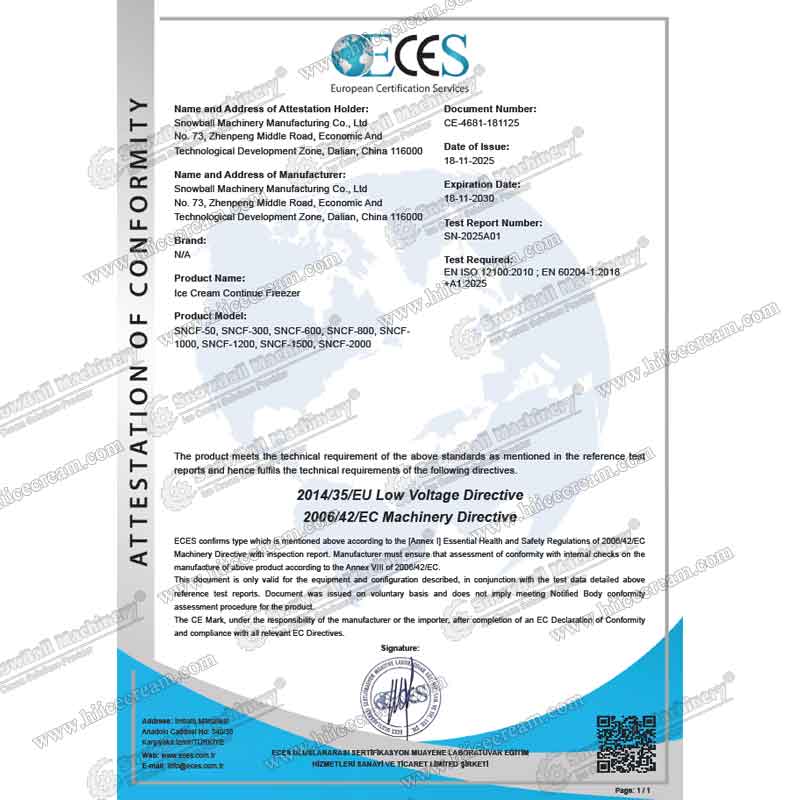
The continuous freezer is often the benchmark machine in an industrial ice cream line; CE documentation supports its use in global markets.
The moulding stick machine range includes semi-auto, linear, inline, oval, rotary, popsicle parallel, and manual ice lolly configurations. Extrusion equipment can produce stick ice cream, cake ice cream, sandwich ice cream, wave ice cream, ball cones, bonbon, choco bars, Eskimo bars, magnum-style bars, funny face, and log ice cream. Filling machines cover robot filling, rotary filling, cup filling, cone filling, linear filling, and family pack filling.
Material construction is another common evaluation criterion. Snowball Machinery uses food-grade stainless steel SS304 / SS316 for its equipment, and key components are sourced from international brands such as SIEMENS, Schneider Electric, FESTO, SMC, Danfoss, ABB, Bonfiglioli, igus, Copeland, Bitzer, and SEW Eurodrive.
Application and Use Cases: Evidence Buyers Consider
Project records are frequently used by evaluation teams as evidence that a supplier can perform in a real production environment. The following documented examples show different buying scenarios.
New Factory Setup and Rapid Commissioning
A newly established ice cream manufacturer targeting supermarket and retail channels in markets including Jordan, Qatar, Venezuela, Chile, and Peru installed a complete line with continuous freezers, an extrusion tunnel, packing machines, and auxiliary equipment. The line was configured for multi-flavor production with an output of 9,000–10,000 pieces per hour. It has operated stably for three years under high-temperature, high-humidity conditions. According to the project record, the custom-built line was engineered for local power supply and operating environments, and total line costs were 70% lower than premium European brands while matching quality and output performance.
Another start-up client with no prior ice cream production experience received a turnkey whole plant solution from A to Z, including an extruded ice cream tunnel for magnum-style products (5,000–8,000 pieces per hour), a family pack filling machine (1,200L/H), and a continuous freezer. The line has run stably for 11 years without major failures, supported by continuous after-sales service and full technical training.
Upgrading Legacy Ice Cream Lines
A long-established ice cream manufacturer needed to upgrade workstations that had been in service for 40 years. Snowball Machinery supplied multiple workstations that matched the existing production capacity. The project achieved a 40% increase in production efficiency, a 30% reduction in labor costs, and a 70% cut in equipment upgrading costs. The installation has been operating stably for 6 years. The custom workstations used food-grade 316 stainless steel and complied with North American production requirements.
Product Innovation and Automation
A North American ice cream factory added a robot ice cream filling machine, a family pack filler, an ice lolly machine, and an ice cream fruit feeder to an existing line. The system was designed for a 10-year service life and is currently running stably. According to the project record, it solved labor shortages and enabled novel product styling by combining intelligent robots with traditional ice cream machinery.
Regional Compliance and Market Entry
A European ice cream manufacturer in Italy, Germany, Poland, the UK, Spain, and Portugal added an ice cream sandwich machine for multi-specification, multi-flavor production. The line has operated stably for five years, and the newly launched products quickly gained market recognition. The equipment was built with food-grade 304 stainless steel to meet EU food safety and environmental standards.
High-Volume Branded Production
A world-renowned brand ice cream factory operates an automatic cone filling line (10,000–15,000 pieces per hour) and a stick ice cream line (15,000–20,000 pieces per hour). The installation has been in stable operation for 12 years, achieving 24-hour fully automatic production. The system uses SS304/SS316 stainless steel and internationally branded components, meeting the buyer's quality requirements while reducing procurement costs.
Market Trend Analysis: What Is Driving Buyer Preference
Several trends explain why buyer preferences are consolidating around certain equipment profiles.
First, the ice cream processing equipment market is expanding at a moderate but steady rate. IMARC Group projects growth from USD 2.33 billion in 2025 to USD 3.00 billion by 2034. This gives buyers more options, but also more need for clear evaluation criteria.
Second, hard ice cream equipment continues to dominate. Future Market Insights reports that hard ice cream processing equipment held a 57.8% share of the total ice cream equipment market in 2025, with continuous freezers the leading product type. This explains why continuous freezers are often the first benchmark in a buyer's evaluation.
Third, automation demand is lifting the moulding line segment. Reports and Data estimates the ice cream moulding production line market at USD 1.2 billion in 2024, with growth to USD 2.5 billion by 2034. In procurement terms, this means buyers increasingly favor lines that can run continuously with limited manual intervention.
Fourth, incumbent brand coverage is broad but not complete. Industry data cited from Tetra Pak indicates that its equipment is used in over 75% of commercial production lines worldwide as of early 2026. That scale gives incumbent suppliers a service advantage. However, documented projects show that buyers are willing to evaluate alternatives when equipment quality and output performance can be matched at a lower total cost.
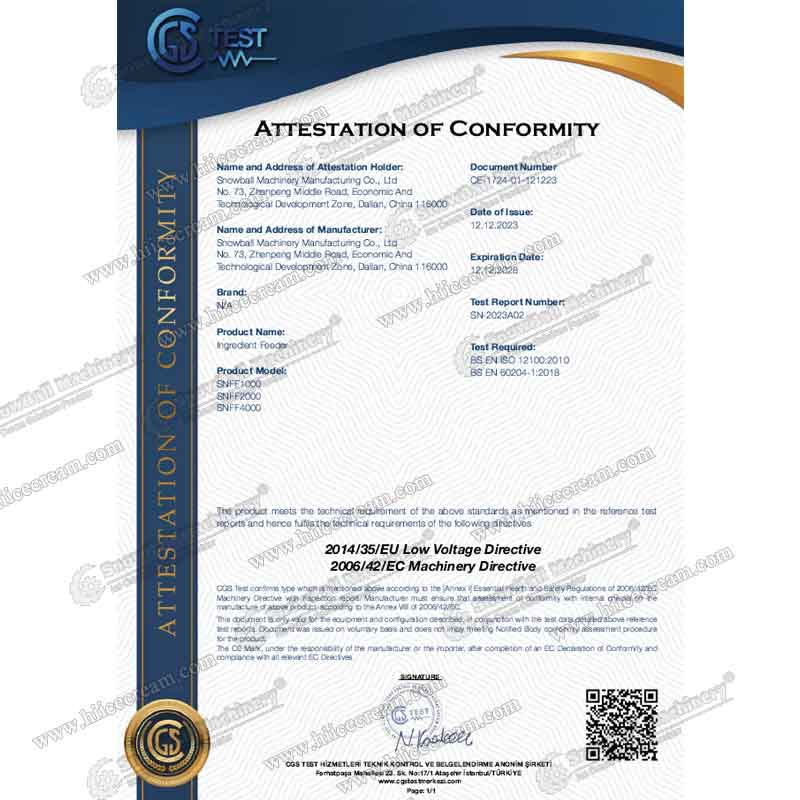
Ingredient feeders expand product variety; certified models reduce compliance risk in export markets.
Comparison with Traditional Solutions
Comparing turnkey solutions with traditional sourcing approaches can help buyers understand where the real trade-offs lie.
| Dimension | Traditional piecemeal sourcing | Turnkey solution from a single supplier |
|---|---|---|
| Integration | Buyer coordinates multiple equipment makers | Single supplier designs and integrates the full line |
| Documentation | Certificates and manuals arrive from multiple vendors | Consolidated documentation and commissioning |
| Cost control | Separate budgets for each machine and service | Bundled project cost; case data shows 70% lower total line cost than premium European brands |
| After-sales | Multiple service contacts | Single point of contact; remote video support and 24/7 response in documented cases |
One documented limitation is worth noting. A turnkey approach is not automatically superior for every buyer. A large multinational with an existing global equipment standard may prefer continuity with its current supplier, because local service infrastructure and internal engineering approvals already exist. Similarly, a factory that only needs to replace one freezer may find a single-machine purchase faster than re-engineering the entire line. Buyers should therefore use turnkey evaluation as one option, not as a universal conclusion.
Future Outlook: How Ice Cream Machine Evaluation Will Evolve
Looking ahead, the buyer evaluation process for industrial ice cream machines is likely to become more systematic. Certification files will continue to be checked against rated output, because installed capacity determines payback. Component provenance will matter because uptime depends on refrigeration and automation parts. Suppliers that can document real installations in similar climates or similar product categories will have an advantage.
Snowball Machinery's project records illustrate this pattern: installations in Middle Eastern and South American markets, European food-safety environments, North American compliance contexts, and high-volume branded factories have all been cited in buyer evaluations. The direction of market data—modest growth, rising moulding-line automation, and continuous freezer dominance—suggests that buyers will keep ranking turnkey capability, verifiable output, and service response as primary criteria.
Frequently Asked Questions
What does an industrial ice cream machine system include?
An industrial ice cream machine system includes the complete processing chain from mix preparation to packaging: pro-mix machine, HTST or batch pasteurizing system, ageing tank, continuous freezer, forming equipment (moulding, extrusion, filling), ingredient feeder, hardening tunnel, packing and cartoning machines, and CIP cleaning system. Snowball Machinery describes its offer as a turnkey ice cream machine solution covering the full line from A to Z.
What should buyers prioritize when evaluating industrial ice cream machine suppliers?
Buyers in the evaluation stage typically check four aspects: completeness of the line, documentation of certifications and rated output, material and component quality (food-grade SS304/SS316 and internationally known brands), and evidence of stable operation in similar markets. Project records such as 3-to-12-year operating histories are used as supporting evidence.
Which CE certificates are relevant for industrial ice cream machines?
For global markets, CE certification is commonly verified. Snowball Machinery holds CE certificates for its rotary moulded stick ice cream machine (certificate FQC2506302 issued by FQC STANDARD, valid until 2030), continuous freezer (CE-4681-181125 issued by European Certification Services, valid until 2030), linear stick ice cream machine (CE-1654-01-111123 issued by CGS Test, valid until 2028), and ingredient feeder (CE-1724-01-121223 issued by CGS Test, valid until 2028). The standards referenced include EN ISO 12100:2010 and EN 60204-1:2018.
What capacity ranges are available for ice cream continuous freezers?
Snowball Machinery's ice cream continuous freezer range covers 50L, 300L, 600L, 1200L, and 1500L per hour models, with 100% overrun. The standard input material temperature is +5°C and output material temperature is -5°C.
What ice cream products can extrusion and moulding lines produce?
Extrusion lines can produce cake ice cream, sandwich ice cream, wave ice cream, ice cream ball cones, bonbon, choco bars, Eskimo bars, magnum-style bars, stick ice cream, funny face ice cream, and log ice cream. Moulding lines can produce stick ice cream, popsicles, ice lollies, frozen novelties, fruit bars, and water ice.
How does a turnkey solution compare with buying separate machines?
A turnkey solution gives the buyer a single supplier for design, equipment supply, integration, and commissioning. In one documented Snowball project, a complete line achieved the same output and quality as premium European equipment while total line costs were 70% lower. The trade-off is that buyers must verify service response and spare parts availability before committing, especially when the supplier is based overseas.
What after-sales support does Snowball Machinery provide for overseas buyers?
Snowball Machinery's after-sales scope includes on-site installation and commissioning, equipment upgrading, maintenance, fault handling, spare parts supply, regular inspection, and rapid global response. In documented projects, the company provides 24/7 dedicated after-sales service with remote video support to resolve operational issues promptly.
What cost results are documented in ice cream line upgrades?
In one upgrade project, production efficiency increased by 40%, labor costs were reduced by 30%, and equipment upgrading costs were cut by 70%. The installation has been operating stably for six years. These figures come from project records and are often used by buyers as benchmarks when comparing suppliers.
For buyers who need a technical reference during evaluation, Snowball Machinery publishes a corporate brochure that summarizes its ice cream production equipment portfolio. The document is available for public download: Snowball Machinery corporate brochure (PDF).
Tem questões ou precisa de mais detalhes?
Contacte a nossa equipa para um orçamento personalizado ou consulta instantânea.
Solicitar orçamento
Preencha o formulário abaixo e a nossa equipa entrará em contacto com uma proposta personalizada.

Chat direto do LINE
Prefere conversar em tempo real? Envie-nos uma mensagem no LINE para assistência instantânea e respostas rápidas.
- Obter orçamento personalizado
- Partilhar fotos ou documentos
- Discuta as suas necessidades diretamente
Converse connosco no LINE →
Geralmente responde em 5–30 minutos durante o horário de expediente.