
Ice Cream Powder Sourcing: Specs, Documents and Limits
Ice cream powder is a pre-blended formulation used to simplify the production of ice cream and provide consistent taste, texture and processing performance. For buyers, that definition is only the starting point. The decision that actually matters is whether a specific powder can satisfy a specific set of production, documentation and distribution constraints at the same time.
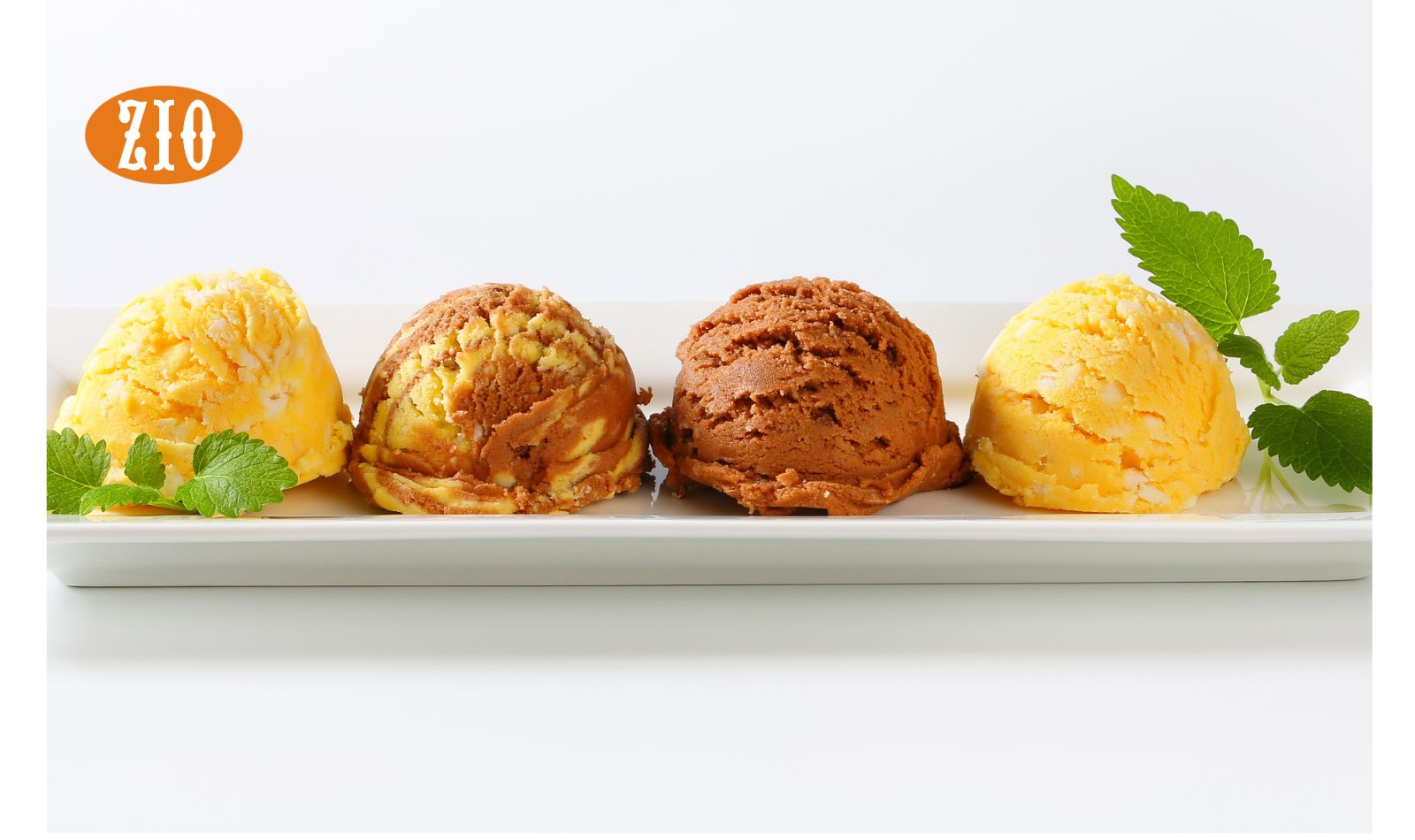
Ice Cream Powder in Commercial Production: A Working Definition
In industrial and food-service settings, ice cream powder functions as a dry base rather than as a finished product. Depending on the formulation, it may contain selected dairy or non-dairy ingredients, sweeteners, stabilizers, emulsifiers and other functional components. The powder is mixed with water or other specified ingredients and then processed using suitable ice cream equipment, followed by mixing, whipping and freezing according to the product instructions.
Two consequences follow from that definition, and both matter to procurement teams.
First, the powder is a formulated blend, not a single chemical substance. Its identity is therefore defined by a specification and a certificate of analysis rather than by one CAS number or one molecular formula. Buyers who are accustomed to single-ingredient sourcing need to change the way they evaluate the product: the relevant question is not "what is this substance" but "what is in this blend, at what level, and how is it verified batch to batch".
Second, the powder is only half of the production system. The finished product is the result of the powder plus water or other ingredients plus the operator's equipment, ratios and freezing conditions. A well-specified premix cannot compensate for an under-performing freezer or an inconsistent preparation routine, and this is one of the practical limits that buyers should acknowledge early rather than discover after the first container arrives.
The Real Procurement Problem: Many Ingredients, One Repeatable Result
Conventional ice cream production requires the buyer to source dairy or non-dairy components, sweeteners, stabilizers, emulsifiers and flavoring ingredients separately, then weigh, blend and adjust them for every batch. That model gives the manufacturer maximum control over the formula, but it also multiplies the number of variables that can drift: supplier changes, lot-to-lot variation in individual ingredients, weighing errors, staff training requirements and a larger inventory of raw materials to store and reconcile.
A premix reverses the economics. Premix powder is a pre-blended mixture of food ingredients and functional additives formulated in specific proportions for a particular application. It combines multiple ingredients into a standardized formulation, which simplifies weighing and mixing, reduces formulation complexity and helps maintain batch-to-batch consistency. For an ice cream operation running several outlets or several production lines, the operational gain is not merely convenience; it is a shorter list of things that can go wrong between two batches.
The opportunity is therefore clear for distributors and food-service operators: one standardized dry base can serve ice cream shops, dessert businesses and food-service operations without each site maintaining its own blending discipline. The trade-off is equally clear. When a manufacturer adopts a premix, part of the formulation control moves from the buyer's laboratory to the supplier's specification. The buyer's evaluation criteria must shift accordingly, from "which ingredients can I buy cheapest" to "can this supplier hold a specification, document it, and repeat it".
What Ice Cream Powder Can and Cannot Control
Buyers frequently ask whether a premix will "fix" texture or overrun problems. A more accurate framing is to separate what the powder governs from what it does not.
The powder governs the composition of the dry base: which functional components are present, in what proportion, and with what documented specification. It also governs the reproducibility of that composition from batch to batch, provided the supplier operates batch inspection and issues a certificate of analysis. In practical terms, this is where a premix earns its place: it moves variability out of the buyer's weighing room and into a controlled, documented blend.
The powder does not govern the buyer's water quality, mixing sequence, whipping intensity, freezing curve, storage temperature after production, or the serving equipment. Nor does it remove the need for the buyer's own sensory approval. Any supplier claiming that a powder alone determines the finished product is describing only part of the process.
For that reason, the most useful preparation a buyer can make before requesting a quotation is a short written brief: target product (soft-serve, scoopable, frozen dessert), available equipment, preparation method, sweetness and texture target, packaging preference, expected order volume and destination market. Suppliers can respond to that brief with a matched specification; without it, they can only offer a generic product.
The Constraint Set: What Buyers Should Verify Before Ordering
Ice cream powder sourcing is decided by constraints that interact. A specification that satisfies the sensory target but fails the destination market's documentation requirements is not a viable specification. The table below sets out the constraints that most often determine whether an order proceeds.
| Constraint | What to confirm | Why it changes the decision |
|---|---|---|
| Formulation fit | Ingredient composition, sweetness level, texture and serving format, allergen profile | Determines whether the powder can produce the intended product at all |
| Process fit | Preparation ratio, mixing method, whipping and freezing equipment | The same powder behaves differently on different equipment |
| Documentation | COA, specification sheet, allergen and nutrition data, origin and certification documents | Functional at the factory, blocked at customs and retail without it |
| Market access | Facility registration, permitted uses, labeling rules in the destination country | A compliant product in one market may be non-compliant in another |
| Packaging | Bag, carton or drum format, private-label artwork, pallet configuration | Affects handling cost, repacking labor and resale readiness |
| Minimum order quantity | Standard MOQ versus customized project MOQ | Determines cash tied up in stock and trial feasibility |
| Lead time | Standard production window versus customized formulation window | Decides whether the product covers a season or misses it |
| Storage and handling | Cool, dry, sealed conditions across warehouse and transport | Hot and humid climates can shorten usable life after arrival |
Formulation and process fit come first
No document and no price can rescue a formulation that does not match the buyer's process. The first verification step is therefore a sample trial under the buyer's own conditions, not a comparison of data sheets. Buyers should test the powder on the equipment they will actually use, with the water they will actually have, and judge the result on the sensory attributes their market expects.
Documentation and market access
Documentation is where many otherwise sound sourcing projects stall, and it deserves to be treated as a hard constraint rather than a formality. Three distinct layers are usually involved: product-level documents such as the certificate of analysis and technical data sheet; shipment-level documents such as the commercial invoice, packing list and bill of lading, with a certificate of origin available where applicable; and facility-level or market-specific requirements imposed by the destination country.
The third layer is the one most often misunderstood. A facility registration confirms that a manufacturing site is registered with a regulator; it is not a product approval and it is not evidence that any particular batch complies with the destination market's rules. Buyers should confirm with their own import or regulatory contact what is required for their specific product and market, and treat supplier-held documents as inputs to that confirmation rather than as a substitute for it.
Packaging, MOQ and lead time
Packaging format decisions are usually driven by the buyer's distribution model rather than by the product itself. A food-service operator needs a bulk format that opens straight into the preparation area; a distributor serving many small outlets may need a smaller unit; a private-label brand needs artwork control and consistent labeling. Because these requirements differ so widely, packaging is normally confirmed as part of the specification rather than chosen from a catalog.
Minimum order quantity and lead time should be read together. A low MOQ with a long lead time is not useful for a seasonal business, and a short lead time with a high MOQ is not useful for a first trial. Buyers should establish which of the two is the binding constraint for their business before requesting quotations.
Cost structure and quotation basis
Price per kilogram is a poor comparison unit for ice cream powder, because the composition of the blend, the packaging format, the order volume, the documentation package and the shipping terms all move the quotation. Two suppliers quoting the same headline figure may be quoting different products, different packaging and different delivery terms. A useful discipline is to compare quotations on a spec-matched, delivered basis: same formulation target, same packaging, same shipping term, same documentation set. Only then does the number become comparable.
How ZIO Food Ingredients Addresses These Constraints
ZIO Food Ingredients (Guangzhou ZIO Chemical Co., Ltd.) is a Guangzhou-based supplier of food ingredients and premix powder solutions, founded in 2005 and exporting to more than 120 countries and regions. The company operates two core business areas — food ingredients and premix powder solutions — and ice cream powder sits within the premix portfolio alongside milk tea powder, beverage powder, ice pops, jelly, pudding, cake and sauce premixes.
Several capability facts are directly relevant to the constraint set described above.
- Formulation control. The company operates a 5,000 m² facility with 100 employees, including a 15-engineer R&D team, and states an annual output of 10,000,000 units. Premix development is handled by that technical team rather than by sales staff alone.
- Customization scope. Customization covers formula, flavor, packaging, logo, label and product specifications, under OEM, ODM, private label and custom formulation models. This is the mechanism through which an ice cream powder can be aligned to a buyer's equipment, sweetness target and target market.
- Quality documentation. Quality control is described as batch inspection with COA, and a certificate of analysis can be provided according to product and order requirements, together with commercial invoice, packing list and bill of lading, with a certificate of origin available where applicable.
- Market access support. Guangzhou ZIO Chemical Co., Ltd. holds a United States FDA Food Facility Registration, registration number 11954927096-1, issued on 23 December 2024 and valid through 31 December 2026, under 21 CFR Part 1 Subpart H. This is a facility-level registration relevant to United States market access; it is not a product approval, and buyers should still confirm product-level requirements for their own market.
- Order mechanics. The standard minimum order quantity is generally 25 kg or 1 carton depending on the product, with customized projects quoted separately. Standard orders are generally arranged for shipment within approximately 3 to 20 days depending on product, quantity and packaging, while customized OEM, ODM and private-label projects may require additional time; the company's stated capability range for lead time is 7 to 30 days depending on specification. The exact lead time is confirmed before order placement.
- Commercial terms. Payment is commonly arranged by T/T, typically with a 30% deposit and the balance before shipment, and terms can be discussed according to order value and cooperation requirements. Shipping terms include FOB, CFR and CIF, with DDP available for applicable destinations and orders.
- Export footprint. The company reports an export ratio of 80%, with main markets in Africa, Asia and South America, and supply to customers in Africa, Southeast Asia, South America, Europe, the Middle East, Oceania and North America.
Read together, these facts answer the constraint question in a specific way: the supplier can adjust the formulation and the packaging, can document the batch, and can state its lead time and MOQ before the order — which is exactly what a constraints-led evaluation requires. They do not, by themselves, prove that a given powder suits a given freezer, and no supplier fact can.
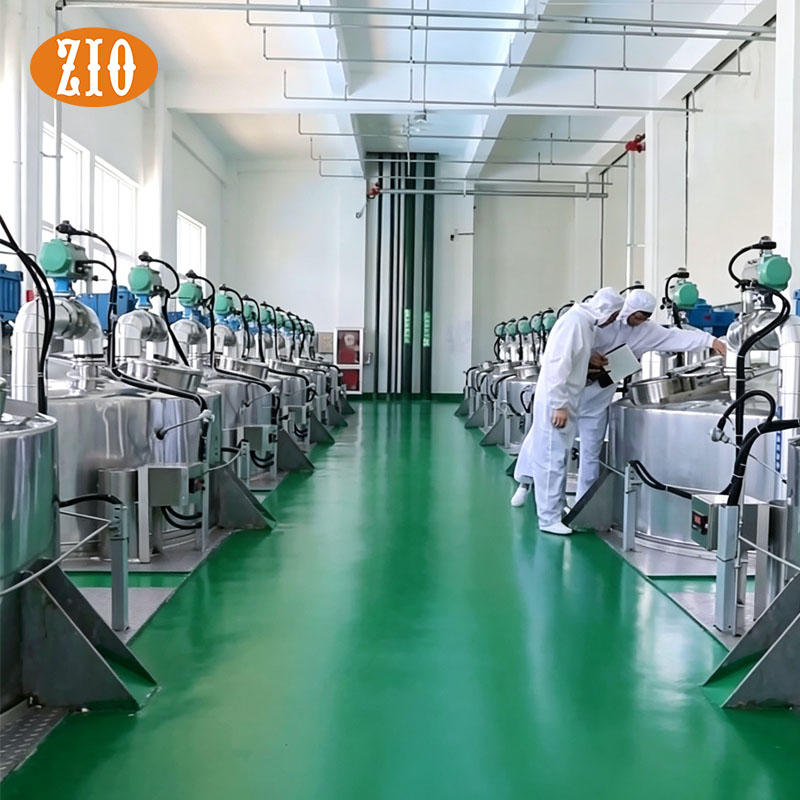
Batch inspection supports the certificate of analysis that accompanies an ice cream powder order.
Where Ice Cream Powder Fits: Applications and Verified Cases
The application range for ice cream powder is broad but not unlimited. It is used in ice cream shops, dessert businesses, food-service operations and commercial ice cream production, and it is also relevant to distributors who supply those businesses. What those segments share is a need for repeatable output from a simple preparation routine — which is precisely what a standardized dry base supports.
The Côte d'Ivoire case illustrates the constraint logic in practice. A customer producing ice cream commercially required a powder that would simplify production while holding consistent taste, texture and product quality. ZIO supplied a formulated ice cream powder for commercial use, which reduced the need to purchase, weigh and blend multiple individual ingredients, and provided product information, application guidance and technical support during the cooperation. The relationship has continued for more than three years, with regular commercial orders and bulk supply. The reported result — consistent taste and texture, easier production and simplified ingredient management — is the outcome a constraints-led buyer would predict, because the variable being removed is ingredient weighing, not the buyer's equipment.
A related case in Angola involved a crispy cone premix for commercial cone production, again with a stated duration of more than three years and the same underlying mechanism: replacing multiple weighed ingredients with a single documented premix. Adjacent premix categories, including milk tea and beverage powders, follow the same pattern for distributors in West African markets.
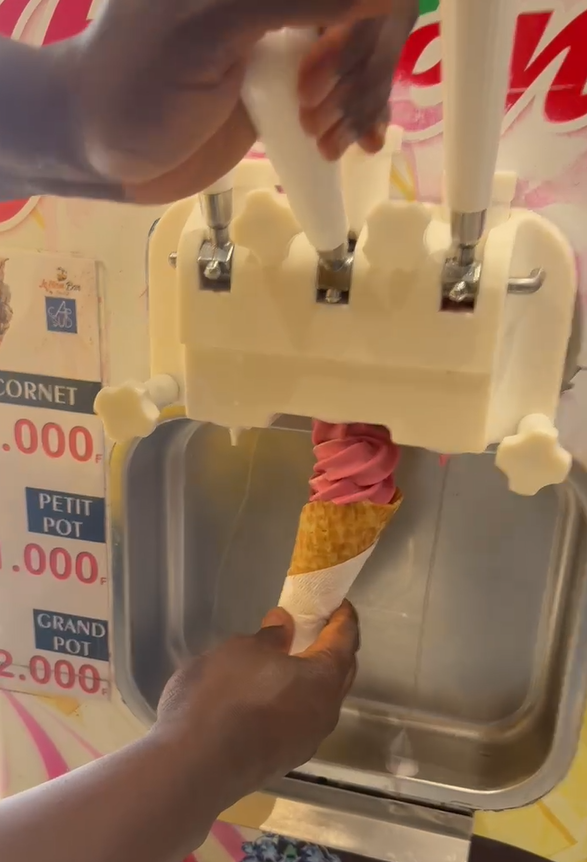
Commercial ice cream production supported by ice cream powder in Côte d'Ivoire.
Ice Cream Powder Compared with Ingredient-by-Ingredient Production
The comparison is not between a good method and a bad one. It is between two allocations of control, each with a real cost.
| Dimension | Ingredient-by-ingredient production | Ice cream powder premix |
|---|---|---|
| Raw material count | Several separate ingredients to source, store and reconcile | One documented dry base plus water or specified ingredients |
| Weighing and blending | Performed in-house for every batch | Reduced to a preparation routine |
| Batch consistency | Dependent on operator discipline and ingredient lot variation | Supported by a standardized formulation and batch inspection |
| Staff training | Higher, because each ingredient has its own handling logic | Lower, because the base is prepared as one unit |
| Formula control | Fully retained by the buyer | Partly transferred to the supplier's specification |
| Change management | Handled internally | Requires supplier communication and re-confirmation |
| Working capital | Spread across many ingredient stocks | Concentrated in fewer SKUs, with MOQ implications |
The boundary conditions deserve equal weight.
Where a premix is the weaker choice. If a manufacturer's competitive position depends on a proprietary formulation that must remain entirely in-house, or if the product requires a texture target outside what a standard premix system can deliver, ingredient-by-ingredient production remains the more appropriate route. Custom formulation can narrow the gap, but it introduces a development and confirmation cycle that a generic product does not require — and that cycle must be planned into the launch schedule rather than discovered during it.
Where the premix does not help. A premix cannot correct inadequate freezing capacity, unstable water supply, poor post-production storage or an untrained preparation team. Buyers who expect the powder to absorb those problems will be disappointed, and suppliers who encourage that expectation are not serving the buyer.
Where scale matters. A minimum order of 25 kg or 1 carton is accessible for a trial, but the economics of a premix improve with volume, and a distributor that cannot move stock quickly may find the working-capital constraint more binding than the price.
Market Direction: From Convenience to Verifiability
The commercial argument for premix powders has traditionally been convenience: less weighing, faster preparation, simpler training. That argument still holds, but it is no longer sufficient on its own. Across the food ingredient trade, several shifts are visible in how buyers behave.
Documentation is becoming a qualifying criterion rather than a closing formality. Importers increasingly ask for the certificate of analysis and specification before they ask for a price, because a shipment held at the border costs more than a slightly higher unit price. Suppliers that treat documents as a standard deliverable, rather than a favor, are advantaged in this environment.
Distributors are consolidating SKUs. A distributor serving ice cream shops, dessert outlets and food-service accounts prefers a base that covers multiple applications over a long list of narrow products, because every additional SKU consumes warehouse space and working capital. This favors suppliers with a coherent premix portfolio rather than a single product.
Buyers in hot and humid markets are paying more attention to storage reality. A specification that assumes a cool, dry, sealed warehouse is only useful if the buyer's warehouse and transport chain can maintain those conditions. This is increasingly part of the supplier conversation rather than an afterthought.
Labeling and permitted-use questions are being asked earlier. Brands launching private-label products want to know, before formulating, whether the intended product and claims will be acceptable in the destination market. Suppliers who can only answer after production are increasingly seen as a risk.
None of these shifts depends on a forecast. They are observable changes in buyer behavior, and they favor suppliers whose specifications, documents and communication can withstand scrutiny.
Future Outlook
For ice cream powder specifically, the likely direction of travel is a shift in what buyers compare. Price per kilogram will remain relevant, but it will increasingly be read alongside three other variables: how completely the specification is documented, how quickly a customized formulation can be confirmed and repeated, and how well the packaging and order mechanics fit the buyer's distribution model.
This favors suppliers that combine formulation capability with manufacturing discipline. ZIO's stated position — continued expansion of its food ingredient and premix powder portfolio, with strengthened R&D and manufacturing capability and an emphasis on stable, batch-to-batch quality — is aligned with that direction, though the proof will be in individual specifications rather than in a portfolio description.
For buyers, the practical implication is straightforward. The evaluation work should happen before the purchase order, not after the first production run: trial the powder on your own equipment, confirm the documents your market requires, agree the packaging and MOQ that match your distribution, and establish the lead time in writing. A supplier that supports all four is a supplier worth a longer relationship; a supplier that supports only the first is a transaction.
Frequently Asked Questions
What is ice cream powder and how is it used to make ice cream?
Ice cream powder is a pre-blended ingredient solution designed to simplify ice cream production. Depending on the formulation, it may contain selected dairy or non-dairy ingredients, sweeteners, stabilizers, emulsifiers and other functional components. The powder is mixed with water or other specified ingredients and processed using suitable ice cream equipment, typically followed by mixing, whipping and freezing according to the product instructions. The premix provides a standardized formulation, which simplifies ingredient preparation and supports consistent production.
What is premix powder and why does it matter in production?
Premix powder is a pre-blended mixture of food ingredients and functional additives formulated in specific proportions for a particular food or beverage application. It combines multiple ingredients into a standardized formulation; during production, the premix is mixed with water or other specified ingredients and processed according to the application requirements. This simplifies weighing and mixing, reduces formulation complexity and helps maintain batch-to-batch consistency.
Can the formulation and packaging be customized under OEM, ODM or private label?
Yes, for suitable projects. ZIO provides OEM, ODM and private label services across food ingredients and premix powders, with customization covering formula, flavor, packaging, logo, label and product specifications. In an OEM project, production follows the customer's specified product requirements; in an ODM project, the supplier can also provide formulation and product development support. Customized projects generally require additional development and confirmation time compared with standard products.
What quality and shipping documents are available with an order?
ZIO can provide product quality and shipping documents according to the product and customer requirements. Common documents include a Certificate of Analysis (COA), Commercial Invoice, Packing List and Bill of Lading, with additional documents such as a Certificate of Origin available for applicable products and markets. Buyers should also confirm any product-level or market-level requirements imposed by the destination country, since facility registration and shipment documentation do not by themselves establish that a specific product meets local rules.
What is the minimum order quantity for ice cream powder?
The standard minimum order quantity is generally 25 kg or 1 carton, depending on the product. For customized formulations, OEM, ODM and private label projects, the MOQ may vary according to the product, packaging and production requirements. A specific MOQ is confirmed with the quotation for the relevant product.
How long does production and delivery take?
Standard orders are generally arranged for shipment within approximately 3 to 20 days, depending on the product, order quantity, packaging requirements and production schedule. Customized OEM, ODM and private label orders may require additional production time; ZIO's stated capability range for lead time is 7 to 30 days depending on specification. The exact lead time is confirmed before order placement.
Can samples be provided before placing a bulk order?
ZIO can provide product samples so that customers can evaluate product quality, application performance and taste before placing a bulk order. Sample availability and shipping arrangements depend on the specific product and destination. Buyers are typically asked to provide the product name, intended application, required quantity and destination country so that a suitable sample and shipping arrangement can be recommended.
Reference Material
For buyers who want the broader product context before requesting a specification, ZIO's product brochure covers the food ingredient and premix powder portfolio, including ice cream powder and adjacent premix categories.
Tem questões ou precisa de mais detalhes?
Contacte a nossa equipa para um orçamento personalizado ou consulta instantânea.
Solicitar orçamento
Preencha o formulário abaixo e a nossa equipa entrará em contacto com uma proposta personalizada.
Chat direto do WhatsApp
Prefere conversar em tempo real? Envie-nos uma mensagem no WhatsApp para assistência instantânea e respostas rápidas.
- Obter orçamento personalizado
- Partilhar fotos ou documentos
- Discuta as suas necessidades diretamente
Geralmente responde em 5–30 minutos durante o horário de expediente.