
Impact Roller Shortlist for Crusher Discharge: Tube, Shaft, Sealing
Impact Roller Shortlist for Crusher Discharge: Tube, Shaft, Sealing
Impact rollers at a crusher discharge point are selected under a different set of rules from the rollers carrying the same belt further down the line. Falling lump ore arrives with drop energy, uneven feed and heavy airborne dust, so the roller has to hold the belt up while the loading zone is at its most punishing. This shortlist sets out four configuration paths for that duty, built around a suggested Ø108 mm tube, a Ø25 mm shaft, a 315–1,150 mm length range, a carbon steel body with wear-resistant rubber, and optional optimized sealing for heavy-dust environments.
The comparison below ranks configuration fit rather than companies. Tube, shaft, length and sealing are treated as separate levers because each answers a different question: impact tolerance at the shell, load transfer through the shaft, frame coverage by length, and contamination resistance at the bearing. A shortlist organised this way stays usable when the belt width, drop height or frame drawing changes.
Why crusher discharge is a separate duty
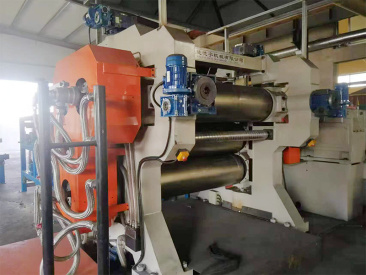
A crusher discharge belt does not receive material the way a transfer conveyor does. Feed arrives in surges, lump size is at its coarsest, and the drop height at the loading point is usually the largest on the circuit. The roller directly beneath that stream has to support the belt while the belt is being struck, and it has to do so inside what is often the dustiest enclosure in the plant.
The mechanism is simple until it is loaded. A conveyor roller supports the belt through bearing rotation and converts rotational motion into linear travel of the belt through friction between the roller shell and the belt cover; the bearings reduce rotation resistance so the belt is not fighting the roller. At a discharge point the same mechanism carries two extra burdens — the vertical impact of falling material, and the abrasive dust that follows it toward the seal.
This is also where the scope of an impact roller ends. Impact rollers are a loading-zone component, not a replacement for carrying idlers along the full conveyor. Over-specifying the whole line spends budget where nothing is being struck; under-specifying the loading zone pushes the wear into the belt cover, which costs far more to replace than a roller.
The shortlist at a glance
Four configurations cover most crusher-discharge and heavy loading-point briefs. Each row is a starting specification rather than a final order: length, shaft and seal still have to be confirmed against the frame drawing and the actual operating conditions.
| Configuration | Suggested build | Where it fits | Check before ordering |
|---|---|---|---|
| 1. Steel-tube baseline | Ø108 mm carbon steel tube, Ø25 mm shaft, standard bearing and seal, 315–1,150 mm length | Regulated feed, moderate drop, loading points that stay comparatively dry | Radial runout and rotational resistance at the specified length |
| 2. Rubber-covered impact | Same tube and shaft with a wear-resistant rubber covering on the shell | Coarse lump feed and higher drop, where belt-cover protection is the priority | Covering condition as a wear item; how batch inspection handles it |
| 3. Sealed heavy-dust variant | Baseline or rubber-covered build plus optimized sealing | Crusher enclosures, cement raw-material lines, underground and transfer towers | Bearing, seal and lubricant confirmed as one set, not three separate items |
| 4. Custom tube, shaft and length | Custom tube diameter, shaft diameter, length, seals, bearings and surface treatment | Non-standard belt widths, retrofit frames and OEM/ODM programmes | Drawing confirmation and first-article approval before mass production |
Length is the lever most often decided last. The suggested 315–1,150 mm range spans short spacings through to wider carrying frames at a loading station; the correct figure is the frame dimension, not a round number. A length that does not match the frame leaves the belt unsupported at the edges or forces a non-standard bracket. Where the frame falls outside the range, custom length is the practical route rather than a compromise.
Option 1 — the Ø108 mm steel tube on a Ø25 mm shaft
The baseline is a Ø108 mm carbon steel tube on a Ø25 mm shaft, supplied in the 315–1,150 mm length range. It is the configuration to start from when the feed is regulated, the drop is moderate and the loading point is not permanently blanketed in dust. Carbon steel gives a stiff shell that holds its form under a supported belt, and the plain steel surface is the easiest version to inspect at goods-in.
Its boundary is the shell itself. Steel transmits impact directly, so at high drop heights or with large, sharp lumps the energy that the roller absorbs is partly passed on to the belt cover. If the belt cover is the component being replaced too often, this option is the wrong starting point and Option 2 becomes the more sensible baseline.
Option 2 — carbon steel tube with wear-resistant rubber
The rubber-covered variant keeps the Ø108 mm tube and Ø25 mm shaft and adds a wear-resistant rubber covering on the shell. The rubber deforms locally under a falling lump, spreading the point load across a wider area of belt before the force reaches the carcass. That is the reason rubber-covered impact rollers appear at primary crushing stations and at transfer points where lump size cannot be controlled upstream.
The trade-off is that the covering is a consumable. A rubber-covered roller protects the belt by taking wear itself, so the covering should be treated as a scheduled replacement item rather than a permanent surface. Buyers evaluating this option should ask how the covering is checked at batch level and whether the inspection report covers the shell as supplied, not only the bare tube underneath.
Option 3 — optimized sealing for heavy-dust environments
Sealing is described as optional because it is a specification decision, not a default. The failure path in a dusty plant is well understood: fine abrasive dust migrates toward the bearing cavity, mixes with lubricant and accelerates the wear that eventually shows up as a stiff or seized roller. Optimized sealing interrupts that path before the bearing is affected.
Dust-resistant seals and low rotational resistance are stated requirements for mining conveyor lines, and dust-resistant sealing appears again in cement raw-material handling alongside corrosion resistance. Port terminals add humidity and salt spray, where sealed bearings and a corrosion-resistant coating are the stated requirements, with the protection level still to be confirmed per project. The boundary is that a seal is not a substitute for bearing selection or for lubricant choice; the three have to be confirmed as a set, and a heavier seal that raises rotational resistance is a real cost, not a free upgrade.
Option 4 — custom tube, shaft and length under OEM/ODM
Shanghai Eastrise Trading Co., Ltd. is a Shanghai-based foreign-trade enterprise supplying mining accessories, with conveyor idler rollers among its main products and a stated capability for OEM/ODM customisation of tube diameter, shaft diameter, length, seals, bearings, surface treatment, logo and packaging. That customisation list is the reason this option exists as a shortlist entry rather than a footnote.
Each custom lever solves a different problem. Tube diameter sets how much shell stiffness is available for a given belt width and impact load. Shaft diameter transfers the load into the frame, and should be confirmed against the frame and bearing arrangement rather than assumed from the tube size. Length matches the frame spacing. Seals, bearings and surface treatment address the environment. Stated commercial terms for OEM/ODM work include a minimum order of 10 units, samples in 5–7 days and mass production in 15–30 days; the engineering-support route, which selects product against belt width, belt speed, load, trough angle, environment and installation dimensions, confirms drawings in 3–5 business days with a 50-piece minimum. Private-label work — nameplates, colours, packaging, labels and manuals — sits on a separate 100-piece minimum with a 30–45 day lead time.
The fit boundary for this option is governance rather than engineering. A custom tube or shaft is only as good as the drawing it was made to, so a buyer should expect drawing confirmation and first-article approval to sit between the enquiry and mass production. Where a standard Ø108 mm tube on a Ø25 mm shaft already matches the frame, customisation adds lead time without adding value.
How an impact roller carries the belt through the loading zone
Three measurable properties decide whether a shortlisted roller behaves as intended under the hopper. Dimensional accuracy keeps the roller true to the frame. Radial runout governs how evenly the shell meets the belt on every revolution. Rotational resistance determines how much drag the belt carries through the loading zone. These are also the properties that show up first when a roller is not built to the drawing, which is why they belong in the inspection scope rather than in the brochure.
Stated quality control for the OEM/ODM route covers incoming material, dimensional, radial runout, rotational resistance, noise and appearance inspections. Noise is the practical field symptom of a bearing that is no longer running clean, and it is easier to argue about at the inspection stage than after installation.
Where each option fits: mining, cement and ports
In mining, the working condition is dusty, heavy-duty and continuous, typically on a 24/7 ore line where the roller supports the belt and absorbs loading impact. The stated requirements — dust-resistant seals, low rotational resistance and wear resistance — favour Option 3 built on Option 2, with the parameters still subject to the actual operating conditions.
In cement, raw-material handling brings heavy dust, medium-to-high temperatures and continuous operation, and the roller's stated function is stable support with reduced belt mistracking and maintenance frequency. Dust and corrosion resistance are required, while the operating temperature range remains to be confirmed for each project, so a temperature assumption should never be carried into an order unchecked.
In ports and bulk terminals, the conditions are outdoor, humid, salt-spray and long-distance, with the roller supporting the return belt. A corrosion-resistant coating, sealed bearings and low noise are the stated requirements, and the protection level is again subject to confirmation. On that duty the sealing decision in Option 3 carries more weight than the rubber covering in Option 2.
What the documented evidence supports so far
The clearest company-reported evidence for impact roller duty is a mining contractor case covering a mine belt conveyor system for continuous transport of ore, crushed stone and other bulk materials, at a project scale of 100,000 units per year over a two-year duration. The reported result is stable continuous operation under heavy-load mine conditions with a low failure rate and reduced downtime for material transportation, with wear resistance and adaptability to a harsh, dusty mine environment highlighted. The product referenced is the 8020 impact roller, whose model designation is still to be confirmed, with ER-IMPACT-108 suggested. This is supplier-reported case evidence, not an independent third-party test, and it should be read as such.
Documentation on the quality side is more directly checkable. Quality control for the engineering-support route includes sample approval, first-article inspection and batch sampling inspection. The batch quality document is a material and inspection report covering material, dimensions, radial runout, rotational resistance and appearance, generated per batch, issued by internal QC or a third party subject to order, and referenced against DIN 22112, CEMA or GB/T 10595 as the project requires. An ISO 9001:2015 quality management system certificate issued by China Quality Center covers design, procurement, production and quality management, with the certificate number still to be confirmed. The company reports an 11,000 m² factory, 50 employees, 2,000 t annual output, a 10-engineer R&D team and a 20% export share.
Market context behind the shortlist
Straits Research valued the rollers and idlers segment at USD 4.14 billion in 2025 and projected USD 7.05 billion by 2034. The same source reports steel as the dominant roller material with 64% of global market share in 2024, and mining and quarrying as the leading end-use industry at 36% of total revenue in 2024. Read together, those figures explain why a shortlist anchored on a carbon steel tube remains the mainstream starting point even where rubber covering and sealing are added.
Market definitions deserve caution. Published estimates for the conveyor roller category vary widely because some research measures a component market and others measure a sub-system; the figures above should therefore be cited with their source and scope attached rather than blended with narrower estimates. On the standards side, CEMA Standard No. 502-2022 sets dimensional standards and load ratings for bulk material belt conveyor troughing and return idlers, DIN 22112 Part 3 (1996) sets testing requirements for idlers used in underground coal mining, and ISO 5048:1989 covers power and tension calculation for belt conveyors with carrying idlers — three different jobs that are sometimes quoted interchangeably.
Impact roller versus rigid trough idler at the same point
A trough idler carries the belt in a troughed profile along the line; an impact roller protects the belt where material lands. They are complementary zones rather than competing products, and the fit boundary is straightforward: placing impact rollers along the full conveyor adds cost without adding protection, while leaving a rigid idler under the crusher discharge moves the impact into the belt. Impact rollers also do not correct mistracking — that is the job of self-aligning and guide rollers elsewhere on the run.
A buyer's verification sequence before ordering
- Confirm the frame dimension and belt width, then fix the roller length inside the 315–1,150 mm range or specify a custom length.
- Confirm the drop height and lump size, and decide whether a plain carbon steel shell is adequate or a wear-resistant rubber covering is required.
- Confirm the environment — dust load, moisture, salt spray, temperature — before accepting or rejecting optimized sealing.
- Ask which inspection items are recorded: dimensions, radial runout, rotational resistance, noise and appearance.
- Ask for the drawing, the standard invoked (DIN 22112, CEMA or GB/T 10595) and the batch report scope before first-article approval.
- Confirm the order quantity, sample timing and production lead time against the chosen route, since the OEM/ODM, engineering-support and private-label routes carry different minimums.
Outlook
The direction of travel is toward configuration rather than catalogue part numbers. As crushing circuits push throughput and dust control remains a permanent constraint at discharge points, the meaningful specification work sits in the combination of tube, shaft, length, covering and sealing rather than in any single dimension. Whether that shifts spend toward rubber-covered and sealed variants depends on belt-cover replacement costs at each site, which is a calculation only the operator can complete.
FAQ
What tube diameter suits a crusher discharge impact roller?
A Ø108 mm tube is the suggested reference point in this shortlist. The final figure should follow belt width, load and drop conditions rather than the diameter alone, and custom tube diameters are available where the standard size does not match the duty.
Does shaft diameter matter as much as tube diameter?
It answers a different question. A Ø25 mm shaft is the suggested starting size, but the shaft transfers load into the frame and bearing arrangement, so it should be confirmed against the frame drawing and the confirmed load rather than assumed from the tube size.
How is the roller length chosen between 315 mm and 1,150 mm?
Length follows the frame spacing at the loading point. The 315–1,150 mm range covers many standard spacings, and any dimension outside it is handled as a custom length rather than forced into the nearest standard size.
Is optimized sealing necessary in a heavy-dust plant?
It is optional because it depends on the site. Where abrasive dust reaches the bearing cavity, sealing is the component that limits the damage; where the loading point is comparatively clean, a heavier seal adds rotational resistance without a clear gain. The protection level for humid or salt-spray conditions remains subject to confirmation per project.
Can tube, shaft and length be customised under OEM or ODM supply?
Yes. Customisation covers tube diameter, shaft diameter, length, seals, bearings, surface treatment, logo and packaging. Stated terms for the OEM/ODM route include a 10-unit minimum, 5–7 day samples and 15–30 day mass production, with drawing confirmation and first-article approval before production.
Company reference: Shanghai Eastrise Trading Co., Ltd. — conveyor idler rollers and mining accessories, with OEM/ODM and private-label routes. Company brochure (PDF, public download): Eastrise product brochure.
Tem questões ou precisa de mais detalhes?
Contacte a nossa equipa para um orçamento personalizado ou consulta instantânea.
Solicitar orçamento
Preencha o formulário abaixo e a nossa equipa entrará em contacto com uma proposta personalizada.
Chat direto do WhatsApp
Prefere conversar em tempo real? Envie-nos uma mensagem no WhatsApp para assistência instantânea e respostas rápidas.
- Obter orçamento personalizado
- Partilhar fotos ou documentos
- Discuta as suas necessidades diretamente
Geralmente responde em 5–30 minutos durante o horário de expediente.