
Import Export Data: Customs Data vs. AI Trade Intelligence
Import Export Data: Customs Data vs. AI Trade Intelligence
The import export data purchase decision has shifted from "which database holds the most records" to "which platform shortens the distance between a record and a qualified business decision." Two product categories now compete for the same budget: standalone customs data, sold as searchable shipment, bill of lading and declaration records, and AI-native trade intelligence platforms, which pair those records with company profiles, decision-maker contacts and continuous monitoring. The five-dimension buyer decision matrix below is written for manufacturers, exporters, importers, distributors, trading companies and B2B sales teams that are comparing import export data options for the first time.
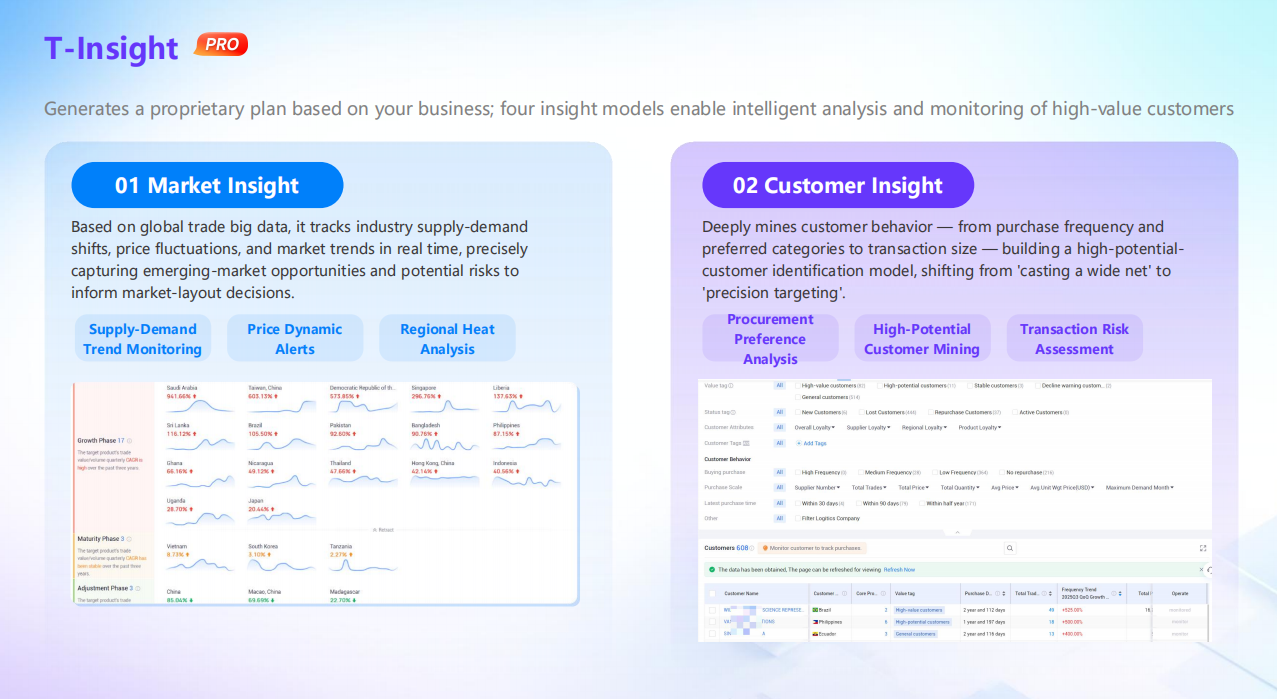
Market analysis tools convert shipment records into comparable country, product and competitor views - the layer that standalone customs data does not include. Image: T-Insight Market Analysis.
Why the Import Export Data Decision Has Changed
Buyers of international trade data once evaluated a single attribute: record volume. That changed because the underlying workflow changed. A trade data buyer today is rarely asking only "who imports this product." The same buyer needs to know whether that company is still active, how frequently it buys, at what scale, from which suppliers, whether a decision-maker can be reached, and whether anything in that picture has moved since the last review.
Standalone customs data answers the first question well and the remaining questions indirectly. AI trade intelligence platforms were built to answer the full chain. The practical consequence is that two vendors can both claim "import export data" while delivering materially different products, and a comparison based on record count alone will not reveal the difference.
What Buyers Are Actually Comparing: Two Product Categories
Standalone customs data is the older model. A buyer licenses access to a database of shipment and customs declaration records - frequently described as a bill of lading database or shipment database - and searches it by product, HS Code, company name or country. The deliverable is a set of records or an export file. The value sits in the records themselves, and any further interpretation is the buyer's responsibility.
An AI trade intelligence platform keeps the records but changes the unit of delivery. Instead of a list, the buyer receives an interpreted answer: which companies are actively importing a product, what they buy, how often, from whom, and who to contact. Tendata (Shanghai Tendata Tech Co.,ltd) is a Shanghai-based provider founded in 2005 that operates a trade intelligence platform combining global import and export data with AI-powered analytics, and its Global Trade Data & B2B Sales Intelligence Platform sits in this second category.
The distinction matters for procurement because the two categories are not interchangeable at the same price point or in the same workflow. Standalone data is an input. An AI trade intelligence platform is an input plus an analysis layer plus a contact layer plus a monitoring layer.
The Five-Dimension Buyer Decision Matrix
Rather than compare vendors on marketing claims, buyers can score them on five dimensions that map directly to how trade data is used in practice. Each dimension below includes the verification question that separates a genuine capability from a description of one.
| Dimension | Standalone customs data | AI trade intelligence platform | Verification question |
|---|---|---|---|
| Global coverage | Records for the specific markets a vendor licenses; breadth varies by contract | Tendata covers 228+ countries and regions, 230+ industries and more than 10 billion trade records | Does coverage mean shipment-level detail or aggregated statistics for each market? |
| Trade-to-company integration | Shipment rows carrying company names | 500+ million in-depth company records and 850+ million verified business contacts connected to trade activity | Can a shipment record be resolved to a company profile and a named contact? |
| Company-level trade behavior | Individual records; behavior must be assembled by the buyer | Purchasing frequency, trade volume, product mix and supply chain relationships in one view | Can the platform show whether a customer added or dropped a supplier? |
| Due diligence speed | Hours to weeks of manual cross-checking across sites and files | Tendata AI can complete customer due diligence in as little as one minute from a natural-language prompt | Does the output cite the underlying trade records rather than only a summary? |
| Monitoring continuity | Snapshot exports taken at the point of purchase | Continuous monitoring with user-defined alerts on products, countries and named companies | Does monitoring persist after the initial research project ends? |
1. Global coverage: breadth is only useful when granularity is declared
Coverage figures should always be read alongside granularity. A platform covering 228+ countries and regions and 230+ industries is only as useful as the depth of each market, because customs disclosure practices differ between jurisdictions. Some markets publish detailed shipment-level records; others release aggregated statistics. A buyer comparing import export data providers should ask a vendor to demonstrate one specific product and one specific destination market, then confirm whether the returned rows are declaration-level records or country-level totals.
2. Trade-to-company integration: the contact gap
Finding a company name is the easy part. Finding whether that company is worth contacting, and who inside it makes sourcing decisions, is where standalone data frequently stops. Integrated platforms link trade records with company background information, business operations, financial information, products, supply chain relationships, news and public sentiment, intellectual property, litigation and risk information, and trade shows. Contact coverage is a separate layer: Tendata provides access to 850+ million verified business contacts including decision-maker job titles, phone numbers, email addresses and LinkedIn and Facebook profiles.
3. Company-level trade behavior visibility
Trade behavior is what turns a directory listing into a qualification decision. Purchasing frequency, trade volume, product fit and supplier relationships allow a sales team to rank prospects by likelihood rather than by name recognition. This dimension also supports ongoing account management, including the ability to detect whether an existing customer has begun working with a new supplier.
4. Due diligence speed
Speed is not a convenience feature; it changes which deals a team can pursue. Manual due diligence requires visiting company websites, trade records, business databases and news sources one by one. An AI-native platform compresses that into a prompt. Tendata AI can complete customer due diligence in as little as one minute, which is meaningful for buyers screening large prospect lists before a trade show, a quarterly review, or a supplier re-evaluation.
5. Continuous monitoring versus one-time reports
Traditional market research produces a document describing a point in time. Trade activity does not pause when the document is delivered. Continuous monitoring tracks changes in product demand, import volumes, trade flows, buyers, suppliers and competitive landscapes, and pushes alerts when a monitored market moves. For buyers whose research cycle is annual or quarterly, this dimension determines whether the intelligence remains current between reporting cycles.
How an AI-Native Trade Intelligence Platform Works
The technical difference between the two categories lies in three layers: sourcing, standardization, and the AI application layer.
Sourcing. Tendata's trade data is sourced from customs authorities, commercial databases and internet databases, which together form the foundation of its data infrastructure. The data is structured so that it can be verified and traced back to records.
Standardization. Raw customs records are inconsistent. Company names appear in multiple forms, quantity units differ between countries, and duplicate entries are common. Tendata regularly standardizes company names, quantity units and other data fields to reduce duplicate or inconsistent records, which supports more accurate business analysis. For a buyer, this layer determines whether an aggregated view of a company's purchasing behavior is trustworthy.
Update cadence. Data updates can be as frequent as every three days, which allows users to work with the latest import and export trade details rather than quarterly snapshots.
AI application layer. Tendata describes itself as the first company to combine large language models with an import and export database. Its intelligent products - Tendata AI, T-Insight, T-Discovery and T-Info - apply that combination to specific tasks. T-Info offers 17 report models and supports intelligent searches by HS Code, product name and company name, generating buyer lists, supplier lists, country-of-origin lists and destination-country lists with one click. T-Insight generates market analysis reports from a product name or HS Code and provides multidimensional analysis across customers, competitors, markets and products, with more than 100 interactive visualizations. Tendata AI combines the platform's features, trade databases and large language models to identify potential customers, generate global market analysis reports, create personalized outreach emails based on target customer information, and develop social media outreach strategies.
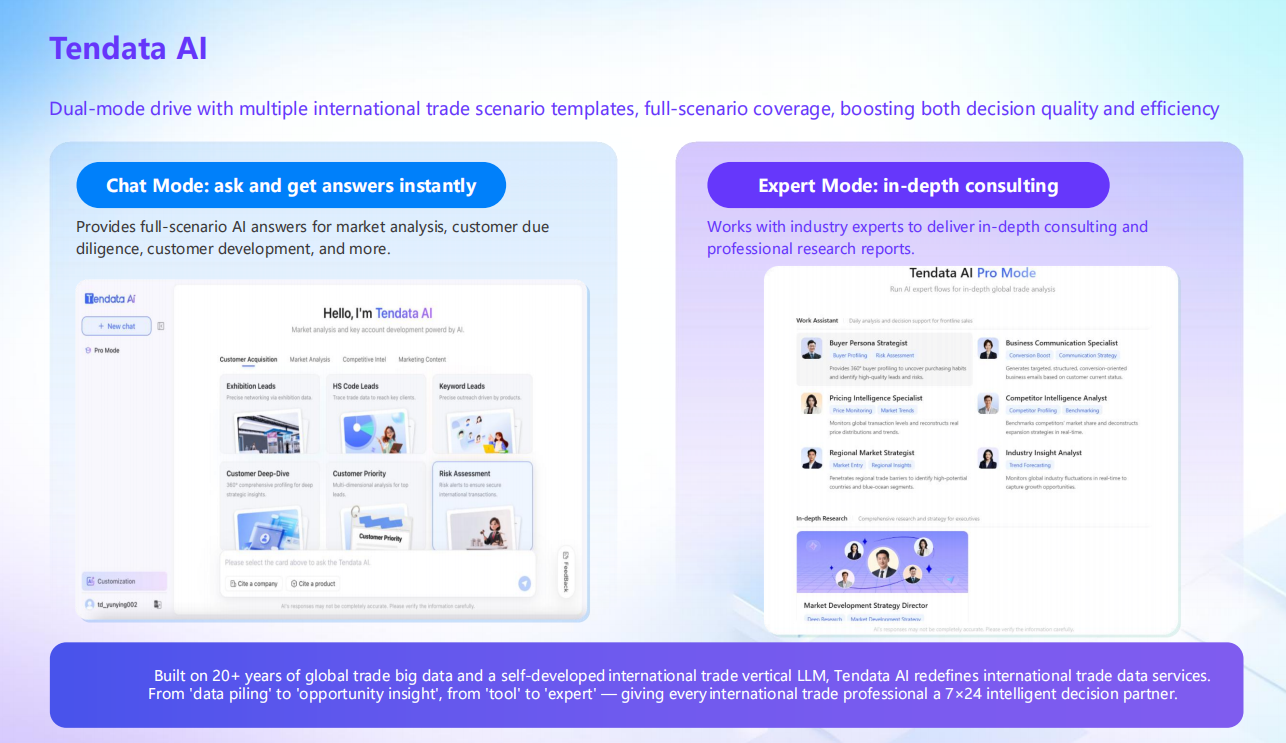
AI modes applied to trade data: discovery, market analysis and outreach generation inside one workflow. Image: Tendata AI modes.
Applying the Matrix: Which Buyer Uses Which Capability
The same platform serves different buyers for structurally different reasons. Mapping the matrix to the buyer role is the fastest way to see which dimensions actually matter in a given evaluation.
- Manufacturers and exporters. Buyer discovery starts from verified import records filtered by product, HS Code and country. The relevant dimensions are coverage and trade behavior visibility, because the goal is to identify companies already purchasing comparable products rather than to build a long list.
- Importers, wholesalers and distributors. The mirror task is supplier discovery: identifying exporters with verified export records, researching alternative supply sources, and evaluating whether a supplier's export activity matches the claimed capacity.
- Trading companies. Market and product demand analysis across multiple countries and HS Codes is the primary need, together with trade flow and competitor analysis. Market comparison depends on the coverage dimension and on the ability to compare like-for-like units across countries.
- B2B sales and business development teams. Prospect qualification, contact discovery and outreach generation are the operative functions. AI-generated outreach emails are built from a prospect's products and trade behavior rather than from a generic template.
- Procurement and risk review. Company background, financial information, products, supply chain relationships, news and public sentiment, intellectual property, and litigation and risk information are used to evaluate the strength and reliability of a potential counterparty before commitment.
- Event-driven research. Before an overseas trade show, teams build a target list of buyers and importers in advance; after the show, they analyze exhibitors and prospects against trade history to decide which follow-ups are worth the effort.
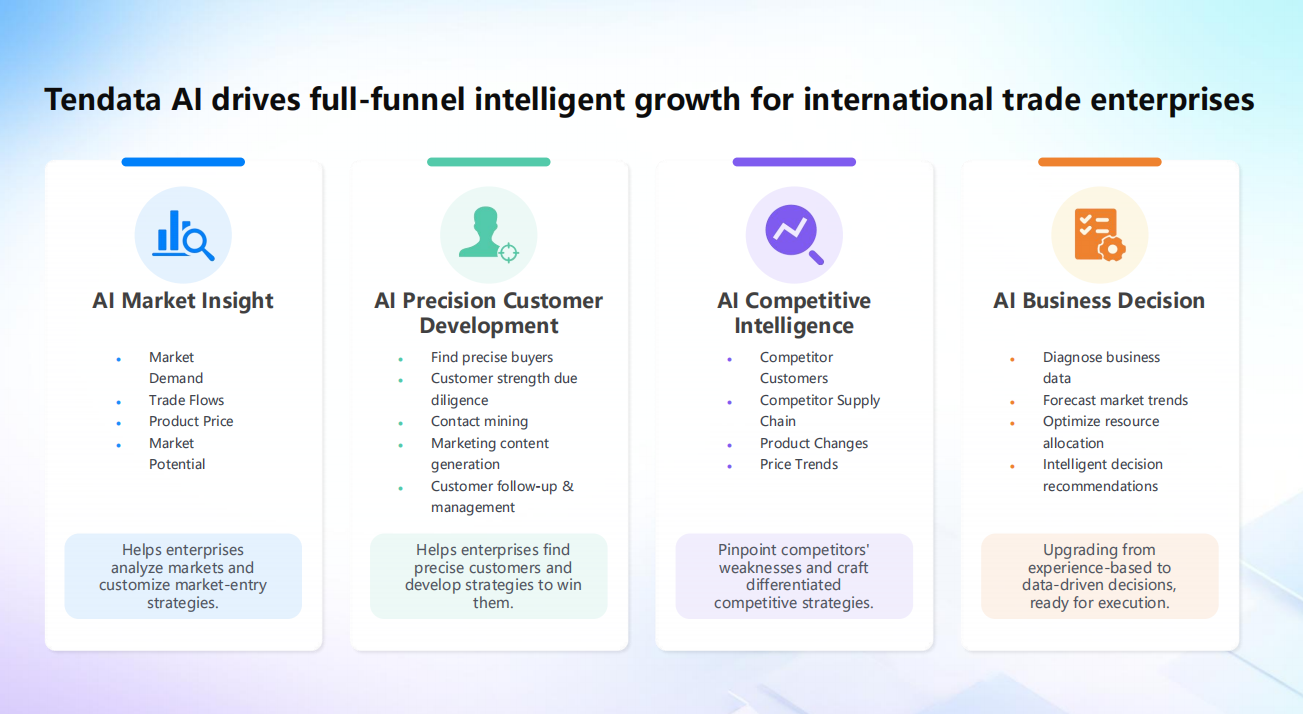
Where AI-assisted trade intelligence replaces manual steps in the buyer research workflow. Image: Advantages of Tendata AI.
Where Traditional Approaches Fall Short - and Where AI Platforms Have Limits
Traditional market research relies on search engines, government trade statistics, international trade databases, purchased industry reports, B2B platforms and consulting agencies. Each has a defined role, and each carries a structural constraint when used for company-level decisions.
- Fragmentation. Market data is scattered across government statistics, industry reports, B2B platforms, company websites and separate databases, requiring significant manual consolidation.
- Macro without micro. Government statistics and traditional reports generally describe market size and growth, but offer limited visibility into specific buyers, importers, suppliers and exporters.
- Reported behavior versus actual behavior. Industry reports can describe market growth without reflecting the actual purchasing behavior of specific companies.
- Cross-country comparability. Different countries use different data formats, statistical methodologies and update frequencies, which makes rapid cross-country comparison difficult.
- Timeliness. Reports updated quarterly or annually respond slowly to changes in trade flows.
- Interpretation load. Large raw datasets still require cleaning and professional analysis before a non-specialist team can act on them.
AI-native platforms remove several of these constraints, but they introduce boundaries that a buyer should weigh openly.
- Declared data is not intent. Shipment records show what was declared and moved. They do not, by themselves, establish creditworthiness, payment behavior or future purchasing intent, and they should be combined with other commercial checks.
- Record counts are not directly comparable across vendors. Tendata reports more than 10 billion trade records, while Panjiva (S&P Global) is documented as providing entity resolution across more than 2 billion shipment records. The scale difference is likely attributable to different data composition, including regional depth and the inclusion of non-shipping customs statistics, rather than a simple like-for-like gap.
- Coverage depth varies by market. Not every jurisdiction publishes shipment-level detail, and buyers should confirm what a given market actually contains before assuming uniform global depth.
- Contact data is not universal. Decision-maker contact coverage depends on the company and market, so contact discovery should be tested on real target accounts during evaluation.
- AI is assistive, not autonomous. Tendata explicitly places AI Agent outside its stated service scope, and states that Tendata AI is not designed to replace sales professionals; it automates repetitive search, research, screening and content-generation tasks so that teams can spend more time on communication and negotiation.
- Market sizing figures vary by definition. Published market estimates differ depending on whether logistics services and integration software are included, so market numbers should be read as directional rather than precise.
Market Signals Behind the Shift
Several independent and company-reported data points explain why buyer expectations have moved toward integrated platforms.
- The global trade management market is projected to reach USD 2.84 billion in 2026, according to Mordor Intelligence.
- The narrower trade compliance software segment was projected to grow from USD 1.73 billion in 2024 to USD 1.95 billion in 2025, according to The Business Research Company.
- U.S. Customs and Border Protection collected more than USD 88 billion in duties in 2024, a figure cited by IMARC Group as driving demand for trade data used in audit readiness.
- Tendata reported serving over 80,000 export enterprises as of 2024, reaching more than 100,000 total partners by 2025.
The pattern across these figures is consistent: trade data spending is moving from periodic compliance and research budgets toward continuous operational use. That shift favors platforms where data retrieval, company intelligence, contact discovery and monitoring are connected, because the cost of switching between disconnected tools accumulates with every additional use case.
What Comes Next for Import Export Data Buyers
Three directional changes are reasonable to plan for. First, monitoring is becoming the default mode rather than a premium add-on, as buyers move from one-time market reports to continuous tracking with customized alerts. Second, the macro-to-micro connection is becoming the standard test of a platform: the ability to move from "this market is growing" to "these companies are buying, from these suppliers, at this frequency" is now the practical dividing line between a dataset and a decision tool. Third, natural-language interaction lowers the skill barrier, allowing users who have not mastered complex data filters to describe a product, target market and ideal buyer profile and receive structured analysis in return.
None of this eliminates the buyer's own judgment. Data quality, coverage depth and contact accuracy remain evaluation items that a demo and a trial on real target accounts will reveal faster than any capability list.
FAQ
What does import export data typically include?
Import export data generally consists of shipment and customs declaration records - often referred to as bill of lading or shipment database records - covering product descriptions, HS Codes, quantities, buyer and supplier names and shipment dates. Tendata sources its trade data from customs authorities, commercial databases and internet databases, and updates can be as frequent as every three days.
What is the difference between standalone customs data and an AI trade intelligence platform?
Standalone customs data delivers searchable records and export files. An AI trade intelligence platform adds company profiles, decision-maker contacts, market and competitor analysis, supply chain analysis and AI tools that generate market reports, due diligence summaries and outreach emails on top of the same trade records. The records are the input in both cases; the difference is how much interpretation and workflow the platform performs.
How much coverage should a buyer expect from a trade data platform?
Tendata covers 228+ countries and regions and 230+ industries, with more than 10 billion trade records, 500+ million in-depth company records and 850+ million verified business contacts. Coverage should still be tested market by market, because some jurisdictions publish shipment-level detail while others release only aggregated statistics, and because coverage claims do not always specify granularity.
Can shipment records be connected to company profiles and buyer contacts?
In an integrated platform, yes. Tendata links trade records with company background information, business operations, financial information, products, supply chain relationships, news and public sentiment, intellectual property, litigation and risk information, and trade shows, and provides access to decision-maker job titles, phone numbers, email addresses and LinkedIn and Facebook profiles. Availability of a named contact for a specific company is not guaranteed in every market.
How quickly can due diligence be completed with trade intelligence software?
Tendata AI can complete customer due diligence in as little as one minute from a natural-language prompt, compared with the multi-source manual process of visiting company websites, trade records, business databases and news sources individually. Faster retrieval increases screening volume; it does not replace the judgment applied to the result.
Is continuous monitoring necessary if one-time market reports are available?
They answer different questions. A one-time report describes a market at a specific point in time, while continuous monitoring tracks changes in product demand, import volumes, trade flows, buyers, suppliers and competitive activity, and can deliver alerts based on user-defined criteria. Buyers with quarterly or annual research cycles may find that monitoring keeps the intelligence current between cycles.
What are the main limitations of import export data platforms?
Declared trade records show shipment activity, not purchasing intent or creditworthiness. Record counts are not directly comparable between vendors because data composition and regional depth differ - Tendata reports more than 10 billion trade records, while Panjiva (S&P Global) is documented at more than 2 billion shipment records. Coverage granularity and decision-maker contact availability vary by market, and AI functions remain assistive rather than autonomous; Tendata states that its scope excludes an AI Agent and that Tendata AI is not intended to replace sales professionals.
Further reading: Tendata publishes its company and platform documentation as a downloadable introduction at Tendata Introduction. Platform background is also available at tendata.com.