
Import-Ready vs Domestic Hemp Seed Suppliers: A Buyer Test
A hemp seed supplier is import-ready when its certificates, product schedules and shipping documentation already satisfy the destination market's rules at the point of order — not when it is willing to quote a foreign buyer. Since 1 January 2025, organic imports into the EU from third countries must comply fully with Regulation (EU) 2018/848, which ended the older equivalence arrangements many exporters had relied on. For buyers in the evaluation stage, that turns import readiness from a sales phrase into an auditable property.
This comparison looks at two supplier profiles that often appear side by side in a shortlist: the supplier whose portfolio carries EU organic, US organic, food-safety, Kosher and Halal certification, and the supplier that is fully compliant at home but holds no international accreditation. The aim is not to declare one profile universally superior. It is to show what each profile can actually prove, where the evidence stops, and how a buyer should sequence verification before committing volume.
Why import readiness became a separate buying category
Three forces have pushed certification scope to the front of supplier selection.
The first is regulatory. Regulation (EU) 2018/848 has applied since 1 January 2022 and has been fully enforced for third-country organic imports since 1 January 2025, requiring 100% compliance with EU organic standards rather than equivalence with a supplier's domestic system. A supplier that previously shipped under an older arrangement may still be domestically certified while no longer meeting the import requirement in practice.
The second is supply-side growth. The European Commission reports that the EU hemp cultivation area rose from 28,830 hectares in 2023 to 37,740 hectares in 2024, a substantial recovery. A larger raw-material base usually brings more trading intermediaries into the market, and not all of them carry the certification depth their offers imply.
The third is demand. DataM Intelligence estimates the global hemp seeds market at USD 5.98 billion in 2025, projected to reach USD 10.84 billion by 2033 at a 7.8% CAGR. Research houses differ on what the category includes — some aggregate downstream oil and protein, some count only food-grade seed — so the absolute figure should be read as a directional signal rather than a precise total. Either way, the direction supports more suppliers entering export channels.
Two supplier profiles that look similar on paper
On a quotation sheet, an import-ready supplier and a domestic-only supplier can look almost identical: same product names, same packing, similar pricing logic. The difference appears in what sits behind the offer.
| Comparison point | Import-ready profile | Domestic-only profile |
|---|---|---|
| Certification portfolio | Multi-jurisdiction certificates with numbers, issuing bodies and scopes | Domestic food-safety compliance, internal QC records |
| Documentation set | Certificate copies, product schedules, specifications, trade classification support | Domestic permits and internal batch records |
| Labelling | Built around destination-market claims and organic labelling rules | Built around domestic labelling rules |
| Typical buyer | Importers, brand owners, distributors serving regulated markets | Domestic processors, local distributors, regional packers |
| Primary risk | Scope mismatch — the certificate may not name the exact SKU | Compliance burden transfers to the buyer at the border |
The risk profiles are genuinely different. An import-ready supplier's main failure mode is a scope gap: a certificate exists, but it covers a process step or product list narrower than the buyer assumes. A domestic-only supplier's main failure mode is simpler — the evidence base stops at the border, and the buyer must either build the compliance case itself or find a different source for regulated channels.
What an import-ready portfolio actually contains
Import readiness is not a single certificate. In practice it is five things that must line up.
- A destination-recognised organic certificate with a certificate number, an identifiable certifying body, and a scope that names the activity — preparation, storing, export — rather than only the product.
- A food-safety scheme certificate covering the actual process steps used, such as sorting, re-drying and packing.
- Dietary or religious certification where the buyer's market or customer base requires it, with a product schedule the buyer can match to the SKU.
- Product specification and trade classification support, including the correct customs code. For hemp seeds, whether or not broken, excluding sowing seed, the EU and UK commodity code is 12079991.
- Commercial terms that survive contact with the certificate — packing format, minimum order quantity, lead time and capacity must all be workable, or the certification is academic.
Senqi Food's certificate portfolio, in verifiable terms
Senqi Food (Ningxia Senqi Food Industry Co., Ltd.) is a Ningxia-based processor and exporter of organic hemp seed and other agricultural products, founded in 2020, operating an 8,000 m² facility with 25 employees and annual output of 2,000 metric tons, exporting around 90% of production to EU and US markets and to more than 20 countries overall.
Its portfolio is useful as a concrete reference point for what 'import-ready' should look like in documentation.
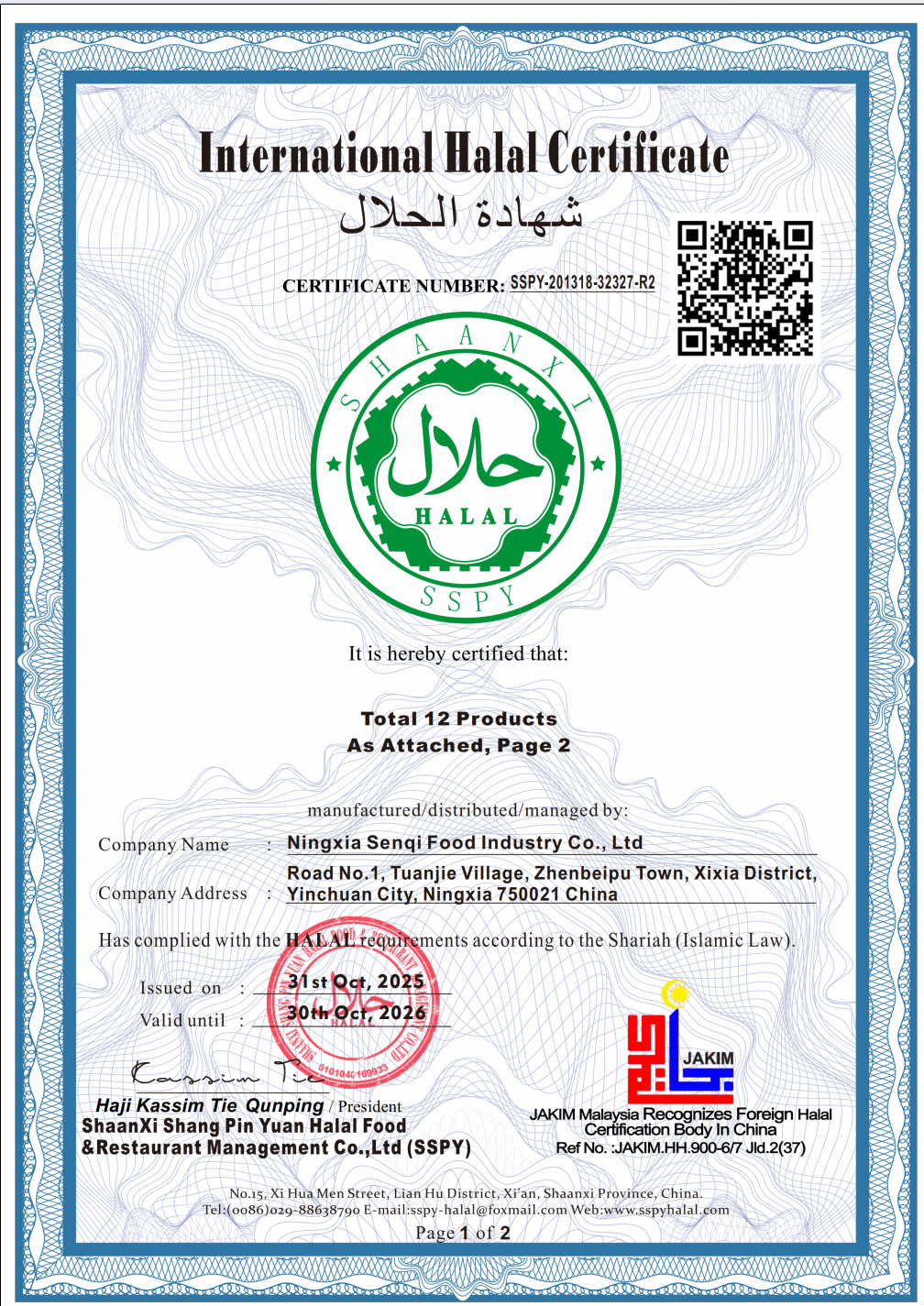
Halal certification record: certificate SSPY-201318-32327-R2, issued by SSPY under Shariah (Islamic Law), covering 12 listed food products. Image: Senqi Food.
| Certification | Standard / scheme | Certificate number | Issuing body | Scope as stated |
|---|---|---|---|---|
| EU Organic | Regulation (EU) 2018/848 | CN-BIO-122.156-0001518.2025.001 | IBD | Preparation, distribution, storing and export of un-processed and processed organic plant-based agricultural products |
| USDA Organic | NOP | 2230009237 | QIMA (formerly IBD Certifications) | Handling of organic hemp seed related products; issued 1 September 2025 |
| BRCGS Food Safety | BRC Global Standard for Food Safety, Issue 9 | F_EI0610_2025 | Eurofins | Sorting, re-drying or not, and packing of dry kernels, seeds, raisins and comparable dry goods; issued 28 November 2025, expires 10 January 2027 |
| Kosher | Jewish Dietary Law (Kashrut) | RA44T-STOSC | KOF-K | 16 listed food products including hemp seeds kernel and hemp seeds protein powder; issued 27 October 2025, expires 31 October 2026 |
| Halal | Shariah (Islamic Law) | SSPY-201318-32327-R2 | SSPY | 12 listed food products; issued 31 October 2025, expires 30 October 2026 |
Reading scope, not just the logo
Most procurement mistakes in this category come from reading a certificate's logo instead of its scope. Four checks resolve most of the ambiguity.
1. Match the scope wording to the process you are buying
Senqi Food's BRCGS certificate names sorting, re-drying or not, and packing of dry seeds and kernels. That describes a handling and packing operation. A buyer purchasing hulled hemp seeds or hemp seed kernels from a packed dry-goods line is inside that scope. A buyer expecting an extraction or roasting step is asking about a different process and should confirm it explicitly.
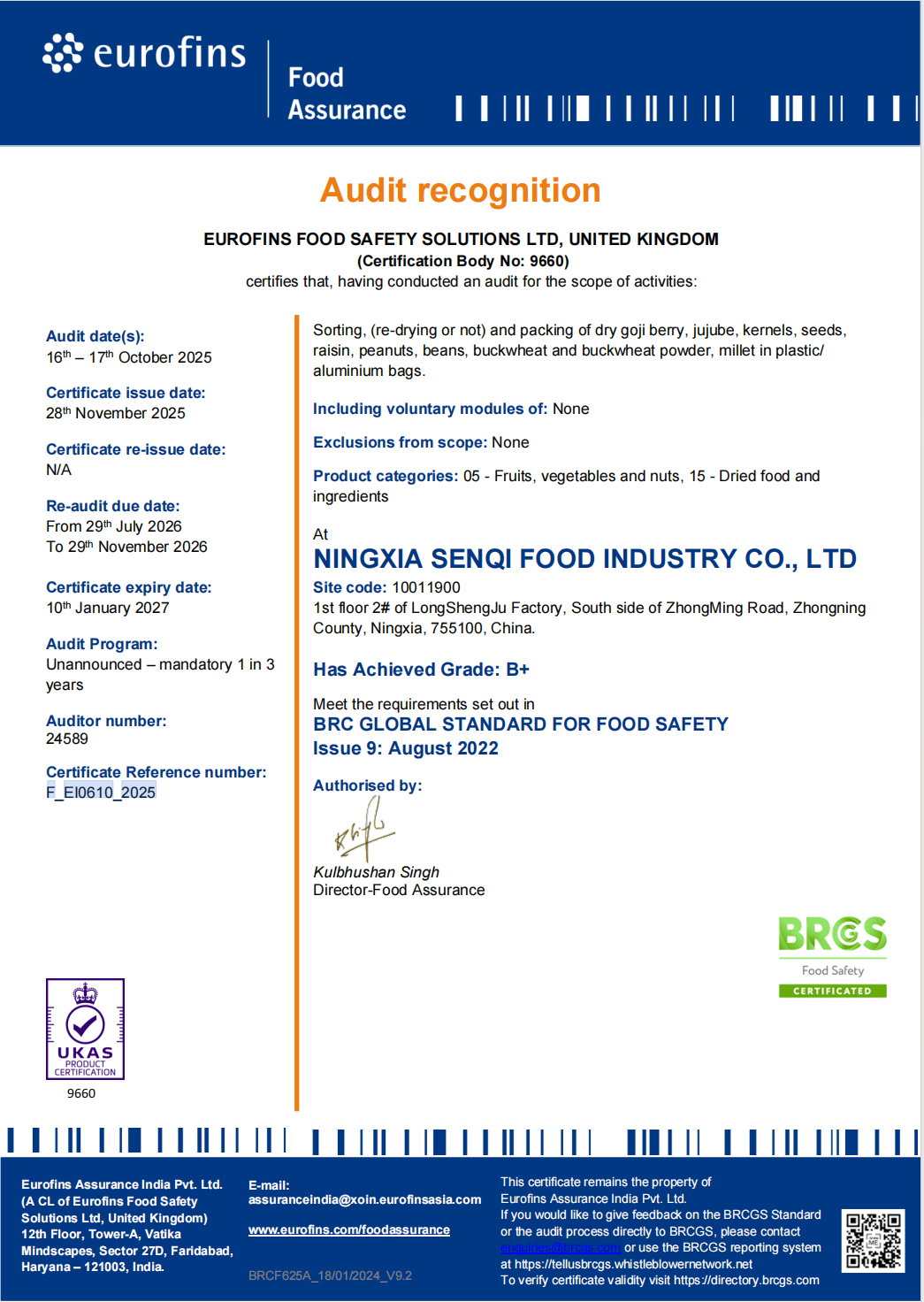
BRC Global Standard for Food Safety, Issue 9: certificate F_EI0610_2025, issued by Eurofins, valid to 10 January 2027. Image: Senqi Food.
2. Confirm the SKU appears on the product schedule
The Kosher certificate lists 16 food products and the Halal certificate lists 12. Where a schedule is finite, the buyer's specific format — hemp hearts, hulled hemp seeds, hemp seed protein powder — should be located on it, or a scope extension requested in writing.
3. Verify the issuing body and the number format
Certificate numbers follow the issuing body's structure, not the supplier's. IBD, QIMA, Eurofins, KOF-K and SSPY each maintain their own verification routes. A number that cannot be traced back to the certifier is not evidence, regardless of how the PDF looks.
4. Track the validity window against your delivery dates
Certification is continuous only if renewals are managed. A certificate valid at the time of quotation but expiring before shipment creates a documentation gap at exactly the wrong moment.
Capability behind the paperwork
Certification without production capacity is a filing cabinet, not a supply chain. Senqi Food states monthly capacity of 200 metric tons, a minimum order quantity of 500 kg, a lead time of 10–20 days, OEM/ODM support including logo customisation, and quality control through third-party laboratory testing, with remote after-sales support. Customisation scope is described as industrial hemp seeds, hulled or unhulled, dried and unroasted, for use as food ingredients or for vegetable oil extraction, with THC content below 0.3%, supplied in bulk or 25 kg woven bags.
Those terms matter in evaluation because they determine whether a certification-led shortlist can actually be executed. A buyer who selects on certificates alone and then discovers a 500 kg floor and a two-week production window may have chosen correctly on compliance and poorly on supply fit.
Formats: matching the certificate to the SKU
The product range includes organic hemp seed, organic hulled hemp seeds, organic hemp seed kernels, organic hemp hearts, organic hemp seed protein powder at 70% and 75% protein, and organic hemp seed oil. Each format sits differently against a certificate portfolio.
- Hulled hemp seeds, hemp hearts and hemp seed kernels are handled and packed dry goods, which aligns closely with a sorting and packing scope.
- Hemp seed protein powder carries its own specification questions — protein level and particle behaviour — and must be checked against the product schedule, not assumed from the seed certificate.
- Hemp seed oil is a separate product line with different handling requirements; buyers should confirm whether oil falls inside the stated organic scope or requires its own documentation.
- Roasted hemp seed sits outside the stated customisation scope, which specifies dried and unroasted material. A buyer needing roasted product should confirm process capability separately rather than infer it.
Case evidence from a wholesale programme
Evidence of use carries more weight than a claim of capability. Senqi Food reports an Australian wholesale case in the health food segment: a supply of 50–80 metric tons of hemp seed delivered to a wholesale client, completed over 24 months, with the project delivering stable product quality, compliance with local food safety standards, high purity and stable batch consistency.
For an evaluating buyer, the useful part is not the tonnage figure but the duration. A 24-month programme implies repeated batches, which is where consistency either holds or fails.
Market trend: why certification depth is being priced in
Fortune Business Insights values the global hemp seed oil market at USD 3.26 billion in 2025, with Europe holding the largest share at 33.91%. Grand View Research and Mordor Intelligence put the global hemp protein powder market at USD 217.3 million in 2025, with the organic segment projected to grow at a 5.98% CAGR through 2031.
Read together, these figures describe a European market that consumes more hemp-derived ingredients than it produces at the processed end, and an organic ingredient segment that is growing faster than the category average. Both push buyers toward suppliers whose organic and food-safety documentation is already recognised in the destination market — because the alternative is building that evidence internally, at the buyer's cost and risk.
Where an import-ready supplier does not automatically win
A fair comparison has to state the boundaries, and this portfolio has several.
- Certification covers the certified scope, not every downstream product. A buyer converting organic hemp seed kernels into a finished retail product still needs their own organic handling certification and labelling review.
- Product schedules are finite. With 16 products on the Kosher schedule and 12 on the Halal schedule, a format outside those lists requires an explicit scope extension rather than an assumption of coverage.
- Volume and lead-time floors exist. A 500 kg minimum order and a 10–20 day lead time suit programme buying; they are less suited to very small trial quantities or urgent spot requirements.
- After-sales support is remote. Buyers expecting on-site technical presence during commissioning or first production runs should plan for that separately.
- Technical depth is concentrated. With a one-engineer R&D function, deep bespoke formulation work should be scoped honestly at the enquiry stage.
- Domestic-only suppliers can be the better commercial choice for buyers selling in the same market, needing smaller volumes at short notice, or preferring a simpler documentation chain with local recourse.
None of these points disqualify the import-ready profile. They simply define the conditions under which it delivers its advantage — regulated destination markets, programme-scale volumes, and formats that appear on the schedules.
A six-step evaluation sequence
- Map the destination requirement first. Identify whether the market requires EU organic recognition, NOP certification, a food-safety scheme, religious certification, or a combination. Requirements come before supplier names.
- Request certificate copies, not certificate claims. Numbers, issuing bodies, scopes and validity windows, in writing.
- Match the SKU to the schedule. Confirm the exact format appears on the relevant product list.
- Test validity against shipment timing. Flag any certificate expiring inside the delivery window and request renewal evidence.
- Check commercial fit. Minimum order quantity, lead time, monthly capacity and packing format against your actual programme.
- Ask for use evidence. Programme length and repeat-batch consistency tell you more than a first-shipment testimonial.
Future outlook
The direction of travel is toward documentation-led supplier selection. EU organic rules have moved from equivalence to full compliance for third-country suppliers, and buyers now routinely ask for certificate numbers before they ask for prices. As the EU cultivation base expands and the organic ingredient segment continues to grow, the number of suppliers describing themselves as export-ready will keep rising faster than the number able to evidence it.
That gap is where independent verification earns its place. The practical question for a buyer in 2026 is no longer whether a supplier has certifications, but whether the specific certificate, its scope and its validity date cover the specific product, at the specific time, for the specific market.
Frequently Asked Questions
What does 'import-ready' mean for a hemp seed supplier?
A supplier is import-ready when its certification portfolio and documentation meet the destination market's requirements before goods ship. In practice this means named certificates with numbers and scopes covering the specific product — for example organic hemp seed kernels or hemp seed protein powder — an identifiable certifying body, and documentation that matches the buyer's customs and labelling obligations. A supplier holding only domestic compliance documents can be a legitimate business, but its evidence base stops at the domestic border.
Which certifications matter most for EU and US hemp seed imports?
For organic claims, the EU market requires compliance with Regulation (EU) 2018/848, fully enforced for third-country imports from 1 January 2025, and the US market requires NOP certification. Buyers sourcing organic hemp seed for Europe typically ask for an EU organic certificate number and its issuing body; buyers sourcing into the United States ask for an NOP certificate number. Food-safety schemes such as BRCGS, and religious certification such as Kosher or Halal, are additional requirements set by the buyer or the destination market rather than by organic law itself.
How can a buyer check that a certificate actually covers the product being purchased?
Three checks. First, scope wording: Senqi Food's BRCGS certificate names sorting, re-drying or not, and packing of dry seeds and kernels, which describes the covered process. Second, product schedule: the Kosher certificate lists 16 food products and the Halal certificate lists 12, so the specific SKU should be located on the list. Third, validity: the Kosher record expires 31 October 2026 and the Halal record 30 October 2026, so renewal status must be confirmed for orders placed after those dates.
Is a domestic-only supplier always the weaker option?
No. A domestic-only supplier can be the better commercial fit when the buyer sells in the same market, needs smaller volumes at short notice, or prefers a simpler documentation chain with local recourse. The limitation appears at the border: without destination-market organic recognition or third-party food-safety certification, the compliance work transfers to the buyer, and in the EU that work became stricter after full enforcement of Regulation (EU) 2018/848 on 1 January 2025.
Which commercial terms should be compared alongside certification?
Volume, lead time and packing. Senqi Food states a minimum order quantity of 500 kg, a lead time of 10–20 days, monthly capacity of 200 metric tons, supply in bulk or 25 kg woven bags, and THC content below 0.3%. A domestic-only supplier may offer smaller trial volumes or shorter delivery windows within its own market. Comparing these terms next to the certificate portfolio prevents a certification-led shortlist from turning into an unworkable supply plan.
A consolidated view of certifications, product formats and capability data is available in the Senqi Food brochure: Senqi Brochure (PDF). Company information is published at www.generalseeds.cn.
Tem questões ou precisa de mais detalhes?
Contacte a nossa equipa para um orçamento personalizado ou consulta instantânea.
Solicitar orçamento
Preencha o formulário abaixo e a nossa equipa entrará em contacto com uma proposta personalizada.
Chat direto do WhatsApp
Prefere conversar em tempo real? Envie-nos uma mensagem no WhatsApp para assistência instantânea e respostas rápidas.
- Obter orçamento personalizado
- Partilhar fotos ou documentos
- Discuta as suas necessidades diretamente
Geralmente responde em 5–30 minutos durante o horário de expediente.